
The Second Half of Macro Influencer Fu Peng's Career

marsbitPublicado a 2026-04-21Actualizado a 2026-04-21

Resumen

Fu Peng, a prominent Chinese macroeconomist and former chief economist of Northeast Securities, has joined Hong Kong-based digital asset management firm Bitfire Group (formerly New Huo Group) as its chief economist. This move, announced in April 2026, triggered an 11% surge in Bitfire's stock price. Fu, known for his accessible macroeconomic commentary and large social media following, will focus on integrating digital assets into global asset allocation frameworks, particularly combining FICC (fixed income, currencies, and commodities) with cryptocurrencies for institutional clients. His career includes roles at Lehman Brothers and Solomon International, with significant influence gained through public communication. However, in late 2024, Fu faced temporary social media bans after a controversial private speech at HSBC on China's economic challenges, though he denied regulatory sanctions. He later left Northeast Securities citing health reasons. Bitfire, a licensed virtual asset manager serving high-net-worth clients, seeks to build trust and attract traditional capital through Fu’s expertise and credibility. The partnership represents a strategic shift for both: Fu enters the crypto sector after a traditional finance peak, while Bitfire aims to leverage his macro framework for institutional adoption. Outcomes remain uncertain regarding capital inflows and compatibility within corporate structure.

Author: BitalkNews

On the morning of April 20, 2026, the stock price of New Huo Group suddenly surged, rising more than 11% during the session.

What triggered this market movement was a piece of news that simultaneously ignited the financial and crypto circles: Fu Peng, former chief economist of Northeast Securities, officially joined New Huo Group as chief economist.

The news was first disclosed by Tencent News' "First Line," and New Huo Group subsequently confirmed it. Fu Peng himself also stated to the media: "It is mainly about combining FICC and C businesses."

Among them, FICC refers to fixed income, foreign exchange, and commodities, while C refers to cryptocurrency. His main work after joining will be to incorporate digital assets into the global asset allocation framework, providing macro research and asset allocation support for New Huo's institutional clients.

This is the first time he has reappeared in the public eye with an official position nearly a year after leaving Northeast Securities. For him, this is not just a change of employer but more like a restart of his career narrative.

The first half reached the pinnacle in the traditional financial system but was interrupted by controversy and illness; the second half is chosen in Hong Kong, in the crypto track, at the intersection where traditional finance and digital assets are slowly merging.

The Path of an Atypical Chief

In 2004, Fu Peng joined Lehman Brothers and later served as the head of global macro hedge strategy design at Solomon International Investment Group, responsible for currency, commodity, and major asset linkage analysis, for nearly four years.

He returned to China at the end of 2008 and worked at institutions such as Shandong High-Tech Investment, CIFCO, Galaxy Futures, Galaxy Securities, and Essence Securities.

In February 2020, he joined Northeast Securities as chief economist. His approach in this role differed from most of his peers: he made self-media his main battlefield.

He often used analogies and metaphors to explain economic logic, with a performance-style flair. His Weibo account, "Fu Peng's Financial World," has accumulated over 4 million followers, while his Douyin (TikTok) followers have reached 1.485 million. On Xiaohongshu and Bilibili, he has 355,000 and 773,000 followers, respectively.

In 2024, he published "Witnessing the Countercurrent," using a three-layer framework of "politics/distribution—macro—assets" to explain changes in global asset logic after 2016.

This approach gave him high recognition in the financial circle, making him an analyst who could present complex macro logic in an accessible way to ordinary investors.

The Consequences of a Speech

In late November 2024, Fu Peng was invited to give a year-end speech at an internal HSBC Private Wealth Planning event in Shanghai. The content covered China's declining demand, shrinking middle-class income,加剧的消费分化, and his judgment that current stimulus policies could not replicate the effects of the 2008 measures.

The recording and transcript were widely circulated online, removed from multiple platforms, and his WeChat and short video accounts were banned for nearly half a year.

Rumors emerged that he was canceled due to regulatory talks. Fu Peng publicly responded, directly criticizing HSBC, sharing chat records, and stating, "A lawyer's letter is already on the way, waiting for your apology."
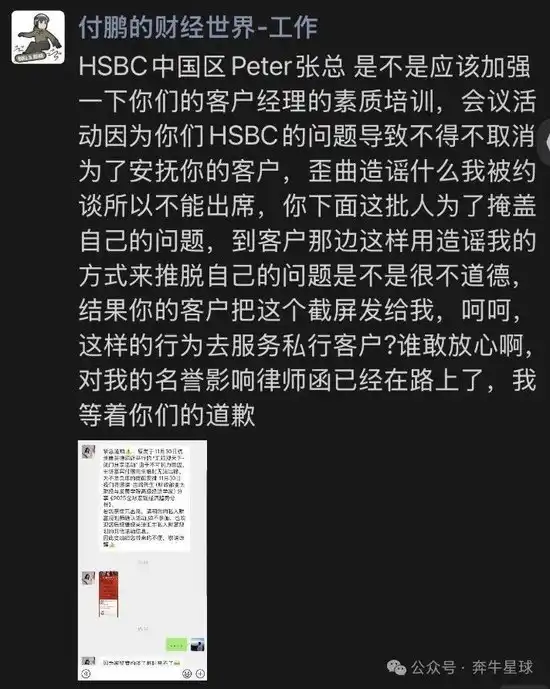
Northeast Securities also stated: There has been no recent regulatory discussion. HSBC responded that it was "looking into the relevant situation." After that, the matter quietly faded from public discussion, with no further progress, eventually ending without resolution.

During the account ban, Fu Peng's channels for public expression were significantly reduced.

On April 30, 2025, he officially resigned from Northeast Securities, explaining externally: He had just undergone two major surgeries and needed to rest for more than half a year.

Predictive Ability and Boundaries

Among Fu Peng's fan base, there are many stories about his accurate predictions, covering the 2008 financial crisis, the recovery of the Japanese stock market, and the turning point of China's real estate cycle. Since 2016, he has consistently emphasized de-globalization and changes in interest rate trends, with parts of his framework later validated to some extent.

However, his prediction record is not consistent. There have been clear deviations in short-term exchange rates and specific policy windows, with some judgments criticized as overly pessimistic or significantly inaccurate due to policy interventions. He himself admits that macro research focuses on structural variables, not next quarter's data. This is both a methodological explanation and a preventive clarification for short-term inaccuracies.

What he provides is a framework for interpreting the world, not a stable, reproducible prediction tool. Describing him as a prophet who gets everything right is a misinterpretation.

One of his major advantages is his ability to express complex macro logic in an accessible manner while maintaining relatively independent judgment. This allows his influence to reach a broader audience, and this characteristic is precisely what New Huo Group needs most.

Why Choose New Huo

Theoretically, Fu Peng had more than one option for his comeback. Traditional securities firms would welcome him back, and the role of chief economist is familiar to him, but he chose New Huo.

The space in traditional finance is narrowing. For someone who spoke so bluntly in the HSBC speech, returning to the system would mean something he likely understands better than anyone.

His skill set was never limited to traditional assets; FICC has always been his forte. After institutionalization, the connection between crypto assets and macro logic has become increasingly evident. Interest rate cycles, dollar liquidity, geopolitical risk premiums—these variables affect both traditional and digital assets.

There is also a more practical factor: a comeback requires a suitable stage.

New Huo Group is licensed in Hong Kong, listed on the Hong Kong stock exchange, and operates within a compliance framework. At the same time, its size and stage provide enough flexibility to allow a strong-minded individual to build a new research system. This is a completely different situation from playing a fixed role in a mature large institution.

Why New Huo Needs Him

New Huo Group currently positions itself as a digital asset management institution for high-net-worth clients. It holds Hong Kong SFC Type 1, 4, and 9 licenses and a TCSP trust license, making it one of the较早实现全牌照虚拟资产管理的机构 in Hong Kong.

In 2025, Weng Xiaoqi became CEO, launched the Bitfire Premium service, acquired a majority stake in the Japanese licensed exchange BitTrade, exited the retail market, and focused on family offices, listed companies, and institutional clients. At the end of March 2026, the company was renamed New Huo Group Holdings Limited, with the English name Bitfire Group.

Financially, total revenue for the 2025 fiscal year was HKD 8.661 billion, a year-on-year increase of over 450%, but growth was mainly driven by low-margin crypto OTC trading volume. The company整体依然亏损. Management has designated 2026 as the year for profitability, with significant pressure.

The compliance framework is in place, and growth numbers are impressive, but what New Huo truly lacks at this stage is not流量, but trust.

The clients it serves—family office partners, financial executives of listed companies, private investors with substantial wealth—do not lack information or data. What they lack is a narrative framework that can make them comfortable with digital assets and a professional image from the traditional financial world.

Weng Xiaoqi stated this logic quite bluntly: "Fu Peng's profound global macro research capabilities and precise market liquidity insights will become the company's top strategic brain... helping clients accurately grasp certainty in the era of 'FICC+C.'"

Fu Peng's background in international investment banking and hedge funds, his independent public persona, and his million-level influence constitute a recognizable professional signal for traditional wealthy individuals evaluating whether to allocate more funds to digital assets.

This is a transaction where both sides get what they need.

A Beginning Without a Conclusion

On one side is a person who emerged from the traditional financial system, experienced highs, controversies, and a forced interruption, now seeking a space to continue expressing and contributing. On the other side is a company striving to transition from a trading platform to an institutional service provider, attempting to establish a language more easily understood by traditional capital.

Can the appeal of macro narratives translate into real institutional capital inflows? How long can Fu Peng's independent style last within the framework of a listed company?

Will the trust of traditional wealthy clients in digital assets ultimately be built on framework认同, or will it still require further regulatory developments? These questions will take time to answer.


Preguntas relacionadas

QWhat is the immediate market reaction to Fu Peng joining Xinhua Group, and what was the stock performance?

AXinhua Group's stock price surged by over 11% during the morning session on April 20, 2026, following the announcement of Fu Peng's appointment as Chief Economist.

QWhat are Fu Peng's main responsibilities at Xinhua Group, particularly regarding FICC and C?

AFu Peng's primary role is to integrate digital assets into the global asset allocation framework, providing macro research and asset allocation support for institutional clients, with FICC referring to fixed income, currencies, and commodities, and C referring to cryptocurrencies.

QWhy did Fu Peng leave his previous position at Northeast Securities, and what was the public reason given?

AFu Peng left Northeast Securities in April 2025, with the public explanation being that he needed to recuperate for over six months after undergoing two major surgeries.

QWhat incident led to Fu Peng's social media accounts being suspended, and how did he respond?

AHis accounts were suspended after a speech at a HSBC private wealth event in late 2024, where he discussed sensitive economic issues. He publicly criticized HSBC, threatened legal action, and shared chat records demanding an apology.

QWhy does Xinhua Group need someone like Fu Peng, and what does his appointment signify for their business strategy?

AXinhua Group needs Fu Peng to build trust with high-net-worth and institutional clients by providing a credible macro narrative for digital assets, leveraging his traditional finance background and public influence to attract traditional capital into the crypto space.

Lecturas Relacionadas

¿El ETF spot de HYPE acumula capital durante 14 días consecutivos, llegando a un nuevo máximo de 75 dólares, y esto es solo el comienzo?

Arthur Hayes, cofundador de BitMEX, predice que HYPE superará a SOL en esta corrida alcista, con un objetivo de 150 dólares. Este optimismo se basa en el fuerte desempeño de los nuevos ETF spot de HYPE, que han registrado entradas netas durante 14 días consecutivos, acumulando más de 136 millones de dólares y absorbiendo aproximadamente el 1% de la capitalización de mercado de HYPE. Este flujo contrasta con las salidas netas recientes de los ETF de BTC y ETH. El comprador clave es el Fondo de Asistencia (AF) de Hyperliquid, que destina el 99% de las tarifas del protocolo a recomprar HYPE, generando un soporte de precio fundamental. Junto con la demanda de los ETF, esto ayuda a contrarrestar la presión de venta de los desbloqueos de tokens del equipo. Grandes instituciones como a16z y Galaxy Digital están acumulando HYPE de manera significativa, con a16z posiblemente siendo el mayor tenedor institucional externo. Bitwise y Grayscale han lanzado productos relacionados, y la empresa vinculada a HYPE, Hyperliquid Strategies (PURR), será incluida en el índice Russell 3000, lo que podría atraer más capital institucional. Los analistas destacan que HYPE ha pasado de ser visto como un simple "altcoin" a una criptomoneda de "segunda generación" con captura de valor real y demanda institucional sólida.

Odaily星球日报Hace 8 min(s)

¿El ETF spot de HYPE acumula capital durante 14 días consecutivos, llegando a un nuevo máximo de 75 dólares, y esto es solo el comienzo?

Odaily星球日报Hace 8 min(s)

Blockmaze Define el Futuro de la Tokenización de Activos del Mundo Real con una Infraestructura Centrada en el Cumplimiento Normativo para un Mundo On-Chain de $500 Billones

Blockmaze, respaldado por Finvasia Group, está definiendo el futuro de la tokenización de activos del mundo real (RWA) con una infraestructura que prioriza el cumplimiento normativo. Diseñado para cerrar la brecha entre las finanzas tradicionales y la tecnología blockchain, el ecosistema regulado de Blockmaze garantiza que los activos tokenizados no solo se creen, sino que tengan reconocimiento legal, sean conformes y estén conectados con la propiedad real en un mercado global estimado en más de 500 billones de dólares. Con presencia en más de 45 registros regulatorios y licencias en ocho jurisdicciones, Blockmaze proporciona soluciones listas para lanzar a emisores e instituciones. Su enfoque integra la conformidad en el núcleo de la infraestructura, conectando los tokens digitales con marcos legales del mundo real para generar confianza institucional. El CEO Tajinder Virk destaca que el mayor desafío no es crear tokens, sino establecer su reconocimiento legal y propiedad verificable más allá de la cadena de bloques. Blockmaze opera como una infraestructura blockchain de Capa 1 específica para RWAs, combinando innovación tecnológica con gobernanza institucional para permitir la transición segura, transparente y regulada de activos tradicionales a la economía digital.

TheNewsCryptoHace 24 min(s)

Blockmaze Define el Futuro de la Tokenización de Activos del Mundo Real con una Infraestructura Centrada en el Cumplimiento Normativo para un Mundo On-Chain de $500 Billones

TheNewsCryptoHace 24 min(s)

Colección de opiniones sobre el futuro de ETH: ¿Puede el valor de Ethereum fluir de vuelta a ETH?

L'actual sentiment de mercat és baix. Les discussions sobre ETH mostren una divisió significativa: David Hoffman de Bankless ha vengut tot el seu ETH, mentre que Tom Lee de BitMine augmenta les seves posicions. **Bulls (Optimistes):** Creuen que el valor fonamental d'ETH es manté. Ethereum segueix sent la xarxa principal per a DeFi, RWA, L2 i finances tokenitzades, atraient capital institucional a llarg termini. Figures com Tom Lee, Raoul Pal i Joseph Lubin destaquen el seu rol com a infraestructura essencial. Hayden Adams (Uniswap) veu ETH com a part d'un sistema monetari descentralitzat més ampli. Els arguments es basen en la captura de valor a mesura que l'economia en cadena creix. **Bears (Baixistes):** Consideren que la captura de valor d'ETH s'ha afeblit. David Hoffman argumenta que l'èxit d'Ethereum no es tradueix necessàriament en guanys per a ETH. Altres, com Markus Thielen, citen la manca de fluxos d'efectiu clars i la sortida de capitals institucionals. Eric (autor de l'EIP-1559) i Ignas assenyalen el rendiment inferior d'ETH i com els beneficis de l'ecosistema (comissió dels L2) no revertixen en ETH. **Conclusió:** El debat central ja no és si Ethereum prosperarà, sinó si el seu creixement es traduirà en una demanda sostinguda i acumulació de valor per a l'actiu ETH en si mateix. Això representa un canvi clau en la seva valoració pel mercat.

marsbitHace 55 min(s)

Colección de opiniones sobre el futuro de ETH: ¿Puede el valor de Ethereum fluir de vuelta a ETH?

marsbitHace 55 min(s)

El Crypto ha muerto, los Perps perduran

La industria cripto atraviesa una transformación profunda, dejando atrás la era centrada en la creación de activos nativos (como altcoins y tokens de gobernanza). Estos activos, cuya utilidad real a menudo se limita a la especulación, están perdiendo relevancia frente a una nueva realidad: las cadenas de bloques se están consolidando principalmente como infraestructura de liquidación y canal global para activos tradicionales. El cambio es evidente. Activos como acciones estadounidenses (NASDAQ, NVIDIA), bonos, oro o petróleo están ganando protagonismo en plataformas on-chain, mientras que el atractivo de las criptomonedas nativas se desvanece. La función principal validada a gran escala no ha sido el almacenamiento de valor complejo, sino la transferencia eficiente, global y sin fronteras, ejemplificada por el éxito de las stablecoins. En este contexto, los contratos perpetuos (Perps) emergen como el producto más adaptado y duradero del ecosistema. Su genialidad y, a la vez, su aspecto más controvertido, radica en simplificar cualquier activo (desde una acción hasta el oro) a un mero "precio" sobre el que se puede apostar con apalancamiento, 24/7, de forma global y sin permisos. Hyperliquid es un caso paradigmático de este éxito. No por inventar algo radicalmente nuevo, sino por capitalizar el *timing* perfecto: ofrecer una experiencia similar a un CEX pero on-chain, ganar confianza tras eventos como FTX, y aprovechar la demanda de exposición a la volatilidad de activos macro y acciones tradicionales. Así, el sueño de "reinventar las finanzas" cede paso a una visión más pragmática: la industria se concentra ahora en proporcionar una nueva capa de transmisión o "API" para el mundo financiero tradicional. El ciclo de creación especulativa de activos nativos ("la crypto") puede estar agonizando, pero la utilidad de los contratos perpetuos para negociar la exposición al precio de cualquier activo parece destinada a perdurar.

marsbitHace 59 min(s)

El Crypto ha muerto, los Perps perduran

marsbitHace 59 min(s)

Tencent, Alibaba, ByteDance: la batalla por las tiendas de Skill

Skill se ha convertido en una palabra clave candente en el campo de la IA. Se refiere a un "manual de instrucciones" para los AI Agents: un archivo estructurado que especifica las herramientas a invocar, los criterios de juicio y los estándares de salida. A medida que proliferan los Skills, surgen plataformas de distribución. En marzo, gigantes tecnológicos chinos como Tencent, Alibaba y ByteDance lanzaron tiendas de Skills en sus plataformas de Agent, seguidos rápidamente por otros como Zhipu, Meituan y Xiaohongshu. La batalla por estas tiendas es esencialmente una lucha por la entrada de tráfico en la era de la IA: quien controle la distribución, controlará a los usuarios. Sin embargo, excepto ByteDance que prueba el pago por Skills, la mayoría de plataformas ofrecen versiones gratuitas. Los actores se dividen en tres categorías: 1. **Grandes empresas de Internet** (Alibaba, ByteDance, Tencent, Meituan): Utilizan las tiendas de Skills para dirigir tráfico y monetizar dentro de sus ecosistemas (servicios en la nube, transacciones, publicidad). 2. **Empresas de modelos de lenguaje grandes** (Zhipu, Moonshot AI): Buscan retener usuarios para impulsar el uso de sus modelos base, donde está su principal fuente de ingresos. 3. **Plataformas de contenido** (Xiaohongshu): Tratan los Skills como un nuevo formato de contenido, monetizando a través del tráfico y la publicidad generados. La lógica común es que la tienda en sí no genera ganancias, pero es una entrada crucial para adquirir y retener usuarios. Los ingresos reales provienen de fuera: consumo de potencia de cálculo, transacciones, publicidad o uso del modelo. No obstante, el negocio de las tiendas de Skills enfrenta varios obstáculos: * **Dificultad de fijación de precios:** La salida de un Skill puede variar según el modelo o el contexto, careciendo de la estabilidad y estandarización que permiten sistemas de evaluación como los de las App Stores. * **Costes opacos:** Los usuarios no pueden comparar el consumo de tokens entre Skills antes de instalarlos, añadiendo incertidumbre al coste total. * **Riesgos de seguridad:** Existen casos de "Skills envenenados" que roban datos. Los mecanismos de revisión, aunque necesarios, aumentan la barrera para los desarrolladores. * **Falta de protocolos estandarizados:** La ausencia de descripciones y límites de permisos estandarizados dificulta la portabilidad y evaluación consistente de los Skills. En resumen, los Skills son flujos de trabajo personalizados que resisten la estandarización, un requisito previo para la comercialización a gran escala. Aunque existe demanda de pago (ej., en escenarios empresariales o herramientas personales específicas), las tiendas actuales se asemejan más a vitrinas de exhibición que a mercados transaccionales. Ningún actor ha logrado aún que "comprar un Skill" sea tan sencillo y confiable como descargar una app, debido a los desafíos inherentes de inestabilidad, personalización y seguridad.

marsbitHace 1 hora(s)

Tencent, Alibaba, ByteDance: la batalla por las tiendas de Skill

marsbitHace 1 hora(s)

Trading

Spot
Futuros
活动图片




