Telegram Takes Direct Control of TON, Social Traffic Rewrites the Public Chain Narrative

marsbitPublicado a 2026-05-11Actualizado a 2026-05-11

Resumen

Telegram founder Pavel Durov announced that Telegram will replace the TON Foundation as the core driver and largest validator of The Open Network (TON). Key initiatives include a sixfold reduction in transaction fees, performance upgrades, and improved developer tools within the next few weeks. This marks a strategic shift from Telegram merely providing user access to deeply integrating TON into its platform's core infrastructure. The goal is to transform Telegram's massive social traffic into sustainable on-chain activity. While viral mini-apps like Notcoin have demonstrated Telegram's ability to drive user adoption, TON aims to support frequent, low-value transactions inherent to social platforms—such as tipping, in-app payments, and game rewards. Ultra-low fees and sub-second finality (0.6 seconds) are crucial to making blockchain interactions seamless and nearly invisible within the Telegram user experience. However, Telegram's increased central role raises questions about network decentralization. Durov argues that Telegram's participation will attract more large validators, thereby enhancing decentralization. TON also offers high annual staking rewards (18.8%), aiming to retain capital within its ecosystem. The fundamental challenge for TON is no longer leveraging Telegram's user base, but becoming an indispensable, seamless infrastructure layer for Telegram's everyday applications—moving from an adjacent chain to an embedded utility.

Author | Asher(@Asher_ 0210)
On May 4th, Telegram founder Pavel Durov announced on platform X that TON network transaction fees have been reduced by 6 times, nearing zero. More crucially, he stated that Telegram will replace the TON Foundation, becoming the new core driving force of the TON network and its largest validator. TON's focus will now shift to technological advantages, including a new ton.org, new developer tools, and performance upgrades, with a timeframe of the next 2 to 3 weeks.
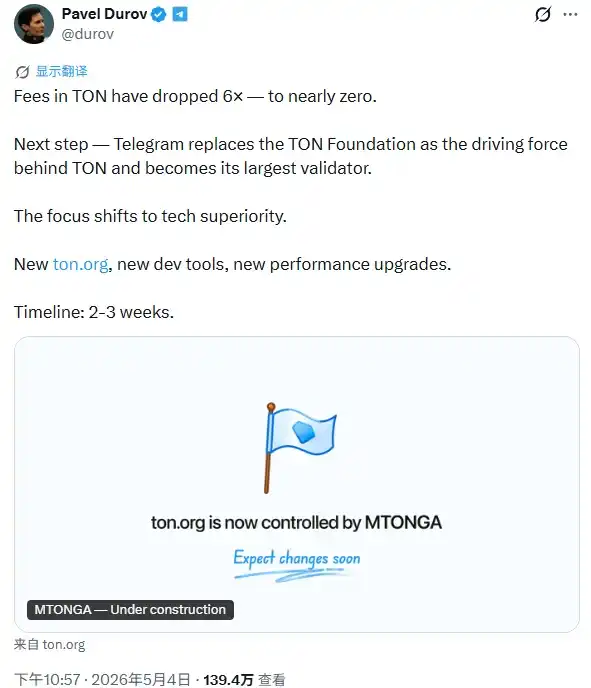
Telegram Founder: TON Fees Reduced by 6x, Telegram to Become Largest Validator

In the past, the relationship between TON and Telegram was more like a strong binding with weak leadership. Telegram provided the gateway, while the Foundation and community were responsible for advancement, with a layer of distance always between them. But this time, Telegram isn't just continuing to bring users to TON; it's beginning to enter more foundational positions such as validator, technical roadmap, and development tools. TON is no longer just a chain adjacent to the Telegram ecosystem but is being reintegrated into Telegram's product system.

TON Doesn't Lack a Gateway; It Lacks Turning the Gateway into Use Cases

Past market discussions about TON often revolved around Telegram's user scale. But for a public chain, having a gateway doesn't equal having an ecosystem, and having user reach doesn't equal having long-term usage. TON's unique aspect is its inherent attachment to a high-frequency social platform, where Mini Apps, wallets, channels, bots, games, and payments already exist within Telegram. This allows TON to avoid having to find users from scratch like most Layer1s. However, if these scenarios cannot solidify into sustained on-chain interactions, Telegram's traffic can only bring waves of short-term hype.

Projects like Notcoin and Dogs have proven that Telegram can quickly generate viral spreads. Simple gameplay combined with social relationship chains can indeed attract a large number of users into crypto applications in a short time. But such explosions come and go quickly. TG mini-games and airdrops can bring attention but can hardly alone sustain a long-term ecosystem.

Therefore, the fee reduction, speed increase, developer tools, and validator role emphasized by Pavel Durov this time point not to a single technological upgrade, but to TON addressing its most critical missing link—transforming Telegram's gateway into sustainable use cases. Only when fees are low enough, confirmation speeds are fast enough, and developer integration is simple enough can scenarios like channel tipping, Mini Apps tasks, game rewards, creator revenue, ad revenue sharing, bot calls, and group micropayments potentially evolve from product features into on-chain activities.

TON no longer needs to repeat the story of "backed by Telegram." What it truly needs to prove is whether the high-frequency behaviors within Telegram can be effectively borne by TON.

Fee Reduction and Speed Increase Aim to Enable Smaller, Higher-Frequency Transactions

The fee reduction by TON this time shouldn't be understood merely as cost optimization typical of public chains. Viewed within the context of Telegram, it actually solves the problem of whether small-amount, high-frequency interactions can become viable.

Most potential on-chain behaviors within Telegram are not large transfers but more fragmented daily operations. Individual transaction amounts are low, but occurrence frequency is high. If users have to perceive fees, wait for confirmations, and repeatedly handle wallet interactions with every button click, these scenarios can hardly truly take off.

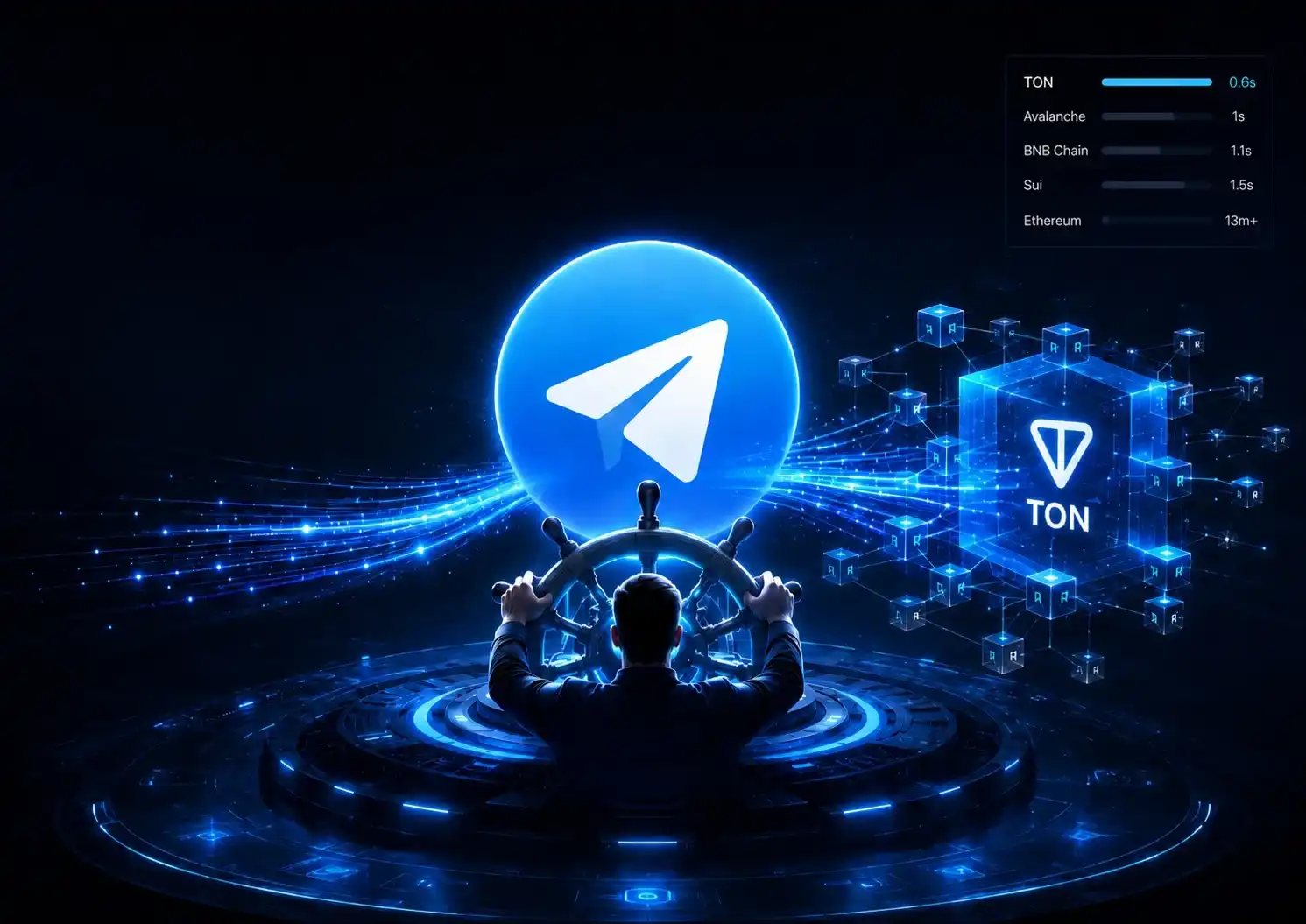
Therefore, fee reduction and speed increase must be considered together. Fees approaching zero lower the usage barrier; reducing finality time to 0.6 seconds lowers the perception of waiting. For Telegram, the chain shouldn't become an extra layer perceived by users but should be hidden as much as possible behind product actions like sending messages, clicking buttons, and viewing balance changes.
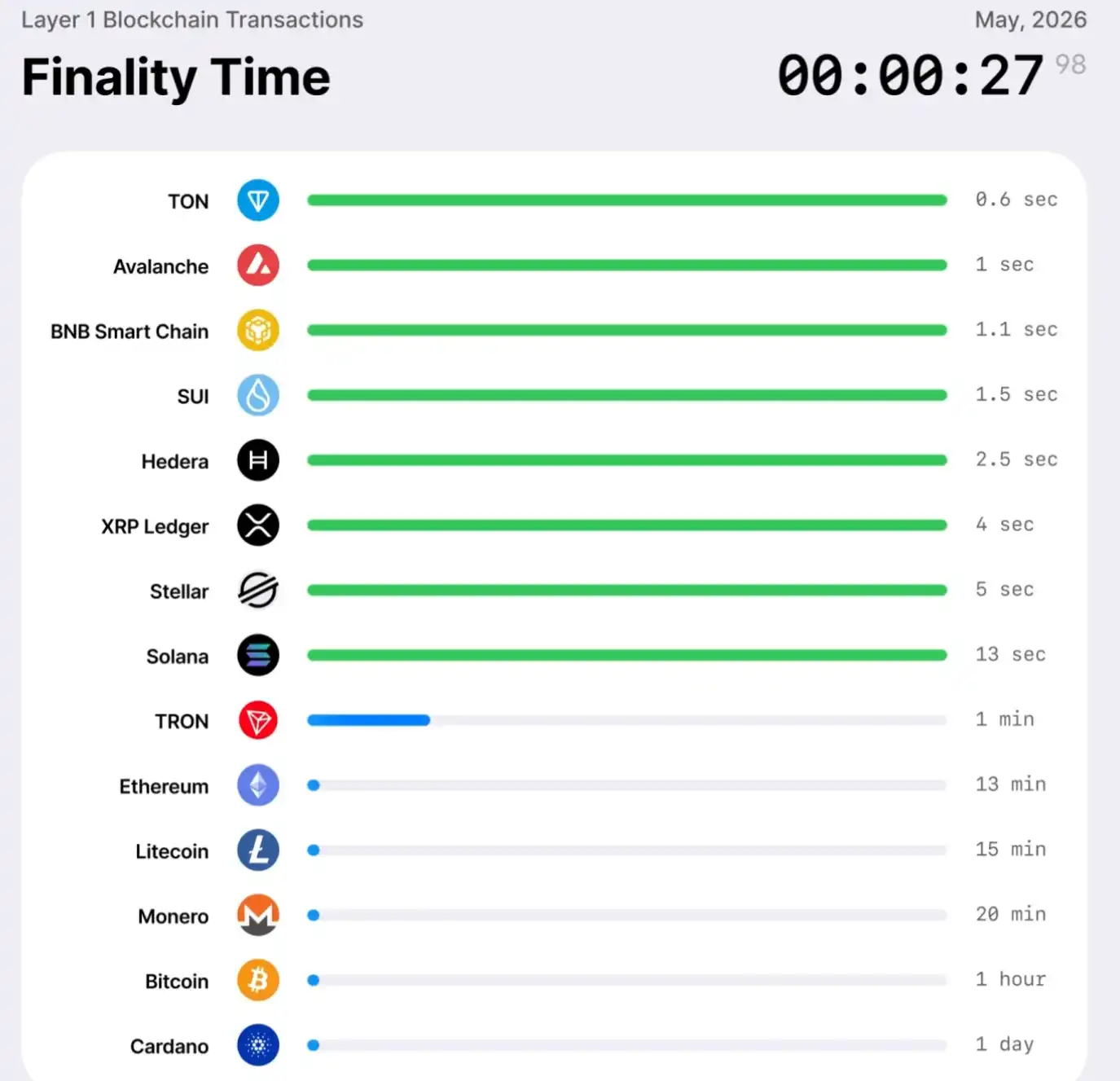
Comparison of "Finality Time" Among Mainstream Public Chains

This also distinguishes TON from many other Layer1s. Its goal isn't solely to make DeFi trades faster or transfers cheaper; it aims to embed the chain into Telegram's daily use. Only when cost, waiting time, and wallet operations are minimized enough can TON potentially evolve from a Telegram-related public chain into the underlying network directly invoked by Telegram's application layer.

From Gateway to Validator, Telegram Begins Penetrating TON's Core

Telegram becoming TON's largest validator is the most significant step in this change. It means Telegram is no longer just providing TON with a gateway and brand endorsement but is entering the network's security and operational mechanisms. Previously, TON was driven by the Foundation and community, which offered greater openness but a relatively decentralized pace. Now, with Telegram directly involved, its products, wallet, Mini Apps, payments, and developer tools have the opportunity to be realigned.

Efficiency may increase, but controversy will also grow. Telegram replacing the TON Foundation as the main driving force and becoming the largest validator will inevitably lead to renewed external discussions about TON's centralization risks. In response, Pavel Durov stated that Telegram's participation would attract more large-scale participants into the validator pool, thereby enhancing decentralization. This logic is not without merit, but the final judgment will depend on results, not statements.

The truly important aspects going forward are whether the validator structure can become more diverse, whether governance information is sufficiently transparent, whether the Foundation and community retain independent space, and whether ecosystem projects can continue developing without relying on Telegram's will.

Therefore, Telegram's return is not a simple positive but a trade-off. For TON to enter the mainstream application layer, it needs Telegram's strong execution capabilities; but the more prominent Telegram's role, the more TON needs to prove it is not merely an internal settlement chain serving Telegram.

High Staking Rewards Retain More Tokens for TON

Pavel Durov subsequently emphasized that TON ranks first in annual staking rewards among the top 50 cryptocurrencies by market cap, with a high rate of 18.8%. Compared to fee reduction and speed increase, high staking rewards are more likely to mobilize capital sentiment and provide TON with another layer of holding rationale in the market's eyes.
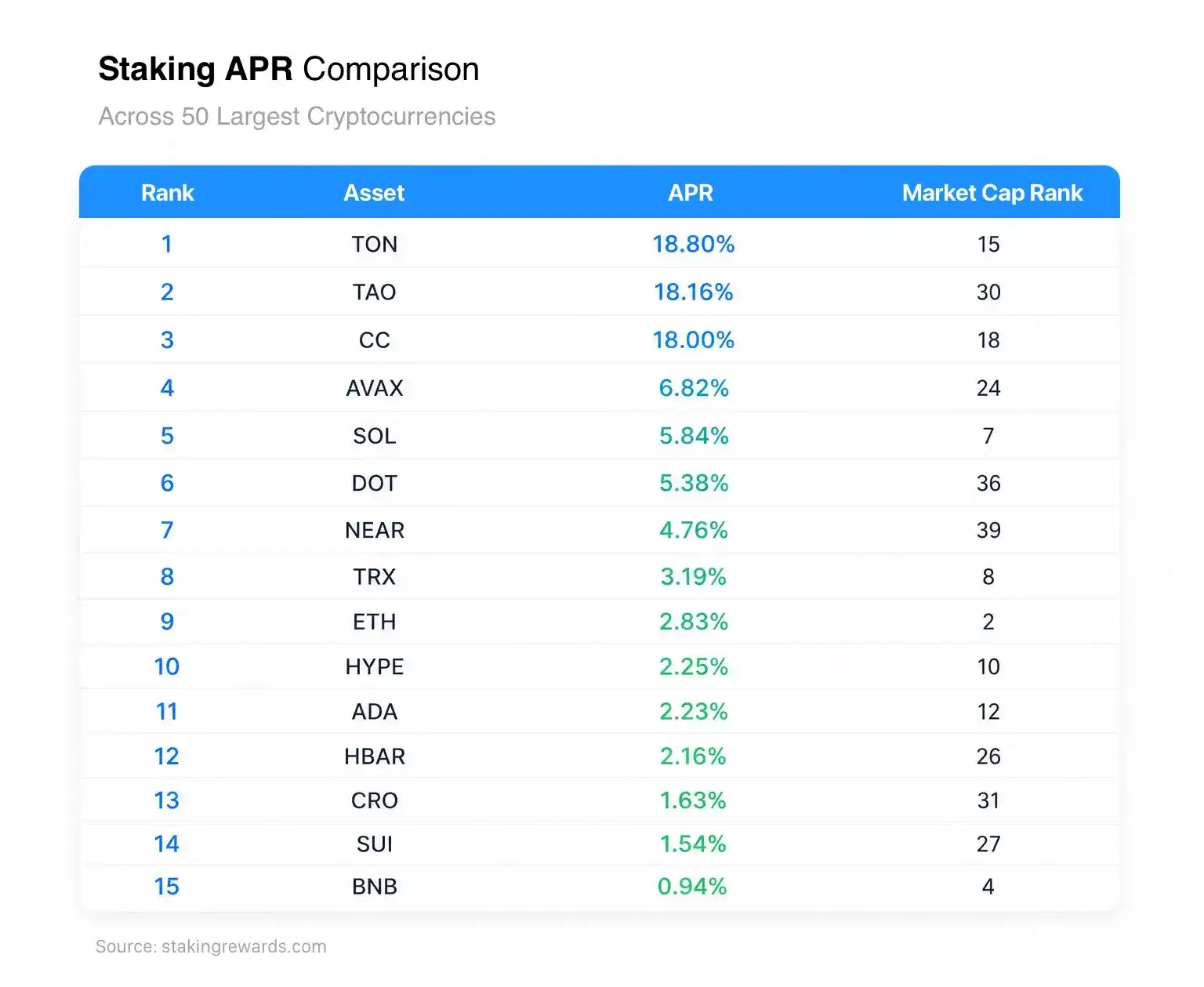
TON Annual Staking Rewards Rank First Among Top 50 Cryptocurrencies

This also makes TON's narrative somewhat more complete. It's not just relying on Telegram's user gateway to attract attention or improving experience through technical upgrades; it's also using staking rewards to keep capital within its ecosystem. The simultaneous presence of gateway, performance, validators, and rewards makes this change more substantial than a single positive factor.

Of course, high yield itself is not the end goal; it's more like buying TON a longer observation period. As long as subsequent developer tools and performance upgrades are delivered, and more capital is locked into the network, a positive feedback loop with real usage may form. For TON, the value of staking rewards isn't just about increasing holding returns but making the market willing to continue waiting for it to truly convert Telegram's gateway advantage.

TON's Return to Telegram Is Not the Finish Line, But a Tougher Challenge

The key for TON going forward is not to continue leveraging Telegram for traffic, but to truly become part of Telegram's application ecosystem. If Telegram's chat, payments, applications, creator economy, and automated interactions are gradually undertaken by TON, then TON's competitors will not just be other Layer1s, but all networks attempting to become the next-generation application infrastructure.

TON isn't just repeating the social traffic story; it's beginning to attempt to turn social traffic into on-chain order. The gateway is just the beginning; usage is the answer. Telegram can push TON to the forefront, but whether it stays there ultimately depends on whether TON can become the layer of infrastructure that operates behind user perception, within the functioning of applications.

If the past TON was still proving how close it is to Telegram, now it must prove how deeply integrated it can be within Telegram's daily use. True mainstream adoption isn't about making users aware they are using a chain, but about making the chain part of the application experience.

TON's opportunity lies here, and so does its pressure.

Preguntas relacionadas

QAccording to the article, what is the new role that Telegram will assume in the TON network, as announced by Pavel Durov?

ATelegram will become the new core driver of the TON network, replacing the TON Foundation. It will also become the network's largest validator.

QWhat is identified as the key challenge TON needs to overcome, beyond just having access to Telegram's large user base?

ATON needs to transform its access and user reach into sustainable, long-term usage scenarios. It must convert Telegram's high-frequency social interactions into persistent on-chain activities.

QWhy are the reductions in transaction fees and improvements in speed particularly important for TON within the Telegram context?

ALow fees (approaching zero) and fast finality (0.6 seconds) are crucial to enable the small, frequent, and fragmented transactions typical of Telegram's daily use cases. They lower the barrier and reduce user friction, allowing the blockchain to operate seamlessly in the background of the app experience.

QWhat potential downside or concern is raised regarding Telegram becoming the core driver and largest validator of TON?

AThe move raises concerns about increased centralization risk and questions regarding the future independence of the TON Foundation and community projects. It represents a trade-off between stronger execution from Telegram and the need for TON to maintain network decentralization.

QHow does the article frame the high annual staking reward offered by TON, and what purpose does it serve?

AThe high staking reward (18.8% annually, ranked first among top 50 cryptocurrencies) is seen as a mechanism to attract and lock in capital within the TON ecosystem. It provides an additional incentive for holding TON and buys time for the network to realize its potential in converting Telegram's user base into active usage.

Lecturas Relacionadas

Conversación con Jia Hang: Un vistazo a 20 años de expansión global de los pagos chinos

Entrevista con Jia Hang: Veinte años de expansión global de los pagos chinos Jia Hang, veterano con más de dos décadas en la industria, repasa la evolución de los pagos chinos en el exterior desde tres perspectivas clave: Unión de Pagos de China (China UnionPay), Alipay+ y las stablecoins. En sus inicios en China UnionPay, el objetivo era construir la tercera red de tarjetas global, siguiendo el modelo de JCB. La estrategia, denominada "tarjeta del norte para uso en el sur", consistía en expandir la aceptación de la tarjeta siguiendo a los turistas chinos. Sin embargo, este enfoque no logró resolver el problema fundamental de la emisión local de tarjetas fuera de China, lo que limitó su penetración en mercados locales. Posteriormente, en Ant Group, se impulsó Alipay+, una red que conectaba billeteras digitales locales a nivel global, evitando la necesidad de crear un "Alipay global" desde cero. Aunque innovadora, Alipay+ seguía compitiendo en la misma capa que Visa y Mastercard (pagos al consumo), sin ofrecer un valor disruptivo o un nuevo modelo de distribución de incentivos que desafiara la red establecida. Hoy, Jia Hang dirige DCS en Singapur, enfocándose en pagos con stablecoins. Aquí ve un cambio de paradigma: las stablecoins no compiten directamente con las redes de tarjetas, sino que desafían el sistema bancario tradicional al ofrecer una nueva infraestructura para el movimiento de fondos. Su potencial radica en reorganizar las redes de pago globales alrededor de cuentas (stablecoins) en lugar de tarjetas, permitiendo una penetración desde pagos transfronterizos hasta el comercio minorista local, especialmente en economías con controles de capital. Su conclusión clave: la próxima red de pago global no surgirá solo de una nueva tecnología, sino de una combinación de nuevo valor para el usuario, un nuevo reparto de beneficios y un nuevo mecanismo de gobernanza.

marsbitHace 4 min(s)

Conversación con Jia Hang: Un vistazo a 20 años de expansión global de los pagos chinos

marsbitHace 4 min(s)

La acción de Circle se desploma un 76%, el stablecoin vinculado al dólar de Hong Kong se lanzará en dos semanas

El precio de las acciones de Circle ha caído un 76%, tras alcanzar un máximo de 260 dólares en junio del año pasado hasta situarse en 62 dólares a mediados de julio. Esta fuerte corrección refleja una revaluación profunda del mercado, impulsada por la creciente competencia y las presiones sobre los márgenes, lo que llevó a Mizuho a rebajar su calificación y precio objetivo. Heath Tarbert, presidente de Circle, destacó la ejecución a largo plazo de su estrategia y la sólida posición de USDC (730 mil millones de dólares en circulación). Sin embargo, el ecosistema enfrenta desafíos: el nuevo stablecoin Open USD, respaldado por unas 140 empresas, busca captar partners mediante el reparto de rendimientos de las reservas. Además, Visa, con su enorme red de pagos, ha lanzado una plataforma que inicialmente da soporte a Open USD, aunque sigue siendo compatible con USDC. Mientras tanto, Tether (USDT) tiene aproximadamente dos años para ajustar sus reservas y cumplir con la Ley GENIUS, que exige activos de alta liquidez como efectivo y bonos del Tesoro de EE.UU., algo que podría complicarse dado su actual exposición a metales preciosos, préstamos y Bitcoin. En Hong Kong, el ritmo se acelera: se espera que Standard Chartered y su asociada, Anchor Financial Technology, lancen pronto un stablecoin vinculado al dólar de Hong Kong (HKDAP), tras recibir una de las primeras licencias del regulador local. La clave será si pueden transformar esa licencia en flujos de capital reales, especialmente en comercio transfronterizo. La caída de Circle simboliza la transición del mercado de stablecoins de un posible "winner-takes-all" a una competencia multifacética, donde la ventaja de escala ya no garantiza por sí sola una prima de valoración. La ejecución concreta de las estrategias a largo plazo será decisiva en los próximos dos años.

marsbitHace 12 min(s)

La acción de Circle se desploma un 76%, el stablecoin vinculado al dólar de Hong Kong se lanzará en dos semanas

marsbitHace 12 min(s)

Bajo el asedio del capital, la descentralización es la única línea de defensa de las cadenas públicas

**Resumen:** En un mundo impulsado por el poder y la codicia, el autor, un realista de mentalidad maquiavélica, argumenta que la **descentralización es la única característica fundamental e irremplazable de una cadena de bloques pública**. Mientras que otros priorizan la escalabilidad, las asociaciones comerciales o la financiación, él sostiene que estas son derivadas o incluso contraproducentes. La lógica central es que cualquier sistema que logre una adopción masiva atraerá inevitablemente intentos de captura por parte de corporaciones y capitales, motivados por el interés propio de proteger sus rentables modelos de negocio. El riesgo principal no son los ataques externos como el de 51%, sino la **usurpación interna del control**. La historia de plataformas como Visa, Mastercard o Google muestra una trayectoria inevitable de "degeneración" hacia herramientas monopolísticas. Una capa base pública y programable representa un premio mucho mayor. Por ello, las cadenas de consorcio o "permissioned", las L1 con validadores centralizados o las L2 con un único secuenciador son inherentemente vulnerables y serán cooptadas, sirviendo solo para consolidar el poder de los oligarcas existentes. La evidencia del mundo real, como ciertas redes de consorcio que excluyen a competidores clave, confirma este patrón. Las grandes empresas promueven soluciones pseudo-descentralizadas principalmente como una **táctica dilatoria** para frenar la adopción de la tecnología verdaderamente abierta que amenaza sus modelos basados en fricción e ineficiencia. Sin embargo, a largo plazo, el mercado, como el agua, fluirá hacia la infraestructura más segura y descentralizada. Concluye que, a pesar de sus defectos, una cadena como **Ethereum, con su alto grado de descentralización, sigue siendo la mejor defensa contra la captura corporativa y la solución práctica óptima disponible**.

Foresight NewsHace 20 min(s)

Bajo el asedio del capital, la descentralización es la única línea de defensa de las cadenas públicas

Foresight NewsHace 20 min(s)

Trading

Spot
活动图片