Written by: Thejaswini M A
Compiled by: Chopper, Foresight News
I am located in the UTC+5:30 time zone of Bengaluru. The opening of the U.S. stock market corresponds to 7 PM local time. I have been working in crypto market reporting for five years, and for five years, I have constantly watched the non-stop trading screen. There are no market closures, no pre-market or after-hours trading sessions here. Regardless of day or night, morning or evening, weekends or holidays, the market moves without interruption.
The operational model of traditional financial markets is completely different. The trading hours of the New York Stock Exchange are from 9:30 AM to 4 PM ET, Monday through Friday; the London Stock Exchange from 8 AM to 4:30 PM; and the Tokyo Stock Exchange from 9:00 AM to 3:30 PM, with breaks in between.
Major exchanges take turns opening. Theoretically, as the globe rotates and day and night alternate, capital should flow continuously. But in reality, mainstream exchanges all have fixed trading hours, and compliant markets experience long periods of inactivity.
This routine originates from the physical limitations of early pit trading with manual open outcry. Computer technology should have broken the shackles of time; instead, it merely sped up transaction matching, while fixed market opening rules were preserved.
The laws of physics state that an object at rest stays at rest unless acted upon by an external force. The unchanging nature of financial market trading hours is precisely due to the lack of a driving force for change. It was not until a Sunday morning this past May that the market, ahead of traditional investment banks, provided a valuation for SpaceX, breaking the established order.
The Hyperliquid platform operates around the clock. The related derivative contract went live at 05:16 UTC, achieving a trading volume of $33 million within 24 hours, while institutions like Morgan Stanley were not yet open for business.
The Indian time zone happened to witness this unique pricing competition. U.S. financial media only began reporting it at 9:30 AM ET, by which time I had already been watching the market for an afternoon.
CME Group is the world's largest derivatives trading platform. Institutional traders trade crude oil, gold, interest rates, stock indices, and Bitcoin futures there, with daily trading volumes reaching trillions of dollars. Its brand history can be traced back to 1898.
Intercontinental Exchange (ICE) owns the New York Stock Exchange and several other global derivatives trading platforms, making it another industry giant.
These two control the world's top financial infrastructure. Their risk warnings are easily taken seriously at the regulatory level. Now, these two institutions are lobbying the U.S. Commodity Futures Trading Commission and Congress to crack down on the Hyperliquid platform. They accuse the platform of operating without identity verification, making it easy to breed market manipulation and potentially become a channel for evading sanctions.
The Hyperliquid platform does not have a user identity verification mechanism. Although its website front-end blocks sanctioned addresses, the underlying protocol is completely open with no entry barriers. Users can bypass the web interface to interact directly with the smart contract, without any identity verification required.
The platform has no position limit rules, whereas CME limits the maximum position size per contract to prevent market manipulation and systemic risk. CME monitors trading patterns to guard against illegal activities like spoofing or coordinated trading. Hyperliquid lacks a corresponding risk control monitoring system.
These concerns are all reasonable. Affected by negative regulatory news, the price of the HYPE token fell 9% on May 15th; on May 18th, two market makers withdrew $100 million in liquidity.
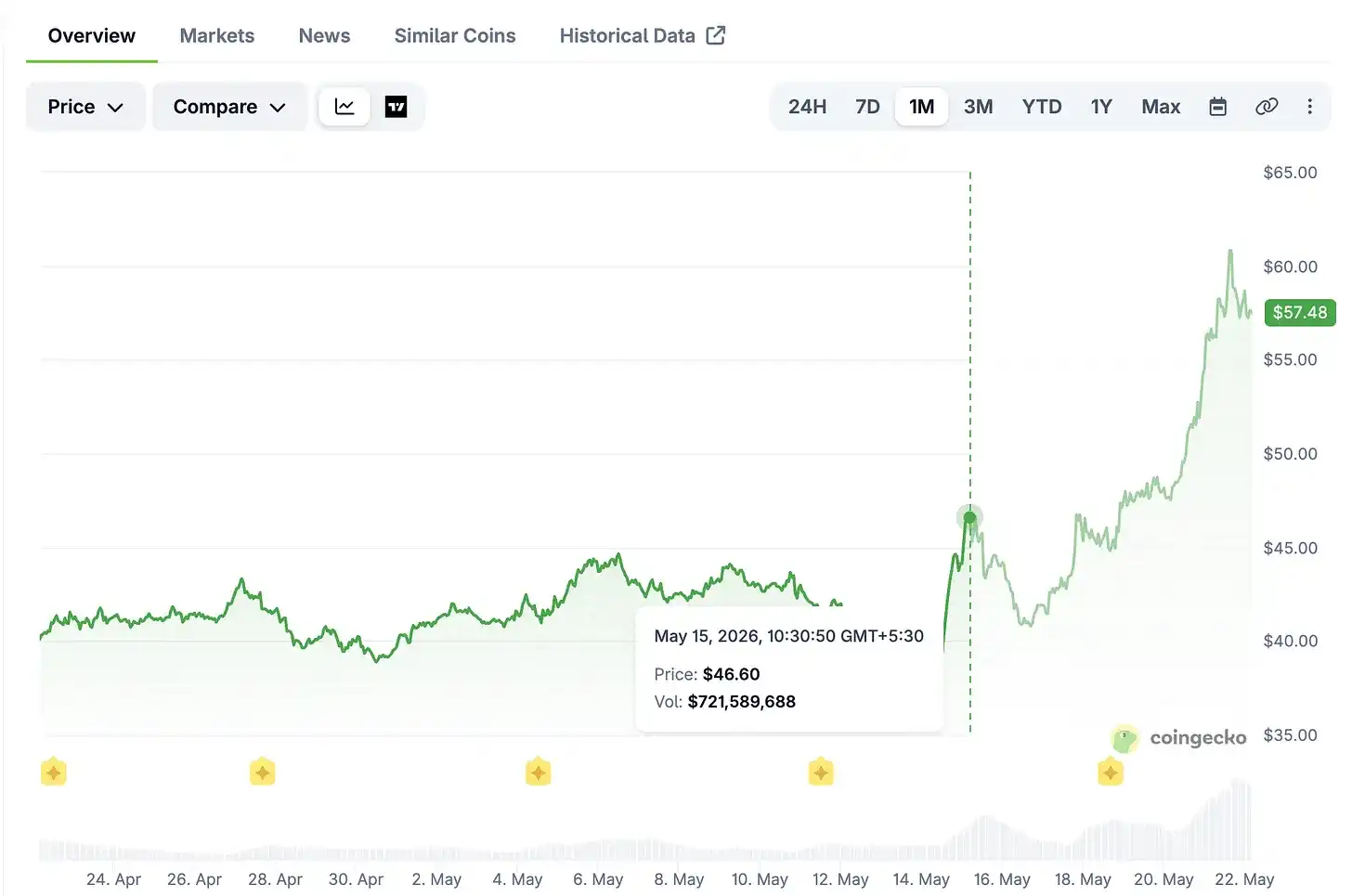
However, the regulatory scrutiny is not directed at crypto perpetual contracts, which have operated for years without regulatory intervention, but focuses on crude oil derivative contracts. These contracts achieved a trading volume of $720 million during CME's closed weekend, touching the interests of traditional institutions.
The concerns of CME and ICE are not unfounded, but they are not neutral observers either. Their business models rely on the monopoly barrier created by legally-defined trading hours. Technological competition within the industry is acceptable, but cross-dimensional competition in terms of time is intolerable to traditional giants.
Hyperliquid seizes the window when traditional markets are closed to trade crude oil, completely breaking the temporal operating system of traditional finance. Established institutions are trying to pressure regulators to unify trading hours, while emerging platforms advocate for the right to legally operate on weekends.
The Hyperliquid team consists of only 11 people, with offices in Singapore. In the 30 days leading up to May 21, 2026, the platform generated $51 million in revenue; in March of this year, the notional trading volume of derivatives reached $2.6 trillion.
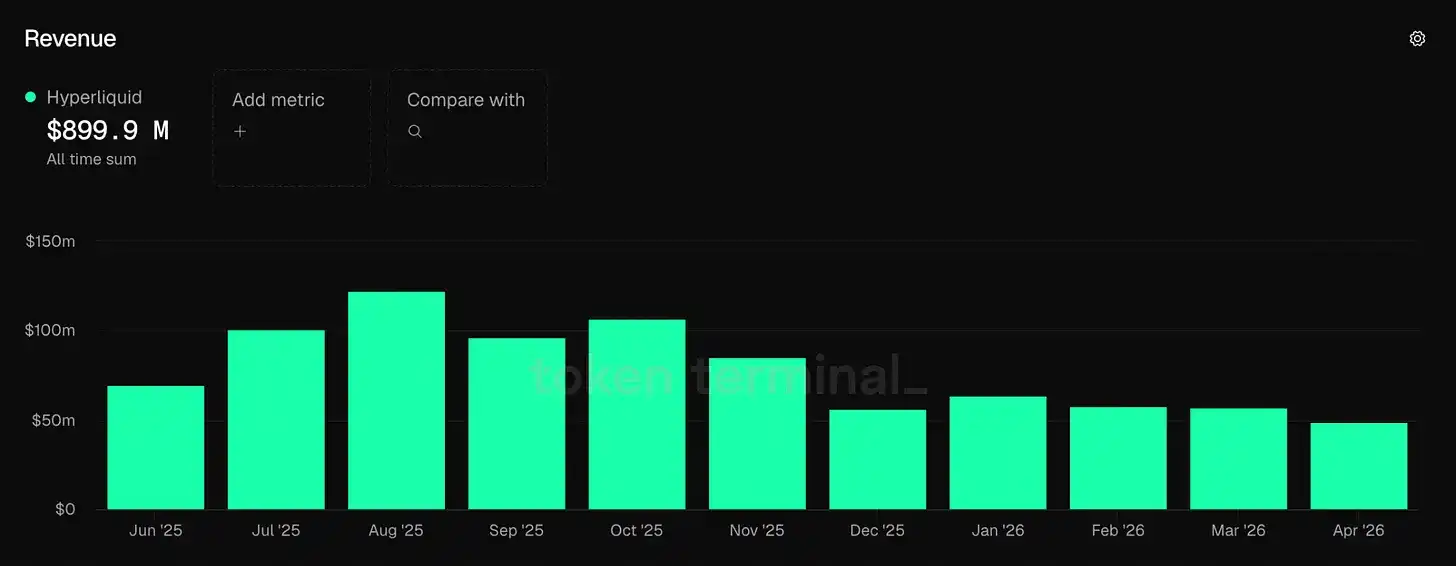
The platform allocates 97% of trading fees to an on-chain treasury pool, used to repurchase HYPE tokens. A small team generating high revenue makes for an exceptionally rare per-capita revenue-generating capability in both finance and crypto. As of late May, HYPE is up 101% year-to-date.
This competitiveness does not stem solely from technical advantages in derivative products. The temporal advantage of 24/7, non-stop trading is the core value proposition. Subsequent new product categories have further amplified this differentiated advantage.
On May 1st, the Trade.xyz platform built on Hyperliquid launched a pre-IPO perpetual contract for the AI chip company Cerebras, covering the two weeks leading up to the official IPO.
The market initially predicted the stock would trade at a 50% premium to the $185 offering price, estimating an opening price around $277. As information was continuously updated, one hour before the Nasdaq's official opening, the platform contract was quoted at $340, only a 3% error from the final opening price of $350. The stock rose 89% above its offering price after listing.
In contrast, traditional secondary market platforms like Forge and EquityZen had prediction values differing from the actual opening price by 35%, enough to highlight Hyperliquid's efficient price discovery capability. The market correcting its quotes as information gradually lands is a reasonable price discovery mechanism.
On Sunday, May 17th, Trade.xyz again launched a pre-IPO perpetual contract for SpaceX. The contract's initial reference price was $150, climbing to $216 within hours, eventually stabilizing at $203, corresponding to a total company valuation of $2.4 trillion.
At that time, SpaceX had not yet published its prospectus, Wall Street analysts had not issued valuation reports, and the company's roadshow had not started. Market traders had no way of knowing that the company had secretly filed with the SEC as early as April, with a preset valuation range of $1.75 to $2 trillion.
The market's self-calculated valuation directly hit the upper limit of the company's internal valuation range, without referencing any official disclosures. Several days later, on May 20th, SpaceX officially released its 277-page public filing.
Currently, three products offer investors exposure to SpaceX using different compliance logics, with each product adopting a distinct legal strategy.
The PreStocks platform uses a special investment fund structure, purchasing real company shares and then splitting them into on-chain tokens, allowing ordinary investors to indirectly hold shares. It once became a convenient channel for investing in non-listed tech companies.
However, just before the Hyperliquid-related contract launch, AI companies Anthropic and OpenAI publicly denied third-party tokenized equity products. Some platforms in Hong Kong and the UAE issued related tokenized assets without company permission. Both companies stated that such equity transfer activities lacked legal validity. Upon the news, PreStocks token prices were halved. Once the underlying company objects, derivative products based on its equity lose their foundation.
Ondo Global Markets, relying on a U.S. licensed broker-dealer, issues stock tokens, with each token backed by corresponding underlying securities. Its compliance system is sound, and the Depository Trust & Clearing Corporation (DTCC) is building supporting clearing infrastructure.
But Ondo's greatest strength is also its greatest weakness: its operational entity is clear and identifiable. If regulators halt operations or the company files infringement claims, the relevant institutions and custodians face direct accountability risks. Operating by the rules makes it easier to become a regulatory target.
The SpaceX synthetic perpetual contract launched by Hyperliquid is completely detached from underlying physical assets. The product has no corresponding equity, licensed institution, or physical asset ownership. It is a purely synthetic derivative, settled solely in USDC on a decentralized network, with trading purely based on price fluctuations.
Even if SpaceX wanted to halt related valuation trading, it would have nowhere to start. The product has no corresponding legal entity to hold accountable, nor a centralized issuer to pressure.
This model cleverly avoids accountability risk. Without a physical anchor, it cannot be directly targeted.
But the pros and cons of this model are equally hard to define. Unverified trading channels allowing massive capital flows outside the global banking system do pose national security risks. On May 17th, Hyperliquid co-founder Jeff Yan went to Washington to meet with policymakers, also indicating the platform faces serious regulatory pressure.
The founders have public identities and backgrounds. If SpaceX sues for trademark or intellectual property infringement, legal documents can be served to hold them accountable.
However, accountability against individuals cannot stop the smart contract from running. PreStocks products depend on real equity; if the equity becomes invalid, the product dies. Ondo's platform struggles to operate normally if accounts are frozen.
Hyperliquid contracts are deployed based on self-executing code. Once deployed, the smart contract is immutable, and on-chain order matching continues autonomously, even if founders face legal issues.
This is the idealized form of decentralization, but real-world operation still has shortcomings. The Ondo platform's validator network has only 20 nodes, not a large-scale distributed network, and identities are traceable. Past token incidents also prove that project parties can intervene based on their judgment; nodes are not absolutely non-interferable.
Ultimately, the temporal advantage of 24/7 non-stop trading is a core barrier that traditional finance cannot replicate.