Strategy Watch #4

insights.glassnodePublicado a 2026-05-22Actualizado a 2026-05-22

Resumen

Strategy Watch #4 provides a monthly institutional analysis of digital asset fund performance and allocation trends. The report covers six sections. Key findings for April show mixed capital flows: Bitcoin outflows eased significantly, nearing neutral, while stablecoin inflows surged to multi-month highs, indicating a defensive rotation into dollar instruments. Ethereum remained in persistent net outflow. ETF and DAT flows were positive for Bitcoin, while Ethereum flows staged a notable late-month reversal from deep outflows to meaningful inflows. However, DeFi TVL on Ethereum reversed its March stabilization, with accelerated outflows suggesting sustained allocator caution toward on-chain yield strategies. CME basis yields for both BTC and ETH deteriorated sharply, turning deeply negative as futures moved into backwardation, removing carry opportunities. Across strategies, all sub-strategies posted gains for the month, a rare alignment. Despite a more constructive market backdrop, manager cash levels climbed to multi-year highs, indicating selective and cautious positioning. The report also includes a DeFi/Yield strategy deep dive, on-chain vault performance analysis, and updates on institutional allocations, including rising pension fund activity.

The full report is freely available in PDF format.

Download PDF version

Welcome to Strategy Watch #4

Strategy Watch was built to address a clear demand for high-signal, impartial analysis of fund-level performance and allocation trends in digital assets.

Our objective is straightforward — to make Strategy Watch a must-read monthly publication for the digital asset investment community.

This publication is strengthened by direct input from market participants. Funds and allocators that contribute data and insights help shape a more complete and valuable view of the landscape. If you have insights, data, or allocation updates worth sharing, we welcome your contribution.

Present your latest initiatives and updates to a curated audience of institutional allocators.

Share updates ↗

Inside the Latest Strategy Watch

The report is structured across six core sections, each focused on a distinct dimension of institutional activity in digital assets:

01 Institutional Flow Monitor | Defensive positioning persisted through April as BTC and ETH outflows eased further, stablecoin demand accelerated, and ETF inflows remained constructive.

02 Fund and SMA Performance | Every sub-strategy posted gains for the month, a level of cross-strategy alignment not seen in recent memory. Is this a rebound or repositioning?

03 Strategy Deep Dive: DeFi/Yield | Hear a CIO's perspective on where edge comes from as lending spreads compress and smart contract risk evolves

04 On-chain Vault Performance | Are ETH curators underperforming ETH staking yield?

05 Manager Monitor | Find out how more than 400+ managers are positioning for Q2, with cash levels climbing to multi-year highs despite a more constructive market backdrop.

06 Allocation Updates | Pension allocations rise alongside strategic acquisitions and new launches across yield, trading, and digital asset strategies.

in partnership with

The Premier Digital Assets Allocator Platform. Learn more


Institutional Flow Monitor

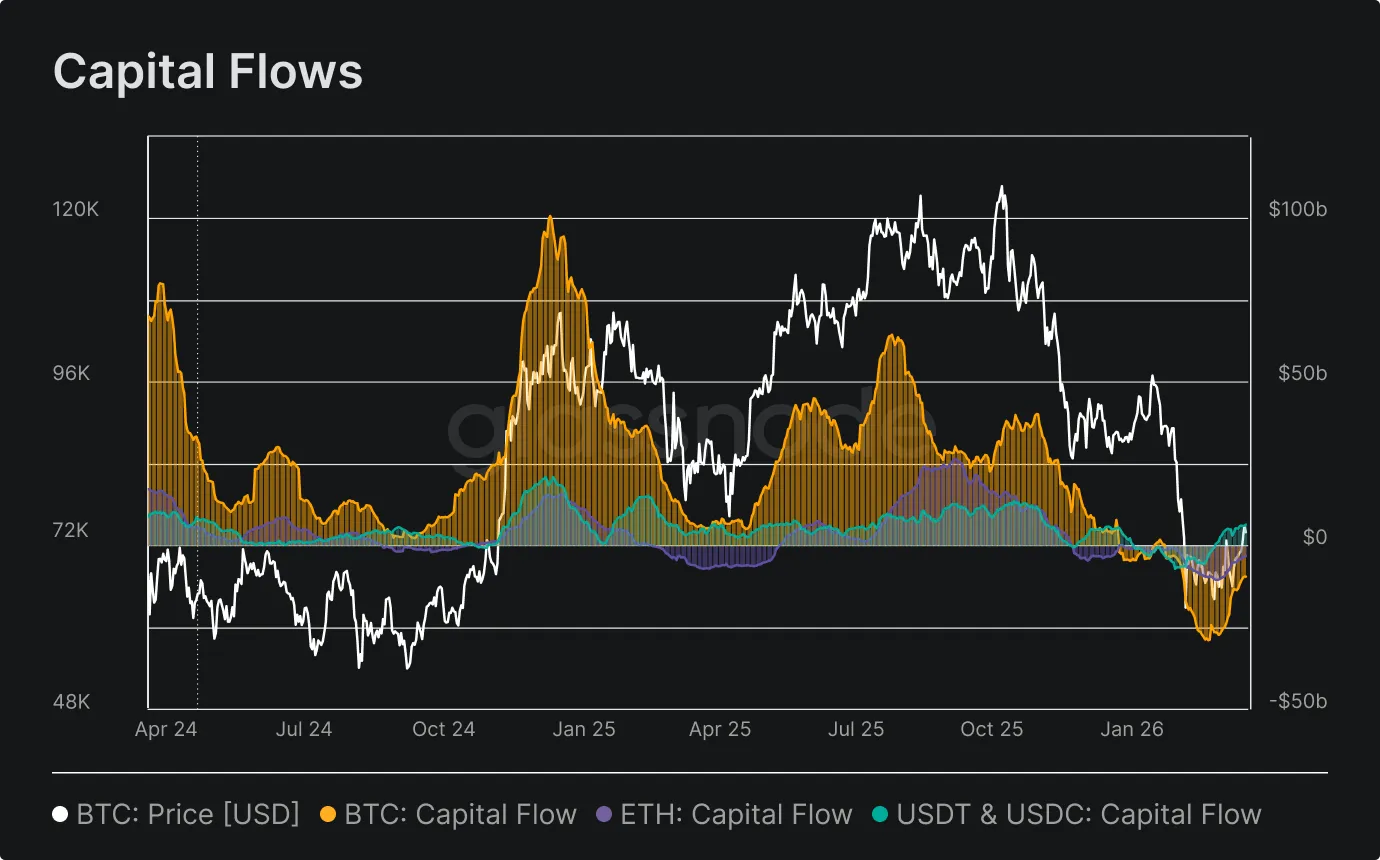
  • BTC capital flows nearly recovered to neutral through April while stablecoin inflows surged to multi-month highs, though ETH remained persistently in net outflow.

Bitcoin capital flows recovered materially through April, improving from -$6.9B at month-open to nearly neutral at -$0.7B by month-end, continuing the gradual deceleration of outflows observed in March. Stablecoins showed the strongest directional move, with inflows accelerating from +$1.8B in early April to +$5.4B by month-end, suggesting a meaningful rotation of capital into dollar-denominated on-chain instruments. Ethereum stood apart from both trends, remaining in persistent net outflow throughout the month and closing at -$1.6B, broadly unchanged from its March reading. The divergence between a stabilizing BTC, surging stablecoin demand, and a lagging ETH points to a selective rather than broad-based recovery in capital allocation.
ETF & DAT Net Flows

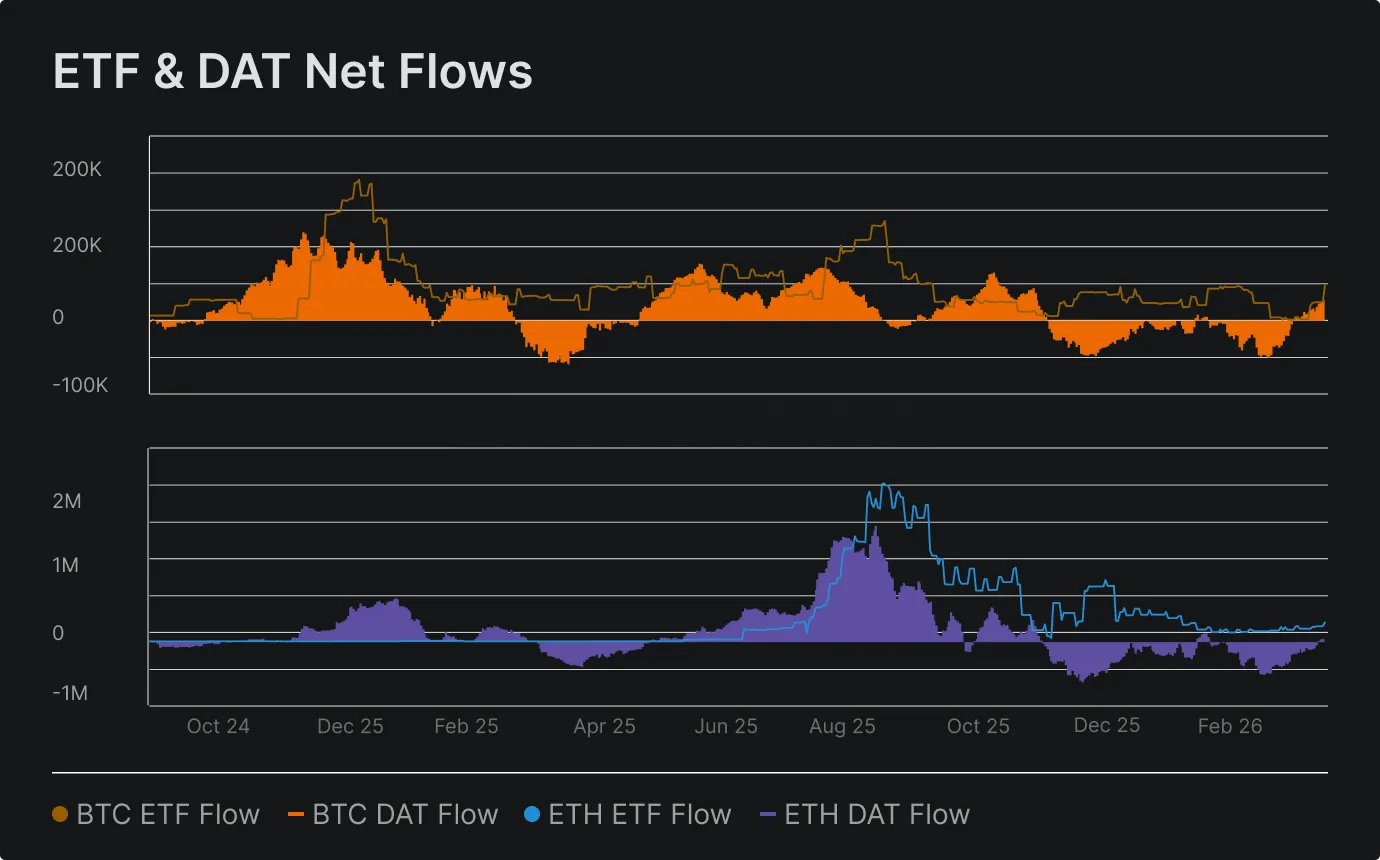
  • BTC ETF and DAT flows held positive through April while ETH staged a notable turnaround, flipping from deep outflow in early April to meaningful inflows by month-end.

Bitcoin ETF flows maintained positive territory throughout April, recovering from a mid-month dip to close at +26.3k BTC, while DAT flows strengthened progressively to +58.8k BTC by month-end. The more significant shift came from Ethereum, where ETF flows opened the month at -135k ETH before turning positive around April 18 and closing at +140.6k ETH. ETH DAT flows remained constructive throughout, finishing at +408.6k ETH. While BTC institutional demand showed consistency, the ETH turnaround is the more notable development, though it remains early and the magnitude of the late-month recovery warrants monitoring before drawing conclusions about a durable change in positioning.
DeFi TVL & Stablecoin Cap

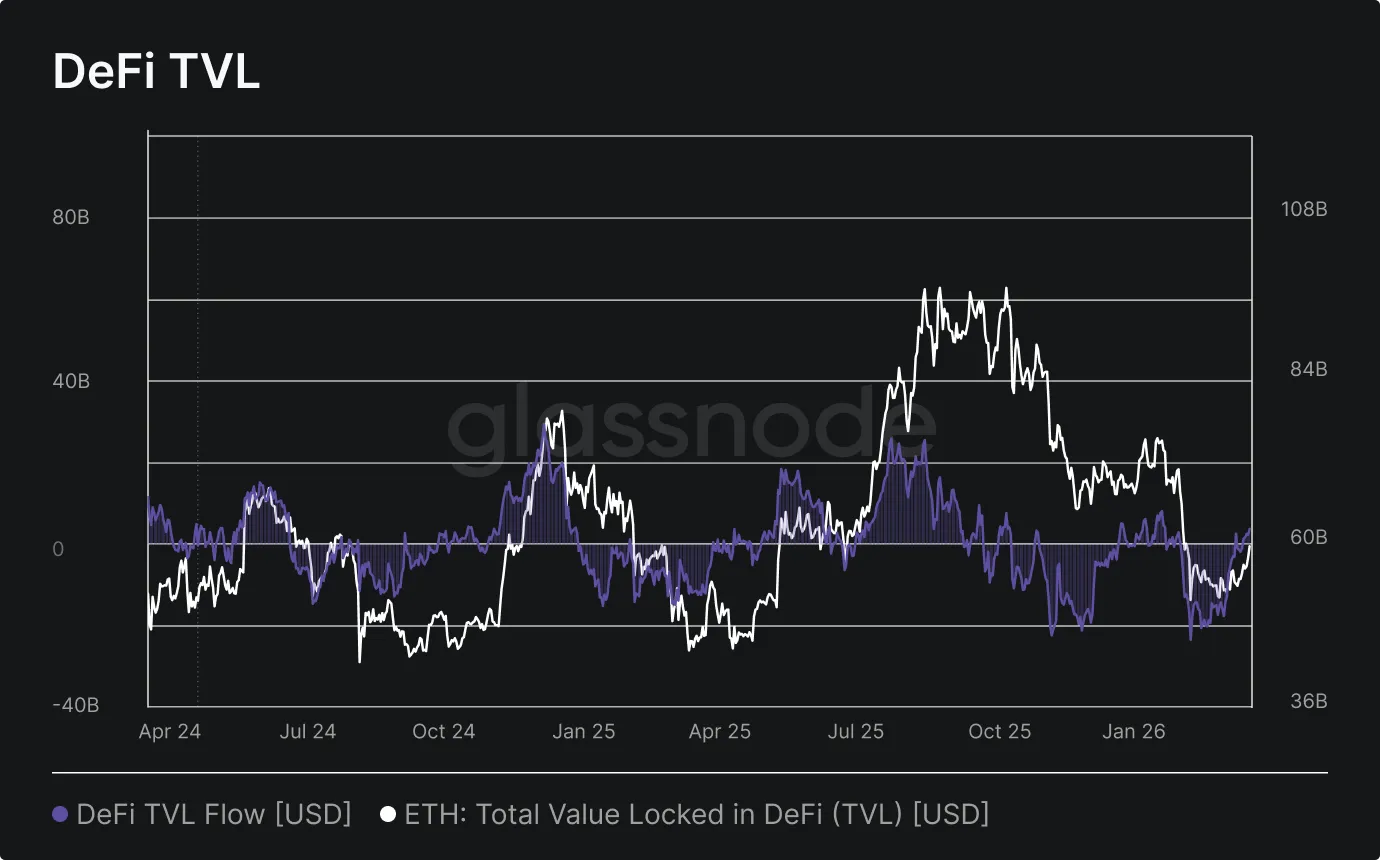
  • DeFi TVL flows on Ethereum reversed sharply in April, erasing the March stabilization as outflows accelerated to multi-month highs in the final week.

After nearly reaching neutral at month-end March, Ethereum DeFi TVL flows deteriorated steadily through April. The first half of the month was relatively contained, with flows oscillating near neutral before turning more negative around mid-month. The picture changed materially in the final ten days, with outflows accelerating to a peak of -$11.3B around April 25 before partially recovering to -$7.6B at month-end. Total ETH locked in DeFi fell from ~$54B at month-open to ~$44.9B by close. The reversal of March's stabilization trend suggests the earlier recovery was fragile, and the renewed pace of withdrawal points to sustained allocator caution toward on-chain yield strategies heading into May.
CME Basis Yield

  • CME basis yield deteriorated sharply through April for both BTC and ETH, with carry returns turning deeply negative by month-end as futures markets shifted into persistent backwardation.

After closing March at -$3.9M and +$0.9M respectively, BTC and ETH CME basis yields both briefly recovered in early-to-mid April, with BTC reaching +$3.3M and ETH +$1.7M around April 9-12. The recovery proved short-lived. Both assets deteriorated sharply through the second half of the month, with BTC closing April at -$21.2M and ETH at -$6.0M. The depth and pace of this reversal suggests futures markets moved into meaningful backwardation, removing the economic basis for cash-and-carry strategies entirely. For institutions running market-neutral books, the carry environment in April offered no compensation, reinforcing the broader picture of reduced leverage deployment and subdued institutional risk appetite.


Disclaimer: This report does not provide any investment advice. All data is provided for information and educational purposes only. No investment decision shall be based on the information provided here and you are solely responsible for your own investment decisions.
Exchange balances presented are derived from Glassnode’s comprehensive database of address labels, which are amassed through both officially published exchange information and proprietary clustering algorithms. While we strive to ensure the utmost accuracy in representing exchange balances, it is important to note that these figures might not always encapsulate the entirety of an exchange’s reserves, particularly when exchanges refrain from disclosing their official addresses. We urge users to exercise caution and discretion when utilizing these metrics. Glassnode shall not be held responsible for any discrepancies or potential inaccuracies. Please read our Transparency Notice when using exchange data.

Preguntas relacionadas

QWhat is the primary objective of the Strategy Watch publication?

AThe primary objective of Strategy Watch is to become a must-read monthly publication for the digital asset investment community by providing high-signal, impartial analysis of fund-level performance and allocation trends in digital assets.

QAccording to the Institutional Flow Monitor, what was the trend for Bitcoin (BTC) and stablecoin capital flows in April?

AIn April, Bitcoin (BTC) capital flows nearly recovered to neutral, showing a significant improvement from a -$6.9B net outflow at the beginning of the month to nearly -$0.7B by month-end. In contrast, stablecoin inflows surged to multi-month highs, accelerating from +$1.8B to +$5.4B by month-end.

QHow did Ethereum (ETH) ETF flows change during the month of April?

AEthereum (ETH) ETF flows staged a notable turnaround in April. They opened the month at a deep outflow of -135k ETH, then turned positive around April 18th, and closed the month at a meaningful inflow of +140.6k ETH.

QWhat happened to DeFi TVL (Total Value Locked) on Ethereum in April?

ADeFi TVL flows on Ethereum reversed sharply in April. After nearly stabilizing in March, outflows accelerated, reaching a peak of -$11.3B around April 25th and closing the month at -$7.6B. Total ETH locked in DeFi fell from approximately $54B to $44.9B.

QWhat was the trend for CME basis yield for both BTC and ETH through April?

ACME basis yield for both BTC and ETH deteriorated sharply through April. After briefly recovering in early-to-mid April, both turned deeply negative by month-end, with BTC closing at -$21.2M and ETH at -$6.0M, indicating futures markets moved into persistent backwardation.

Lecturas Relacionadas

¿Microsoft ha perdido el rumbo en la competencia de IA? ¿Puede Copilot devolverlo a la senda correcta?

**Resumen en español:** Microsoft, que inicialmente lideró la carrera de IA gracias a su asociación con OpenAI, enfrenta ahora una ventaja erosionada. Competidores como Claude y Gemini han reducido la exclusividad de GPT, mientras que la aparición de *AI Agents* amenaza su modelo de negocio SaaS tradicional. La baja tasa de adopción de pago de Copilot y la pérdida de cuota frente a herramientas como Cursor y Claude Code evidencian los desafíos. En respuesta, Microsoft está redefiniendo su estrategia: ya no apuesta todo a un solo modelo, sino que busca convertirse en una plataforma empresarial de IA "agnóstica de modelos". El objetivo es integrar diferentes modelos (OpenAI, Anthropic, futuros propios) en su ecosistema, reteniendo el valor central en las plataformas de trabajo, datos, seguridad y flujos de las empresas. El CEO Satya Nadella se ha involucrado directamente en el desarrollo de productos como Copilot Tasks y Copilot Cowork, impulsando una mayor velocidad interna. La compañía ha reestructurado equipos, invertido en Anthropic como respaldo, y relajado los términos con OpenAI. Su nueva apuesta es monetizar no solo el modelo, sino toda la infraestructura segura y conectada alrededor de él, incluso con nuevos modelos de precios híbridos. Sin embargo, el camino es costoso, con gastos de capital previstos de unos 190.000 millones de dólares para 2026. El verdadero reto no es ser el único ganador, sino mantener la entrada principal al software empresarial en un mundo donde los modelos se están convirtiendo en una commodity y los *Agents* siempre activos, como el proyecto OpenClaw, representan el siguiente cambio de paradigma. Para Nadella, esto no es solo un ajuste de producto, sino un "reinicio" de la compañía para la era de la IA.

marsbitHace 30 min(s)

¿Microsoft ha perdido el rumbo en la competencia de IA? ¿Puede Copilot devolverlo a la senda correcta?

marsbitHace 30 min(s)

¿Por qué los stablecoins de divisas nunca despegaron?

**Por qué los stablecoins de forex nunca despegaron** Los stablecoins digitales están avanzando más allá de los criptonativos, con un potencial de crecimiento masivo en banca minorista. Sin embargo, actualmente solo ofrecen cuentas en dólares, limitando su alcance global donde el 95-99% de las transacciones son en otras monedas. Los stablecoins de forex directos (como EURC) enfrentan obstáculos enormes: baja liquidez (solo ~$600M vs. $400B en dólares), problemas de paridad, baja adopción en exchanges y FinTechs, y complejidades regulatorias. Tether y Circle tienen una ventaja casi insuperable en efectos de red. La solución no es competir con nuevos stablecoins *spot*, sino adoptar un enfoque *sintético* inspirado en las finanzas tradicionales, donde el 69% del mercado de divisas son derivados. La respuesta son los **NDF (Non-Deliverable Forwards) ajustados a mercado**: * Los usuarios **mantienen sus fondos en USDT/USDC** (con su liquidez, canales on/off-ramp y oportunidades de yield). * Mediante un NDF sintético, obtienen exposición a una moneda extranjera (ej. EUR, CHF). * Su saldo se **cotiza y gana/pierde valor en la moneda objetivo**, pero la liquidación subyacente sigue siendo en dólares. Esto ofrece una paridad sólida (via oráculos), máxima liquidez, eficiencia de capital y escalabilidad a múltiples divisas sin infraestructura bancaria local. **Casos de uso clave:** 1. **Bancos digitales y carteras:** Pueden ofrecer cuentas multicurva a usuarios y empresas, aumentando depósitos y retención sin que los fondos abandonen la red estable del dólar. 2. **Carry Trade (arbitraje de tasas):** Permite ganar el diferencial de tasas de interés entre monedas (ej., JPY vs. BRL) de manera sintética y estable, con un mercado potencial mayor que productos como Ethena. 3. **Pagos globales para empresas:** Similar al modelo de Stripe, permite a comerciantes recibir pagos en stablecoins de dólar pero fijar precios y gestionar riesgos en su moneda local. En resumen, el futuro del forex en blockchain pasa por **exposición sintética sobre la red de stablecoins de dólar dominante**, no por crear nuevos stablecoins *spot* para cada divisa. Esta capa de infraestructura es crucial para que la banca digital con stablecoins alcance una escala global de billones de dólares.

链捕手Hace 1 hora(s)

¿Por qué los stablecoins de divisas nunca despegaron?

链捕手Hace 1 hora(s)

Trading

Spot
Futuros

Artículos destacados

Cómo comprar 4

¡Bienvenido a HTX.com! Hemos hecho que comprar 4 (4) sea simple y conveniente. Sigue nuestra guía paso a paso para iniciar tu viaje de criptos.Paso 1: crea tu cuenta HTXUtiliza tu correo electrónico o número de teléfono para registrarte y obtener una cuenta gratuita en HTX. Experimenta un proceso de registro sin complicaciones y desbloquea todas las funciones.Obtener mi cuentaPaso 2: ve a Comprar cripto y elige tu método de pagoTarjeta de crédito/débito: usa tu Visa o Mastercard para comprar 4 (4) al instante.Saldo: utiliza fondos del saldo de tu cuenta HTX para tradear sin problemas.Terceros: hemos agregado métodos de pago populares como Google Pay y Apple Pay para mejorar la comodidad.P2P: tradear directamente con otros usuarios en HTX.Over-the-Counter (OTC): ofrecemos servicios personalizados y tipos de cambio competitivos para los traders.Paso 3: guarda tu 4 (4)Después de comprar tu 4 (4), guárdalo en tu cuenta HTX. Alternativamente, puedes enviarlo a otro lugar mediante transferencia blockchain o utilizarlo para tradear otras criptomonedas.Paso 4: tradear 4 (4)Tradear fácilmente con 4 (4) en HTX's mercado spot. Simplemente accede a tu cuenta, selecciona tu par de trading, ejecuta tus trades y monitorea en tiempo real. Ofrecemos una experiencia fácil de usar tanto para principiantes como para traders experimentados.

524 Vistas totalesPublicado en 2025.10.20Actualizado en 2025.10.20

Cómo comprar 4

Discusiones

Bienvenido a la comunidad de HTX. Aquí puedes mantenerte informado sobre los últimos desarrollos de la plataforma y acceder a análisis profesionales del mercado. A continuación se presentan las opiniones de los usuarios sobre el precio de 4 (4).

活动图片