National-Level Players Enter the Game: The 2025 Revelation of Cryptocurrency Crime Spiraling Out of Control

marsbitPublicado a 2026-01-10Actualizado a 2026-01-10

Resumen

Summary: In 2025, state-level cryptocurrency activity surged, marking a new phase in the maturation of illicit on-chain ecosystems. Illicit addresses received at least $154 billion, a 162% year-over-year increase, largely driven by a 694% spike in transactions involving sanctioned entities. Stablecoins dominated these flows, accounting for 84% of all illicit transaction volume. Key trends include North Korean hackers stealing a record $2 billion, including the largest crypto theft in history from Bybit. Russia launched the ruble-backed A7A5 token, which saw $93.3 billion in transaction volume within a year, facilitating large-scale evasion. Chinese money laundering networks emerged as dominant, sophisticated operators offering full-service criminal enterprises. Iran-linked proxy networks moved over $2 billion for activities including oil sales and weapons procurement. Illicit actors and nations increasingly rely on full-stack infrastructure providers resistant to takedowns and sanctions. Furthermore, the connection between crypto and real-world violent crime is growing, with increased use in human trafficking and a rise in violent coercion attacks to seize crypto assets during price peaks. Collaboration between law enforcement, regulators, and crypto firms is crucial to counter these evolving, interconnected threats.

Original Author: Chainalysis

Original Compilation: Chopper, Foresight News

In 2025, we observed a significant increase in cryptocurrency-related activities at the national level, marking a new mature stage in the development of the illegal on-chain ecosystem. Over the past few years, the professionalization of the cryptocurrency crime sector has deepened; illegal organizations have now established large-scale on-chain infrastructure to support transnational criminal networks in procuring goods and services and laundering proceeds from crypto crimes. Against this backdrop, governments have also begun to enter this field, leveraging these mature professional service providers on one hand, while building their own customized infrastructure on the other to evade sanctions on a large scale. As governments connect to this cryptocurrency supply chain originally built for cybercriminals and organized crime groups, government agencies, compliance, and security teams now face severe challenges in terms of consumer rights protection and national security.
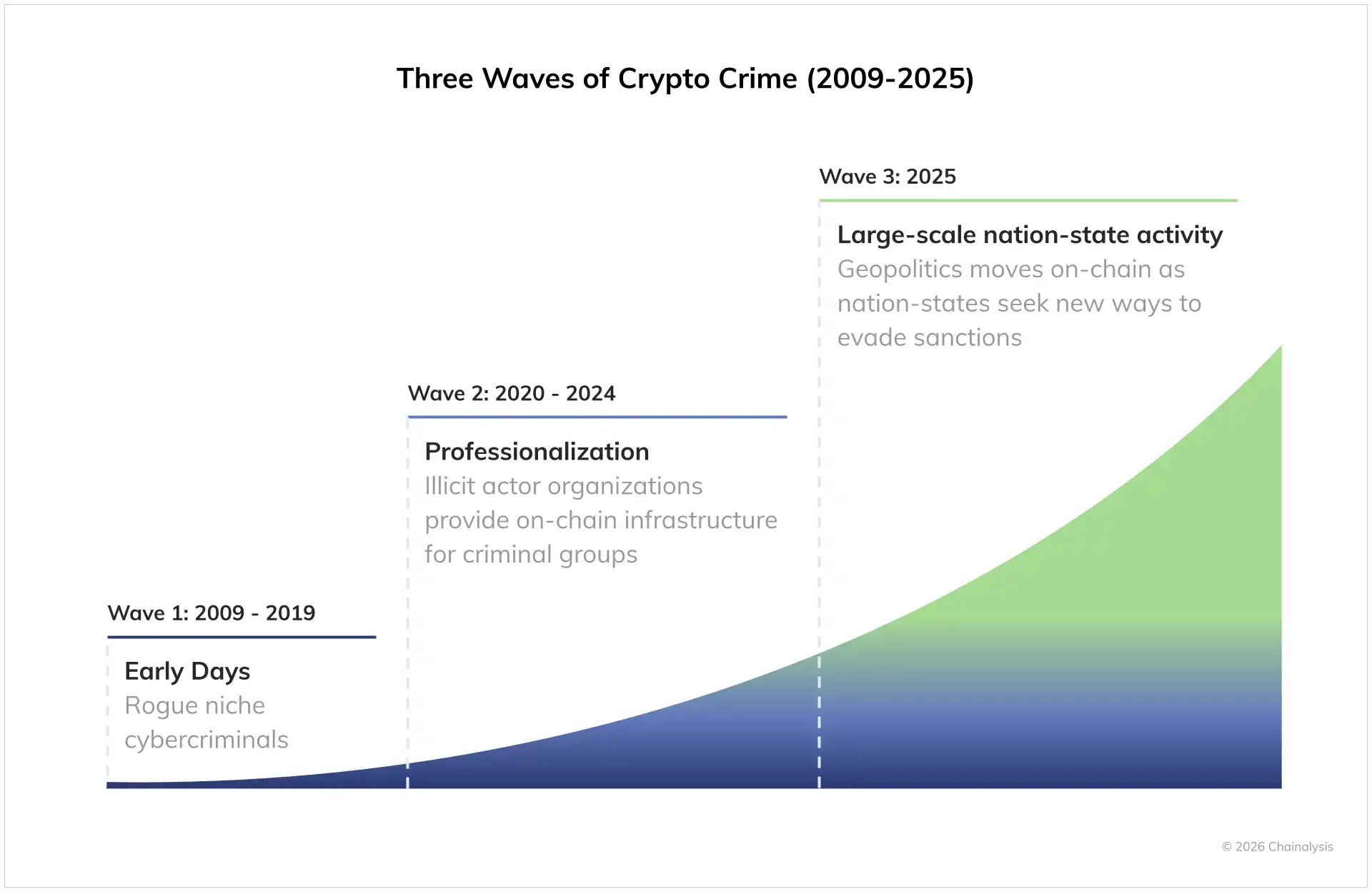
What are the specific on-chain manifestations of these trends and other industry changes? Next, we will analyze them by combining data and macro trends.
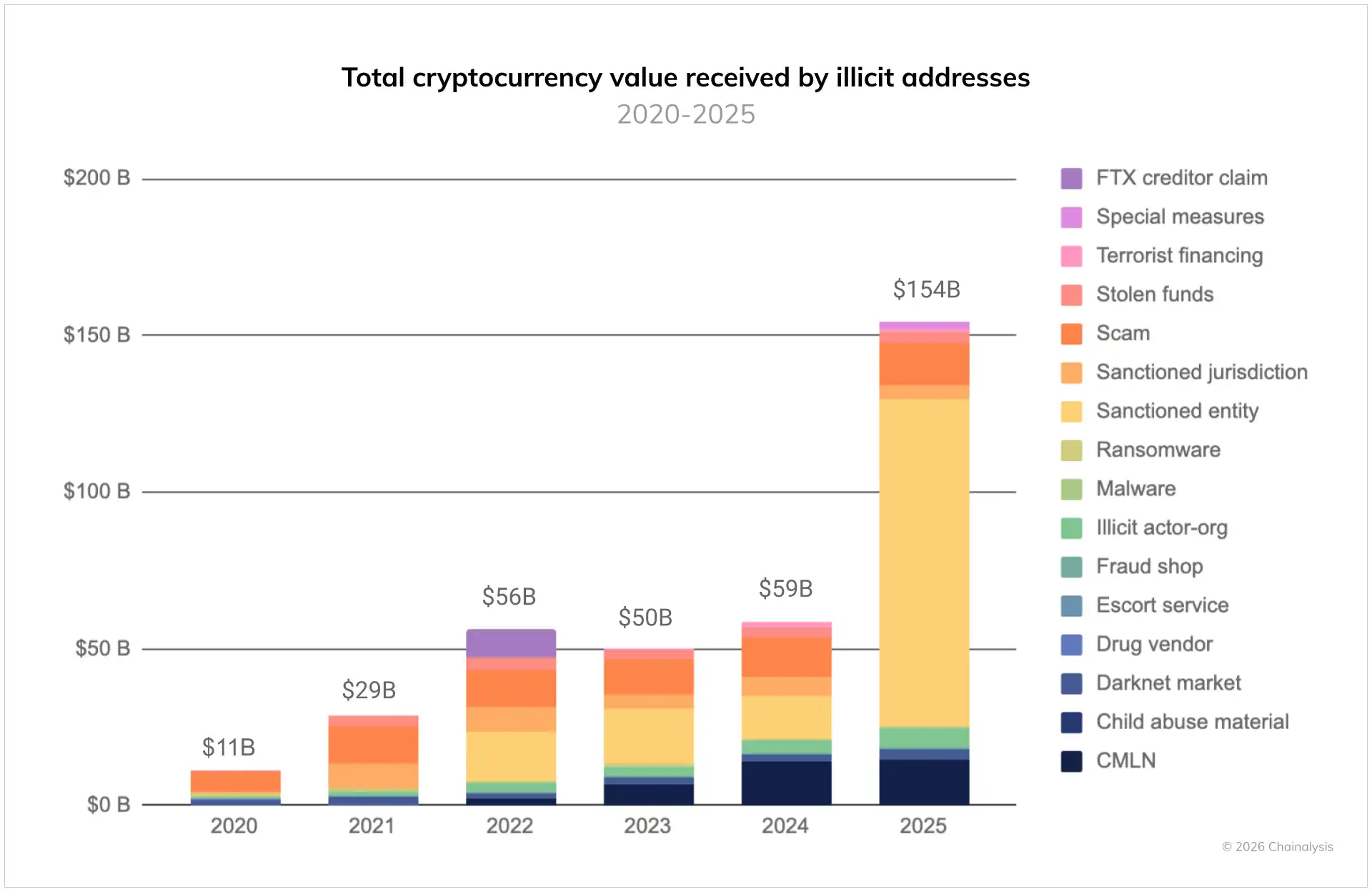
According to our monitoring data, the scale of funds flowing into illegal cryptocurrency addresses in 2025 reached at least $154 billion, a sharp increase of 162% year-on-year. This growth was primarily driven by a surge in fund inflows to sanctioned entities, which soared by 694% year-on-year. However, even excluding the growth from sanctioned entities, 2025 was still a record year for cryptocurrency crime, as the scale of the vast majority of illegal activities increased.

Nevertheless, the scale of these illegal transactions still pales in comparison to the overall cryptocurrency economy, as the main participants in the cryptocurrency market remain legitimate transactions. According to our estimates, although the proportion of illegal transactions in the total traceable cryptocurrency transaction volume in 2025 increased slightly compared to 2024, it remained below 1%.

As shown in the figure below, we also observed a continuous shift in the types of assets involved in cryptocurrency crimes.
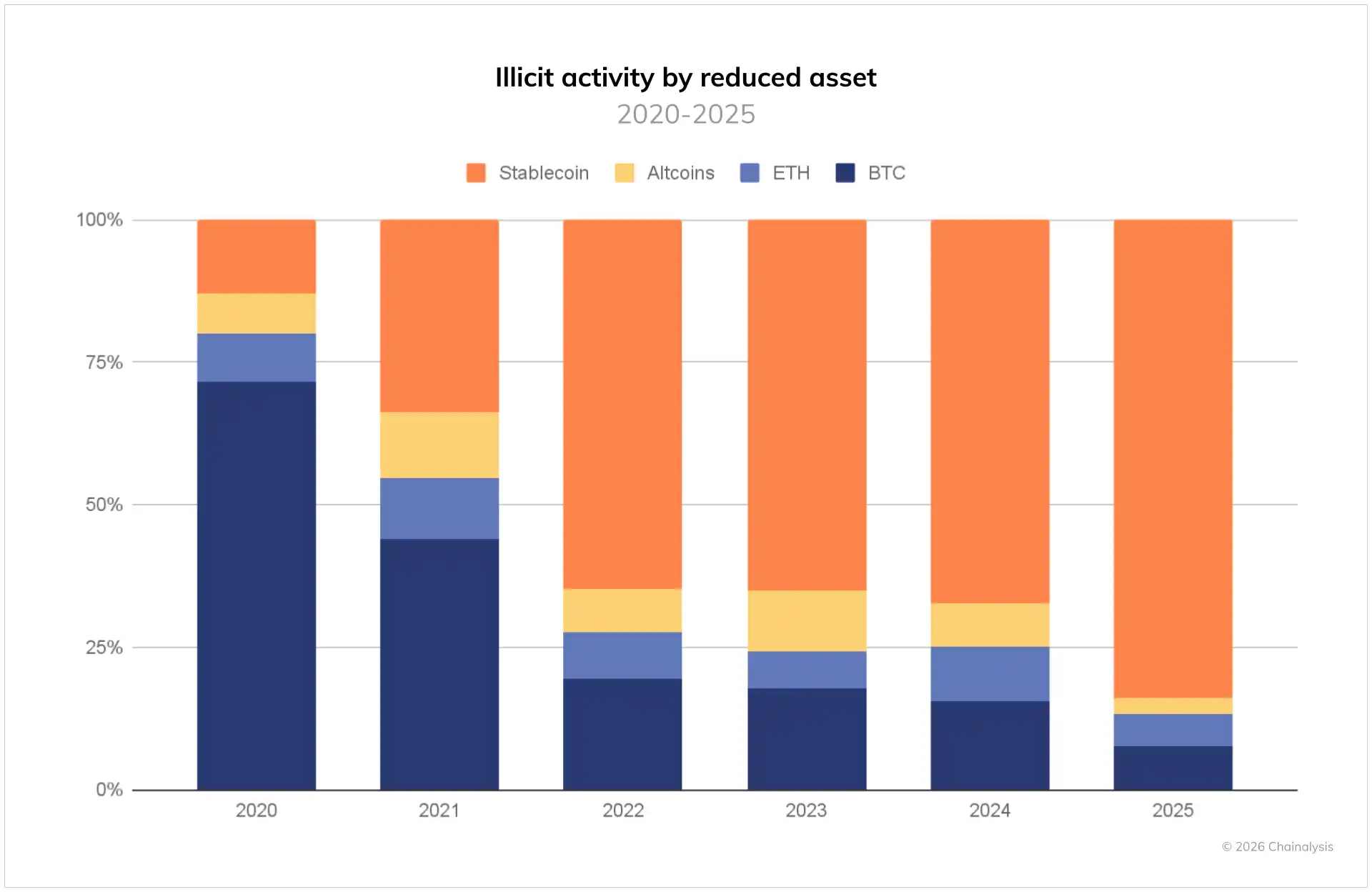
Over the past few years, stablecoins have gradually become the dominant asset in illegal transactions, currently accounting for 84% of the total illegal transaction volume. This trend aligns with the overall development characteristics of the cryptocurrency ecosystem: with advantages such as convenient cross-border transfers, low volatility, and wide application scenarios, stablecoins continue to expand their share in the overall cryptocurrency transactions.

The following sections will delve into the core trends that defined the cryptocurrency crime landscape in 2025, which remain worthy of attention in the future.

National-Level Threats Drive Transaction Scale: North Korea Sets New Record in Theft, Russia's A7A5 Token Facilitates Large-Scale Sanction Evasion

In 2025, stolen funds remained a major threat to the cryptocurrency ecosystem, with hacking groups linked to North Korea alone stealing $2 billion. This figure was primarily driven by several highly destructive large-scale hacking incidents, the most notable of which was the attack on the Bybit exchange in February. The incident involved nearly $1.5 billion, making it the largest digital asset theft in the history of cryptocurrency. Although North Korean hackers have long been a major force threatening the cryptocurrency ecosystem, the past year set new records both in terms of the amount stolen and the sophistication of intrusion and money laundering methods.

Particularly noteworthy is that the scale of on-chain activities by governments reached unprecedented levels in 2025. Russia introduced relevant legislation in 2024 to promote the use of cryptocurrencies to evade sanctions, and this measure was officially implemented in February 2025. The country launched the ruble-backed token A7A5, which achieved a transaction volume of over $93.3 billion in less than a year since its launch.

Meanwhile, over the past few years, Iran's proxy networks have conducted money laundering, illegal oil transactions, and bulk commodity procurement for weapons through confirmed wallet addresses that have been placed on the sanctions list, with a cumulative transaction volume exceeding $2 billion. Despite multiple military strikes, Iran-supported terrorist groups such as Hezbollah, Hamas, and the Houthis continue to use cryptocurrencies on an unprecedented scale.

In 2025, Chinese money laundering networks emerged as a dominant force in the illegal on-chain ecosystem. These organizations operate with high precision, greatly driving the diversification and professionalization of cryptocurrency crimes, offering specialized criminal services including "money laundering services." Building on early illegal operation models such as "Huiyin Guarantee," these networks have established full-service criminal enterprises, covering areas such as fraud, scams, laundering proceeds from North Korean hacking thefts, sanction evasion, and terrorism financing.

Full-Stack Illegal Infrastructure Providers Fuel Malicious Network Activities

While governments are increasing their use of cryptocurrencies, traditional cybercrime activities remain rampant: ransomware operators, child sexual abuse and cybercrime platforms, malware distributors, scammers, and illegal trading markets still rely on extensive support networks to maintain operations. Illegal actors and governments are increasingly dependent on full-stack on-chain infrastructure providers, including domain registrars, secure and reliable hosting services, and other technical infrastructure that can be used to carry out malicious network activities.

These infrastructure providers have evolved into comprehensive infrastructure platforms capable of resisting platform takedowns, abuse complaints, and sanction enforcement. As the scale of these services continues to expand, they may become key drivers in expanding the scope of malicious network activities for economic crime and state-supported forces.

The Increasing Correlation Between Cryptocurrency and Violent Crime

In the perception of many, cryptocurrency crime is still confined to the virtual world. The masterminds are merely anonymous figures hiding behind keyboards, posing no real-world threat. However, in reality, the connection between on-chain activities and violent crime is deepening. Human trafficking groups are increasingly using cryptocurrencies for transactions; at the same time, disturbingly, the number of violent coercion attacks has risen significantly, with criminals using violent means to force victims to transfer crypto assets, and such assaults often occur during peak cryptocurrency price periods.

Looking ahead, collaboration between law enforcement agencies, regulatory bodies, and cryptocurrency companies will be key to addressing these complex, ever-changing, and interconnected threats. Although the proportion of illegal transactions in legitimate cryptocurrency transaction volume remains limited, maintaining the integrity and security of the cryptocurrency ecosystem has never been more important.


Preguntas relacionadas

QWhat was the total value of illicit cryptocurrency transactions in 2025, and what was the primary driver of this growth?

AThe total value of illicit cryptocurrency transactions in 2025 reached at least $154 billion, representing a 162% year-over-year increase. This growth was primarily driven by a massive 694% surge in transaction volume from sanctioned entities.

QWhich asset has become the dominant currency for illicit transactions and what percentage of the total illicit volume does it represent?

AStablecoins have become the dominant asset for illicit transactions, currently accounting for 84% of the total illicit transaction volume.

QWhat significant role did nation-states play in the 2025 crypto crime landscape according to the article?

ANation-states significantly escalated their involvement in 2025. Russia launched the ruble-backed A7A5 token, which processed over $93.3 billion in volume to circumvent sanctions. North Korean hacking groups stole a record $2 billion, and Chinese money laundering networks emerged as dominant, sophisticated players in the illicit ecosystem.

QWhat new concerning trend connects cryptocurrency to real-world physical violence?

AA concerning trend is the rise in violent coercion attacks, where criminals use physical violence to force victims to transfer their cryptocurrency assets. These attacks often occur during periods of peak cryptocurrency prices.

QDespite the growth in illicit activity, how does its scale compare to the overall cryptocurrency economy?

ADespite the significant growth, illicit transactions still represent less than 1% of the total traceable cryptocurrency transaction volume, meaning the vast majority of cryptocurrency market activity remains legitimate.

Lecturas Relacionadas

Cifras en la cadena de bloques en la víspera del inicio: 1.600 millones negociados antes de que comience el Mundial

Antes del inicio del Mundial 2026, los mercados de predicción en cadena ya han acumulado un volumen de operaciones significativo. Solo el contrato "Campeón del Mundial" en Polymarket alcanzó aproximadamente 16 mil millones de dólares en volumen total antes de que comience el torneo. La curva de actividad ha aumentado drásticamente en los meses previos, pasando de unos 368 millones a finales de marzo a superar los 12 mil millones en mayo. El ecosistema es amplio: existen alrededor de 100 mercados en Polymarket que cubren todas las partidas, y junto con plataformas como Kalshi, ofrecen contratos para resultados de partidos, clasificaciones de grupo y hasta eventos no deportivos, como riesgos logísticos. Los precios de estos contratos, que fluctúan entre 0,01 y 0,99 dólares, reflejan probabilidades implícitas en tiempo real según el desarrollo de los eventos. La infraestructura subyacente ha madurado, utilizando stablecoins reguladas como USDC para garantías y oráculos descentralizados como Chainlink para la resolución de resultados. Incluso la FIFA ha reconocido formalmente esta categoría, nombrando a ADI Predictstreet como su primer socio oficial en mercados de predicción. En vísperas del pitido inicial, las criptomonedas relacionadas con el fútbol, como los fan tokens, ya cotizan activamente. A pesar de la variada regulación entre jurisdicciones, queda claro que la tecnología blockchain ya se ha integrado profundamente en las capas de liquidación, predicción y asociaciones oficiales del mayor evento futbolístico, marcando una transformación fundamental en su relación con el deporte.

marsbitHace 4 min(s)

Cifras en la cadena de bloques en la víspera del inicio: 1.600 millones negociados antes de que comience el Mundial

marsbitHace 4 min(s)

La Futura Narrativa Trillonaria del Cripto a la Luz de la OPV de SpaceX: ¿Qué Sectores Cripto Asumirán el Relevo?

Autor: Climber, CryptoPulse Labs El próximo IPO de SpaceX, valorando la compañía en aproximadamente 1,77 billones de dólares, no se trata solo del espacio, sino de un cambio en la lógica de valoración del capital hacia la infraestructura y los ecosistemas futuros. Este evento señala posibles áreas de crecimiento y efecto derrame para el mercado cripto. 1. **IA: Del enfoque en aplicaciones a la infraestructura.** El mercado está pasando de valorar aplicaciones de IA fáciles de replicar a priorizar los recursos de base escasos, como la potencia de cálculo. Proyectos como TAO (red de protocolos), RENDER, AKT e IO (redes de GPU) podrían revalorizarse como proveedores de infraestructura esencial, análogos a AWS en la era de Internet. 2. **RWA (Activos del Mundo Real): Más allá de los bonos.** La dificultad para invertir en activos futuros de alto crecimiento como SpaceX podría impulsar la tokenización de activos de capital y equity. Esto podría redefinir la circulación de activos, creando un mercado global de liquidez 24/7. Los primeros beneficiarios serían proyectos de infraestructura como ONDO (emisión), LINK (oráculos de datos) y Plume (redes de liquidez). 3. **Infraestructura clave: Stablecoins, pagos y DePIN.** Cualquier expansión económica en la cadena requerirá una capa de liquidación robusta. Las stablecoins evolucionan de medio de intercambio a infraestructura financiera global. Los protocolos de pago podrían convertirse en super-entradas. Los proyectos DePIN, que usan incentivos tokenizados para construir redes físicas (como WiFi o mapas), podrían ser revalorizados, siguiendo la lógica que da alto valor a redes como Starlink. En conclusión, el IPO de SpaceX refleja una transición capital: de financiar narrativas a financiar infraestructura y flujos de caja. Los ganadores a largo plazo en el espacio cripto podrían no ser las aplicaciones más llamativas, sino aquellos que construyan los sistemas base: infraestructura de IA, RWA, stablecoins, redes de pago y DePIN.

marsbitHace 26 min(s)

La Futura Narrativa Trillonaria del Cripto a la Luz de la OPV de SpaceX: ¿Qué Sectores Cripto Asumirán el Relevo?

marsbitHace 26 min(s)

¡Colapso brutal en el mundo de las cripto! Bitcoin rompe los 60.000 dólares, Ethereum se desploma más de un 10% y MicroStrategy es acosada por los bajistas

El sector de criptomonedas sufre una fuerte caída: Bitcoin rompe el soporte de 60.000 dólares y Ethereum se desploma más del 10%, mientras la empresa MicroStrategy es objeto de un ataque de los vendedores en corto. Bitcoin cayó a un mínimo de seis meses, tocando los 59.099,25 dólares, con una pérdida semanal del 16%. La venta de parte de las tenencias de Bitcoin por parte de MicroStrategy, dirigida por Michael Saylor, desencadenó liquidaciones forzadas por valor de cientos de millones. Esto, combinado con unos datos de empleo en EE.UU. más fuertes de lo esperado que impulsaron los rendimientos de los bonos, presionó a los activos de riesgo. Las acciones de MicroStrategy cayeron un 24% en la semana, su peor desempeño desde 2022. La actividad con opciones de venta (puts) contra la empresa se disparó. Analistas señalan que los fondos especulativos se están redirigiendo hacia acciones de IA y chips, creando un efecto de desalojo para las criptomonedas. Además, las perspectivas para la ley "Clarity Act" en EE.UU., que podría haber sido un catalizador, se han desvanecido. Bitcoin ha perdido más de la mitad de su valor desde el máximo histórico de octubre de 2025. Su correlación con los índices bursátiles estadounidenses, que era fuerte, se ha roto recientemente. Los ETF de Bitcoin registraron una pequeña entrada de fondos, poniendo fin a 13 días de salidas, pero su patrimonio total se ha reducido significativamente. A pesar del pesimismo, algunos, como el CEO de Strive, Matt Cole, mantienen que los fundamentos de Bitcoin son sólidos y ven la caída como una oportunidad de compra. Mientras tanto, la presión sobre los instrumentos de deuda de MicroStrategy (STRC) aumenta, ya que los inversores exigen mayores rendimientos tras el cambio de estrategia de la empresa. El aumento de las probabilidades de subidas de tipos de interés por parte de la Fed añade más presión al panorama.

华尔街日报Hace 1 hora(s)

¡Colapso brutal en el mundo de las cripto! Bitcoin rompe los 60.000 dólares, Ethereum se desploma más de un 10% y MicroStrategy es acosada por los bajistas

华尔街日报Hace 1 hora(s)

Las acciones tecnológicas se desploman y el Bitcoin se hunde, mientras el capital minorista enfrenta la prueba definitiva en vísperas de la salida a bolsa de SpaceX

Las acciones tecnológicas sufrieron su mayor caída en meses y Bitcoin cayó por debajo de los 60.000 dólares, coincidiendo con los preparativos de SpaceX para su próxima OPV, la mayor de la historia. Los datos de empleo de EE.UU. en mayo, más fuertes de lo esperado, redujeron las expectativas de recortes de tipos de la Fed, provocando fuertes ventas en sectores de alta valoración como la IA y los semiconductores. Bitcoin perdió un 7%, borrando todas las ganancias desde las elecciones de Trump. La caída sincronizada pone a prueba la capacidad de los inversores minoristas, cruciales para la OPV de SpaceX, que planea asignar hasta un 30% de las acciones a este segmento. Sin embargo, el efectivo disponible en cuentas minoristas está en mínimos, por lo que es probable que tengan que vender otros activos, como acciones de Tesla, para financiar la compra. Los expertos advierten que el mercado actual está saturado de opciones especulativas (criptomonedas, "meme stocks", ETFs apalancados, etc.) que compiten por el mismo capital minorista. Aunque la OPV de SpaceX podría generar un nuevo entusiasmo, retener a los inversores minoristas es un reto mayor. Tienden a operar a corto plazo, impulsados por el momento, y las herramientas de trading modernas facilitan un movimiento rápido de capital entre distintas narrativas de inversión. En este contexto, incluso una OPV histórica como la de SpaceX es solo el último y más caro participante en una constante batalla por la atención y los fondos de los inversores.

华尔街日报Hace 1 hora(s)

Las acciones tecnológicas se desploman y el Bitcoin se hunde, mientras el capital minorista enfrenta la prueba definitiva en vísperas de la salida a bolsa de SpaceX

华尔街日报Hace 1 hora(s)

Trading

Spot
Futuros
活动图片




