In Just 70 Days, Polymarket Easily Rakes in Tens of Millions in Fees

Odaily星球日报Publicado a 2026-03-16Actualizado a 2026-03-16

Resumen

Polymarket, a prediction market platform, has generated over $11.2 million in fees in just 70 days since introducing transaction fees on January 6. Initially applied only to "15-minute crypto up/down" markets, the fee structure charges more when odds are near 50% (up to 1.56%) and less when they approach 0% or 100%. By March 6, fees were expanded to all crypto-related markets, which now drive most of the revenue. Weekly fee income has shown consistent growth, reaching $1.84 million in a recent week. If current trading volume and structure continue, Polymarket’s annualized revenue is estimated at $58.4 million under a conservative model. A more aggressive projection—assuming fees are applied to all markets—could yield up to $360 million per year. The platform has also distributed $13.41 million in liquidity provider incentives, which March revenue is on track to cover entirely. Polymarket’s revenue potential hinges on two factors: continued growth in trading volume and further expansion of fee-based markets. The platform has effectively proven the profitability of the prediction market model, positioning it as a highly efficient revenue generator in the crypto ecosystem.

Original | Odaily Planet Daily (@OdailyChina)

Author | Azuma (@azuma_eth)

On January 6th of this year, Polymarket officially ended its "zero-fee" model, beginning a trial implementation of transaction fees starting with the "15-minute cryptocurrency up/down" markets. The specific fee rate varies with the market's real-time odds — the closer the odds are to 0% or 100%, the lower the fee; conversely, the closer the odds are to 50%, the higher the fee, up to a maximum of 1.56%.

Later, on January 28th, about three weeks after the fees were introduced, we published an article titled "Data Estimates Show Polymarket Could Easily Exceed $100 Million in Annual Revenue, Assuming...". The article provided a static estimate based on Polymarket's trading volume and activity structure at the time: in the most conservative scenario, if the scope of fee-charging markets remained unchanged, Polymarket was projected to generate approximately $38 million in annual income; in the most aggressive scenario, if Polymarket extended fees to all markets, it was projected to earn $418 million in annual fee revenue.

When we last estimated Polymarket's revenue, we were hampered by an overly short observation period and too few calculable samples. Now, nearly two months later, we have used richer data to re-estimate Polymarket's revenue expectations. The results show that the so-called "conservative" estimate was indeed too conservative, and the "aggressive" expectation isn't too exaggerated.

Changes in Revenue Data

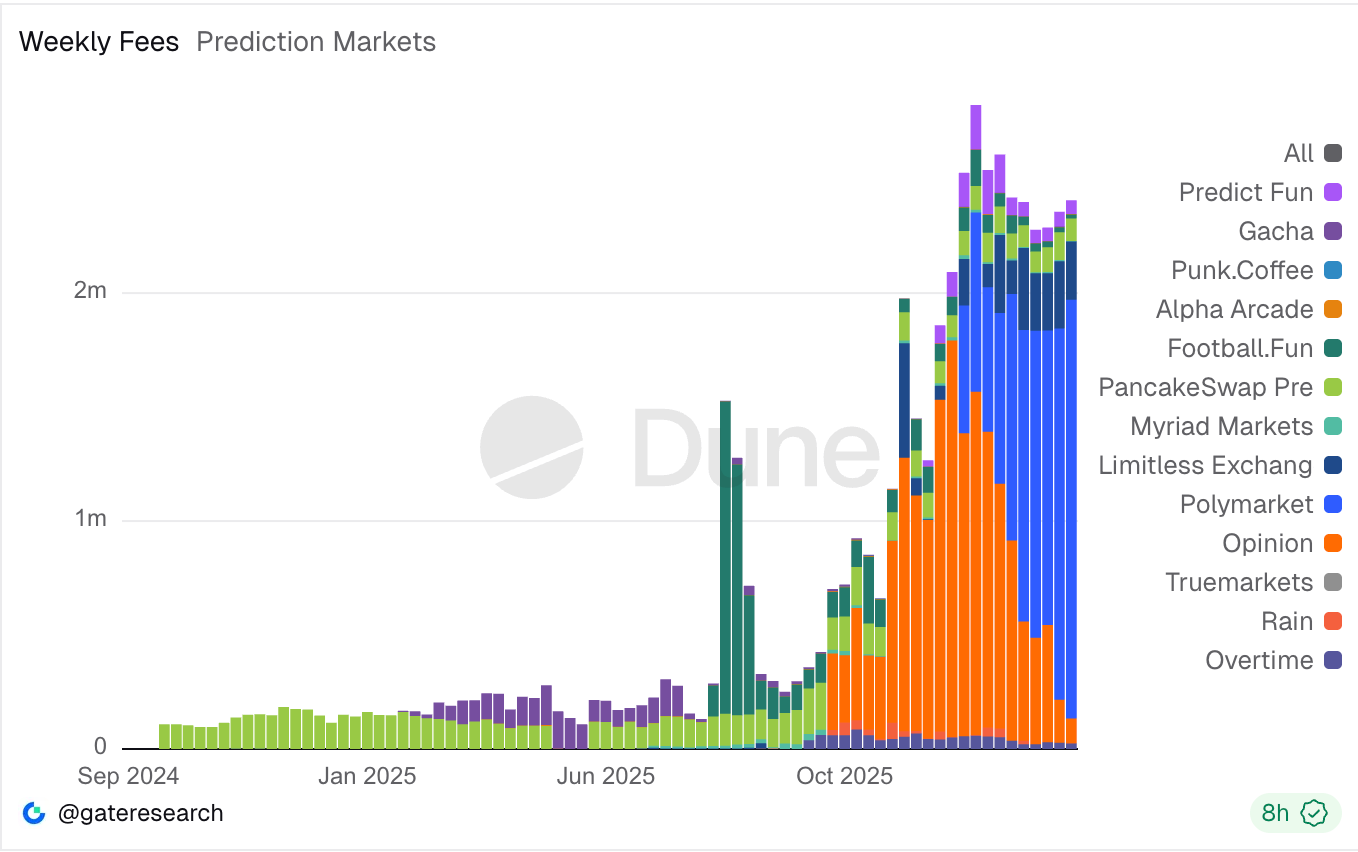
According to data compiled by Gate Research on Dune, since transaction fees were introduced on January 6th, Polymarket has accumulated over $11.2 million in fee revenue.

Using the most conservative method for another static estimate, assuming the trading volume and activity structure of the relevant markets remain unchanged, Polymarket is projected to generate approximately $58.4 million in annual revenue.
However, this estimation method does not accurately reflect Polymarket's revenue-generating capability.

The reason is that Polymarket's revenue data is clearly in a growth trend — over the past 10 weeks, the platform's weekly fee revenue has been $560,000, $786,000, $633,000, $749,000, $1.08 million, $1.28 million, $1.35 million, $1.29 million, $1.63 million, $1.84 million... showing almost weekly significant growth.

Reasons for Revenue Growth

There are two reasons for the growth in Polymarket's fee revenue. First, Polymarket has expanded the scope of fee-charging markets; second, Polymarket's overall trading volume and the trading volume in fee-charging markets have been growing continuously.

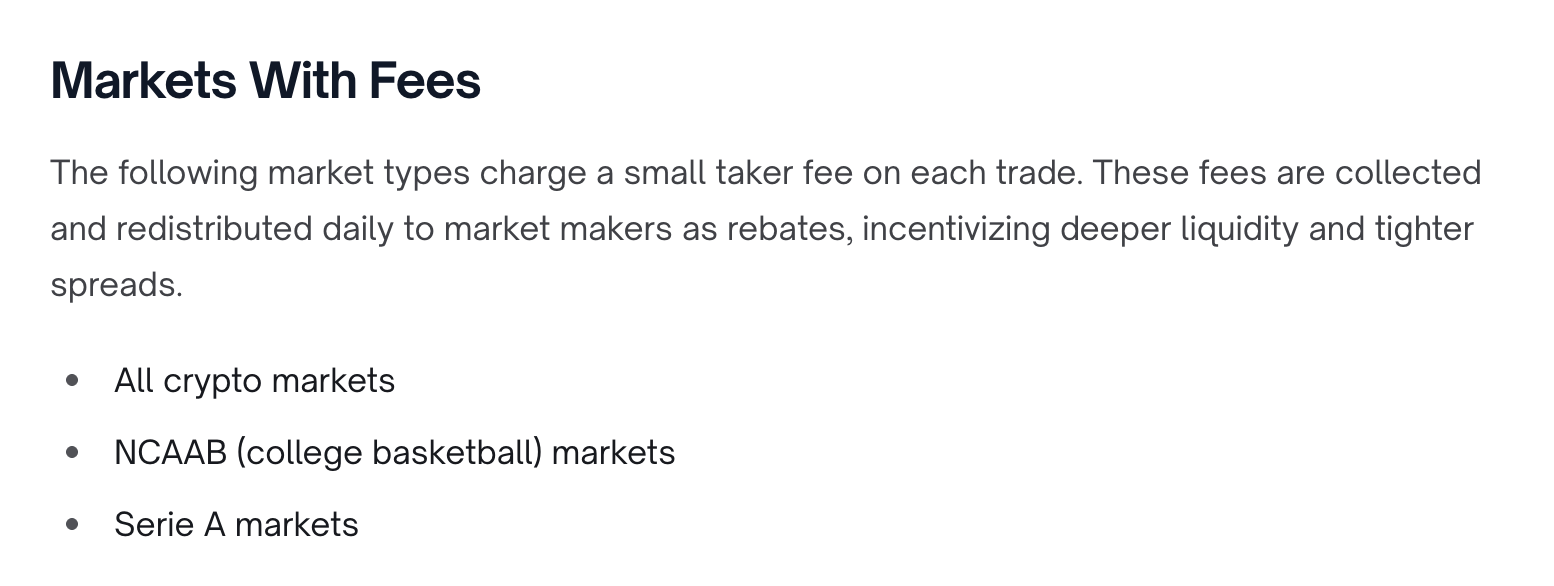
Regarding the scope of fee-charging markets, Polymarket extended the fee mechanism to all cryptocurrency-related markets on March 6th. Additionally, even earlier, it had begun trialing fee collection in sports markets like NCAA and Serie A. However, the former (cryptocurrency-related markets) currently remains the primary source of fee revenue.
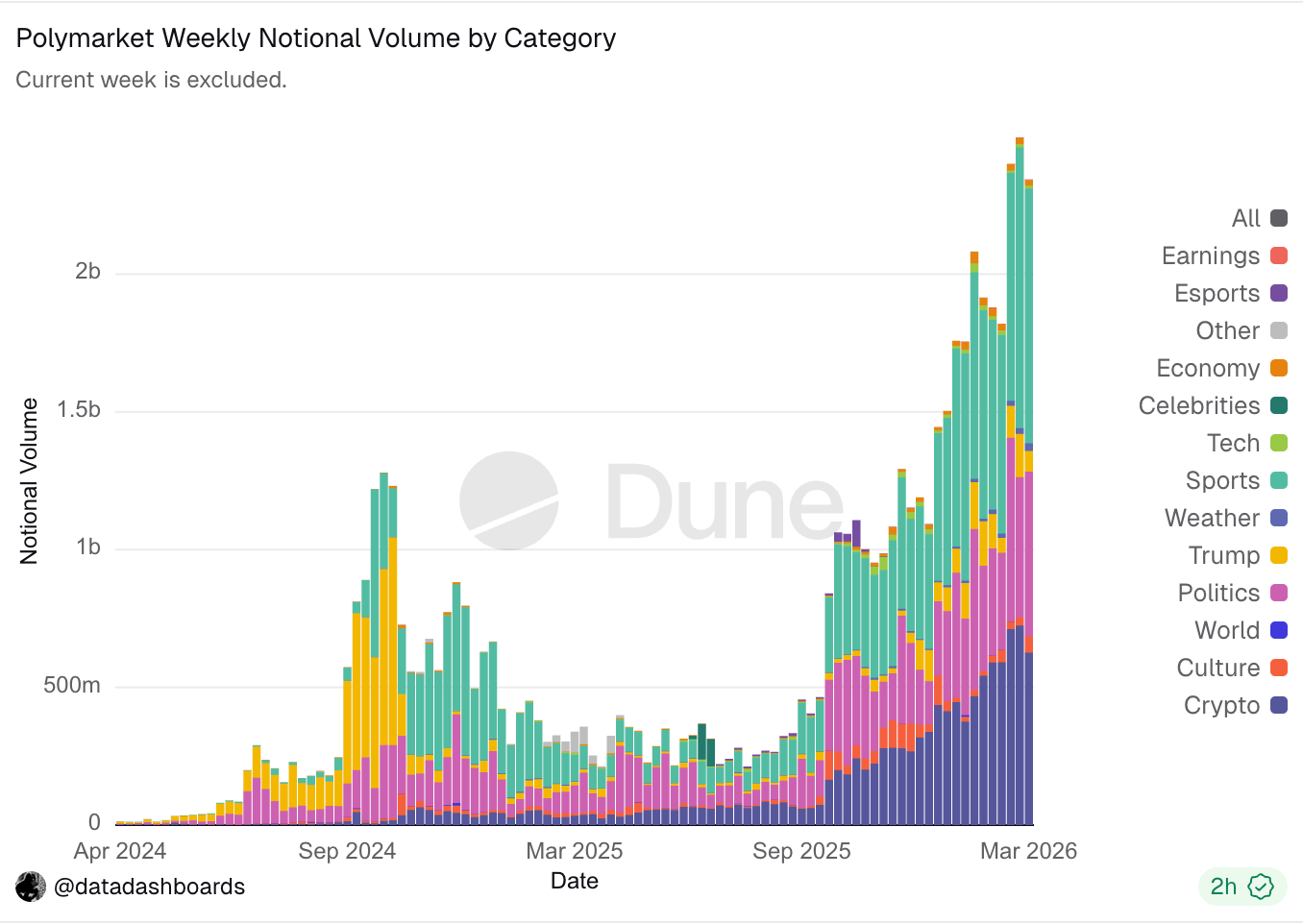
Regarding trading volume, the data dashboard compiled by Data Dashboards on Dune shows that Polymarket's weekly overall trading volume and cryptocurrency market volume (the bottom purple bars) have been growing steadily.
Future Revenue Projections

When we last projected Polymarket's revenue, we had to manually extract the trading volume proportion of "15-minute cryptocurrency up/down" related markets within all cryptocurrency-related markets. But now, since Polymarket extended fees to all cryptocurrency-related markets on March 6th, this estimation is much more straightforward. As for NCAA and Serie A, perhaps because the former hasn't entered the "March Madness" official tournament yet, and the latter has relatively low cultural attention in the US, the trading volume scale of these markets is significantly smaller compared to cryptocurrencies, so they are temporarily ignored here.

Taking data from the only full week after March 6th (March 9th-15th), the trading volume of cryptocurrency-related events accounted for 26.7% of the platform's total trading volume that week. In the same week, Polymarket's fee revenue was approximately $1.84 million. Based on this ratio for a static projection, under the current trading volume level and structure, if Polymarket introduces a similar fee model across all markets, it is projected to bring in $360 million in annual revenue for the platform.

The Money Printer is Already Running

It is worth mentioning that, as a key measure for Polymarket to expand liquidity, the platform has so far distributed a total of $13.41 million in subsidies to liquidity providers (LPs). In contrast, if the data for the remainder of March can continue the performance of the first half, the fee revenue generated by Polymarket within this month alone could cover the total expenditure on liquidity subsidies.
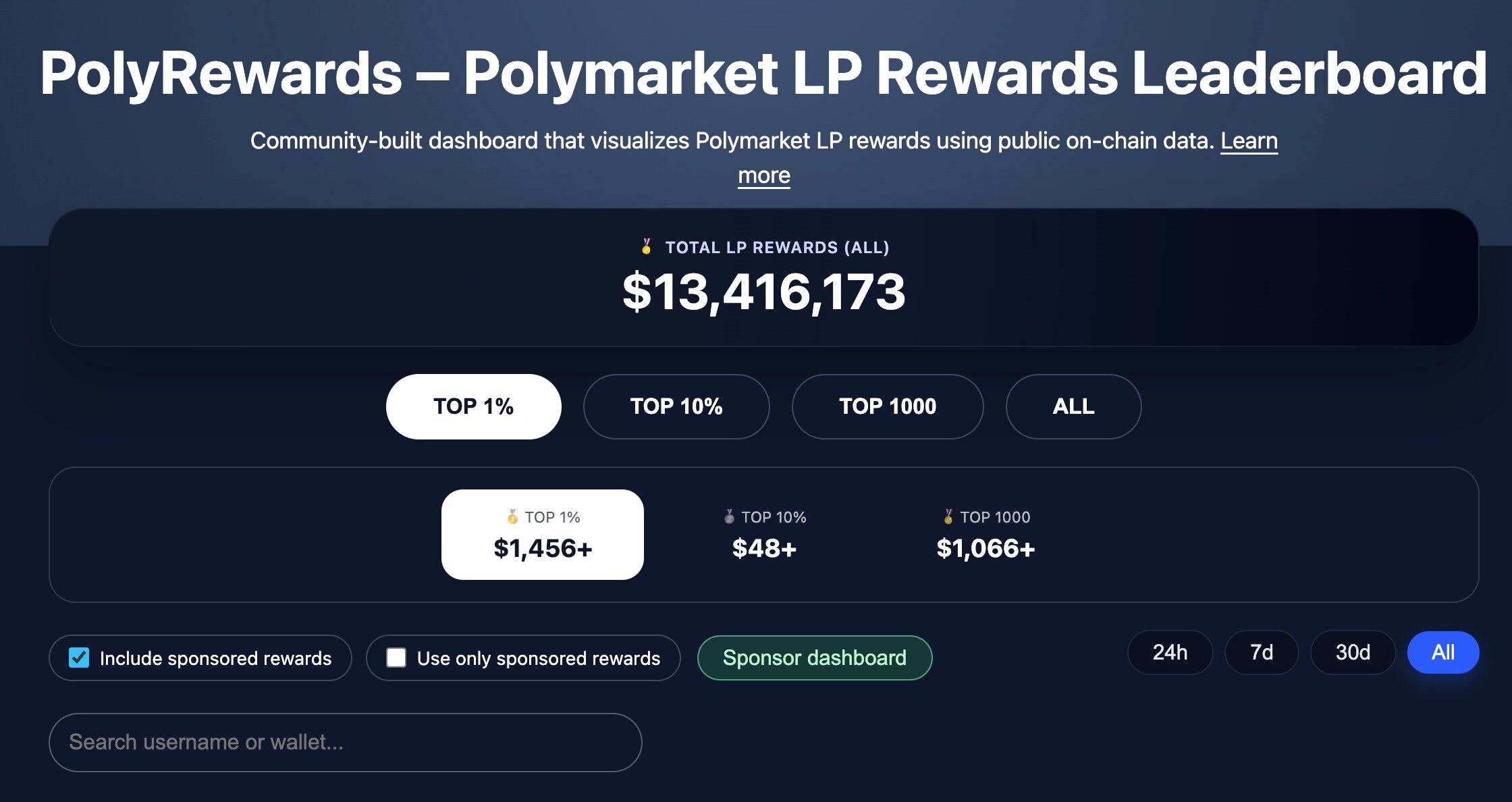
Polymarket has largely proven the revenue-generating capability of this new form of prediction markets. Future revenue growth will mainly depend on two variables — how much more trading volume can grow, and whether fees can be further extended to more markets.

If these two variables continue to trend upwards, prediction markets might become the simplest and most direct "money printer" in the cryptocurrency industry.


Preguntas relacionadas

QWhen did Polymarket start charging transaction fees, and what was the initial market targeted?

APolymarket started charging transaction fees on January 6, beginning with the '15-minute cryptocurrency up/down' markets.

QHow much fee revenue has Polymarket accumulated since it began charging fees?

APolymarket has accumulated over $11.2 million in fee revenue since it started charging transaction fees.

QWhat are the two main reasons for the growth in Polymarket's fee revenue?

AThe two main reasons are the expansion of fee-charging markets to include all crypto-related markets and the continuous growth in overall trading volume, particularly in cryptocurrency markets.

QWhat is the estimated annual revenue for Polymarket if fees are extended to all markets, according to the latest data?

AIf fees are extended to all markets, the estimated annual revenue for Polymarket is approximately $360 million, based on current trading volume and structure.

QHow does Polymarket's fee revenue compare to the subsidies it has provided to liquidity providers (LPs)?

APolymarket has provided a total of $13.41 million in subsidies to LPs. If the revenue trend from the first half of March continues, the fee income for the month alone could cover the total subsidies paid to LPs so far.

Lecturas Relacionadas

Las acciones de empresas de inteligencia artificial se negocian como 'memecoins', mientras que Bitcoin apenas cambia de precio: revisión de la semana

El artículo comienza con una advertencia de seguridad sobre una vulnerabilidad en las carteras frías Coldcard que podría comprometer las claves privadas, instando a los usuarios a tomar medidas inmediatas. En los mercados financieros tradicionales, la atención se centró en una fuerte venta masiva en el sector de la IA y los mercados asiáticos, especialmente en Corea del Sur, donde el índice KOSPI cayó un 35% en un mes. El fondo "Situational Awareness" de Leopold Aschenbrenner sufrió grandes pérdidas, lo que provocó liquidaciones forzosas y se especula con una posible manipulación por parte de Citadel. Los analistas debaten el futuro del sector de la IA y los semiconductores tras la corrección. En el ámbito macroeconómico, la reunión de la Fed generó preocupación, mientras que Japón intervino para frenar la caída del yen, con resultados limitados hasta ahora. En criptomonedas, el panorama fue negativo: varias plataformas como BitMart anunciaron su cierre, y empresas como Coinbase (COIN) reportaron resultados decepcionantes y despidos. MicroStrategy (MSTR) continuó acumulando reservas en dólares y recompró acciones propias, en una estrategia criticada por algunos. Se destacan debates sobre el futuro de DeFi (como Trade.xyz en Hyperliquid) y posibles actividades de información privilegiada. Finalmente, se menciona un renovado interés de inversores como Jason Calacanis en proyectos de cripto e IA como Bittensor ($TAO), aunque se advierte sobre la precaución necesaria con este tipo de recomendaciones. El artículo cierra reiterando la advertencia sobre la vulnerabilidad de Coldcard y la importancia de la autodeposición y la responsabilidad personal en cripto.

cryptonews.ruHace 1 min(s)

Las acciones de empresas de inteligencia artificial se negocian como 'memecoins', mientras que Bitcoin apenas cambia de precio: revisión de la semana

cryptonews.ruHace 1 min(s)

Frases semilla: 12 palabras que se interponen entre usted y la pérdida total

Una frase semilla, normalmente de 12 o 24 palabras de una lista de 2,048, es el núcleo matemático de una cartera de criptomonedas. Genera todas las claves privadas y direcciones. No hay copias de seguridad corporativas ni recuperación de contraseñas; quien posea estas palabras controla los fondos de forma absoluta e irreversible. Un robo de 292 millones de dólares en enero demostró que el riesgo real no es la criptografía, sino la ingeniería social. El atacante engañó a la víctima para que revelara su frase. Aunque se recuperó una pequeña parte, esto es una excepción que subraya la dificultad de recuperar fondos una vez comprometida la semilla. La seguridad de 12 palabras es astronómicamente alta frente a un ataque de fuerza bruta, requiriendo tiempos de cálculo mayores que la edad del universo. Sin embargo, si se filtran algunas palabras, la seguridad se desploma de forma no lineal. Conocer 7 de las 12 palabras reduce el tiempo de descifrado a menos de un año. La suma de verificación de BIP39 tiene una función práctica: detectar errores tipográficos al restaurar una cartera, evitando que se cree una cartera vacía por error. La causa principal de pérdida no es el robo, sino la pérdida de acceso propio. Se estima que hasta el 23% de todos los bitcoins minados son inaccesibles permanentemente debido a frases olvidadas, copias destruidas o falta de planificación sucesoria. La frase semilla es la prueba única e irrecuperable de propiedad. Perderla significa perder los activos para siempre.

cryptonews.ruHace 5 min(s)

Frases semilla: 12 palabras que se interponen entre usted y la pérdida total

cryptonews.ruHace 5 min(s)

Trading

Spot
活动图片