How Does Backpack's Staking Token-to-Equity Conversion Work?

marsbitPublicado a 2026-02-25Actualizado a 2026-02-25

Resumen

Backpack, a Solana-based wallet and exchange platform founded by ex-FTX members, has announced a novel staking-to-equity conversion plan. Users who stake its native token for at least one year can convert those tokens into real company equity at a fixed ratio, with 20% of equity reserved for this purpose. The platform emerged after FTX’s collapse, having lost 80% of its operational funds, and gradually built its user base through its Mad Lads NFT community and a compliant exchange. It recently acquired FTX Europe and secured regulatory licenses. Backpack’s tokenomics include a 1 billion total supply, with 62.5% pre-IPO allocation. The TGE will release 25% of tokens, entirely to users. The model ties token distribution to IPO milestones—a rare hybrid approach in crypto. This move aims to transform users from token holders into legal company owners. However, it faces significant regulatory challenges, particularly from the SEC, which may view the token as a security. The dual-structure of token and equity could also complicate IPO investor relations. While innovative, the plan operates in a regulatory grey area—attempting to bridge decentralized tokenomics with traditional equity financing.

Original | Odaily Planet Daily (@OdailyChina)

Author | DingDang (@XiaMiPP)
On February 24, Backpack CEO Armani Ferrante announced a staking-to-equity conversion plan, allowing users who stake Backpack's native token for at least one year to exchange these tokens for real company equity at a fixed ratio. The company has reserved 20% of its equity for this plan.

This brief statement conveys far more information than a conventional TGE narrative.

In traditional TGE narratives, users are seen as traffic and community token holders; in this design, Backpack attempts to elevate users from product users to legal company owners.

The question is: Can it really work? Is this a financial innovation or a high-risk experiment dancing on the edge of regulation? Does it change the power structure, or is it just a more advanced form of chip management? To understand this, we must look back at Backpack's own history.

Backpack: A Company Rising from the Ruins

Backpack is a "wallet + exchange" integrated platform centered on the Solana ecosystem, founded by Armani Ferrante, a former member of FTX and Alameda Research. It was established after the collapse of FTX, emphasizing compliance and user custody.

However, unlike the "trading first, ecosystem later" development path of centralized exchanges like Binance, Backpack's path is the reverse. It started with a wallet and NFTs, gradually accumulating users, community, and technical foundations, and eventually launched an exchange.

Looking back at Backpack's history. In 2022, the collapse of FTX not only tore apart the credit structure of the entire crypto industry but also directly impacted projects associated with it. Backpack had just completed a $20 million funding round led by FTX Ventures and Jump Crypto before FTX's collapse. But as the empire crumbled, about 80% of Backpack's operating funds evaporated. At that time, Backpack was positioned as a "wallet + xNFT operating system," aiming to provide Solana users with a safer, integrated entry point, avoiding reliance on centralized platforms.

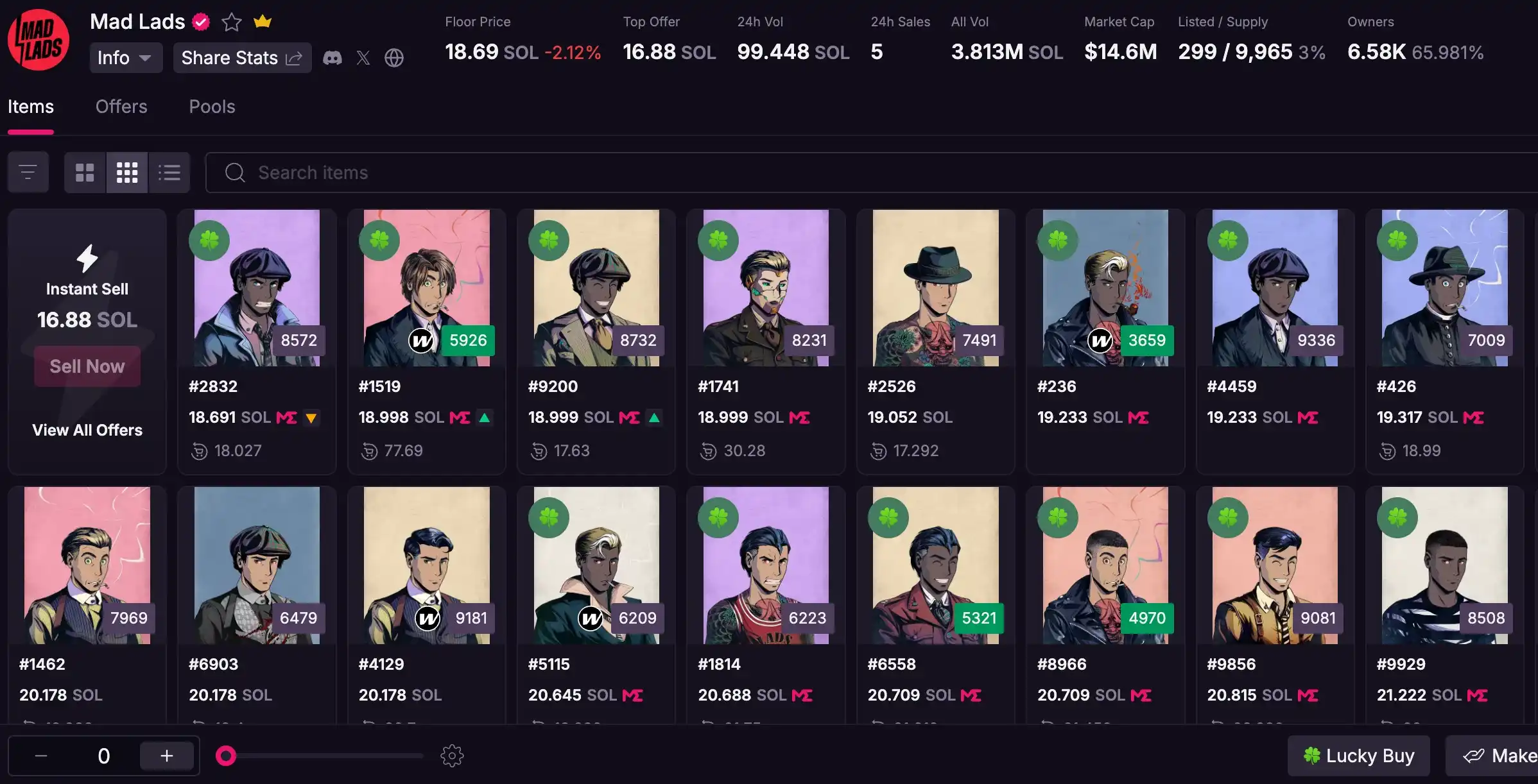
In April 2023, during the bear market trough, Backpack quietly launched the Mad Lads NFT series, with a minting price of 6.9 SOL. It quickly became one of the top NFT communities on Solana, with the floor price once reaching 229.4 SOL. Today, despite the overall decline of NFTs, the Mad Lads floor price remains at 18.8 SOL, more than double the original minting price.
In November of the same year, Backpack obtained a Dubai VARA license and launched Backpack Exchange, though it was only in a limited testing phase at the time. By then, it had accumulated user trust through its wallet and NFTs, leveraging the exchange to monetize traffic. In February 2024, Backpack completed a $17 million Series A funding round, valuing the company at $120 million. In January 2025, it acquired FTX Europe's assets for $32.7 million, obtaining a European MiFID II license, further strengthening its compliance foundation and committing to handle FTX EU customer claims.

Backpack was born with a silver spoon but rebuilt from the ruins. After nearly three years, Backpack has accumulated a trading volume of over $400 billion and user assets exceeding $350 million.

Now, it is poised for a greater leap.

Token Issuance Plan and Equity Linkage

On February 17, Backpack announced the start of identity verification before TGE, the first step for users to claim tokens.

According to Backpack's token economic model, the total token supply is 1 billion. The pre-IPO total supply is 625 million tokens (62.5%), released in three phases:

  • Phase 1 (TGE): Releases 25% of the total supply, or 250 million tokens. Of these, 240 million (24%) are allocated to points holders, and 10 million (1%) to Mad Lads holders. This phase is 100% allocated to users, with no internal team share.
  • Phase 2 (Pre-IPO): Accounts for 37.5%, or 375 million tokens, as "growth-triggered unlocks," released gradually based on key milestones (such as regulatory approvals, new product launches, and geographic expansion).
  • Phase 3 (Post-IPO): Also accounts for 37.5%, or 375 million tokens, deposited into company treasury, locked for one year after IPO, for the team and investors.

From its token distribution plan, we can already see that token issuance is closely tied to an IPO. Backpack is currently negotiating terms for a new $50 million funding round at a valuation of $1 billion. At this valuation, the 20% equity reserved is worth $200 million.

In the short history of the cryptocurrency industry, token issuance has quietly evolved from an optional financing tool to an almost "instinctive choice" and default path for nearly all projects. As users, we are familiar with this method, but Backpack's approach goes beyond what we know.

From an industry perspective, this model fills a gap. Coinbase successfully IPOed in 2021 but never issued a native token; DeFi projects like Uniswap issued governance tokens but did not pursue an equity listing. Backpack is attempting a "dual-track" system: tokens for community incentives and equity for long-term ownership, which is unprecedented in the crypto industry.

Is Token Issuance + IPO Feasible?

Although this plan is bold and innovative, it faces regulatory challenges.

Under U.S. regulatory context, most tokens could be considered securities by the SEC. If so, companies must comply with registration, disclosure, and anti-fraud rules. If an IPO is pursued in the future, the SEC will review the history of token issuance, structural design, and potential compliance violations.

More complex is the potential "ownership conflict" between equity and tokens: IPO investors worry about dilution of rights (such as voting rights and dividends), while token holders expect value capture, which could be seen as "dual financing" or misleading behavior. Especially during the Gensler era (2022-2024), enforcement tightened, and many projects abandoned IPOs altogether.

In short, token issuance takes the "decentralized/on-chain financing" fast lane, while an IPO takes the "centralized/compliant/equity financing" slow lane. Backpack is trying to drive both vehicles simultaneously, which requires极强的 structural design and regulatory communication skills. Otherwise, it could face delays in listing or regulatory fines.

While there is no complete precedent in the crypto industry, there are partial ones. Coinbase, also a centralized exchange, completed its IPO in 2021, but it had considered issuing a token. Backpack co-founder Can Sun revealed in a podcast two years ago that he participated in Coinbase's上市 work, helping design its token economic model. Although Coinbase ultimately chose a pure equity listing, this experience provided valuable reference for Backpack. At that time, he already planned to realize this unfulfilled ambition at Backpack.

Can It Change the Industry?

Today, the reality of the crypto industry is that many tokens lose over 80% of their value within a year of listing. "Peak at issuance" has almost become a curse. Backpack seems to be寻找 another path: giving tokens the possibility of converting to equity,推动 incentive methods to change.

In the past, the familiar model was "earn tokens with product," where projects first build a good product, and users earn token rewards through usage, such as fee sharing, liquidity mining, airdrops, etc. Token value comes from the product's actual performance. Backpack's approach更像 using token expectations to feed company valuation, i.e., equity binding, IPO narrative, using the expected value of tokens to quickly gather funds, community, and attention, thereby raising the company's valuation and accelerating financing and product iteration. Tokens are no longer just reward tools but valuation engines.

Of course, this transformation is full of uncertainty. How will regulators define it? How to balance rights between equity and tokens? Will the market really buy into the narrative of future shareholders? These questions have no ready answers. But in a pessimistic moment for the crypto industry, Backpack is at least trying to provide a new tension.

Backpack once rebuilt from the ruins; this time, it is building a bridge in the cracks of the system.


Criptos en tendencia

Preguntas relacionadas

QWhat is the core mechanism of Backpack's staking-to-equity conversion plan?

AUsers who stake Backpack's native token for at least one year have the opportunity to convert these tokens into real company equity at a fixed ratio, with 20% of the company's equity reserved for this plan.

QHow did Backpack's development path differ from traditional centralized exchanges like Binance?

ABackpack started with a wallet and NFT ecosystem (e.g., Mad Lads NFT) to build user trust and community, then launched its exchange, whereas traditional exchanges like Binance typically prioritize trading services first before expanding into ecosystems.

QWhat are the three phases of Backpack's token economic model?

APhase 1 (TGE): 25% of total supply allocated to users; Phase 2 (Pre-IPO): 37.5% unlocked based on milestones like regulatory approvals; Phase 3 (Post-IPO): 37.5% reserved for team and investors, locked for one year after IPO.

QWhat regulatory challenges does Backpack face with its dual-token and equity model?

AThe SEC may classify the token as a security, requiring compliance with registration and disclosure rules. The dual structure could also create ownership conflicts between equity investors and token holders, potentially leading to regulatory scrutiny or delays in IPO.

QHow does Backpack's approach aim to change the typical 'peak at launch' token trend?

ABy linking token staking to real equity ownership and an IPO narrative, Backpack uses token expectations to boost company valuation, attract funding, and shift incentives from short-term rewards to long-term ownership, potentially breaking the cycle of post-launch token depreciation.

Lecturas Relacionadas

9,42 millones de minoristas se apresuran por comprar acciones de Longxin Technology, ¿quién resultó adjudicado?

El resultado de la OPV de Changxin Technology (Long鑫 Tech) se ha dado a conocer. Un total de 9.4288 millones de inversores minoristas y 285 instituciones participaron en la suscripción. Tras activar el mecanismo de reequilibrio, la tasa de asignación para minoristas en línea subió a aproximadamente el 0,4714%, la más alta para una nueva acción en la bolsa STAR, con unos 7,7 millones de números asignados. Se necesitaba un capital de aproximadamente 1,06 millones de RMB para obtener una asignación. Las instituciones recibieron el 28,25% de las acciones. Taikang Asset Management fue la institución que más asignaciones obtuvo. Entre los fondos públicos, los tres primeros fueron E Fund, Southern Fund y ICBC Credit Suisse. El fundador de la destacada empresa china de modelos de IA, Liang Wenfeng, a través de sus firmas de gestión cuantitativa Ningbo幻方 y Zhejiang九章, obtuvo la mayor asignación entre los fondos privados, con un valor total de 1750 millones de RMB. Se estima que podría obtener unas ganancias de 730 millones de RMB si la capitalización de mercado de la empresa alcanza los 3 billones de RMB tras su cotización. Se prevé que Changxin Technology cotice el 27 de julio. Su valoración se sitúa principalmente por encima del billón de RMB, con estimaciones que van desde 1 billón hasta más de 4 billones. Sin embargo, la reciente corrección del mercado tecnológico global podría afectar a su desempeño inicial en bolsa.

marsbitHace 5 min(s)

9,42 millones de minoristas se apresuran por comprar acciones de Longxin Technology, ¿quién resultó adjudicado?

marsbitHace 5 min(s)

Una ‘diosa’ de la caridad con 3 millones de seguidores era todo una IA: la farsa del ‘orfanato falso’ desmonta de la noche a la mañana una beneficencia transnacional

La australiana Lily Jay, una influencer de Instagram con casi 3 millones de seguidores, es investigada por ABC NEWS Verify por una supuesta red de estafa benéfica utilizando contenido generado por IA. A través de su 'Lily Jay Foundation', publicaba videos de proyectos en Uganda, Gaza, Nepal y Sudán, incluyendo la inauguración de un orfanato en Uganda, donde la imagen de ella con niños mostraba anomalías típicas de la IA, como letras mal escritas. Las autoridades de Uganda confirmaron que no existe registro de dicho orfanato. Además, imágenes de un premio humanitario que recibió contenían la marca de agua invisible SynthID de ChatGPT. La investigación revela que la fundación, que operaba desde Kosovo, se define en su sitio web como "no una organización benéfica". Aunque solicitaba donaciones, no figuraba como entidad benéfica registrada en Australia, lo que evita la obligación de transparencia financiera. Tres personas figuran como directores, uno vinculado a una firma de relaciones públicas que promocionó el falso premio. Tras la investigación de ABC, el sitio web eliminó para visitantes australianos los botones de donación y la advertencia sobre su estatus, aunque se mantuvieron activos para el extranjero. Expertos advierten que este caso explota la confianza y el deseo de creer en actos de bondad, marcando un peligroso precedente del uso del 'deepfake' y la IA para defraudar en el sector humanitario.

marsbitHace 44 min(s)

Una ‘diosa’ de la caridad con 3 millones de seguidores era todo una IA: la farsa del ‘orfanato falso’ desmonta de la noche a la mañana una beneficencia transnacional

marsbitHace 44 min(s)

L2 'Recalibrating': Cuando L1 se convierte en su propio Rollup, ¿cuál es el final del camino de Ethereum?

"L2 «recalibración»: cuando L1 se convierte en su propio Rollup, ¿cuál es el final de Ethereum?" La relación entre L1 y L2 en Ethereum está evolucionando. Originalmente, L2 (como los Rollups) se centraban en ofrecer espacio de transacción barato, mientras que L1 priorizaba la descentralización y seguridad. Sin embargo, los avances en Ethereum, como el aumento del límite de Gas y el desarrollo de zkEVM, permiten que L1 también escale significativamente. Esto obliga a repensar el valor de L2, que ya no puede basarse solo en costos bajos, sino que debe ofrecer funciones diferenciadas como privacidad o modelos de gobernanza flexibles. La creciente fragmentación entre múltiples L2 plantea problemas de interoperabilidad y experiencia de usuario. La comunidad está trabajando en soluciones como marcos de intenciones (intents) y una capa de interoperabilidad nativa (EIL) para que Ethereum "vuelva a sentirse como una sola cadena", facilitando las interacciones entre diferentes entornos de ejecución sin que el usuario note la complejidad subyacente. Acortar el tiempo de finalidad de L1 también es crucial para aplicaciones cross-chain. Un concepto provocador sugiere que, con la adopción de sistemas de prueba (zkEVM) en la red principal, Ethereum L1 podría, en un sentido arquitectónico, convertirse en una especie de "Rollup de sí mismo", donde la ejecución y la verificación se separan. Esto, junto con la visión de "Native Rollup", podría difuminar los límites tradicionales entre L1 y L2, transformándolos en un espectro de entornos de ejecución con diferentes funcionalidades pero que comparten seguridad, liquidez y un sistema de estado común. En conclusión, el futuro de Ethereum no es que L1 reemplace a L2 o viceversa. En cambio, el ecosistema podría evolucionar hacia un conjunto unificado de entornos de ejecución especializados que, trabajando en conjunto, ofrezcan escalabilidad, diversidad de funciones y una experiencia de usuario cohesiva. El reto es volver a ensamblar, sin perder los beneficios de la escalabilidad, un Ethereum que funcione como un todo integrado para el usuario final.

marsbitHace 46 min(s)

L2 'Recalibrating': Cuando L1 se convierte en su propio Rollup, ¿cuál es el final del camino de Ethereum?

marsbitHace 46 min(s)

Trading

Spot

Artículos destacados

Cómo comprar F

¡Bienvenido a HTX.com! Hemos hecho que comprar Synfutures (F) sea simple y conveniente. Sigue nuestra guía paso a paso para iniciar tu viaje de criptos.Paso 1: crea tu cuenta HTXUtiliza tu correo electrónico o número de teléfono para registrarte y obtener una cuenta gratuita en HTX. Experimenta un proceso de registro sin complicaciones y desbloquea todas las funciones.Obtener mi cuentaPaso 2: ve a Comprar cripto y elige tu método de pagoTarjeta de crédito/débito: usa tu Visa o Mastercard para comprar Synfutures (F) al instante.Saldo: utiliza fondos del saldo de tu cuenta HTX para tradear sin problemas.Terceros: hemos agregado métodos de pago populares como Google Pay y Apple Pay para mejorar la comodidad.P2P: tradear directamente con otros usuarios en HTX.Over-the-Counter (OTC): ofrecemos servicios personalizados y tipos de cambio competitivos para los traders.Paso 3: guarda tu Synfutures (F)Después de comprar tu Synfutures (F), guárdalo en tu cuenta HTX. Alternativamente, puedes enviarlo a otro lugar mediante transferencia blockchain o utilizarlo para tradear otras criptomonedas.Paso 4: tradear Synfutures (F)Tradear fácilmente con Synfutures (F) en HTX's mercado spot. Simplemente accede a tu cuenta, selecciona tu par de trading, ejecuta tus trades y monitorea en tiempo real. Ofrecemos una experiencia fácil de usar tanto para principiantes como para traders experimentados.

352 Vistas totalesPublicado en 2024.12.21Actualizado en 2026.06.02

Cómo comprar F

Discusiones

Bienvenido a la comunidad de HTX. Aquí puedes mantenerte informado sobre los últimos desarrollos de la plataforma y acceder a análisis profesionales del mercado. A continuación se presentan las opiniones de los usuarios sobre el precio de F (F).

活动图片