Crypto Morning Brief: Hassett Hints at Rate Cuts, Stripe to Launch Stablecoin Payment Feature

深潮Publicado a 2025-12-10Actualizado a 2025-12-10

Resumen

Crypto Morning Brief: Kevin Hassett, a top contender for the next Fed chair, signaled openness to significant interest rate cuts if economic data permits. In regulatory news, SEC Chair Paul Atkins stated that most ICOs should not be classified as securities, limiting the SEC’s role to tokenized securities. Hong Kong plans to begin automatic tax data exchange for crypto transactions with partner jurisdictions starting in 2028. Stripe will launch stablecoin payments on December 12, supporting USDC on Ethereum, Base, and Polygon, with a 1.5% transaction fee. It also opened public testing for its blockchain project Tempo with new partners Kalshi and UBS. Circle introduced a privacy-focused stablecoin, USDCx, in partnership with Aleo, and received a financial services license in Abu Dhabi. In other developments, Coinbase partnered with PNC Bank to offer Bitcoin trading to private clients. A TRUMP meme token announced an upcoming mobile game. Meta is reportedly developing a new AI model named Avocado, and SpaceX is planning a potential record-breaking IPO in 2026.

Author: Deep Tide TechFlow

Yesterday's Market Dynamics

Hassett: Fed Has Ample Room for Significant Rate Cuts

Top contender for the next Fed Chair and White House National Economic Council Director Hassett stated on Tuesday that he believes the Federal Reserve has "ample room" for significant interest rate cuts. When asked if he would push for the substantial rate cuts desired by Trump if appointed, he responded: "If the data shows we can do it—like now—I think there is absolutely room to do so."

When pressed further on whether this meant cuts larger than 25 basis points, he clearly answered: "That's right." Trump said in an interview with Politico on Tuesday that rapid rate cuts would be a "litmus test" for his Fed Chair pick. Faced with the question of whether his loyalty, if appointed Chair, would be to Trump or independent economic judgment, Hassett said: "I would stick to my judgment, and I believe the President trusts my judgment."

SEC Chair: Many Types of Crypto ICOs Are Not Securities Transactions, Focus Will Be on Tokenized Securities Regulation

According to a Decrypt report, SEC Chair Paul Atkins stated at the Blockchain Association's annual policy summit that many types of ICOs should be considered non-securities transactions and thus fall outside the SEC's regulatory purview.

Atkins specifically referenced the token taxonomy he introduced last month, which divides the cryptocurrency industry into four main token categories. He argued that three of these—network tokens, digital collectibles, and digital tools—should not inherently be considered securities, and the related ICOs should also be treated as non-securities transactions.

Atkins stated: "Three areas fall under CFTC regulation, we let them handle it, and we will focus on tokenized securities." He noted that the only ICO category the SEC should regulate is tokenized securities, meaning the on-chain representation of securities already regulated by the SEC.

Hong Kong Government Plans Automatic Exchange of Tax Information Related to Crypto Asset Transactions with Partner Jurisdictions Starting 2028

According to a Hong Kong Government news bulletin, the government has launched a public consultation on implementing the Crypto-Asset Reporting Framework (CARF) and amendments to the Common Reporting Standard (CRS) promulgated by the Organisation for Economic Co-operation and Development (OECD).

The government plans to complete local legislative amendments next year, aiming to automatically exchange tax information related to crypto asset transactions with partner jurisdictions starting in 2028, and implement the newly amended CRS starting in 2029. Secretary for Financial Services and the Treasury Christopher Hui stated that this move aims to demonstrate Hong Kong's commitment to promoting international tax cooperation and combating cross-border tax evasion, which is crucial for maintaining Hong Kong's reputation as an international financial center.

The OECD announced this reporting framework in 2023, allowing partner jurisdictions to automatically exchange tax information related to crypto asset transactions annually. Hong Kong has been exchanging financial account information with partners according to the OECD CRS since 2018. The public can submit comments on the relevant proposals by February 6, 2026.

TRUMP Meme Coin Announces Mobile Game in Early Hours Today

According to an official announcement, the TRUMP Meme token X account posted in the early hours today, "TRUMP mobile game coming soon, built for true Trump fans. Free waitlist now open."

Stripe's Stablecoin Payment Feature to Launch on December 12, Supporting Ethereum, Base, and Polygon Networks

According to a disclosure by Adam, co-founder of RWA.xyz, payment giant Stripe will enable stablecoin payment functionality for user accounts on December 12. This feature supports payments using stablecoins like USDC on mainstream blockchain networks such as Ethereum, Base, and Polygon. Stripe stated that stablecoin payments are fully integrated into its optimized checkout suite, and existing integrations can use it without code changes.

Regarding fees, stablecoin payments charge 1.5% of the transaction amount (calculated in USD), with no fixed fee. All transactions will be settled in USD into the user's existing payment balance.

Stripe and Paradigm Open Tempo Blockchain to Public Testing, Add Kalshi and UBS as Partners

According to a Bloomberg report, payment giant Stripe and crypto venture capital firm Paradigm announced on December 9th the public testing of their jointly developed blockchain project, Tempo. Any enterprise interested in developing real-world stablecoin payment applications can participate. This public test also adds Kalshi and UBS (Union Bank of Switzerland) as new partners. Interest in the stablecoin market has surged during President Trump's second term, and the White House has established a federal regulatory framework for these tokens, which are often pegged to real-world assets like the US dollar. Stripe is one of many financial institutions, retailers, and startups that have announced pilot programs, deals, or partnerships related to this rapidly growing sector of the crypto market.

Circle Launches Bank-Grade Privacy Stablecoin USDCx in Partnership with Aleo Blockchain

According to a Fortune report, Circle and the Aleo blockchain announced a partnership to launch a privacy-enhanced stablecoin, USDCx. This stablecoin will provide users with "bank-grade privacy" protection, making transaction data invisible to the public while retaining compliant records for regulatory review.

Circle Obtains Financial Services License from Abu Dhabi Global Market

According to an official announcement from Circle, Circle Internet Group (NYSE: CRCL) announced it has obtained a Financial Services Permission (FSP) from the Financial Services Regulatory Authority of the Abu Dhabi Global Market (ADGM), allowing it to operate as a money services provider in the international financial center.

Concurrently, Circle appointed Dr. Saeeda Jaffar as Managing Director for the Middle East and Africa region. Dr. Jaffar previously served as Senior Vice President and Group Country Manager for the Gulf Cooperation Council at Visa. She will be responsible for leading Circle's regional strategy, deepening partnerships with financial institutions and enterprises, and accelerating the adoption of trusted digital dollar and on-chain payment solutions in the UAE and broader Middle East and Africa markets.

Circle co-founder and CEO Jeremy Allaire stated that regulatory clarity is the foundation for building a more open and efficient internet financial system. This license enables Circle to expand regulated payment and settlement use cases for businesses, developers, and financial institutions in the UAE.

Coinbase Enters Significant Partnership with PNC Bank

Coinbase's Crypto-as-a-Service platform now provides direct Bitcoin trading services to PNC Private Bank clients, making PNC the first major US bank to offer such a service. This partnership aims to seamlessly integrate digital assets into the traditional financial system.

Meta May Launch New AI Large Language Model 'Avocado' in Early 2026

Informed sources revealed that Meta may release a new large language model, Avocado, in the first quarter of 2026 to further compete with companies like Google and OpenAI.

SpaceX Plans IPO at $1.5 Trillion Valuation, Potentially the Largest IPO in History

According to Jinshi Data citing a Bloomberg report, SpaceX is expected to have an IPO valuation of approximately $1.5 trillion, raising significantly more than $30 billion. SpaceX plans to conduct the IPO in mid-to-late 2026, depending on market conditions. SpaceX expects sales of about $15 billion in 2025 and $22 to $24 billion in 2026. SpaceX's IPO plan has the potential to become the largest IPO in history.

Market Trends
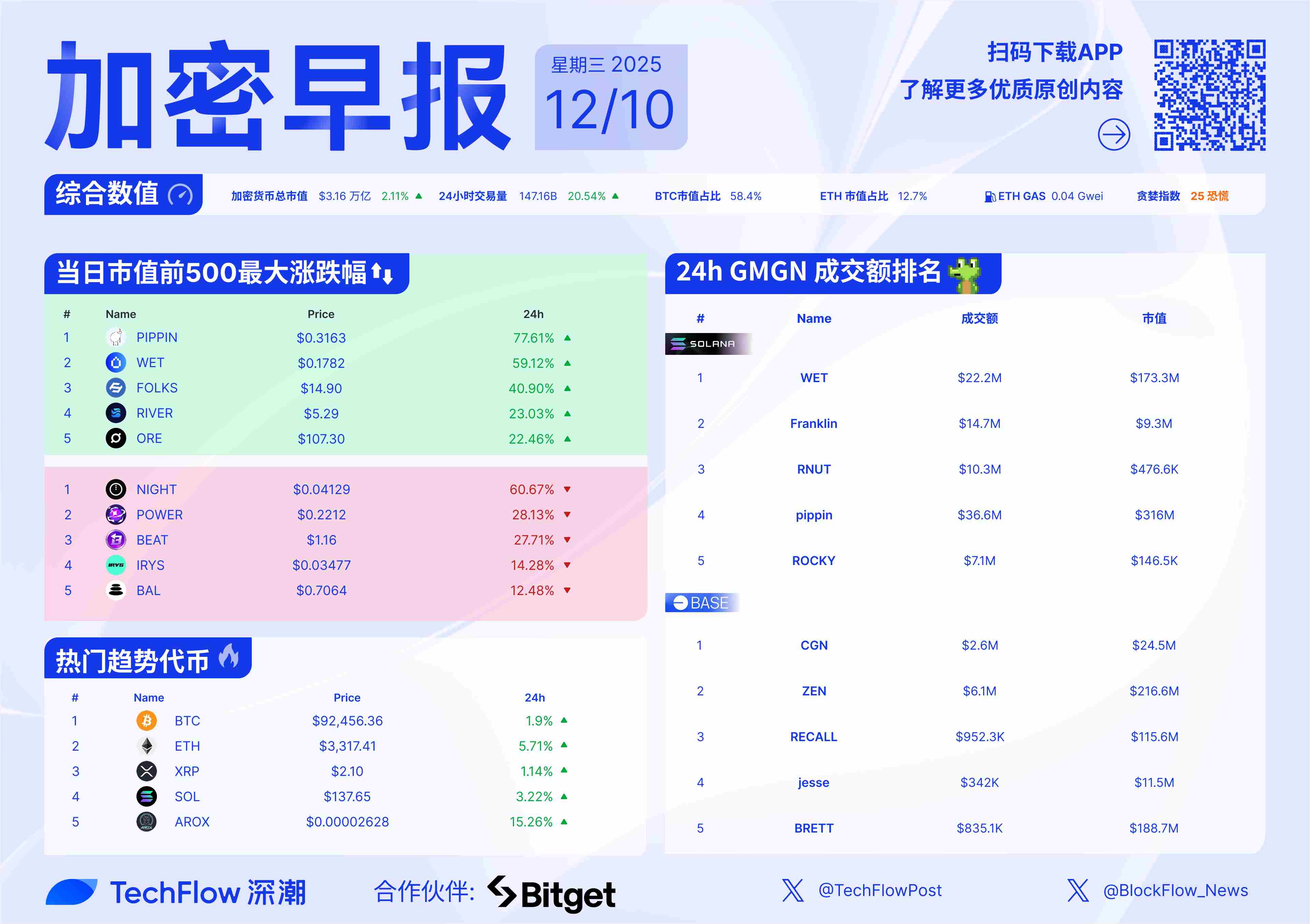
Recommended Reading

Early Thursday Morning, It's Not the Rate Cut Itself That Will Determine the Direction of Risk Assets

This article analyzes the potential impact of the upcoming Federal Reserve interest rate decision on the market, pointing out that the rate cut itself is already fully priced in. The real market drivers lie in the Fed's forecasts for the future interest rate path and its policy stance. Additionally, the article discusses the relationship between the crypto market and Fed policy, as well as the impact of the upcoming labor market data on the overall economy.

Bitwise: My Most Confident Investment in the Crypto Space

This article explores investment strategies in the cryptocurrency space, with the author sharing their views on market uncertainty and how to address it. They emphasize the importance of investing in the entire market and propose a strategy of diversifying risk through cryptocurrency index funds. Furthermore, the article looks ahead to the future development potential of the cryptocurrency industry and related technologies.

What Crypto Decisions Has Fidelity's CEO Made Over the Past Decade?

This article documents an interview with Fidelity Investments CEO Abigail Johnson at the A16Z Founder Summit. She shared how Fidelity has explored the crypto space over the past decade, covering key topics such as early Bitcoin mining, crypto custody, stablecoins, innovative investment models, and the "build vs. buy" approach. The article explores how traditional finance is positioning itself in crypto assets with a new perspective and its outlook for the future.

Behind 'Thefts and Scams' in Cryptocurrency: Why Does Civil Relief Often Hit Roadblocks?

This article recounts cryptocurrency scam cases and analyzes the difficulties in obtaining legal relief, focusing on two real cases that highlight the challenges of both criminal and civil remedies in the cryptocurrency field. The article emphasizes the limitations of civil avenues for recourse when criminal offenses are involved and recommends prioritizing the pursuit of losses through criminal channels.

Where Will the Money for the Next Bull Market Come From?

This article explores the future direction of the crypto market, analyzing potential funding sources for the next bull run. It focuses on key drivers such as institutional capital, Real World Asset (RWA) tokenization, and infrastructure upgrades, while noting that the market is shifting from retail-driven to institutionalized and structurally supported funding.


Preguntas relacionadas

QWhat did Kevin Hassett suggest about the Federal Reserve's potential interest rate cuts?

AKevin Hassett stated that the Federal Reserve has 'ample room' to cut interest rates significantly, and if the data supports it, he believes there is full room to do so, including cuts larger than 25 basis points.

QWhich blockchain networks will Stripe's new stablecoin payments support upon launch on December 12?

AStripe's stablecoin payments will support the Ethereum, Base, and Polygon blockchain networks.

QWhat new type of stablecoin did Circle launch in partnership with Aleo, and what is its key feature?

ACircle launched a privacy-enhanced stablecoin called USDCx in partnership with Aleo, which offers 'bank-grade privacy' by making transaction data invisible to the public while maintaining compliance records for regulatory review.

QAccording to the SEC chairman, which category of ICOs should be the focus of SEC regulation?

ASEC Chairman Paul Atkins stated that the SEC should focus its regulation solely on tokenized securities, which are on-chain representations of securities already regulated by the SEC.

QWhat major banking institution did Coinbase partner with to offer direct Bitcoin trading services to its private bank clients?

ACoinbase partnered with PNC Bank, making it the first major U.S. bank to offer direct Bitcoin trading services to its private banking clients through Coinbase's Crypto-as-a-Service platform.

Lecturas Relacionadas

El último artículo de Fei-Fei Li: Cuando la generación de vídeo, la robótica y NVIDIA se autodenominan modelos del mundo, necesitamos una taxonomía

El artículo de Fei-Fei Li clarifica el término "modelo del mundo", utilizado de manera confusa en IA, proponiendo una taxonomía basada en el ciclo POMDP (Proceso de Decisión de Markov Parcialmente Observable). Identifica tres categorías funcionales: 1) **Renderizador**: genera observaciones (píxeles) visualmente fieles para humanos, como los modelos de video Sora o Genie, pero sin comprensión física precisa. 2) **Simulador**: produce estados del mundo con precisión geométrica, física y dinámica, sirviendo tanto para visualización profesional como para entrenamiento de agentes (robots, vehículos autónomos). 3) **Planificador**: deduce acciones a partir de observaciones y objetivos, cerrando el ciclo percepción-acción, como los modelos de lenguaje-visión-acción (VLA). El artículo argumenta que el simulador es el componente clave y subestimado, pues proporciona la base estructural para la renderización y la planificación. Mientras los renderizadores tienen madurez comercial pero limitaciones físicas, y los planificadores son prometedores pero inmaduros para despliegues reales, los simuladores abarcan aplicaciones cruciales en robótica, diseño y digitalización. La tendencia actual es la fusión de estas categorías, impulsada por la idea de que comparten conocimiento subyacente. Modelos como Marble de World Labs ejemplifican esta convergencia, generando tanto representaciones visuales (splats gaussianos) como mallas para simulación física. La visión final es un **modelo del mundo unificado** capaz de alternar entre renderizar, simular y planificar según la necesidad, avanzando hacia una inteligencia espacial que permita a las máquinas entender e interactuar con el mundo físico.

marsbitHace 1 hora(s)

El último artículo de Fei-Fei Li: Cuando la generación de vídeo, la robótica y NVIDIA se autodenominan modelos del mundo, necesitamos una taxonomía

marsbitHace 1 hora(s)

Especial de Forbes: Las remesas transfronterizas con stablecoins son más rápidas, pero aún no más baratas

**Los pagos transfronterizos con stablecoins son más rápidos, pero aún no más baratos** El sector de pagos transfronterizos con stablecoins está creciendo rápidamente, con tecnología disponible, mejoras regulatorias y mayor volumen de transacciones. Sin embargo, aunque estas transacciones son más rápidas, accesibles y fiables, aún no han cumplido su promesa de ser más baratas. La diferencia de costos es clara: los corredores de divisas tradicionales suelen cobrar entre 60 y 70 puntos básicos por pagos a proveedores internacionales, mientras que las stablecoins prometen reducirlos a solo 2-5 puntos básicos. El problema actual es la falta de pools de liquidez suficientemente profundos y escalados para materializar este ahorro. Según Imran Ahmad de Bitso Business, hasta que los bancos e instituciones inyecten liquidez masiva en estos canales, la ventaja de coste seguirá siendo teórica. Un obstáculo clave para la adopción en pagos B2B es la confianza. Los importadores establecidos suelen confiar en sus agentes de divisas de larga data, una relación personal que las soluciones tecnológicas aún deben superar. Como explica Ezra Kebrab de Caliza, no se trata solo de ser más rápido y barato, sino de garantizar fiabilidad y cumplimiento en cada transacción. Las empresas exitosas en este espacio no buscan reemplazar la infraestructura existente como SWIFT, sino complementarla. Caliza, por ejemplo, utiliza stablecoins pero aún canaliza muchas transacciones a través de SWIFT para garantizar la precisión en datos críticos como números de identificación fiscal, evitando retrasos en aduanas. Este enfoque híbrido ha impulsado un crecimiento mensual sostenido superior al 40%. El futuro del sector dependerá de quién logre consolidar tres pilares fundamentales: licencias regulatorias, acceso sólido a canales de moneda fiduciaria y liquidez profunda. Sin ellos, las empresas corren el riesgo de ser meros intermediarios. Ahmad prevé una inevitable consolidación en el sector, donde solo las empresas con estas bases sólidas sobrevivirán y prosperarán.

marsbitHace 1 hora(s)

Especial de Forbes: Las remesas transfronterizas con stablecoins son más rápidas, pero aún no más baratas

marsbitHace 1 hora(s)

Especial de Forbes: los pagos transfronterizos con stablecoins son más rápidos, pero aún no más baratos

Los pagos transfronterizos con stablecoins están creciendo rápidamente, ofreciendo velocidad, accesibilidad y disponibilidad 24/7, pero aún no cumplen la promesa de ser más baratos. Aunque las stablecoins prometen reducir las comisiones de 60-70 puntos básicos que cobran los agentes de divisas tradicionales a solo 2-5, la ventaja de coste sigue siendo teórica. Según Imran Ahmad de Bitso Business, se necesitan grupos de liquidez más profundos y la entrada de instituciones para que los precios bajen realmente. La adopción en pagos B2B enfrenta el gran obstáculo de la confianza en relaciones comerciales tradicionales de larga data. Ezra Kebrab, CEO de Caliza, enfatiza que no solo se trata de ser rápido y barato, sino de garantizar que los pagos a proveedores se realicen correctamente para evitar problemas como retenciones aduaneras. Empresas exitosas como Caliza, que trabaja con clientes desde agentes aduaneros hasta procesadores de pago globales, ven las stablecoins como un complemento, no un reemplazo, de sistemas como SWIFT, valorando los estándares establecidos para pagos a proveedores. Caliza ha experimentado un crecimiento mensual superior al 40%. Ahmad prevé una consolidación en el sector, donde la clave para sobrevivir será poseer licencias, acceso a canales fiduciarios y liquidez. Sin estos elementos fundamentales, una empresa sería meramente un intermediario.

链捕手Hace 1 hora(s)

Especial de Forbes: los pagos transfronterizos con stablecoins son más rápidos, pero aún no más baratos

链捕手Hace 1 hora(s)

El último artículo de Fei-Fei Li: Cuando la generación de vídeo, la robótica y NVIDIA afirman ser un modelo del mundo, necesitamos una taxonomía

En su último artículo, Fei-Fei Li aborda la confusión actual en torno al término "modelo del mundo" en IA. Propone una clasificación funcional basada en el ciclo clásico de POMDP (agente → acción → estado → observación → agente), distinguiendo tres tipos: 1. **Renderizador:** Genera observaciones (píxeles) visualmente fieles para humanos, como los modelos de generación de video (ej. Sora). Su métrica clave es la calidad visual, pero puede carecer de precisión física. 2. **Simulador:** Genera el *estado* subyacente del mundo: representaciones geométricas y físicamente precisas (geometría, dinámica). Sirve tanto para visualización profesional como para entrenar agentes de IA o robots en entornos virtuales. Li argumenta que es el componente crucial y más subestimado, pues es la base para los otros dos. 3. **Planificador:** Genera *acciones*. Dada una observación y un objetivo, decide qué debe hacer un agente (ej., un robot). Es esencial para cerrar el ciclo percepción-acción. Li señala que estos tres tipos comparten un conocimiento subyacente común sobre el mundo. El campo avanza hacia su fusión, como se ve en modelos que combinan renderizado y simulación (ej., Marble de World Labs). El objetivo final es un "modelo del mundo" unificado capaz de alternar entre estas funciones según sea necesario, lo que redefiniría la inteligencia espacial y la interacción de la máquina con el mundo físico.

链捕手Hace 1 hora(s)

El último artículo de Fei-Fei Li: Cuando la generación de vídeo, la robótica y NVIDIA afirman ser un modelo del mundo, necesitamos una taxonomía

链捕手Hace 1 hora(s)

Trading

Spot
活动图片