Altcoin Season Explosion: What Happens If Bitcoin Dominance Starts To Cool Off?

bitcoinistPublicado a 2026-03-05Actualizado a 2026-03-05

Resumen

Crypto analyst Cyril predicts a potential altcoin season as Bitcoin dominance shows signs of cooling. He notes that altcoins are historically compressed against Bitcoin and are near long-term support levels similar to pre-altcoin season periods like 2020. If Bitcoin stabilizes and its dominance decreases, a rotation into altcoins could occur. Analyst Mark supports this view, pointing to expansion in the business cycle and improved liquidity as bullish catalysts. He highlights that altcoins have shown green monthly candles and a bullish MACD crossover after six years. Additionally, Santiment data indicates social interest in altcoins is at an extreme low, which historically precedes rallies. The recent pump in assets like Dogecoin further suggests a contrarian approach may be beneficial as altcoin seasons often begin when least expected.

Crypto analyst Cyril has predicted that altcoin season could be on the horizon as Bitcoin dominance cools off. Crypto analyst Mark also flagged that the business cycle remains in an expansion stage, which could be bullish for altcoins.

Altcoin Season On The Cards If Bitcoin Dominance Cools Off

In an X post, Cyril noted that the altcoins vs BTC chart (Total market cap excluding top 10 to BTC) shows that altcoins are still historically compressed against Bitcoin. He further stated that these coins are sitting near long-term support similar to prior pre-altcoin season zones, like in 2020.

As to what to expect, the analyst stated that Bitcoin stabilizes and dominance cools off, this setup favors an altcoin season rotation phase. Meanwhile, if BTC continues to outperform, then altcoins stay suppressed longer. As such, he declared that this is early-stage positioning and not peak euphoria.
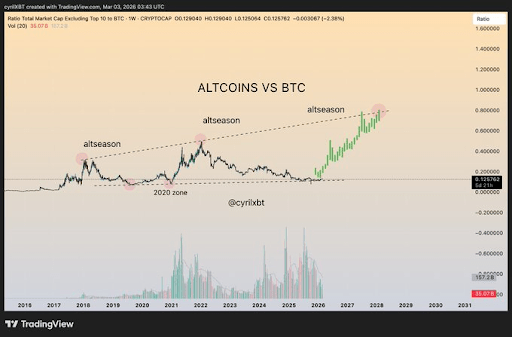
Source: Chart from Cyril on X

Crypto analyst Mark also made a case for how the altcoin season could play out. He alluded to the dollar index chart, which he claimed makes it obvious that crypto is about to explode. The analyst noted that when the business cycle turns, liquidity improves, and then the Bitcoin price runs before altcoins outperform.

Mark also noted that the business cycle has just printed back-to-back expansion months above 50 for the first time since early 2022. He claimed that these runs have lasted for 12 to 24 months. Alongside this bullish catalyst, the analyst highlighted other positives in the market. One is that altcoins are seeing multiple green monthly candles.

Furthermore, these altcoins have seen the first bullish monthly MACD crossover in six years. The crypto market, led by Bitcoin, has been able to absorb the geopolitical shock without breakdown. Mark added that liquidity is quietly turning at the short end while regulatory clarity is approaching. As such, altcoin season could be on the horizon with these bullish catalysts.

The analyst noted that what is playing out is a “rational, objective, historically consistent macro-cycle data.” He warned that it will all seem so obvious when it is too late.

Social Volume Toward Altcoin Interest Is At An Extreme Low

On-chain analytics platform Santiment revealed that social interest in altcoins is currently at an extreme low. They noted that historically, the rallies begin when social volume toward altcoin interest is at extreme lows. As such, Santiment mentioned that this is typically a buy signal as altcoin season occurs when market participants do not expect it.

Notably, altcoins have begun to pick up again as Bitcoin rallied to $74,000 yesterday. Santiment specifically pointed to Dogecoin’s 15% gains over the last 24 hours, noting that it is no coincidence the pump began just after the crowd went historically bearish on altcoins. “It’s wise to be a contrarian to the echo chamber that is crypto social media,” the platform added.

Overall crypto market at $970 billion on the 1D chart | Source: TOTAL2 on Tradingview.com

Preguntas relacionadas

QAccording to analyst Cyril, what condition is necessary for an altcoin season to occur?

ACyril stated that if Bitcoin stabilizes and its dominance cools off, it favors an altcoin season rotation phase.

QWhat did on-chain analytics platform Santiment say about the current social volume towards altcoins?

ASantiment revealed that social interest in altcoins is currently at an extreme low, and that historically, rallies begin when social volume is at such lows, making it a typical buy signal.

QWhat bullish catalyst did analyst Mark highlight regarding the business cycle?

AMark noted that the business cycle has just printed back-to-back expansion months above 50 for the first time since early 2022, and claimed these runs have lasted for 12 to 24 months.

QWhat specific altcoin's recent price action did Santiment point to as evidence for their contrarian theory?

ASantiment specifically pointed to Dogecoin’s 15% gains over the last 24 hours, noting the pump began just after the crowd went historically bearish on altcoins.

QWhat historical period did Cyril compare the current altcoin market setup to?

ACyril stated that altcoins are sitting near long-term support similar to prior pre-altcoin season zones, like in 2020.

Lecturas Relacionadas

Los retiros de Bitcoin continúan: 8 años de almacenamiento en una cartera fría Coldcard terminaron en cero

Retirada de bitcoin continúa: 8 años en cartera fría Coldcard terminan en cero La cartera hardware Coldcard ha sido vulnerada, provocando una nueva oleada de retiradas de fondos de dispositivos afectados. Galaxy Research informa que el volumen total robado asciende a 1.367,05 BTC (unos 88,6 millones de dólares) desde 4.585 direcciones, superando ampliamente los 594,5 BTC reportados inicialmente el 30 de julio de 2026. La mayor parte de lo robado permanece inactiva en las direcciones de los atacantes. El problema no reside en el firmware, que ya fue actualizado por Coinkite, sino en las frases semilla (seed phrases) generadas desde marzo de 2021 debido a un error de programación. Estas frases son fácilmente descifrables, y actualizar el firmware no las cambia. Solo transferir los fondos a una nueva dirección con una nueva frase semilla elimina la vulnerabilidad. El fallo se originó al integrar la biblioteca libNgU, lo que hizo que los dispositivos dejaran de usar el generador de números aleatorios por hardware STM32 y pasaran a usar el generador software Yasmarang, inicializado con datos públicamente accesibles como el número de serie del chip. Afecta a frases semilla creadas en dispositivos Mk2/Mk3 (firmware 4.0.1–4.1.9 y hasta 5.0.3), Mk4/Mk5 (hasta v5.6.0) y Q (hasta v1.5.0Q). Se excluyen aquellas creadas con al menos 50 lanzamientos de dados independientes o una passphrase BIP-39 fuerte y única. Los usuarios deben generar una nueva frase semilla en firmware corregido y transferir sus activos. Un caso ilustrativo es el de un inversor de 39 años que perdió 2 BTC (unos 130.000 dólares) en minutos, ahorrados durante ocho años mediante trabajo físico como protección contra la hiperinflación en su país, con el objetivo de una jubilación anticipada a los 50 años. Su estrategia conservadora de "comprar y mantener en frío" se vio truncada, dejándolo devastado y decidido a abandonar las criptomonedas. Este incidente recuerda vulnerabilidades históricas por generadores de números aleatorios débiles, como la de la biblioteca BitcoinJS (2011-2015), que causó grandes pérdidas. Subraya que el almacenamiento offline no garantiza automáticamente seguridad criptográfica, especialmente cuando la entropía se ve comprometida dentro del propio dispositivo "cerrado".

cryptonews.ruHace 1 hora(s)

Los retiros de Bitcoin continúan: 8 años de almacenamiento en una cartera fría Coldcard terminaron en cero

cryptonews.ruHace 1 hora(s)

Por qué el Bitcoin se mantiene en $64,000 tras la dura pausa de la Fed

Bitcóin cierra julio cerca de los 64.000 dólares tras una volátil reacción a la decisión de la Fed de mantener las tasas sin cambios, aunque sin indicar un pronto aflojamiento monetario. Esto ha provocado una rotación de capital hacia los ETF de Bitcoin, que registraron una entrada neta de 32,1 millones de dólares, mientras que los fondos de Ethereum experimentaron salidas. El mercado de criptomonedas, con una capitalización de unos 2,29 billones de dólares, se mantiene en un rango lateral, con Bitcoin encontrando soporte en 63.000-63.500 dólares y resistencia en 66.000 dólares. La Fed mantuvo su tasa clave, pero tres miembros votaron a favor de un aumento, señalando una postura más dura de lo esperada. En este entorno macroeconómico incierto, los inversores institucionales parecen favorecer a Bitcoin como activo principal, aunque persiste el interés selectivo en activos como Solana. Mientras, la aprobación de la ley CLARITY en EE.UU. se retrasa hasta después del receso de agosto. Para el último día de julio, el enfoque estará en los datos macro de EE.UU. El escenario base para Bitcoin es la consolidación entre 63.000 y 66.000 dólares, con su ruptura superior dependiendo de nuevos flujos institucionales. La estabilidad por encima de 63.000 dólares para BTC, el mantenimiento de Ethereum sobre 1.860 dólares y las entradas continuas en ETF son claves para una posible base de recuperación en la segunda mitad del año.

cryptonews.ruHace 4 hora(s)

Por qué el Bitcoin se mantiene en $64,000 tras la dura pausa de la Fed

cryptonews.ruHace 4 hora(s)

Trading

Spot
活动图片





