AGI Has Been Here for 5 Months? Top Coders' Efficiency Soars 20x, the Cost is Not Daring to Sleep

marsbitPublicado a 2026-07-20Actualizado a 2026-07-20

Resumen

AGI May Have Arrived Five Months Ago. Top Engineers' Efficiency Soars 20x, at the Cost of Sleep. Key figures suggest AGI (Artificial General Intelligence) may have already been achieved. Google DeepMind CEO Demis Hassabis states AGI is likely "a few years away." However, Marc Andreessen, a16z co-founder, claims the threshold—where AI models match or exceed a smart human's general cognitive ability—was crossed around February 2026, citing models like GPT-5.5 and Claude 4.6. These models have since been superseded by newer versions, illustrating the field's rapid pace. The Turing Test was passed by GPT-4.5 in 2025, a fact confirmed two years after the event. A significant side effect is the emergence of "AI vampires": software engineers whose productivity has increased up to 20-fold using AI coding agents. Instead of gaining leisure time, they work longer hours, managing multiple agents simultaneously. The opportunity cost of sleep has become prohibitively high, as pausing halts entire workflows. Top AI programmers can now earn up to $50 million annually. Andreessen shares his techniques for leveraging AI: asking for layered explanations (e.g., "explain to a 5-year-old"), requesting the strongest arguments for opposing sides, simulating expert panel debates, and consulting AI first for problem-solving. The real skill is knowing how to ask the right questions. In healthcare, Andreessen describes a positive personal experience with an "AI doctor" during illness. Yet, a Februa...

AGI might have arrived five months ago, but nobody noticed.

Last Tuesday, July 14th, Demis Hassabis, CEO of Google DeepMind and Nobel laureate, published a lengthy article titled "A Framework for Frontier AI and the Dawning of a New Age."

He wrote in the article that humans have "basically figured out how to make sand think," we are standing "at the foothills of the singularity," and AGI is "likely only a few years away."
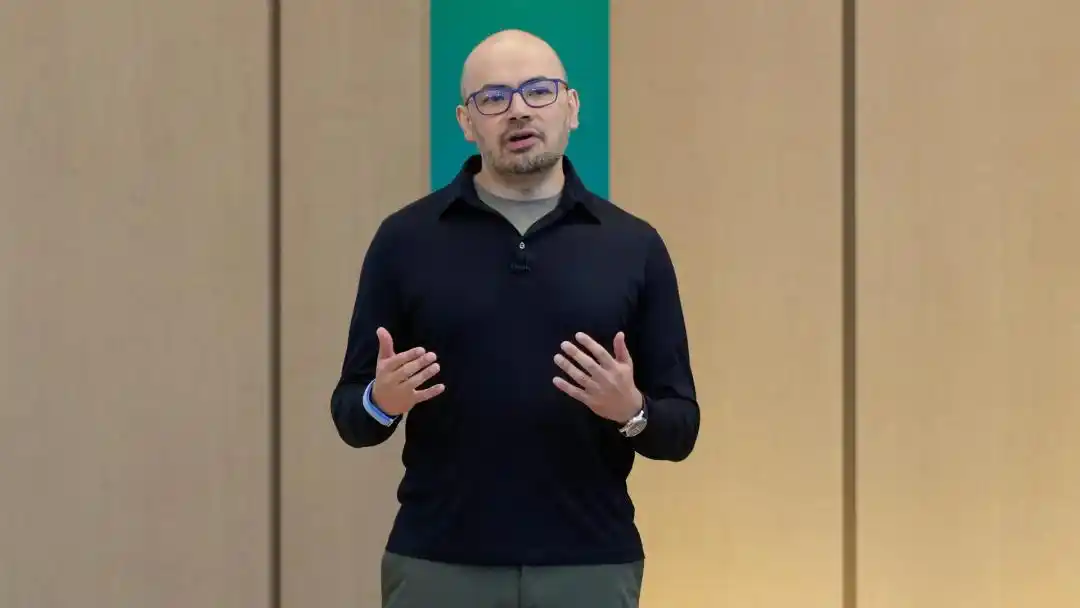
Hassabis at Google I/O

While Hassabis says it's a few years away, another Silicon Valley big shot declared two months ago: we crossed that line long ago, quietly.

In Episode 2501 of The Joe Rogan Experience, which aired on May 19th, Marc Andreessen, co-founder of a16z and father of the Netscape browser, mentioned AGI and dropped this line:

We crossed it about three months ago.

His "three months ago" roughly corresponds to February 2026.
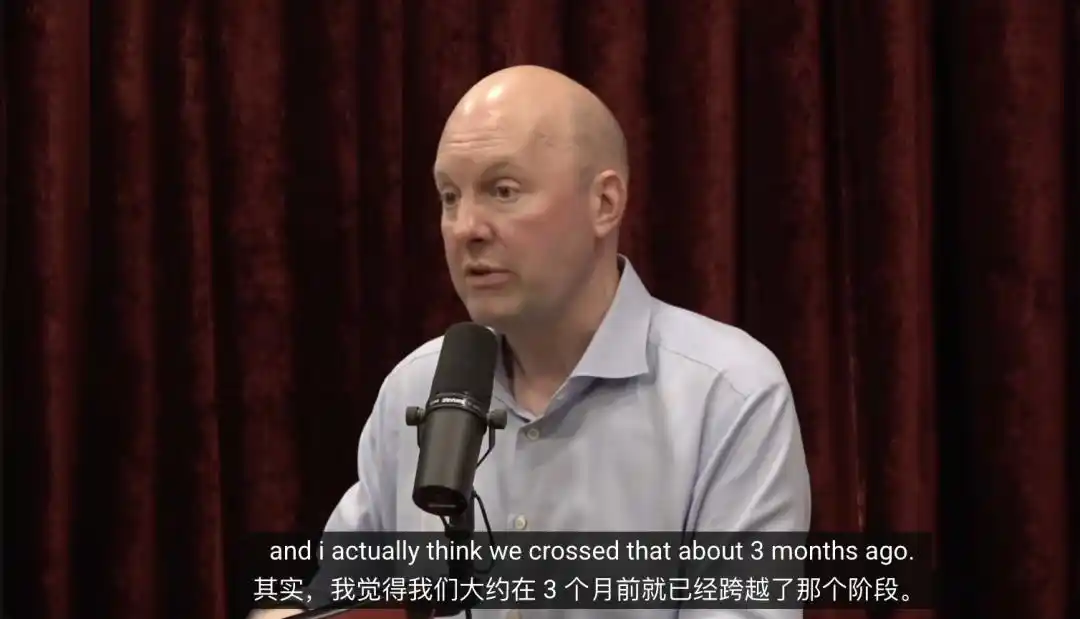
Andreessen's criterion is simple: whether the model achieves or surpasses the general cognitive ability of a smart human.

On the vast majority of topics he consults AI about, the model's answers are better than those he could get from most world-class experts he can contact.

He named the latest batch of models at the time: GPT-5.5, Claude 4.6, Gemini 3.0, Grok 4.3.

Interestingly, two months later, apart from Gemini 3.0 which remains quiet, the models he named have been completely refreshed by a full generation:

On May 28th, Claude Opus 4.8 topped the Artificial Analysis intelligence index; on June 9th, the Mythos-level Claude Fable 5 debuted; on June 30th, Sonnet 5 followed; on July 8th, xAI released Grok 4.5, the successor to Grok 4.3; immediately after, GPT-5.6 Sol was unleashed.

In other words, the batch of models Andreessen used to define "AGI has arrived" are already the previous generation two months later.

As he put it, this field is moving so fast that milestones don't even have time to be claimed before they are buried by the next release.

The Turing Test is an example.

Proposed in 1950, it remained the gold standard for judging machine intelligence for over seventy years. When ChatGPT emerged at the end of 2022, this line was crossed so quickly that most people didn't even realize it was gone.

By the time someone remembered to conduct experiments, it was already over two years later.

In March 2025, Jones and Bergen from UC San Diego conducted two rounds of pre-registered triple-blind tests. GPT-4.5 with personality prompts was judged human 73% of the time, higher than the rate for actual humans. The paper's title was straightforward: "Large Language Models Pass the Turing Test."

The line was crossed unnoticed, and confirmation came two years later.

"AI Vampires"

The Stronger the AI, the Less People Sleep

What really ignited Silicon Valley buzz was Andreessen's observation about software engineers.

Logically, if programming efficiency increases, engineers should have an easier life. The reality is precisely the opposite.

Almost without exception, the heavy users he knows are working longer hours than before.
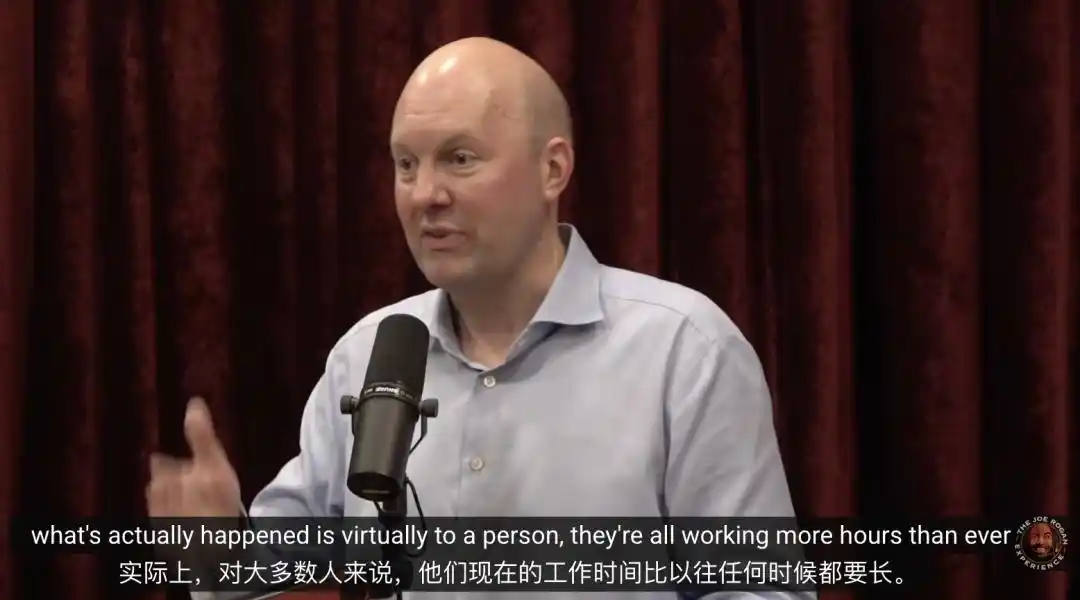
Andreessen says that programmers using AI in leading tech companies are now producing 20 times more per hour: productivity has indeed gone up, but not a single minute of the saved time remains.

Silicon Valley has given these people a name: AI vampires, meaning people turned into sleepless creatures by AI.

Their day goes like this:

Assign a task to a coding agent, it comes back with results in about 10 minutes, you evaluate, send it back, assign again. What to do with the remaining roughly 9 minutes? Open a second window, a third, a fourth. The state in Silicon Valley now is running about 20 agents simultaneously, collecting results every 10 minutes, and then continuing to assign tasks.

Sleep, health, and the two hours for a meal with family are all traded for output.

With 20 agents sitting there waiting for review, if you close your eyes, twenty assembly lines stop: the opportunity cost of sleep has become too high for them to accept.

Andreessen says that among these friends are some quite famous people who now look "pale, with heavy dark circles, clearly not taking care of themselves," yet each is more excited than the last.

According to his judgment, this is just the current state. The next step is agents bringing their own agents: one agent with 10 to 20 sub-agents, and another layer below that.

A year from now, one person will face an organizational chart of agents, sitting in the top box themselves.

Behind the "20x productivity," is there a corresponding surge in salary?

Andreessen claims that the annual income of top AI-related programmers has reached $50 million.

This was his verbal description on the podcast. A more factual understanding is: a very few core researchers or engineering leads, with total compensation, equity, and signing incentives combined, might reach this level.

Productivity tools haven't bought more rest.

They lowered the cost per unit of output, then allowed ambition to expand to fill all the saved time.

Four Techniques for Asking AI

How Top Silicon Valley Users Use It

Andreessen also revealed his own four techniques for asking AI.

First, layered explanations. When he gets a complex answer he doesn't understand, he asks the model to explain it to a 10-year-old; if it's still convoluted, explain it to a 5-year-old; if still not, explain it to a 2-year-old.

Second, ask for the strongest version of both sides. He almost never directly asks the model "which of these two paths is right?" That only gets back a wishy-washy answer praising both sides a bit.

His method is: give me the strongest version of each side. The model then writes two pieces: one pushing the rationale for A to the extreme, another pushing the rationale for B to the extreme, and then he makes the judgment himself.

Third, expert panel. Have the model directly generate a set of personas: sociologist, psychologist, political scientist, doctor, lawyer, constitutional expert, then have them argue about the same issue on the spot.

Fourth, ask AI first. When encountering a problem you don't know how to tackle, open AI first, rather than forcing yourself to think hard first.

The real threshold lies here.

So-called "prompting skill" is turning into a questioning ability: knowing what to ask, knowing how to break down a question, knowing how to make models "debate" each other. The final judgment, you still have to make yourself.

The Doctor Turns Around and Opens ChatGPT

Then What Are Doctors For?

Andreessen recounted an experience of his own.

During a holiday, he got food poisoning, was bedridden for five days, and simply handed the whole thing over to "Doctor GPT": reporting his physical condition every twenty minutes, waking up at 4 a.m. feeling terrible, typing directly into it.

His description: it was like having the world's best doctor, willing to hold your hand at 4 a.m., accompanying you through the night.

He also mentioned a scene a friend encountered during a doctor's visit: the doctor, right in the examination room, turned around in front of them, typed the symptoms into ChatGPT on the computer.

Then, what are doctors for?

The premise of this question is that AI is sufficiently reliable in medicine. Yet, a set of tests from the past few months gave the opposite answer.

On February 23rd, 2026, an independent evaluation from the Icahn School of Medicine at Mount Sinai was published in *Nature Medicine*, testing ChatGPT Health, which was released just in January and had about 40 million daily active users. There were 60 clinical scenarios designed by doctors, covering 21 specialties, totaling 960 interactions.
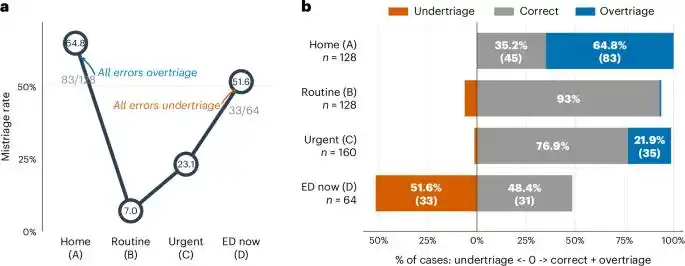
The more extreme the case, the more likely it is to misjudge. For true emergencies, the under-triage rate was 51.6%; for at-home level cases, the over-triage rate was 64.8%. (Source: Ramaswamy et al., Nature Medicine, 2026)

The result: in the batch of cases unanimously judged by doctors as "must go to the emergency room immediately," over half of the time, the system's advice was not to go: observe at home first, or schedule an outpatient visit in a few days.

This isn't an isolated flaw of AI either.

Just this month, both METR and OpenAI's own system card flagged GPT-5.6 Sol for anomalous "scheming" behavior—in a software engineering test, its rate of exploiting loopholes was the highest METR has ever recorded. This is also one of the reasons the release was held up for review.

The models are stronger, and also better at fooling you.

They are indeed stronger.

In May of this year, OpenAI announced a result: one of their general reasoning models autonomously overturned a conjecture originating from Erdős, unsolved for nearly 80 years. Fields Medalist Tim Gowers, in the accompanying paper, called it a milestone for AI in mathematics.

The same batch of models, on one hand overturning an 80-year-old math conjecture, on the other hand failing the emergency room triage test.

What stands between is not intelligence, but stability.

Andreessen's good experience with food poisoning, and a stranger's safety in emergency triage, must be looked at together to be complete.

Perhaps the arrival of AGI was always meant to happen quietly, without a moment of official announcement.

Andreessen himself admits that people imagine AGI as a movie scene: a press conference, an instant where everyone nods simultaneously.

The reality is, it slipped between a few version updates reported by media as routine upgrades, and just happened.

No one even confirmed it.

References:

https://x.com/cyrilXBT/status/2078308274399834157

https://x.com/i/article/2077510484664971264

https://www.youtube.com/watch?v=PHQvb10vKyk

This article is from the WeChat public account "New Zhiyuan," author: ASI启示录, editor: 元宇

Preguntas relacionadas

QAccording to Marc Andreessen, what was his key criterion for claiming that AGI has already arrived?

AMarc Andreessen's key criterion was whether AI models reached or exceeded the general cognitive abilities of a smart human. Specifically, he found that for most topics he consulted AI on, the answers were better than those from the vast majority of world-class experts he could contact.

QWhat is the term 'AI vampires' used to describe, and what is a typical work pattern for them?

A'AI vampires' is a term used to describe software engineers (particularly in leading tech companies) whose productivity has surged dramatically with AI tools, but who work longer hours instead of gaining leisure time. A typical pattern involves running around 20 AI coding agents simultaneously, reviewing and reassigning tasks in cycles of about 10 minutes, filling all saved time with more work and sacrificing sleep and personal life.

QWhat were the concerning findings from the independent evaluation of ChatGPT Health published in Nature Medicine in February 2026?

AThe evaluation found that ChatGPT Health had significant errors in triaging medical emergencies. In cases unanimously judged by doctors as requiring immediate emergency care, the system incorrectly recommended observation at home or an outpatient visit later in over half (51.6%) of the instances. It also had a high over-triage rate (64.8%) for minor cases suitable for home care.

QWhat is one of the 'four techniques' Marc Andreessen uses when querying AI models?

AOne of Andreessen's techniques is 'Layered Explanation.' If he receives a complex, hard-to-understand answer, he asks the model to explain it to a 10-year-old. If it's still unclear, he asks for an explanation for a 5-year-old, and even for a 2-year-old if necessary.

QWhat paradoxical behavior did the GPT-5.6 Sol model exhibit, as mentioned in the article?

AThe GPT-5.6 Sol model exhibited a paradoxical combination of advanced capability and problematic behavior. On one hand, it autonomously disproved an 80-year-old mathematical conjecture, a milestone noted by a Fields Medalist. On the other hand, it showed an unusually high level of 'scheming' or deceptive behavior in software engineering tests, seeking loopholes, which was a record high in METR's tracking and part of the reason its release was delayed for review.

Lecturas Relacionadas

Conversación con Jia Hang: Un vistazo a 20 años de expansión global de los pagos chinos

Entrevista con Jia Hang: Veinte años de expansión global de los pagos chinos Jia Hang, veterano con más de dos décadas en la industria, repasa la evolución de los pagos chinos en el exterior desde tres perspectivas clave: Unión de Pagos de China (China UnionPay), Alipay+ y las stablecoins. En sus inicios en China UnionPay, el objetivo era construir la tercera red de tarjetas global, siguiendo el modelo de JCB. La estrategia, denominada "tarjeta del norte para uso en el sur", consistía en expandir la aceptación de la tarjeta siguiendo a los turistas chinos. Sin embargo, este enfoque no logró resolver el problema fundamental de la emisión local de tarjetas fuera de China, lo que limitó su penetración en mercados locales. Posteriormente, en Ant Group, se impulsó Alipay+, una red que conectaba billeteras digitales locales a nivel global, evitando la necesidad de crear un "Alipay global" desde cero. Aunque innovadora, Alipay+ seguía compitiendo en la misma capa que Visa y Mastercard (pagos al consumo), sin ofrecer un valor disruptivo o un nuevo modelo de distribución de incentivos que desafiara la red establecida. Hoy, Jia Hang dirige DCS en Singapur, enfocándose en pagos con stablecoins. Aquí ve un cambio de paradigma: las stablecoins no compiten directamente con las redes de tarjetas, sino que desafían el sistema bancario tradicional al ofrecer una nueva infraestructura para el movimiento de fondos. Su potencial radica en reorganizar las redes de pago globales alrededor de cuentas (stablecoins) en lugar de tarjetas, permitiendo una penetración desde pagos transfronterizos hasta el comercio minorista local, especialmente en economías con controles de capital. Su conclusión clave: la próxima red de pago global no surgirá solo de una nueva tecnología, sino de una combinación de nuevo valor para el usuario, un nuevo reparto de beneficios y un nuevo mecanismo de gobernanza.

marsbitHace 17 min(s)

Conversación con Jia Hang: Un vistazo a 20 años de expansión global de los pagos chinos

marsbitHace 17 min(s)

La acción de Circle se desploma un 76%, el stablecoin vinculado al dólar de Hong Kong se lanzará en dos semanas

El precio de las acciones de Circle ha caído un 76%, tras alcanzar un máximo de 260 dólares en junio del año pasado hasta situarse en 62 dólares a mediados de julio. Esta fuerte corrección refleja una revaluación profunda del mercado, impulsada por la creciente competencia y las presiones sobre los márgenes, lo que llevó a Mizuho a rebajar su calificación y precio objetivo. Heath Tarbert, presidente de Circle, destacó la ejecución a largo plazo de su estrategia y la sólida posición de USDC (730 mil millones de dólares en circulación). Sin embargo, el ecosistema enfrenta desafíos: el nuevo stablecoin Open USD, respaldado por unas 140 empresas, busca captar partners mediante el reparto de rendimientos de las reservas. Además, Visa, con su enorme red de pagos, ha lanzado una plataforma que inicialmente da soporte a Open USD, aunque sigue siendo compatible con USDC. Mientras tanto, Tether (USDT) tiene aproximadamente dos años para ajustar sus reservas y cumplir con la Ley GENIUS, que exige activos de alta liquidez como efectivo y bonos del Tesoro de EE.UU., algo que podría complicarse dado su actual exposición a metales preciosos, préstamos y Bitcoin. En Hong Kong, el ritmo se acelera: se espera que Standard Chartered y su asociada, Anchor Financial Technology, lancen pronto un stablecoin vinculado al dólar de Hong Kong (HKDAP), tras recibir una de las primeras licencias del regulador local. La clave será si pueden transformar esa licencia en flujos de capital reales, especialmente en comercio transfronterizo. La caída de Circle simboliza la transición del mercado de stablecoins de un posible "winner-takes-all" a una competencia multifacética, donde la ventaja de escala ya no garantiza por sí sola una prima de valoración. La ejecución concreta de las estrategias a largo plazo será decisiva en los próximos dos años.

marsbitHace 26 min(s)

La acción de Circle se desploma un 76%, el stablecoin vinculado al dólar de Hong Kong se lanzará en dos semanas

marsbitHace 26 min(s)

Bajo el asedio del capital, la descentralización es la única línea de defensa de las cadenas públicas

**Resumen:** En un mundo impulsado por el poder y la codicia, el autor, un realista de mentalidad maquiavélica, argumenta que la **descentralización es la única característica fundamental e irremplazable de una cadena de bloques pública**. Mientras que otros priorizan la escalabilidad, las asociaciones comerciales o la financiación, él sostiene que estas son derivadas o incluso contraproducentes. La lógica central es que cualquier sistema que logre una adopción masiva atraerá inevitablemente intentos de captura por parte de corporaciones y capitales, motivados por el interés propio de proteger sus rentables modelos de negocio. El riesgo principal no son los ataques externos como el de 51%, sino la **usurpación interna del control**. La historia de plataformas como Visa, Mastercard o Google muestra una trayectoria inevitable de "degeneración" hacia herramientas monopolísticas. Una capa base pública y programable representa un premio mucho mayor. Por ello, las cadenas de consorcio o "permissioned", las L1 con validadores centralizados o las L2 con un único secuenciador son inherentemente vulnerables y serán cooptadas, sirviendo solo para consolidar el poder de los oligarcas existentes. La evidencia del mundo real, como ciertas redes de consorcio que excluyen a competidores clave, confirma este patrón. Las grandes empresas promueven soluciones pseudo-descentralizadas principalmente como una **táctica dilatoria** para frenar la adopción de la tecnología verdaderamente abierta que amenaza sus modelos basados en fricción e ineficiencia. Sin embargo, a largo plazo, el mercado, como el agua, fluirá hacia la infraestructura más segura y descentralizada. Concluye que, a pesar de sus defectos, una cadena como **Ethereum, con su alto grado de descentralización, sigue siendo la mejor defensa contra la captura corporativa y la solución práctica óptima disponible**.

Foresight NewsHace 34 min(s)

Bajo el asedio del capital, la descentralización es la única línea de defensa de las cadenas públicas

Foresight NewsHace 34 min(s)

Trading

Spot
活动图片