Cardano Breaks New Milestone As TVL Continues To Surge

BitcoinistPublicado a 2022-03-25Actualizado a 2022-03-25

Resumen

Activity has been on the rise on the Cardano network ever since smart contract capability was introduced last year. However,...

Activity has been on the rise on the Cardano network ever since smart contract capability was introduced last year. However, this has ramped up this year as more decentralized applications (DApps) continue to debut on the blockchain. Alongside this has been the growth of native tokens on the blockchain which has now touched a new record, cementing the network as one of the biggest contenders in the space.
Cardano Native Tokens Touch 4 Million
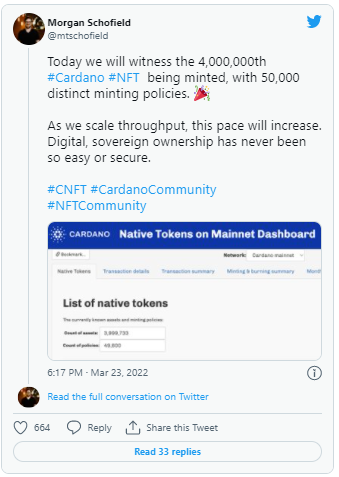
On Wednesday, Morgan Schofield, Head of Ecosystem Growth at Cardano, posted on Twitter that the network was about to set a record of 4 million native tokens that have been issued. At the time of posting, this number had not been reached but using the daily growth rate of native tokens issued on the blockchain, Schofield explained that the network would see 4 million on Wednesday.
True to form, the accelerated growth had seen the number of native tokens issued on the blockchain crossing 4 million less than an hour later. This marked the 4,000,000th Cardano NFT that had been minted on the network, and with 50,000 distinct minting policies issued.
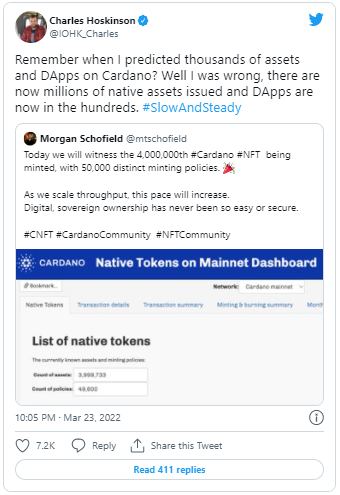
Cardano founder Charles Hoskinson also took to the social media platform to celebrate the milestone. According to Hoskinson, the blockchain had surpassed his expectations, explaining that he “was wrong” with his previous prediction of thousands of native assets being issued on the blockchain.
TVL On The Rise
2022 is proving to be the year of Cardano with the various milestones that the network has been hitting in just the first three months of the year. The network which is basically new to the decentralized finance (DeFi) space has continued to climb in terms of TVL. In 2022 alone, the total value locked on the network has grown more than 25,000%.

Cardano (ADA) price chart from TradingView.com

ADA recovers to $1.1 | Source: ADAUSD on TradingView.com
This TVL has now reached a new milestone above $300 million as activities ramp up on the network. Decentralized exchanges (DEX) such as Minswap and SundaeSwap have been at the forefront of this growth, accounting for more than 90% of all TVL on Cardano.
The accelerated growth has also translated into the price of the digital asset. ADA which had been trending below $1 for the past week had finally been able to break above this resistance point, now resting at $1.13. There’s is no telling how long this accelerated growth rate will continue but one thing is for sure and that is the fact that Cardano is bracing to become a top DeFi contender.
Featured image from TheCryptoBasic, chart from TradingView.com

Lecturas Relacionadas

Bloqueo de chips por parte de las grandes potencias, gigantes que compran centrales nucleares: por qué es el momento de tomar en serio la DeAI

**Resumen: La competencia global por la computación de IA y el auge de la IA descentralizada (DeAI)** En mayo de 2026, el endurecimiento de los controles de exportación de chips de EEUU, la paralización de un centro de datos en Kenia por su enorme consumo energético y el avance de Huawei ilustran una nueva realidad: la competencia por la capacidad de computación ( *compute* ) para IA ha trascendido el ámbito tecnológico para convertirse en un asunto geopolítico y de infraestructura crítica. Se está formando una nueva era de oligopolio. Un puñado de empresas (NVIDIA en chips, AWS/Azure/Google Cloud en plataformas, OpenAI/Anthropic en modelos) controlan las capas esenciales de la cadena de valor de la IA, un fenómeno denominado "pulpo de la IA". Esta concentración conlleva riesgos sistémicos: dependencia y poder de fijación de precios, fragilidad de infraestructuras centralizadas y una creciente "cortina de hierro" de la IA que amplía la brecha digital, especialmente para los países del Sur Global. La competencia se está trasladando al nivel más básico: la energía. El consumo eléctrico de los centros de datos de IA se dispara, llevando a gigantes tecnológicos a buscar fuentes como centrales nucleares. En este contexto, surge la IA Descentralizada (DeAI) como una posible alternativa. Su premisa es crear redes abiertas que conecten recursos de computación (GPUs ociosas, centros de datos) globales y distribuidos mediante protocolos abiertos, criptografía e incentivos económicos. El objetivo es contrarrestar los puntos débiles de la IA centralizada: reducir la concentración del mercado, aliviar la presión sobre redes eléctricas locales, ofrecer una capa infraestructural menos sujeta a una sola jurisdicción y permitir una verificación transparente. Aunque la DeAI aún está en fase inicial y enfrenta desafíos técnicos y de adopción, su valor central no es superar hoy en rendimiento a los sistemas centralizados, sino proponer una arquitectura subyacente que resista la monopolización, rechace la censura y distribuya el poder. Su mera existencia como alternativa viable introduce un contrapeso necesario en un panorama donde el control sobre la inteligencia artificial se está volviendo estratégico.

marsbitHace 5 min(s)

Bloqueo de chips por parte de las grandes potencias, gigantes que compran centrales nucleares: por qué es el momento de tomar en serio la DeAI

marsbitHace 5 min(s)

Trading

Spot
Futuros
活动图片