After FTX: Defi can go mainstream if it overcomes its flaws

CointelegraphPublicado a 2022-11-28Actualizado a 2022-11-28

Resumen

The collapse of the now-bankrupt cryptocurrency exchange FTX has raised many concerns over unregulated centralized platforms. 

The collapse of the now-bankrupt cryptocurrency exchange FTX has raised many concerns over unregulated centralized platforms. 
Investors are now coming to question how safe it is to keep one’s funds on these exchanges and have voiced grave concerns about centralized decision-making without any checks.
FTX held one billion in a customer’s fund and was found to be using the customer-deposited crypto assets to mitigate its own business losses.
Furthermore, a recent report suggests that the downfall of numerous crypto exchanges over the last decade has permanently taken 1.2 million Bitcoin (BTC) — almost 6% of all Bitcoin — out of circulation.
The revelation of unethical practices by FTX in its bankruptcy filing has set a panic among investors who are already losing trust in these centralized trading firms. Exchange outflows hit historic highs of 106,000 BTC per month in the wake of the FTX fiasco and the loss of trust in centralized exchanges (CEXs) has pushed investors toward self-custody and decentralized finance (DeFi) platforms.
Users have pulled money from crypto exchanges and turned to noncustodial options to trade funds. Uniswap, one of the largest decentralized exchanges (DEX) in the ecosystem registered a significant spike in trading volume on Nov. 11, the day FTX filed for bankruptcy.

With FTX’s implosion acting as a catalyst, DEX trading has seen a notable increase in volume. Just last week, Uniswap registered over a billion dollars in 24-hour trading volume, much higher than many centralized exchanges in the same time frame.
Aishwary Gupta, DeFi chief of staff at Polygon, told Cointelegraph that the failure of centralized entities like FTX has definitely reminded users about the importance of DeFi:
“DeFi-centric platforms simply cannot fall victim to shady business practices because ‘code is law’ for them. Clearly, users realize it as well. In the wake of the FTX implosion, Uniswap flipped Coinbase to become the second-largest platform for trading Ethereum after Binance. As decentralized platforms are run by auditable and transparent smart contracts instead of people, there is simply no way for corruption or mismanagement to enter the equation.”
According to data from Token Terminal, the daily trading volume of perpetual exchanges reached $5 billion, which is the highest daily trading volume since the Terra meltdown in May 2022.
Cointelegraph reached out to PalmSwap, a decentralized perpetual exchange, to understand investor behavior in the wake of the FTX crisis and how it has impacted their platform in particular. Bernd Stöckl, chief product officer and co-founder of Palmswap, told Cointelegraph that the exchange has seen a significant bump in trading volumes.
“The usage of DeFi will surely rise thanks to the FTX downfall. It is said that Crypto.com, Gate.io, Gemini and some other centralized exchanges are in hot waters,” he said, adding, “With so many CEXs falling, trust in custodial wallets is very low and the advantages of DeFi will surely be adopted by more users.”
Elie Azzi, co-founder and DeFi infrastructure provider VALK, believes the increase in DEX volumes could be the beginning of a longer-term trend, given a general reluctance from traders to trust CEXs with their assets. He told Cointelegraph:
“DEXs are innovating at a much faster rate than their counterparts, with execution and settlement times becoming almost instantaneous on certain chains. The trend is that DEXs are developing the usability and UI of CEXs, whilst improving on the logic in the back end. Combined with the unique features that DEXs bring, including self-custody, the ability to trade from one’s own wallet and retain control of private keys.”
He added that CEX platforms might see more stringent controls and transparency initiatives, but this “transparency would exist prima facie in full DeFi. Rather, no one would need to trust CEXs with assets, and any activity, be it trading, liquidity provision or else would be recorded in real-time on-chain.”
DeFi’s struggle with targeted hacks
While DeFi protocols have seen a significant bump in the aftermath of centralized exchange failures, the nascent ecosystem itself has been a prime target for hackers in 2022. 
According to data from crypto analytics group Chainalysis, nearly 97% of all cryptocurrency stolen in the first three months of 2022 has been taken from DeFi protocols, up from 72% in 2021 and just 30% in 2020.
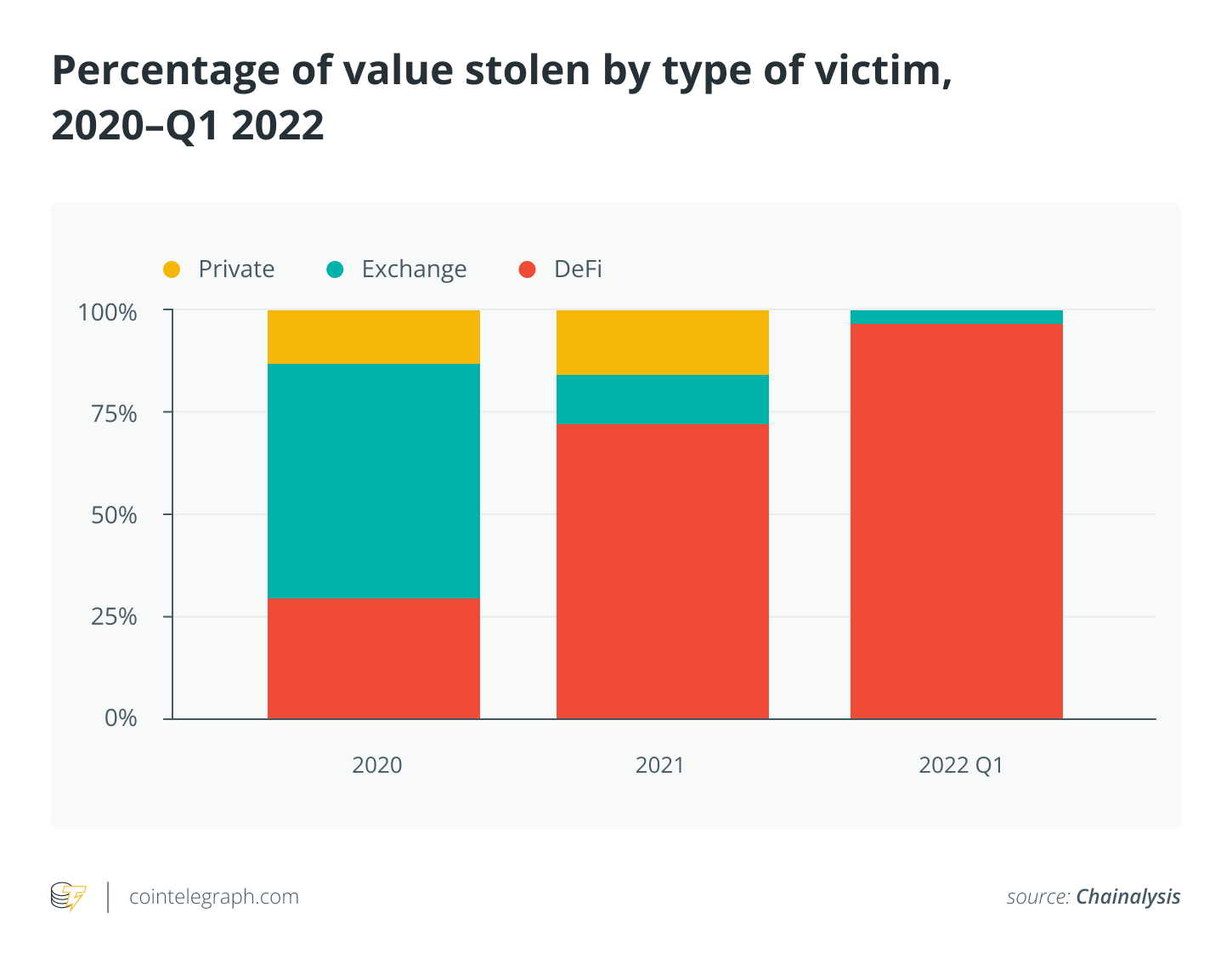
Some of the biggest DeFi exploits of 2022 include the Ronin network exploit in March that resulted in a loss of $620 million worth of funds. The Wormhole bridge hack lost $320 million and the Nomad bridge was compromised for $190 million. In October alone, $718 million worth of crypto assets were stolen from 11 different DeFi protocols.
A majority of the hacks in the DeFi ecosystem have occurred on cross-chain bridges, which Jordan Kruger, CEO and co-founder at DeFi staking protocol Vesper Finance, believes shouldn’t be considered as DeFi exploits.
“A substantial proportion of those exploits (approx. $3 billion this year) have been bridge attacks. Bridges aren’t ‘DeFi’ so much as infrastructure. CEX losses dwarf this number by an order of magnitude. That said, DeFi will improve and become more secure faster than its centralized counterparts because of its ability to iterate faster. This is similar to the way Linux greatly benefitted from an open-source approach and has achieved a strong reputation for security and phenomenal adoption,” she told Cointelegraph.
DeFi is built on the ethos of true decentralization and the decision-making process is often automated via the use of smart contracts. While DeFi does try to eliminate human intervention, vulnerabilities still crop up via different mediums, be it poor coding of smart contracts or breaches of sensitive data.
Lang Mei, CEO of AirDAO, told Cointelegraph that nascent DeFi tech is prone to some bugs and issues but one must remember that the majority of hacks “have been related to either lending or cross-chain bridging, it can be immensely challenging to prevent vulnerabilities in technology which is both radically new and often has a highly-accelerated development schedule due to competition.”
He suggested additional measures that can be taken by developers to minimize the likelihood of exploitable code in their decentralized apps such as “White hat hacking, bug bounty programs, and testnet incentivization are all valuable tools to help identify and correct mistakes. They can also be used to attract and engage users, so it’s essentially a win-win from a team perspective. Decentralization of governance power is also important through the distribution of token supply and safeguards such as multi-signature wallets.”
Till Wendler, co-founder of community-owned DApp ecosystem Peaq, told Cointelegraph that it’s hard to eliminate human-related flaws in smart contacts and design.
“Most thorough smart contract security audit only gets you so far — some exploits result from the way smart contracts interact between themselves in the wider ecosystem, not just from their intrinsic design flaws,” he said, stating, “That said, the DeFi space is definitely now in a better shape than it used to be, and it’s working out its own best security practices on the go, growing more and more reliable by the hour."
Mitchell Amador, CEO at bug bounty protocol Immunefi, told Cointelegraph that DeFi can take help from progression in the security department:
“There’s a huge explosion of security tech being quietly built in the background to tackle the security problem from all angles.”
“Over time, given innovations in UX and security as well as DeFi’s inherent features of transparency, DeFi could permanently overtake centralized platforms, but this dynamic also depends on the wild card of regulations," Amador added.
The collapse of centralized platforms in 2022 and the subsequent rise of noncustodial and DeFi services in its wake is surely a sign of changing times. However, according to many in the crypto space, the most crucial factor in the FTX saga was a lack of understanding and due diligence from the crypto investors.
Myriad crypto pundits have been advocating for self-custody and the use of the decentralized platform for quite some time now. Barney Chambers, the co-founder of the Umbria Network, told Cointelegraph:
“The cryptocurrency space continues to be the wild, wild west of finance. Here are a few pointers to ensure funds are safe: Never connect your wallet to a website you don’t trust, hold your keys in a trusted place such as a hardware wallet, never trust anonymous strangers on the internet when asking for help, and always [do your own research]!”
At present, the only way investors can ensure that their funds are protected is to demand the parties they are investing in to provide transparent and clear information on all accounting and rely on noncustodial solutions in terms of both wallets and trading venues. 
Darren Mayberry, ecosystem head at decentralized operating protocol dappOS, told Cointelegraph that noncustodial services should be the way forward for investors.
“Accountability and audits should be standard procedures for all investors, due diligence is a natural part of business, as is fact-checking and investigation. As for non-custodial wallets — they are the most reliable form of storage that transfers liability solely onto their owner and thus negates the possibility of counterparty risks,” he explained.
DeFi platforms might have their own set of vulnerabilities and risks, but industry observers believe that proper due diligence and reducing human error could make the nascent ecosystem of DEX platforms a go-to option over CEX platforms.

Criptos en tendencia

Lecturas Relacionadas

La Fundación da un paso atrás, Ethlabs da un paso adelante: Ethereum experimenta su mayor reestructuración de la historia

El 23 de junio, la red Ethereum experimentó dos cambios importantes en su gobernanza. Primero, exinvestigadores de la Ethereum Foundation fundaron Ethlabs, una nueva organización sin fines de lucro. Su objetivo es abordar necesidades clave para la adopción institucional a gran escala, como velocidad de transacciones, emisión de activos nativos y escalabilidad, recibiendo el respaldo financiero de grandes tenedores de ETH como Bitmine y SharpLink. Casi al mismo tiempo, la Ethereum Foundation anunció una importante reestructuración, despidiendo al 20% de su personal (54 personas). Esto forma parte de su nueva estrategia para convertirse en una entidad más ligera, centrada en la gobernanza y el mantenimiento del protocolo, y cediendo su papel central como principal impulsora del desarrollo del ecosistema. Este movimiento de "Ethlabs hacia adelante, la Fundación hacia atrás" se interpreta como una respuesta a las críticas sobre lentitud en la toma de decisiones y excesiva dependencia de la Fundación. Ethlabs, que no cuenta con el respaldo explícito del cofundador Vitalik Buterin, busca ser una capa de ejecución más orientada al mercado, centrada en la adopción real y en mejorar la utilidad financiera de Ethereum. El análisis sugiere que la Fundación mantendrá el enfoque en la "corrección" técnica y la neutralidad, mientras que organizaciones como Ethlabs podrán perseguir de manera más directa la "eficacia" y el crecimiento del ecosistema, incluyendo la valorización de ETH. Este cambio busca equilibrar los principios de descentralización con la necesidad de una ejecución más ágil y orientada al mercado para competir en el panorama blockchain actual.

链捕手Hace 38 min(s)

La Fundación da un paso atrás, Ethlabs da un paso adelante: Ethereum experimenta su mayor reestructuración de la historia

链捕手Hace 38 min(s)

Segunda mitad de la política cripto en EE.UU.: El proyecto de ley CLARITY busca 60 votos, el "Comité de una sola persona" de la CFTC se convierte en la mayor incertidumbre

A medio camino de la política cripto en EE.UU.: el avance del proyecto de ley CLARITY en el Senado y las incertidumbres regulatorias El sector cripto espera un momento decisivo con el proyecto de ley CLARITY en el Senado estadounidense, que necesita 60 votos para su aprobación. Quedan solo unos 40 días legislativos este año, lo que hace crucial la negociación bipartidista. Además de CLARITY, están en juego varias propuestas fiscales derivadas del proyecto PARITY y la ley Blockchain Regulatory Certainty Act. Una gran preocupación es la composición de la Comisión de Comercio de Futuros de Materias Primas (CFTC), que actualmente opera con un solo comisionado, lo que genera incertidumbre sobre su capacidad para actuar, especialmente en la lucha por la jurisdicción sobre los mercados de predicción. La industria también lamenta la próxima salida de dos figuras clave: la comisionada de la SEC, Hester M. Peirce, y la senadora Cynthia Lummis, ambas defensoras influyentes de políticas claras para los activos digitales. Expertos del sector opinan que es improbable que CLARITY se apruebe este año debido al calendario ajustado, por lo que la SEC y la CFTC podrían tener que proporcionar más orientación. Las reformas fiscales podrían avanzar si se incluyen en proyectos de ley más amplios. Sobre los mercados de predicción, se debate si deben ser regulados como infraestructura financiera o como juegos de azar, con la CFTC trabajando en un marco más claro. En resumen, la ventana de oportunidad legislativa para 2024 es estrecha, pero el diálogo y los esfuerzos pragmáticos serán esenciales para lograr avances sustanciales.

marsbitHace 3 hora(s)

Segunda mitad de la política cripto en EE.UU.: El proyecto de ley CLARITY busca 60 votos, el "Comité de una sola persona" de la CFTC se convierte en la mayor incertidumbre

marsbitHace 3 hora(s)

Nuevo artículo de Dan Koe: Escapando del destino del asalariado, ¿Cómo sobrevivir a la ola de sustitución por IA?

Autora: DAN KOE En un mundo donde la IA parece amenazar muchos empleos, Dan Koe argumenta que el mayor peligro no es la tecnología, sino depender completamente de otros para la subsistencia y felicidad. El artículo explora cómo escapar de la mentalidad de "esclavo asalariado" y construir una carrera significativa que resista la automatización. **1. Escapar de la trampa del empleado** Koe define la "esclavitud salarial" como verse obligado a realizar trabajos sin sentido por necesidad. Aunque un trabajo puede ser un trampolín útil, rara vez ofrece el flujo constante de desafíos óptimos que genera crecimiento y satisfacción. El sistema educativo y laboral nos entrena para ser especialistas dentro de un sistema, no para entenderlo o crear el nuestro. La única manera de sobrevivir a la sustitución por IA es construir tu propio proyecto. **2. Los cinco ingredientes del éxito** Para ser resiliente y crear tu propio camino, necesitas dominar cinco elementos fundamentales: 1. **Iniciativa**: Actuar sin pedir permiso. 2. **Criterio (gusto)**: El instinto para juzgar qué tiene valor. 3. **Persuasión**: La habilidad de hacer que otros crean en lo que haces. 4. **Perseverancia**: Entender que fallar es parte del proceso. 5. **Iteración**: Ajustar el rumbo basándote en la retroalimentación. Estos elementos se resumen en dos habilidades clave: **resolver problemas** y la **experiencia** para saber qué hacer. La IA facilita la creación de activos, pero el verdadero éxito requiere estas habilidades humanas, que solo se desarrollan haciendo tus propias cosas. **3. La cura: volverse "inempleable"** La solución es transformar tu identidad para convertirte en alguien que no puede ser empleado. Esto se logra mediante tres pasos: * **Cambia tu entorno radicalmente**: Tu identidad está moldeada por tus entornos (familia, escuela, redes sociales). Para cambiar, debes alterar conscientemente todos los estímulos que recibes, sumergiéndote en un nuevo entorno que te obligue a crecer. * **Elige un medio que ofrezca retroalimentación real**: El mayor riesgo es una vida sin posibilidad de error. El crecimiento viene de perseguir metas desconocidas, fallar, aprender y ajustar el rumbo. Esto es la esencia del emprendimiento. * **Domina la creación de medios (contenido) o código**: Según Naval, estas son las palancas de apalancamiento infinito. Koe argumenta que **crear contenido (medios) es más valioso que programar (código)** en el futuro. El valor del contenido es subjetivo y requiere un criterio que la IA no puede replicar por sí sola, mientras que el código es objetivo y su distribución (marketing) depende de entender los medios. **4. Cómo empezar: 15 minutos al día** El proceso para construir tu proyecto de vida (no solo una "marca personal") comienza con una introspección guiada de 15 minutos: 1. **Excava tu materia prima**: Identifica los conocimientos profundos, habilidades naturales e intereses de la infancia que el sistema pudo haber enterrado. 2. **Encuentra tu "disenso"**: Determina en qué crees firmemente, contrario a la opinión popular o a los "expertos" de tu campo. La intersección entre esto y tu materia prima es tu dirección. 3. **Publica tu primera idea mañana**: Combina una respuesta del paso 1 y otra del paso 2 en una pieza de contenido (un post, un video) y publícala. La retroalimentación real del mundo es el único punto de partida para iterar y mejorar. En resumen, el antídoto contra la obsolescencia laboral es tomar la iniciativa, desarrollar un criterio profundo y construir en público un proyecto basado en tu experiencia única, utilizando la creación de contenido como palanca principal en la era de la IA.

marsbitHace 3 hora(s)

Nuevo artículo de Dan Koe: Escapando del destino del asalariado, ¿Cómo sobrevivir a la ola de sustitución por IA?

marsbitHace 3 hora(s)

Informe de Investigación: Morgan Stanley analiza a SanDisk SNDK, la verdad sobre el poder de fijación de precios en centros de datos en la nube y el dividendo del razonamiento de IA

**Resumen: Análisis de Morgan Stanley sobre SNDK - Poder de fijación de precios en centros de datos en la nube y oportunidades en inferencia de IA** Morgan Stanley actualizó su informe sobre SanDisk (SNDK) el 22 de junio, elevando el precio objetivo de 1100 a 1750 dólares y manteniendo la recomendación de "sobreponderar". La lógica central se basa en que la demanda de **inferencia de IA** está reescribiendo las reglas del mercado NAND. Los clientes de centros de datos en la nube, que buscan almacenamiento de alto rendimiento para cargas de trabajo como KV Cache, muestran poca sensibilidad al precio, otorgando a SNDK un sólido poder de fijación. Un pilar clave es el nuevo modelo de negocio (NBM) de SNDK, que ya ha asegurado más de un tercio de sus envíos en bits para el año fiscal 2027. Estos contratos a largo plazo (3-5 años) con precios fijos o con límites garantizan márgenes brutos de alrededor del **80% incluso en escenarios de precios bajos**, proporcionando una resiliencia significativa frente a los ciclos del sector. Se prevé que la escasez de oferta de NAND persista, impulsada por la expansión acelerada de centros de datos para IA. Morgan Stanley espera que los precios promedio (ASP) continúen subiendo hasta mediados de 2027. Los ingresos de SNDK se proyectan que crezcan de 7.355 mil millones de dólares en FY25 a 48.826 mil millones en FY27, impulsados por el negocio en la nube de alto margen, con un EPS que pasaría de 2.74 a 14.73 dólares. Los riesgos incluyen un crecimiento del sector menor al esperado, una mayor competencia y posibles pérdidas de cuota de mercado. Sin embargo, el marco de inversión se sostiene en el cambio estructural de demanda por la IA, la protección de márgenes vía contratos NBM y un entorno de oferta ajustada.

marsbitHace 4 hora(s)

Informe de Investigación: Morgan Stanley analiza a SanDisk SNDK, la verdad sobre el poder de fijación de precios en centros de datos en la nube y el dividendo del razonamiento de IA

marsbitHace 4 hora(s)

Trading

Spot
Futuros

Artículos destacados

Cómo comprar UNI

¡Bienvenido a HTX.com! Hemos hecho que comprar Uniswap (UNI) sea simple y conveniente. Sigue nuestra guía paso a paso para iniciar tu viaje de criptos.Paso 1: crea tu cuenta HTXUtiliza tu correo electrónico o número de teléfono para registrarte y obtener una cuenta gratuita en HTX. Experimenta un proceso de registro sin complicaciones y desbloquea todas las funciones.Obtener mi cuentaPaso 2: ve a Comprar cripto y elige tu método de pagoTarjeta de crédito/débito: usa tu Visa o Mastercard para comprar Uniswap (UNI) al instante.Saldo: utiliza fondos del saldo de tu cuenta HTX para tradear sin problemas.Terceros: hemos agregado métodos de pago populares como Google Pay y Apple Pay para mejorar la comodidad.P2P: tradear directamente con otros usuarios en HTX.Over-the-Counter (OTC): ofrecemos servicios personalizados y tipos de cambio competitivos para los traders.Paso 3: guarda tu Uniswap (UNI)Después de comprar tu Uniswap (UNI), guárdalo en tu cuenta HTX. Alternativamente, puedes enviarlo a otro lugar mediante transferencia blockchain o utilizarlo para tradear otras criptomonedas.Paso 4: tradear Uniswap (UNI)Tradear fácilmente con Uniswap (UNI) en HTX's mercado spot. Simplemente accede a tu cuenta, selecciona tu par de trading, ejecuta tus trades y monitorea en tiempo real. Ofrecemos una experiencia fácil de usar tanto para principiantes como para traders experimentados.

419 Vistas totalesPublicado en 2024.12.12Actualizado en 2026.06.02

Cómo comprar UNI

Discusiones

Bienvenido a la comunidad de HTX. Aquí puedes mantenerte informado sobre los últimos desarrollos de la plataforma y acceder a análisis profesionales del mercado. A continuación se presentan las opiniones de los usuarios sobre el precio de UNI (UNI).

活动图片