8.5 Million USDT Flees Overnight: Can High-Yield Stablecoin Vaults Still Be Safely Deposited?

Foresight NewsPublicado a 2026-06-23Actualizado a 2026-06-23

Resumen

$8.5M USDT Exodus Triggers High-Yield Stablecoin Vault Shutdown Fears of a liquidity crunch following a third-party auditor's withdrawal from competitor MainStreet triggered over $8.5 million in user withdrawals from Altura's stablecoin vault in 24 hours, forcing it to begin an orderly wind-down. Altura clarified it holds no MainStreet assets, indicating the crisis stemmed from a sector-wide loss of confidence rather than direct asset contagion. The incident highlights a critical vulnerability in high-yield stablecoin products: a mismatch between user expectations for instant redemptions and the illiquid, long-duration nature of underlying investments like private credit and real-world assets (RWA). Even without actual losses, the mere prospect of being last in line for repayment can spark a debilitating bank run. The key lesson is that operational liquidity risk and market confidence are decisive factors. Tools like reserve audits, intended to reduce uncertainty, can backfire if their withdrawal accelerates panic faster than assurances can spread. The industry must now observe how Altura manages its asset liquidation and user reimbursements, a process that will test the feasibility of offering DeFi-native speeds on traditionally illiquid yield strategies.


Author: Liam Akiba Wright

Compiled by: Chopper, Foresight News


TL;DR:


  • Altura stated that users withdrew over 8.5 million USDT within 24 hours before the platform began an orderly closure of the vault.
  • This bank run indicates that even high-yield stablecoin products with no direct asset connection to other protocol disputes can still face liquidity pressure from a run.
  • The lingering question is: Can the platform's remaining positions be paid out on time? There are significant time differences in the liquidation cycles of different investment strategies.


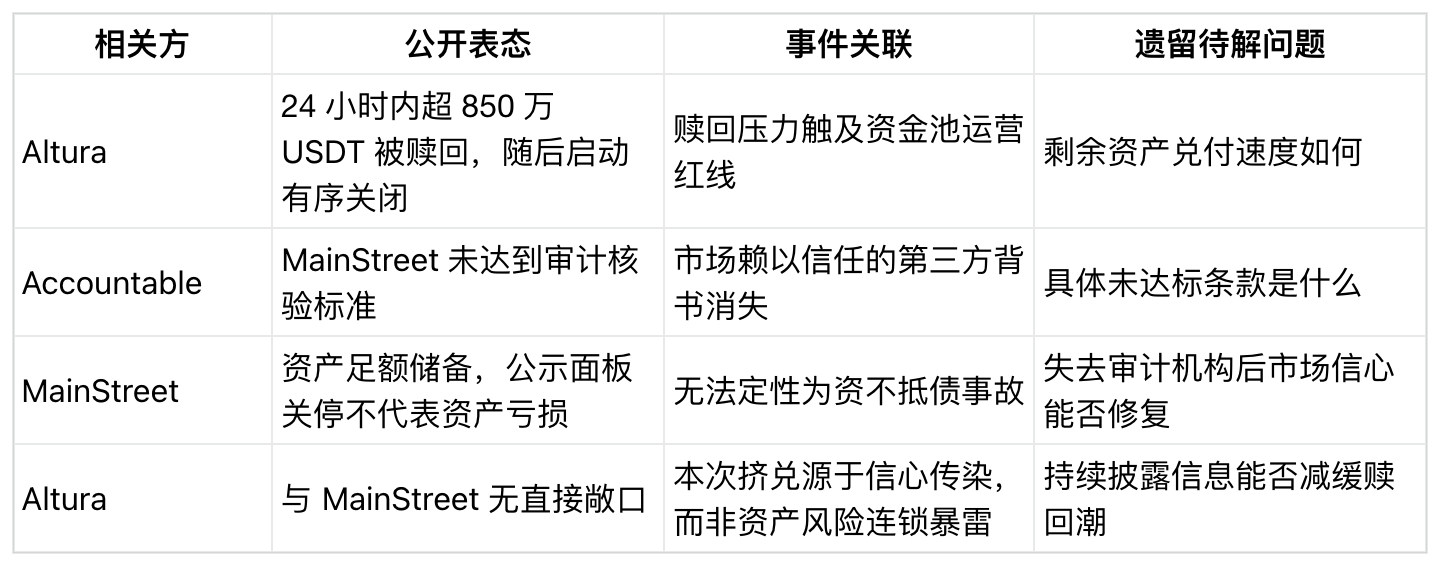
The reserve audit controversy at MainStreet triggered a collapse of market confidence across the entire stablecoin yield sector, with Altura experiencing outflows exceeding 8.5 million USDT in a single day, leading the project to decide on an orderly vault closure.


Altura CEO Ranveer Arora stated that user redemptions exceeded $8.5 million before the vault closure. Altura also asserted that it has no connection whatsoever with MainStreet or its underlying investment strategies. The core of this bank run incident is not the transmission of asset risk, but rather a chain reaction triggered by a collective loss of confidence in similar yield products.


The catalyst for the event was the termination of cooperation between MainStreet and the third-party audit firm Accountable, citing MainStreet's failure to meet audit verification standards. MainStreet publicly claimed to have sufficient asset reserves, but the lack of third-party audit endorsement led to widespread skepticism among users holding similar yield products: If everyone redeems at once, can the fund pool achieve rapid payout?


This is precisely the operational risk exposed by the Altura incident. From a user's perspective, redemption operations seem simple, but the platform's assets are dispersed across different segments such as exchange holdings, private credit lending, and real-world asset (RWA) settlements, each with completely unsynchronized repayment cycles.


MainStreet later stated that the shutdown of the third-party reserve display panel does not indicate asset losses or impairment in the investment portfolio.


Altura's own risk disclaimer is equally crucial: The project explicitly stated that it holds no MainStreet-related assets, and its HyperEVM lending pool, USDT/AVLT trading market, and Ethereum lending targets were unaffected by this event.


However, when users see an audit firm terminate cooperation with a certain stablecoin yield product, their focus shifts from whether a neighboring protocol has risk exposure to whether all similar products can withstand a concentrated redemption wave.


Liquidity Becomes the Core Contradiction in a Concentrated Redemption Wave


Stablecoin users often focus only on the token itself, and the USDT in this incident is also a core settlement vehicle in the crypto market. USDT's peg to the US dollar remains solid, with a total market cap of approximately $186 billion and a 24-hour trading volume exceeding $51 billion.


This market scale has a dual impact: on one hand, USDT's underlying liquidity is extremely abundant, making it difficult for a single USDT-denominated fund pool to shake the overall stablecoin market; but on the other hand, the liquidity of the fund pool itself depends entirely on capital allocation, asset storage channels, settlement rules, and whether counterparties can match users' expected redemption speeds.


Altura's announcement also highlighted this reality: funds stored on exchanges are easier to liquidate quickly compared to private credit or real-world asset (RWA) investments; however, exchange withdrawals are also subject to platform procedures, transfer channels, and market conditions. Private credit and RWA assets have fixed repayment cycles, and processes like loan recovery, share redemption, and settlement windows cannot match DeFi users' demand for instant withdrawals.


The misalignment of repayment cycles for different assets means that even in the absence of actual asset losses, market sentiment can dictate a product's survival. Users who redeem first can withdraw instantly, while those who redeem later can only wait for assets to mature and be liquidated. This expectation drives everyone to redeem early. The mere possibility of batch payouts is enough to accelerate a bank run stampede.


The scale of redemptions in this case is significant. Altura's overall fund pool size reaches tens of millions of dollars, making the 8.5 million USDT single-day redemption a very high proportion. Large-scale concentrated withdrawals force investment portfolios originally focused on yield enhancement to shift towards asset allocation prioritizing liquidity.


Redemption Cycle: The Next Key Indicator to Watch


Looking at the entire stablecoin sector, this lesson cannot be ignored. The total stablecoin market cap is hundreds of billions, with daily trading volumes in the tens of billions. Various yield-bearing stablecoin products promise principal stability plus yield, but their underlying investment strategies often cannot be liquidated instantly.


Such products are operationally feasible, but risks are concentrated at the operational level. Reserve proof displays, third-party audits, exchange holdings, private credit, RWA investments—the liquidity shortcomings of these links are only fully exposed when users abandon the pursuit of yield and simply want to retrieve their cash.


For Altura, the core observation point moving forward is the liquidation process: whether assets can be redeemed orderly, the frequency of platform updates and disclosures, the scale of funds returned at each stage, and whether the platform can prevent users from panic-selling long-term assets at low prices to exit hastily. Current information can only confirm liquidity risks, not prove underlying asset losses at Altura.


For the entire industry's stablecoin yield products, the test from this incident lies in whether third-party audit endorsements can stabilize confidence during market volatility, rather than becoming a trigger for panic. Reserve display panels and third-party verification are tools meant to reduce market uncertainty, but negative news about terminated audit partnerships spreads much faster than project clarifications.


This is the revelation the Altura bank run brings to the industry. In the DeFi fund pool sector, market confidence is by no means an insignificant soft metric; it directly determines whether users are willing to deposit funds long-term, allowing sufficient liquidation cycles for underlying investment strategies.


Preguntas relacionadas

QWhat event triggered the user panic and the subsequent mass withdrawal of over 8.5 million USDT from Altura?

AThe panic was triggered by the news that the third-party audit firm Accountable terminated its cooperation with another stablecoin yield platform, MainStreet, citing MainStreet's failure to meet audit verification standards. This eroded confidence in the entire stablecoin yield sector, leading users to question the liquidity and safety of similar platforms, including Altura.

QAccording to the article, what is the fundamental reason for the liquidity crisis at Altura, despite having no direct exposure to MainStreet's assets?

AThe fundamental reason is a collective loss of confidence in the stablecoin yield sector, leading to a bank run. The crisis is not due to direct asset risk transmission from MainStreet, but rather the mismatch between user expectations for instant withdrawals and the platform's underlying investment assets, which have different and often longer settlement cycles (e.g., exchange holdings vs. private credit or RWA investments).

QWhat key operational risk did the Altura incident expose for stablecoin yield platforms?

AThe incident exposed the liquidity mismatch risk. While platforms invest user funds into various assets (exchange holdings, private credit, RWAs) to generate yield, these assets have different redemption and settlement timelines. These timelines cannot match the DeFi user's expectation for instant withdrawals, creating a vulnerability during periods of mass redemption requests.

QWhat will be a critical indicator to watch regarding Altura's future, as mentioned in the article?

AA critical indicator will be the platform's redemption and wind-down process. This includes observing whether assets can be redeemed in an orderly manner, the frequency of platform updates, the scale of funds returned at each stage, and whether the process can avoid forcing users to sell long-term assets at a discount to exit quickly.

QWhat broader lesson for the stablecoin yield industry does the article draw from the Altura event?

AThe lesson is that market confidence is a critical, hard metric, not a soft one. Tools like third-party audit reports and reserve proof dashboards, intended to reduce uncertainty, can themselves become triggers for panic if their status changes negatively. Confidence directly determines whether users are willing to leave funds deposited long enough for the underlying investment strategies to reach their settlement cycles.

Lecturas Relacionadas

Informe en profundidad de Goldman Sachs: ¿Quiénes serán los ganadores a largo plazo en la industria china de modelos de IA a gran escala?

Informe de Goldman Sachs sobre los posibles ganadores a largo plazo en la industria china de modelos de IA. Los modelos de inteligencia artificial de China se encuentran en un punto de inflexión histórico. Según Goldman Sachs, los modelos de código abierto han alcanzado un rendimiento cercano al de los modelos propietarios globales líderes. Esta evolución ha pasado del enfoque en la eficiencia de costos de DeepSeek el año pasado al momento de la inteligencia del modelo de GLM de Zhipu este año. La adopción por parte de empresas chinas y pymes globales se está expandiendo rápidamente, creando un efecto de vuelo de datos que impulsará nuevas iteraciones. La clave del éxito radica en la innovación arquitectónica y la eficiencia de parámetros, lo que permite a los modelos chinos lograr un rendimiento comparable a un costo significativamente menor. Se está formando una estructura de mercado de dos niveles: un segmento premium (ej. GLM5.2 de Zhipu) y un segmento de bajo costo para tareas de agentes inteligentes y usuarios sensibles al precio. Se proyecta que los ingresos por API y suscripciones de modelos chinos crecerán drásticamente, de 35 mil millones de RMB en 2026 a 879 mil millones en 2030. La estrategia predominante es el código abierto o de pesos abiertos, que favorece la adopción, aunque presenta desafíos para la monetización. La industria podría migrar hacia un modelo de "pesos abiertos + licencia comunitaria" con acuerdos de reparto de ingresos. La expansión internacional, especialmente en mercados no estadounidenses, representa la mayor oportunidad de crecimiento, aprovechando la ventaja de costo-rendimiento. Goldman Sachs identifica a los posibles ganadores utilizando un marco tridimensional que evalúa la capacidad de fijación de precios, la ventaja de costos y la solidez financiera. En modelos de texto básico, Zhipu AI y DeepSeek tienen la posición más sólida. En el ámbito multimodal/generación de video, ByteDance lidera con su modelo Seed. La firma mantiene su calificación de compra para MiniMax, citando su atractiva valoración.

marsbitHace 1 min(s)

Informe en profundidad de Goldman Sachs: ¿Quiénes serán los ganadores a largo plazo en la industria china de modelos de IA a gran escala?

marsbitHace 1 min(s)

Informe Profundo de Goldman Sachs: ¿Quién será el ganador a largo plazo en la industria china de modelos de IA grandes?

China se encuentra en un punto de inflexión histórico en cuanto a modelos de IA a gran escala. Según Goldman Sachs, los modelos chinos de código abierto/ponderaciones abiertas han alcanzado un rendimiento cercano al de los mejores modelos propietarios globales, con una rápida adopción por empresas chinas y pymes mundiales, creando un efecto de círculo virtuoso de datos para futuras mejoras. El informe destaca la ventaja de coste-eficiencia de los modelos chinos, lograda mediante innovaciones arquitectónicas (como MoE) que permiten alto rendimiento con menos parámetros activos (3-5%). Modelos como DeepSeek V4 Pro (1,6 billones de parámetros) y GLM5.2 de Zhipu (0,7 billones) son ejemplos clave. El LongCat 2.0 de Meituan, entrenado con chips nacionales, marca un hito en la autosuficiencia. El mercado se está estructurando en dos niveles: modelos premium (como GLM5.2, ~1$/millón de tokens) y modelos económicos para agentes de IA (~0.06-0.2$/millón). Se proyecta que los ingresos por API/suscripción crezcan desde 35.000 millones de RMB en 2026 hasta 879.000 millones en 2030. La estrategia predominante es el código abierto o ponderaciones abiertas (salvo ByteDance), lo que fomenta la adopción pero limita la monetización directa. Se espera una transición hacia licencias comunitarias con acuerdos de reparto de ingresos para mejorar la rentabilidad. La expansión internacional, especialmente en mercados no estadounidenses, es clave. El enfoque empresarial global está cambiando de maximizar tokens a priorizar el ROI. Plataformas como AWS Bedrock y Gemini ya ofrecen modelos chinos. Para identificar a los ganadores a largo plazo, Goldman Sachs aplica un marco basado en capacidad de fijación de precios, ventaja en costes y solidez financiera. En modelos de texto, Zhipu y DeepSeek tienen la posición más fuerte. En multimodal/generación de video, ByteDance lidera con Seed, seguido por Kuaishou y MiniMax. Se mantiene una calificación de compra para MiniMax y Kuaishou.

链捕手Hace 6 min(s)

Informe Profundo de Goldman Sachs: ¿Quién será el ganador a largo plazo en la industria china de modelos de IA grandes?

链捕手Hace 6 min(s)

¿Es Ethereum realmente un «ordenador mundial»?

Ethereum, fundado como una "computadora mundial", enfrenta desafíos para cumplir plenamente con esa visión. Un análisis de la distribución geográfica de sus nodos validadores revela una concentración significativa: Estados Unidos (38,19%) y Alemania (13,04%) representan más de la mitad de la red. Aunque los nodos domésticos son una característica destacada en EE.UU., los proveedores de nube como Hetzner y OVH también influyen en la ubicación de los nodos. La distribución entre operadores profesionales es más equilibrada. La participación de EE.UU. cae al 25,81%, mientras que naciones asiáticas como Singapur, Hong Kong, Japón y Corea del Sur suman casi un 25%, reflejando una estrategia deliberada para cumplir con requisitos regulatorios locales y reducir la latencia. Regiones como América del Sur, Oriente Medio y África permanecen notablemente subrepresentadas. Este desequilibrio se ve exacerbado por el mecanismo de consenso de Ethereum, donde una menor densidad de nodos en un área puede crear un "punto ciego geográfico", perjudicando el rendimiento de los validadores locales y comprometiendo los principios de descentralización. Sin embargo, esta disparidad también presenta una oportunidad. Existe una ventaja estratégica para quienes puedan establecer infraestructura de validación confiable y localizada en estas regiones actualmente desatendidas, anticipándose a la creciente demanda de servicios de staking que cumplan con la soberanía de datos y las regulaciones locales.

Foresight NewsHace 2 hora(s)

¿Es Ethereum realmente un «ordenador mundial»?

Foresight NewsHace 2 hora(s)

Trading

Spot
活动图片