80% of Tokens Fall Below Issue Price, IPO Financing Soars 48 Times—Crypto Capital Shift Has Occurred

marsbitPublicado a 2026-03-15Actualizado a 2026-03-15

Resumen

The crypto industry is witnessing a significant capital shift from token offerings to traditional equity markets. In 2025, over 80% of tokens traded below their initial offering price due to high volatility, weak demand, and poor tokenomics, eroding investor confidence. Conversely, crypto IPOs surged 48x, raising $14.6 billion, while M&A activity hit a five-year high of $42.5 billion. Equity offerings, compared to tokens, demonstrate similar upside potential but with lower volatility and longer-term growth. Stocks command higher valuation premiums (P/S ratios of 7-40x vs. 2-16x for tokens) due to institutional access, index inclusion potential, and richer trading strategies. Key valuation factors include regulatory moats, revenue diversification, and sector sentiment. M&A activity is accelerating, driven by regulatory compliance and strategic expansion, with focus on trading infrastructure, exchanges, and stablecoins/payments. Major acquisitions were led by Coinbase, Kraken, and Ripple. Upcoming IPOs in 2026 include Kraken, Consensys, Ledger, Animoca, and Bithumb. The future lies in blending TradFi validation with crypto innovation, emphasizing sustainable revenue and long-term value creation.

Author: DWF Ventures

Compiled by: Deep Tide TechFlow

Deep Tide's Introduction: This report from DWF Ventures makes one thing clear with data: money hasn't left crypto, it has just shifted tracks. In 2025, over 80% of tokens traded below their initial offering price, while crypto IPO financing surged 48 times to $14.6 billion, and M&A reached a five-year high of $42.5 billion. This isn't just a matter of market mood; it's a systemic migration of capital structure, with a wave of IPOs including Kraken, Ledger, and Animoca on the way for 2026.

Core Conclusions

The old playbook for token offerings is over. High valuations and declining liquidity have hit investor confidence, and we are seeing a shift of funds towards equity.

Tokens and equity offer similar upside potential, but their risk structures are vastly different: tokens peak faster (within 30 days) and face greater volatility; equity, on the other hand, maintains steady gains over a longer time horizon.

Equity enjoys a higher valuation premium than tokens: this premium can be attributed to institutional access barriers, potential for index inclusion, and the richer trading strategies supported by equity.

Price-to-Sales (P/S) ratio provides a useful benchmark for company evaluation, but the dispersion in valuations reflects the importance of other factors, including regulatory moats, revenue diversification, shareholder value, and sector sentiment.

M&A activity hits a five-year high, consolidation accelerates: Acquiring capabilities is proving faster than building them, and regulatory compliance is driving strategic M&A.

The Current State of Token Offerings

The crypto industry has reached an inflection point. Billions of dollars are pouring in, institutional interest is at a peak, and regulation is becoming friendlier—yet for builders and users, everything feels gloomier than ever. The widening gap between institutional inflows and the morale of the crypto-native community is part of a larger problem—the original spirit of decentralization and cypherpunk experimentation seems to be fading with the influx and immense influence of centralized entities.

Crypto has also thrived in a high-risk, casino-like environment, which is being slowly stripped away as token performance plummets. This is also driven by extractive events that significantly impact retail investors, leading to liquidity withdrawal from the market.

According to a report by Memento Research, over 80% of tokens issued in 2025 are currently trading below their TGE price. Projects have been severely hit by high volatility and a general lack of token demand—due to high valuations that are difficult to justify and sustain. Upside is also scarce, with most tokens facing massive selling pressure from TGE—stemming from early profit-taking, lack of substantial confidence in the product, or poor token economic models (airdrops, CEX listings, etc.). This has dampened investor and retail interest, and events like 10/10 have further exacerbated crypto outflows, calling into question the industry's core infrastructure.
The Rise of IPOs

Meanwhile, in traditional markets, IPOs are gaining strong traction among crypto companies—2025 saw many notable listings, and more companies are filing for upcoming IPOs. Data shows that crypto IPO financing increased 48 times compared to 2024, raising over $14.6 billion in 2025. M&A deals experienced similar growth, with leading core companies seeking to diversify their offerings, which we explore further below. Overall, the strong performance of these companies demonstrates a robust market demand for digital asset exposure, a momentum likely to accelerate further into 2026.

The Flow of Liquidity

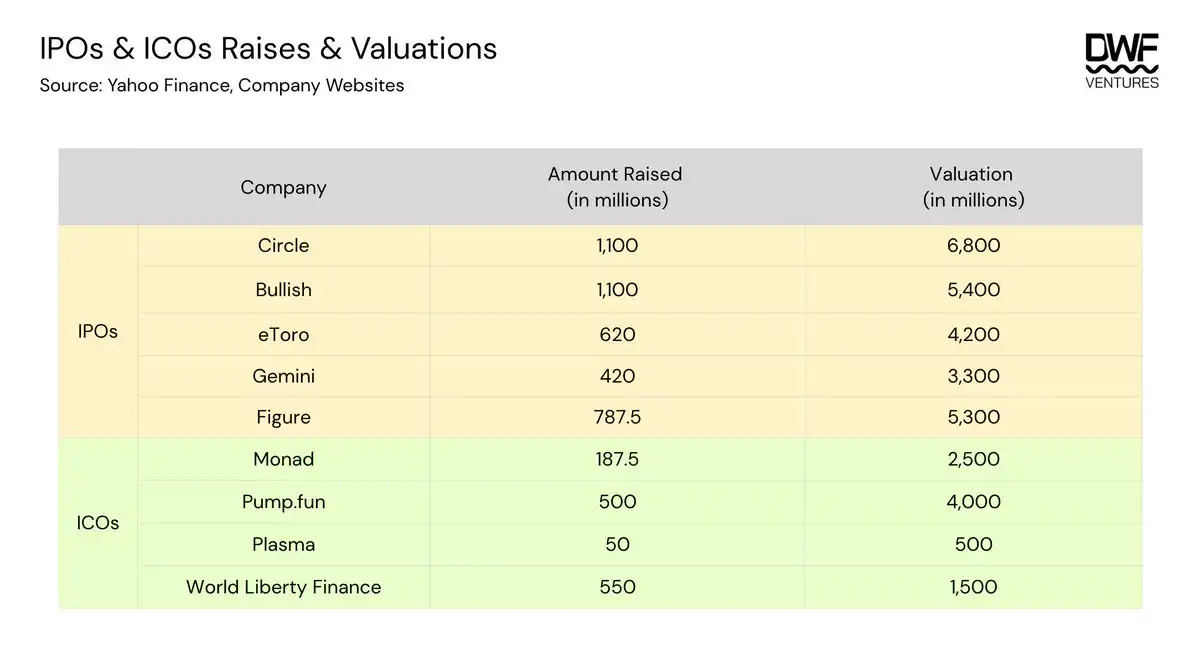
Over the past year, we have seen high-profile IPOs and ICOs both raise significant capital. The table below shows the funding amounts and initial valuations for various companies.

From this, we observe that IPO and ICO valuations are relatively close. Some ICOs, like Plasma, were specifically priced below the valuation for institutional investors, aiming to provide greater upside and participation opportunities for retail investors. On average, the public float for IPOs ranges from 12% to 20%, while for ICOs it ranges from 7% to 12%. World Liberty Finance is a clear exception, offering over 35% of the total supply for sale.

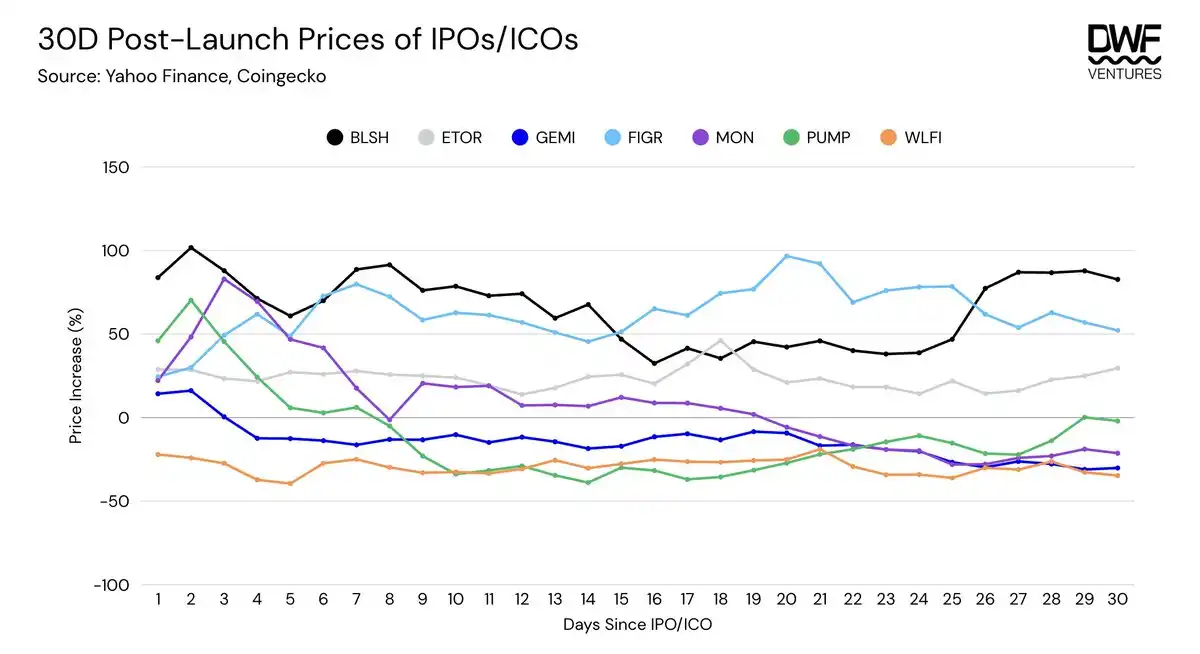
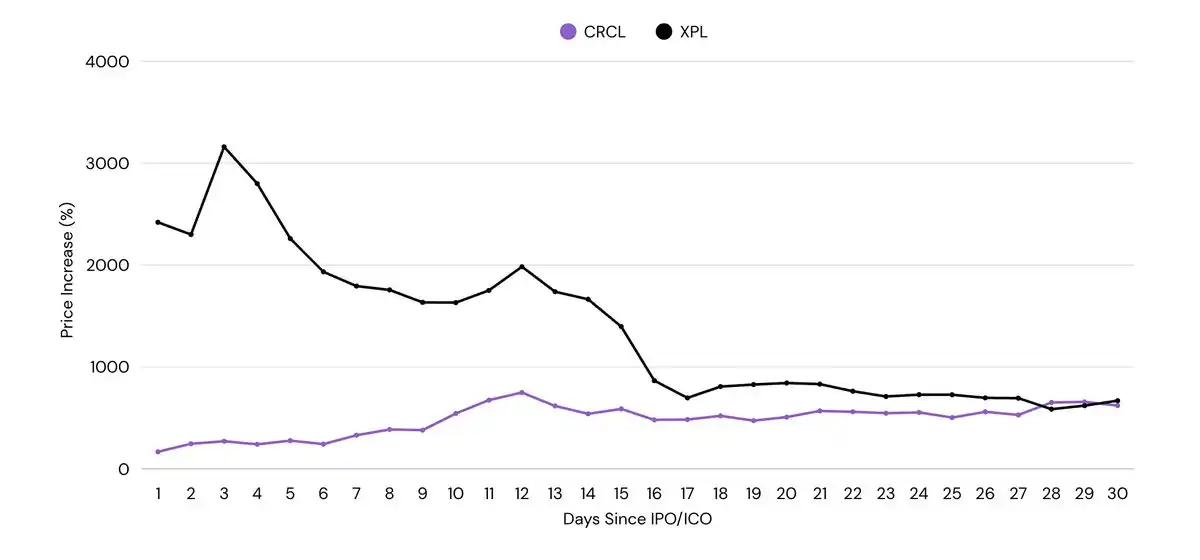
Analyzing the performance of ICOs and IPOs, tokens are associated with greater short-term volatility and a shorter time to peak (within 30 days). On the other hand, equities tend to record steady gains over a longer time horizon. Notably, however, the upside potential is similar for both.

CRCL and XPL are exceptions, having experienced massive gains from the start, offering investors 10x to 25x upside. Nonetheless, their performance also followed the aforementioned trend—XPL retraced 65% from its peak within two weeks, while CRCL climbed steadily over the same period.
Revenue: Assessing the Equity Premium

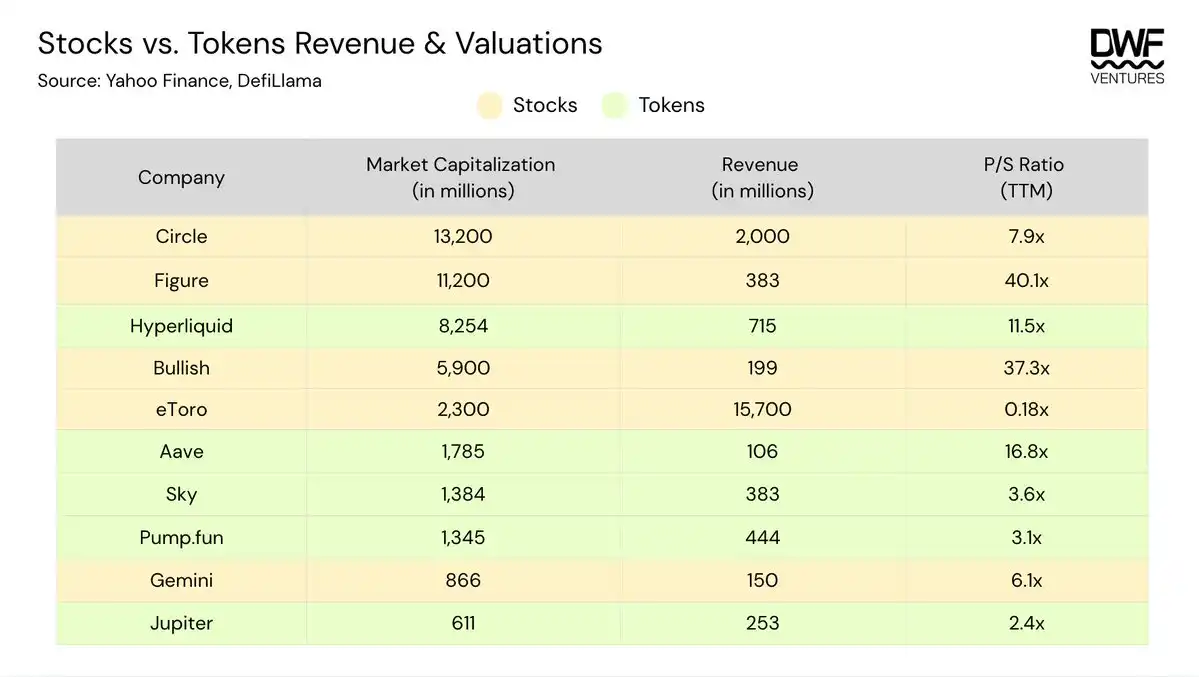
Delving into revenue figures, stocks overall enjoy a higher premium than tokens, with P/S ratios in the ranges of 7-40x and 2-16x, respectively. This can be attributed to enhanced liquidity from several factors:

Institutional Access: Despite growing positive sentiment around holding digital assets on balance sheets, this remains limited to funds with securities-only mandates (particularly pensions or endowments). Opting for an IPO allows companies to tap into this pool of institutional capital.

Index Inclusion: The growth tailwinds in public markets are far stronger than on-chain. Coinbase's inclusion in the S&P 500 in May 2025 as the first crypto company likely contributed to buying pressure from index-tracking funds/ETFs accumulating positions.

Alternative Strategies: Compared to on-chain tokens, equity enables a wider variety of institutional strategies, including options and leverage, whereas on-chain tokens often lack liquidity and counterparties.

Overall, the P/S ratio shows a company's valuation based on the last 12 months of revenue, helping to judge whether a company is undervalued or overvalued relative to its peers. However, factors beyond the numbers that reflect investor sentiment are not captured. Some factors to consider when evaluating stocks/tokens include:

Moats & Diversification: In the fast-evolving digital asset industry, this is crucial. The market is paying a premium for licenses and regulatory compliance, while diversified business models strengthen the value proposition of the core business beyond pure revenue numbers.

For example, Figure launched its own RWA lending pools, open to retail and institutional investors, and became the first SEC-approved yield-bearing stablecoin ($YLDS). Bullish is a regulated exchange that also owns other businesses like CoinDesk, enhancing its value beyond pure trading services. These factors likely contributed to higher premiums.

In contrast, eToro has an extremely low P/S, seemingly "undervalued" on the surface, but a deeper analysis reveals its revenue growth climbing in sync with costs, which is not optimal. Furthermore, the company is purely focused on providing trading services, lacking differentiation and having low margins. This indicates that building defensible moats and diversified business models are also key considerations for investors.

Shareholder Value: Returning capital to investors through buybacks is common in both stocks and tokens, especially for high-revenue companies.

For example, Hyperliquid has one of the most aggressive buyback programs, with 97% of revenue used for buybacks. Since genesis, the aid fund has bought back over 40.5 million HYPE tokens, representing over 4% of the total supply. Such aggressive buybacks impact the price, boosting investor confidence as long as revenue remains stable and the sector has room for growth. This leads to a higher P/S ratio but does not necessarily mean the token is "overvalued," as strong support from the team itself is real.

Sector Sentiment: High-growth sectors driven by institutional or regulatory dynamics naturally command a premium, as investors seek exposure.

For example, Circle's stock price soared quickly after its IPO in June 2025, with the P/S ratio peaking at around 27x. This could be attributed to the passage of the GENIUS Act—a framework dedicated to legitimizing stablecoin adoption and issuance, introduced shortly after Circle's listing, which would make Circle a major beneficiary as a leading player in the stablecoin infrastructure space.

M&A: The Great Consolidation

According to the report, crypto M&A activity hit a five-year high in 2025—driven by massive entry from TradFi institutions, coupled with more friendly regulatory sentiment. After the Trump administration rolled out a series of crypto-friendly policies, the Digital Asset Treasury (DAT) frenzy emerged, making holding digital assets on balance sheets less controversial. Companies also shifted focus to acquisitions, as it is a more efficient way to obtain specific licenses for better compliance. Overall, the introduction of appropriate regulatory frameworks laid the groundwork for M&A acceleration.
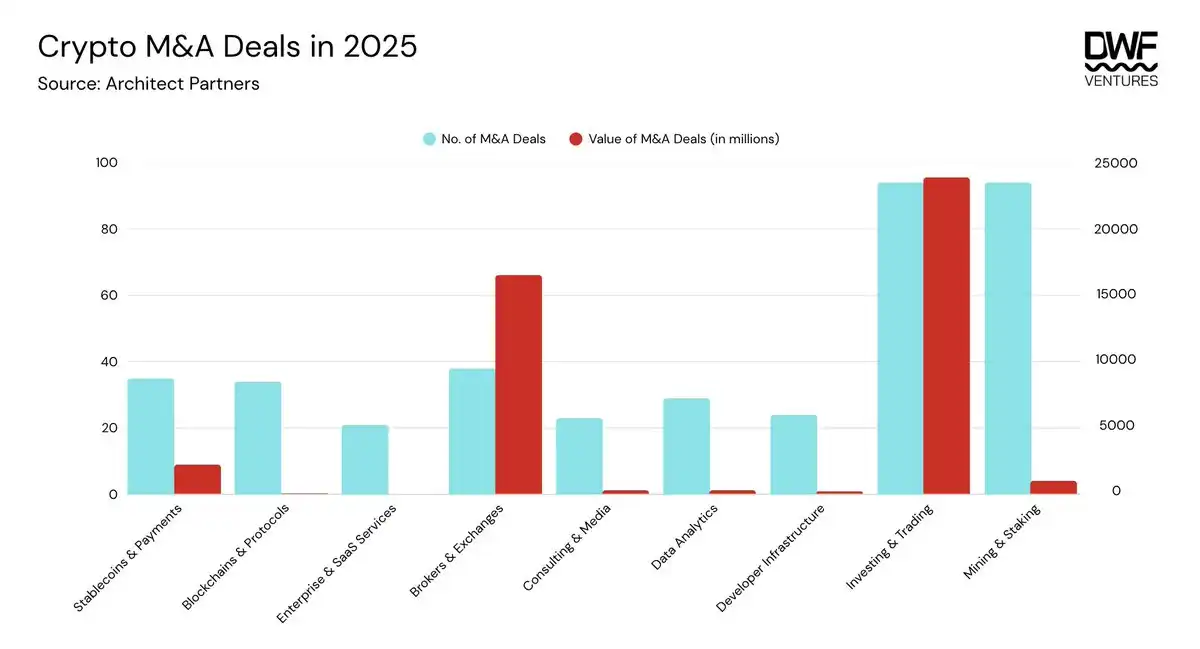
Looking back over the past year, we see a clear rise in the number of deals across categories. The following three categories have become priorities for institutions:

Investment & Trading: Encompassing trade settlement, tokenization, derivatives, lending, and DAT infrastructure;

Brokers & Exchanges: Regulated platforms focused on digital assets;

Stablecoins & Payments: Covering on/off-ramps, infrastructure, and applications.

These three categories together accounted for over 96% of the deal value in 2025, totaling over $42.5 billion.
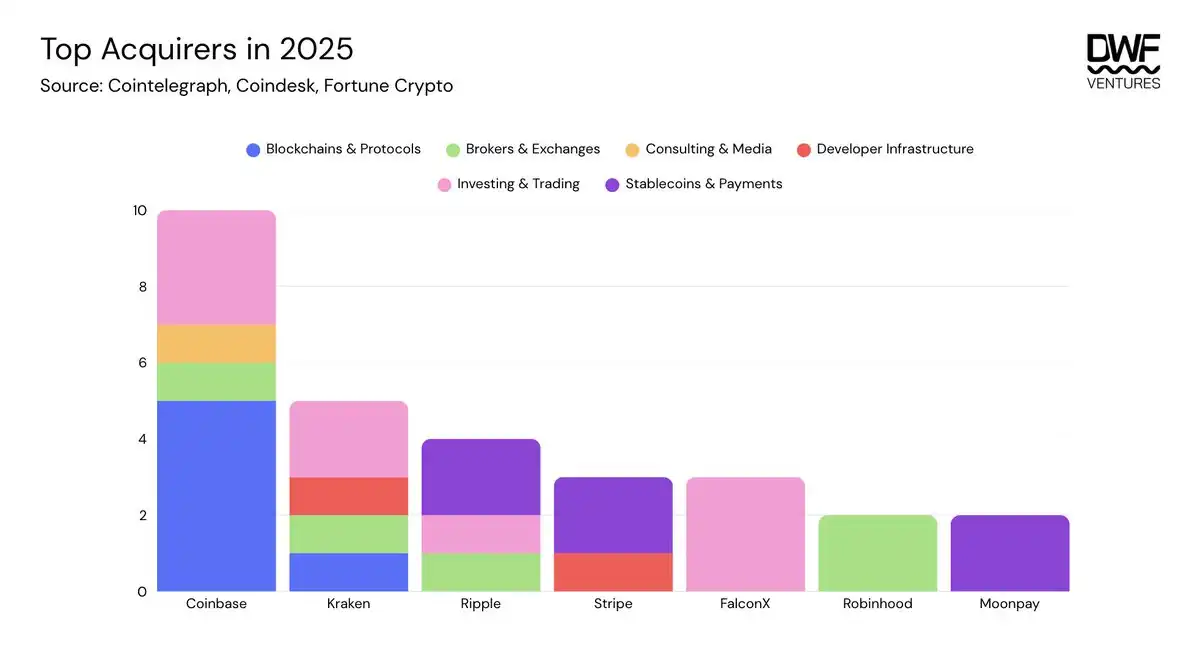
Top acquirers include Coinbase, Kraken, and Ripple, all involved in multiple categories. Among them, Coinbase's moves are particularly prominent, highlighting its ambition to become a "one-stop super app," with a core focus on bringing on-chain to the masses through acquisitions of both traditional and innovative DApps. This is driven by intensifying competition among exchanges and the quest for all-in-one traffic portals.

Companies like FalconX and Moonpay are deeply cultivating their own categories, building full-service capabilities through complementary acquisitions.
The Next Step for Token Offerings

Despite the current market environment and sentiment, we believe 2026 will continue to bring significant tailwinds to the digital asset space. We expect more companies to go public, which is a net positive for the industry overall—it provides access to a larger pool of capital and investors, making the overall pie bigger.

The next batch of IPO candidates includes:

Kraken: Filed an S-1 registration statement with the SEC in November 2025, with strong expectations for an IPO in early 2026;

Consensys: Reportedly working with Goldman Sachs and JPMorgan to prepare for a mid-2026 listing;

Ledger: Targeting a $4 billion valuation, advancing its IPO with Goldman Sachs, Jefferies, and Barclays;

Animoca: Plans to list on Nasdaq in 2026 via a reverse merger with Currenc Group Inc.;

Bithumb: Aims to list on Korea's KOSDAQ in 2026 with a $1 billion valuation, underwritten by Samsung Securities.

The way forward is not a choice between TradFi validation and crypto-native innovation—it is fusion. For builders and investors, this means prioritizing fundamentals and building useful products that generate real, sustainable revenue. A shift towards a long-term mindset may cause some turbulence, but those who adapt will be able to capture the next wave of value creation.

The token is dead, long live crypto.

Preguntas relacionadas

QWhat is the core conclusion of the DWF Ventures report regarding the shift in crypto capital flow?

AThe report concludes that the old model of token launches is over. Capital is shifting from tokens to equity due to high valuations and declining liquidity eroding investor confidence. While both tokens and equity offer similar upside potential, they have vastly different risk structures. Equity enjoys a higher valuation premium, attributed to institutional access, index inclusion potential, and support for richer trading strategies.

QAccording to the report, what percentage of tokens launched in 2025 were trading below their TGE price, and what were the cited reasons?

AOver 80% of tokens launched in 2025 were trading below their Token Generation Event (TGE) price. The reasons cited include high volatility, a general lack of token demand due to difficult-to-justify high valuations, significant selling pressure from early profit-taking, a lack of substantive confidence in the product, and poor tokenomics (e.g., airdrops, CEX listings).

QHow did crypto IPO fundraising and M&A activity change in 2025 compared to 2024?

ACrypto IPO fundraising in 2025 grew 48 times (48x) compared to 2024, raising over $14.6 billion. Mergers and Acquisitions (M&A) activity also surged, reaching a five-year high of $42.5 billion.

QWhat factors does the report attribute to the higher valuation premium for equity over tokens?

AThe higher valuation premium for equity is attributed to three main factors: 1) Institutional Access: IPOs allow companies to tap into a pool of institutional capital (e.g., pensions, endowments) that often have mandates restricting direct digital asset holdings. 2) Index Inclusion Potential: Public market growth drivers are stronger, and inclusion in major indices (like the S&P 500) creates buying pressure. 3) Richer Trading Strategies: Equity supports a wider variety of institutional strategies, including options and leverage, which are less liquid or available for on-chain tokens.

QWhich companies are mentioned in the report as being potential IPO candidates for 2026?

AThe report lists several potential IPO candidates for 2026, including Kraken (filed an S-1 in late 2025), Consensys (reportedly working with Goldman Sachs and JPMorgan), Ledger (targeting a $4B valuation with Goldman, Jefferies, and Barclays), Animoca Brands (planning a Nasdaq listing via a reverse merger), and Bithumb (targeting a $1B valuation on the Korean KOSDAQ).

Lecturas Relacionadas

"Gran Batalla" entre las casas de cambio coreanas y los reguladores, desafiando los límites de la aplicación y la legislación

Corea del Sur: los principales intercambios de criptomonedas desafían a los reguladores La industria cripto de Corea del Sur está en un conflicto regulatorio abierto. La Unidad de Inteligencia Financiera (FIU), principal regulador contra el lavado de dinero, ha impuesto multas y suspensiones de operación a grandes intercambios como Upbit (de Dunamu) y Bithumb por presuntas deficiencias en la verificación de clientes (KYC) y transacciones con VASP no registrados. Sin embargo, los intercambios ya no aceptan pasivamente las sanciones. Upbit ganó un fallo judicial inicial que anuló parte de la sanción de la FIU, con el tribunal señalando que los criterios regulatorios no estaban suficientemente claros. A Bithumb se le concedió una suspensión temporal de su sanción para evitar daños irreparables durante el litigio. La FIU ha apelado el caso de Upbit. En un segundo frente, la asociación de la industria DAXA protesta por una enmienda legal propuesta que obligaría a reportar como "sospechosas" todas las transferencias de cripto superiores a 10 millones de wones (unos 6.800 dólares). DAXA argumenta que esto colapsaría el sistema de reportes y desviaría la atención de las transacciones genuinamente riesgosas. Este enfrentamiento subraya una tensión en la regulación coreana: un marco legal integral aún está en desarrollo, mientras que la FIU aplica agresivamente normas AML existentes. Los intercambios ahora cuestionan la base legal y la proporcionalidad de las sanciones, llevando el debate a los tribunales y el proceso legislativo. El resultado podría redefinir los límites de la aplicación regulatoria en el mercado cripto surcoreano.

marsbitHace 34 min(s)

"Gran Batalla" entre las casas de cambio coreanas y los reguladores, desafiando los límites de la aplicación y la legislación

marsbitHace 34 min(s)

Los multimillonarios detrás de las elecciones de medio mandato más costosas de la historia

**Resumen: Los multimillonarios detrás de las elecciones intermedias más caras de la historia** Esta temporada electoral está marcada por contribuciones récord de grandes fortunas. Jeff Yass, fundador de Susquehanna International Group, es el tercer mayor donante individual con más de 81 millones de dólares, apoyando principalmente causas como la libertad de elección escolar y al comité de acción política de Trump, MAGA Inc. El ciclo electoral federal ha recaudado más de 4,700 millones de dólares, y se prevé que el gasto en anuncios políticos supere los 10,800 millones. Los fondos fluyen mayoritariamente hacia los comités republicanos y los PAC asociados a Trump, que recaudaron 917 millones solo en el primer trimestre, muy por encima de los 262 millones de los demócratas. Los superricos intervienen impulsados por intereses clave: Sergey Brin y Chris Larsen invierten millones para oponerse a un impuesto a los ultra ricos en California, y figuras como Marc Andreessen y Ben Horowitz financian PACs relacionados con la criptomoneda y la IA. Entre los mayores donantes destacan George Soros (102.6 millones), Elon Musk (84.8 millones) y Miriam Adelson (42.6 millones), cuyas donaciones moldean políticas sobre Israel, tecnología y elecciones judiciales. La influencia del "dinero oscuro" anónimo sigue en aumento. Estas enormes sumas subrayan la batalla por el control del Congreso y la definición de políticas cruciales en los últimos dos años de un posible segundo mandato de Trump.

marsbitHace 1 hora(s)

Los multimillonarios detrás de las elecciones de medio mandato más costosas de la historia

marsbitHace 1 hora(s)

Después de 50 veces el almacenamiento, Sun Yuchen siempre está mirando al próximo decenio

La mayoría conoce a Sun Yuchen por sus excéntricas historias, desde gastar millones en cenas con Warren Buffett hasta volar al espacio. Pero detrás del escándalo, lleva una década acertando en inversiones: en 2016 recomendó comprar Bitcoin, Nvidia, Tesla y Tencent. Hoy, quienes siguieron su consejo han multiplicado su capital enormemente. Recientemente, Sun predijo el auge del almacenamiento de datos, y acciones como SanDisk (SNDK) se dispararon casi 50 veces. Ahora, su mirada está puesta en la inteligencia física (Physical AI), destacando cuatro áreas clave: 1. **Inteligencia encarnada (Robótica)**: Empresas como Unitree y Galaxy General lideran la producción y financiación de robots humanoides, impulsados por modelos VLA que permiten a las máquinas "ver" y actuar en el mundo real. 2. **Drones**: Ya son una realidad comercial, desde la agricultura hasta entregas urbanas y uso militar, siendo la primera aplicación de IA con un ciclo comercial cerrado en el mundo físico. 3. **Computación espacial**: Más allá del VR, tecnologías como el Apple Vision Pro buscan que la IA comprenda y interactúe con el espacio físico, un requisito fundamental para robots, drones y vehículos autónomos. 4. **Exploración espacial**: Sun viajó al espacio con Blue Origin y visualiza una "economía espacial" con blockchain para derechos de activos y transacciones interplanetarias. Su lógica de inversión se basa en apostar por sectores con dirección clara, diversificando entre actores clave: en robótica, apuesta por el "cuerpo" (Tesla Optimus) y el "cerebro" (Nvidia); en drones, por aplicaciones militares y comerciales; en el espacio, por SpaceX (próxima gran IPO) y Rocket Lab. En resumen, Sun Yuchen prevé que, mientras la última década transformó el flujo de información, las próximas dos décadas verán a la IA remodelar el mundo físico: robots en fábricas, vehículos autónomos, enjambres de drones y una creciente presencia humana y robótica en el espacio. Mientras muchos aún esperan oportunidades tradicionales, él ya está mirando hacia el próximo horizonte tecnológico.

marsbitHace 1 hora(s)

Después de 50 veces el almacenamiento, Sun Yuchen siempre está mirando al próximo decenio

marsbitHace 1 hora(s)

El mayor IPO de la historia se acerca, superando a SpaceX: 28 años de auto-iteración de la IA, cuenta atrás para la explosión de inteligencia

**Resumen: La carrera hacia el primer IPO de un billón de dólares y la cuenta atrás para la 'explosión de inteligencia'** Anthropic, la empresa de IA fundada en 2021, está cerca de una operación que la valoraría en casi **un billón de dólares**, superando potencialmente a SpaceX en lo que sería una de las OPV más grandes de la historia. Su valoración implícita en mercados previos a la OPV ya alcanza los 1,2 billones. Este frenesí inversor se debe a un crecimiento sin precedentes. Sus ingresos anuales recurrentes (ARR) se dispararon a **450.000 millones de dólares en mayo de 2026**, multiplicándose por 5 en solo cinco meses. Desde 2022, los ingresos han crecido 4.500 veces. Este crecimiento exponencial está impulsado por sus productos estrella, Claude Code y Cowork, que dominan los mercados de codificación con IA y colaboración empresarial. Sin embargo, la verdadera razón detrás de esta valoración astronómica es una audaz predicción de su cofundador, Jack Clark: **para finales de 2028, hay más de un 50% de probabilidad de que los sistemas de IA puedan automejorarse de forma autónoma**, iniciando una "explosión de inteligencia" recursiva. Clark compara esto con una impresora 3D capaz de imprimir cabezales de impresión mejores que sí misma, un concepto que cambiaría todo. Esta visión explica la estrategia de Anthropic de desbancar a gigantes de la consultoría como McKinsey mediante una empresa conjunta de 15.000 millones de dólares con Goldman Sachs y Blackstone. No se trata solo de reemplazar tareas, sino de que la IA ejecute estrategias complejas, probando si puede sustituir el trabajo cognitivo de alto nivel. Así, la vertiginosa valoración de Anthropic no solo cotiza un negocio exitoso, sino **la expectativa de un cambio de paradigma global**. La cuenta atrás hacia 2028, el año de la posible autorreplicación de la IA, ya ha comenzado, planteando tanto oportunidades extraordinarias como riesgos existenciales para la economía y la seguridad mundial.

marsbitHace 1 hora(s)

El mayor IPO de la historia se acerca, superando a SpaceX: 28 años de auto-iteración de la IA, cuenta atrás para la explosión de inteligencia

marsbitHace 1 hora(s)

Trading

Spot
Futuros

Artículos destacados

Cómo comprar T

¡Bienvenido a HTX.com! Hemos hecho que comprar Threshold Network Token (T) sea simple y conveniente. Sigue nuestra guía paso a paso para iniciar tu viaje de criptos.Paso 1: crea tu cuenta HTXUtiliza tu correo electrónico o número de teléfono para registrarte y obtener una cuenta gratuita en HTX. Experimenta un proceso de registro sin complicaciones y desbloquea todas las funciones.Obtener mi cuentaPaso 2: ve a Comprar cripto y elige tu método de pagoTarjeta de crédito/débito: usa tu Visa o Mastercard para comprar Threshold Network Token (T) al instante.Saldo: utiliza fondos del saldo de tu cuenta HTX para tradear sin problemas.Terceros: hemos agregado métodos de pago populares como Google Pay y Apple Pay para mejorar la comodidad.P2P: tradear directamente con otros usuarios en HTX.Over-the-Counter (OTC): ofrecemos servicios personalizados y tipos de cambio competitivos para los traders.Paso 3: guarda tu Threshold Network Token (T)Después de comprar tu Threshold Network Token (T), guárdalo en tu cuenta HTX. Alternativamente, puedes enviarlo a otro lugar mediante transferencia blockchain o utilizarlo para tradear otras criptomonedas.Paso 4: tradear Threshold Network Token (T)Tradear fácilmente con Threshold Network Token (T) en HTX's mercado spot. Simplemente accede a tu cuenta, selecciona tu par de trading, ejecuta tus trades y monitorea en tiempo real. Ofrecemos una experiencia fácil de usar tanto para principiantes como para traders experimentados.

484 Vistas totalesPublicado en 2024.12.10Actualizado en 2025.03.21

Cómo comprar T

Discusiones

Bienvenido a la comunidad de HTX. Aquí puedes mantenerte informado sobre los últimos desarrollos de la plataforma y acceder a análisis profesionales del mercado. A continuación se presentan las opiniones de los usuarios sobre el precio de T (T).

活动图片













