[Key interpretation] Whale abnormally traded 56500 BTC, and the explosion scale reached 250 million dollars

HuobiPublicado a 2022-09-07Actualizado a 2022-09-08

Resumen

BTC's one-day position explosion reached 250 million US dollars, the transfer of giant whale soared, and the spot transaction increased greatly.

1. A large number of BTC transactions

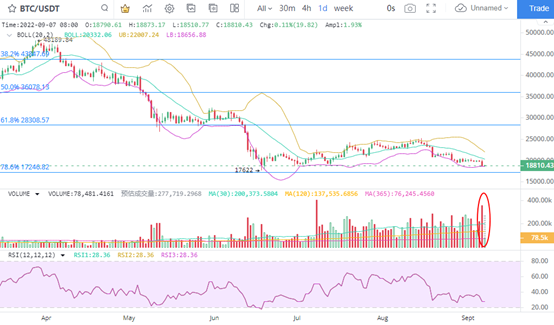
With the rapid expansion of the decline, the trading volume of BTC in the spot market increased rapidly on September 6, almost reaching the highest peak in a year, and the value was only lower than the trading volume on July 8. In other words, more investors participated in BTC's short-term trading, making the short-term break down more authentic. As the cost price of investors has been very concentrated in the past two months, the breaking down of BTC is more worthy of investors' attention. With the progress of the adjustment, BTC has gone farther and farther on the road of further breaking. At present, there is still a chance of short-term shocks in the long and short-term competition, and the price direction after shocks may still be downward.
2. BTC chain transaction rebound

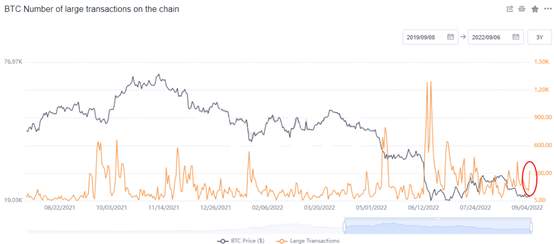
Large value transactions on the BTC chain have obviously continued to rebound. Numerically, the number of large value transactions on September 6 increased to 113, which is converted into 56500 BTCs. This shows that the trading performance of whale investors is still active, especially when BTC is about to fall below the current price platform of $18800, and the long and short competition is more intense.
3. BTC explosion lifting

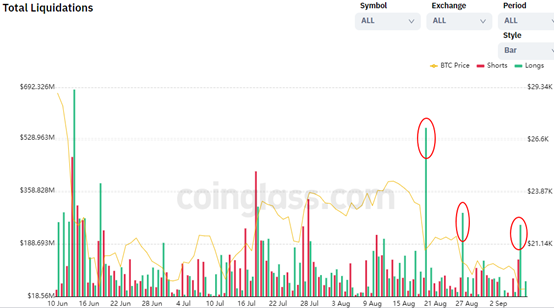
BTC's position explosion scale further maintained a high level, especially during the typical adjustment period, the one-day position explosion scale easily reached $100 million. On September 6, BTC's long position explosion scale increased to 249 million US dollars, which means that more investors have suffered losses. On August 26 and August 19 in the early stage, the size of the positions sold also reached 288 million US dollars and 562 million US dollars. Judging from this, the breakthrough of key points has been sustained by large-scale multi position bursts. Therefore, BTC's breakthrough effect on the downward price is very significant. Despite this, BTC contract position has not significantly decreased. At present, at the key price low point, there is a greater possibility of further changes.
4. Eth drops suddenly

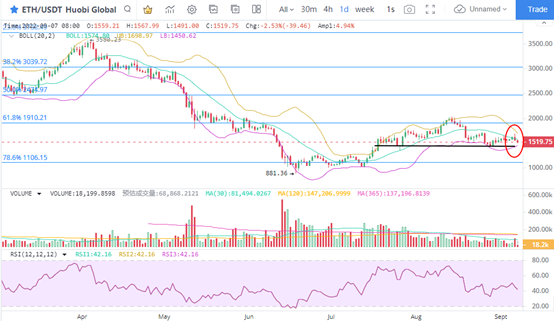
The short-term pullback of eth prices indicates that there are signs of reversal at the daily K-line level. The recent price support platform shown in the figure is about to be confirmed to fall below. At present, with the overall trading volume in the doldrums, there are signs of continuous volume release during the accelerated decline of eth, so the market is still dominated by short sellers. At present, the intraday amplitude of eth reached 8.21% on September 6, twice that of the previous trading day. After the amplitude increases, there are signs of changing the price. After falling below eth's $1400 platform, the price may soon hit the low of $1000.
5. Eth financing interest rate dropped significantly

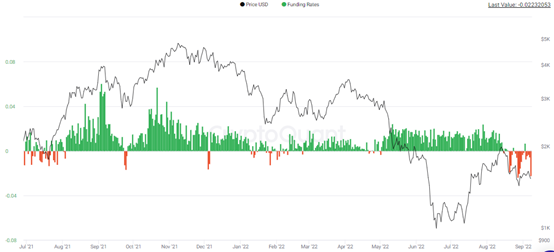
The current price of eth's financing interest rate dropped below 0. On September 7, the financing interest rate was -0.022. This shows that with the adjustment, the recent negative financing interest rate performance has not fundamentally changed, indicating that the price trend is significantly downward. Judging from the pullback of financing interest rate at least, the selling of investors is still very positive, making the prediction that the price may reach the point more pessimistic.

The financing interest rate dropped below 0, indicating that the cost for investors to buy eth has been very low. This shows that the market continues to develop in a declining direction.

Lecturas Relacionadas

¿Cómo usa Codex el ordenador? Tres puntos de entrada y límites de permisos

Este artículo explica las tres formas en que Codex interactúa con el entorno externo: Uso del Ordenador, la extensión de Chrome y el Navegador integrado en la aplicación. Cada una aborda la tarea de "usar el ordenador", pero se adapta a diferentes escenarios, niveles de permisos y confianza. * **Uso del Ordenador (@Computer)**: Es el de mayor alcance, permitiendo operar aplicaciones nativas de macOS/Windows, configuraciones del sistema, el simulador de iOS, e incluso flujos de trabajo entre múltiples apps. Es ideal para procesos GUI sin API o herramientas estructuradas, pero es más lento y tiene los permisos más amplios. Se debe usar como último recurso cuando las herramientas estructuradas no cubren la tarea. * **Extensión de Chrome (@Chrome)**: Permite acceder al estado ya iniciado de sesión en Chrome, incluyendo cookies, perfiles y pestañas abiertas. Es óptimo para tareas que dependen de identidad, como trabajar en Gmail, LinkedIn, Salesforce, paneles internos o investigación que requiera autenticación en múltiples sitios. Ofrece control multi-pestaña y un contexto nativo del navegador, pero acciones como enviar o publicar requieren supervisión. * **Navegador integrado (@Browser)**: Es un navegador aislado dentro del hilo de Codex, sin el estado de inicio de sesión o cookies del navegador principal. Es ideal para desarrollo y depuración web, como trabajar con servidores locales, reproducir bugs visuales, verificar diseños responsivos o dar retroalimentación de diseño directa en la página. Su aislamiento lo hace seguro para tareas de desarrollo, pero no es apto para sitios que requieran identificación. **Appshots** no es un método de control, sino una herramienta para proporcionar contexto visual (capturando la ventana frontal en macOS) y señalar a Codex qué elementos observar, sin otorgar permisos de control. El principio central es elegir la interfaz de operación **más estricta, segura y estructurada** posible para cada tarea: priorizar plugins o MCP sobre control visual; usar el Navegador integrado para desarrollo web; cambiar a Chrome cuando se necesite identidad del navegador; y recurrir al Uso del Ordenador solo como "último kilómetro" para flujos GUI inevitables.

marsbitHace 31 min(s)

¿Cómo usa Codex el ordenador? Tres puntos de entrada y límites de permisos

marsbitHace 31 min(s)

La "ley férrea" de la industria de equipos de chips se está rompiendo

El largo dominio del mercado por parte de los compradores en la industria de equipos de semiconductores está mostrando grietas. Recientemente, proveedores clave de SK Hynix han solicitado aumentos de precios del 3-4%, un hecho casi inaudito en un sector tradicionalmente presionado por reducciones anuales de costos. Este cambio se debe al desequilibrio entre oferta y demanda provocado por la explosión de la computación de IA. La carrera por la capacidad de producción de IA ha creado cuellos de botella críticos. Los equipos de unión térmica por compresión (TCB), esenciales para fabricar memoria de alto ancho de banda (HBM) y chips para IA, están experimentando una demanda sin precedentes, con empresas como Hanmi Semiconductor y ASMPT recibiendo grandes pedidos. Contrariamente a las expectativas previas, la tecnología de unión híbrida más avanzada no reemplazará pronto al TCB, especialmente para HBM4, ya que los fabricantes priorizan soluciones de producción masiva más maduras. La escasez se extiende más allá. Los fabricantes de equipos de prueba se enfrentan a una grave falta de componentes clave, como FPGA y CPU, cuya prioridad de suministro ahora la acaparan los gigantes de centros de datos de IA, retrasando las entregas. Este frenético ritmo de expansión, impulsado por la inversión en IA, ha iniciado un nuevo ciclo alcista para todo el sector de equipos. SEMI prevé que las ventas globales alcanzarán un máximo histórico de 156.000 millones de dólares en 2027. La expansión se centra en tres áreas: lógica avanzada (p.ej., fundiciones como TSMC), memoria HBM (SK Hynix, Micron) y packaging avanzado (CoWoS). En resumen, los principales proveedores de equipos, al controlar tecnologías críticas para materializar la capacidad de producción en la era de la IA, están reescribiendo las reglas de poder y reparto de valor en la cadena de suministro de semiconductores.

marsbitHace 43 min(s)

La "ley férrea" de la industria de equipos de chips se está rompiendo

marsbitHace 43 min(s)

Trading

Spot
Futuros
活动图片