$500 to Buy OpenAI Stock: Silicon Valley's Most Respectable Liquidity Invitation

marsbitPublicado a 2026-04-23Actualizado a 2026-04-23

Resumen

Silicon Valley's largest venture capital platform, AngelList, has launched a new fund called USVC, allowing U.S. retail investors to buy into high-profile AI companies like OpenAI, Anthropic, and xAI with a minimum investment of $500—no accredited investor status required. Promoted by AngelList co-founder Naval Ravikant, the fund is framed as an opportunity for ordinary people to access high-growth private tech investments traditionally reserved for VCs. However, critics argue it functions more like an exit vehicle for early insiders. USVC acquires shares not through primary rounds but largely via secondary transactions—purchasing stakes from early investors, VC funds, and employees looking to cash out at peak valuations. With companies like xAI heavily weighted in the portfolio, the fund effectively channels retail money into providing liquidity for insiders who entered at much lower valuations. The fund’s structure raises concerns: shares are illiquid, with no secondary market, and buybacks are limited and discretionary. The actual annual fee reaches 3.61%, far above the advertised 1% management fee. This model parallels the "low float, high fully diluted valuation" strategy seen in crypto, where early investors profit by selling to latecomers at inflated prices. The timing—alongside similar moves by platforms like Robinhood—suggests that Silicon Valley’s sudden interest in retail inclusion may be less about democratizing access and more about securing exits for insider...

Author: David, Shencha TechFlow

When Silicon Valley VCs are finally willing to let ordinary people join the table, it usually means one thing.

The game is almost over.

Yesterday, AngelList launched a fund product called USVC. AngelList is Silicon Valley's largest venture capital infrastructure platform. According to its official data, it manages over $125 billion in assets and has served more than 25,000 funds.

It has now opened a door to all US investors: a minimum investment of $500, no accredited investor certification required, directly allowing holders to own shares in seven AI companies, including OpenAI, Anthropic, and xAI.

Promoting this product is Naval, also a co-founder of AngelList. His book "The Almanack of Naval Ravikant" has made him one of the few figures in Silicon Valley with both a strong investment track record and significant public influence.
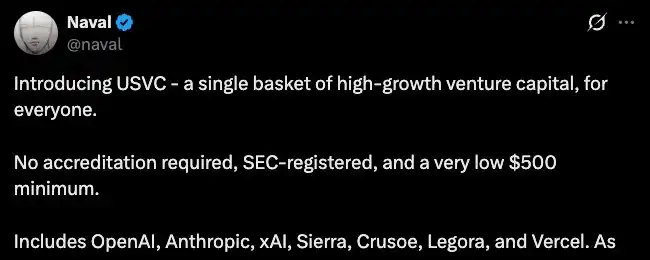
He posted a long thread on X promoting USVC, the gist being that early-stage tech investment is the "adventure capital" of our era, and ordinary people have always been locked out. By the time some great AI companies IPO, their growth is already over. USVC is here to open that door.

Within hours of the tweet, comments emerged asking an uncomfortable question that soured the mood:

These tech companies have been pushed to sky-high valuations, all the explosive growth happened in the private market. Now inviting retail investors to join, what's the difference from looking for exit liquidity?

USVC holds shares in seven companies, with the heaviest weighting in xAI. According to a Decrypt report, as of the end of March, about 44% of USVC's capital had been invested in these seven companies.

However, none of these companies are public. How did they get the shares?

According to the prospectus, USVC has three ways to acquire its targets: investing in emerging fund managers, participating in company growth-round financing, and purchasing secondary shares through AngelList's network.

The first two are straightforward. The third is the key.

Secondary shares mean that the company is not issuing new shares to sell to you; someone who already holds shares is transferring their portion to you. Who is transferring? Early angel investors, VC funds, early employees.

These people might have gotten on board when the company was valued at tens of millions of dollars. Now the company is worth tens or even hundreds of billions. They want to turn paper gains into real money before the IPO. But the private market isn't like a stock exchange; there's no ready queue of buyers waiting to take the other side.

USVC solves this problem perfectly. It raises funds from retail investors and uses that money to buy shares from insiders who want to exit.

AngelList does have a natural advantage for this. According to its website, there are over 4,500 active fund managers on the platform operating more than 25,000 funds, invested in over 13,000 startups.

This network is full of people and shares wanting to be sold, with AngelList sitting right in the middle. This is also the "exclusive access" USVC repeatedly emphasizes.

The access is indeed exclusive, but the direction of the trade doesn't seem to favor retail.

In this trade, the sellers are those who got in when the company was valued at tens of millions. The buyers are those getting in when it's valued at hundreds of billions. The sellers lock in returns of tens or even hundreds of times. The buyers are betting that these already fully-priced companies can still go higher.

Simultaneously, the terms retail investors are getting also say something.

According to the USVC prospectus, the fund is not listed on any exchange, does not anticipate a secondary trading market, may repurchase up to 5% of its net asset value per quarter (solely at the board's discretion, with no guarantees), and has an estimated total annual expense ratio of 3.61%—far higher than the prominently displayed 1% management fee, with the difference coming from layered fees of the underlying funds.
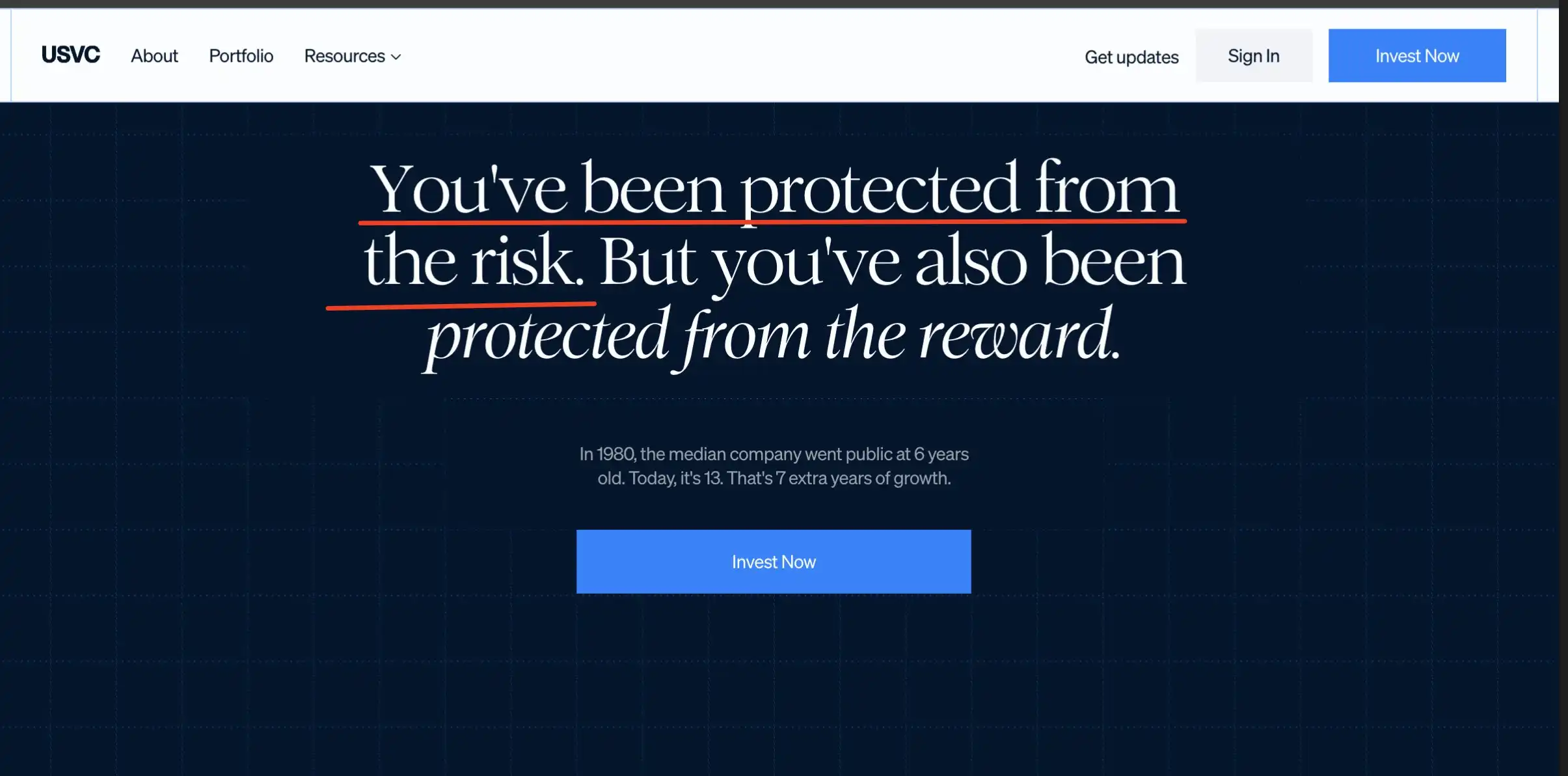
No ability to sell, exit dependent on queuing, and nearly 4% of principal eaten by fees annually. For a product with a $500 minimum investment aimed at ordinary people, this price isn't cheap.

So, the complete picture is likely this.

On one side are the insiders wanting to exit, getting liquidity, locking in profits. On the other side are the retail investors just entering, getting a share that can't be traded, has an exit reliant on queuing, and has an effective fee rate much higher than advertised. The direction of the funds, from start to finish, is only one way: from later arrivals to early arrivals.

The Equity Version of "Low Float, High FDV"

Breaking down the USVC model: insiders accumulate positions at low valuations. After asset prices are pushed high, a channel accessible to retail is packaged, allowing the funds of later arrivals to facilitate the exit of early arrivals.

The crypto industry ran a complete rehearsal of this logic between 2021 and 2024.

During those years, VC-backed token projects had a universal template: seed round valuation a few million, private round rising to tens of millions, and by the time the token listed on exchanges, the Fully Diluted Valuation (FDV) had skyrocketed to tens or even hundreds of billions. But only 2% to 5% of the total supply was in circulation, with the rest locked with VCs and the team, vesting on a schedule.

Low float, high FDV.

What USVC is doing is essentially almost identical to low float, high FDV. Insiders get in when the company is valued at tens of millions. After the company's valuation grows to hundreds of billions, they transfer their shares out through a product aimed at retail.

Naval's own trajectory is also interesting. Last October, he tweeted on X that "Bitcoin is insurance against fiat, Zcash is insurance against Bitcoin." This tweet caused ZEC to surge over 100% in a week. The community then dug up that, according to public reports, Naval had invested $715,000 in the development company behind Zcash as early as 2015 and had served on the Zcash Foundation's board.

The community's conclusion was simple: he was using his personal influence to shill his early investment. Naval did not respond to these质疑 (queries).

From Zcash to USVC, the model hasn't changed. A celebrity uses public credibility to open the demand side and uses a channel to direct that demand towards assets they have a position in.

Of course, in the case of USVC, there doesn't seem to be anything illegal.

USVC is a registered fund, the risk disclosures in the prospectus are ample, and the Zcash tweet didn't constitute investment advice.

But between legal and reasonable, there's always an ambiguous distance. A platform managing a trillion-dollar venture network, using the narrative of "letting ordinary people invest in the future" to raise retail funds, then using those funds to buy out insiders within its own network who want to exit...

Every single part of this is compliant. But all the parts put together easily trigger painful memories for retail investors.

And on the same day USVC launched, Robinhood also announced its fund spent $75 million to buy OpenAI shares, also open to ordinary investors. Two companies did the same thing in the same week: using their respective retail networks to build an exit channel for insiders in the private market.
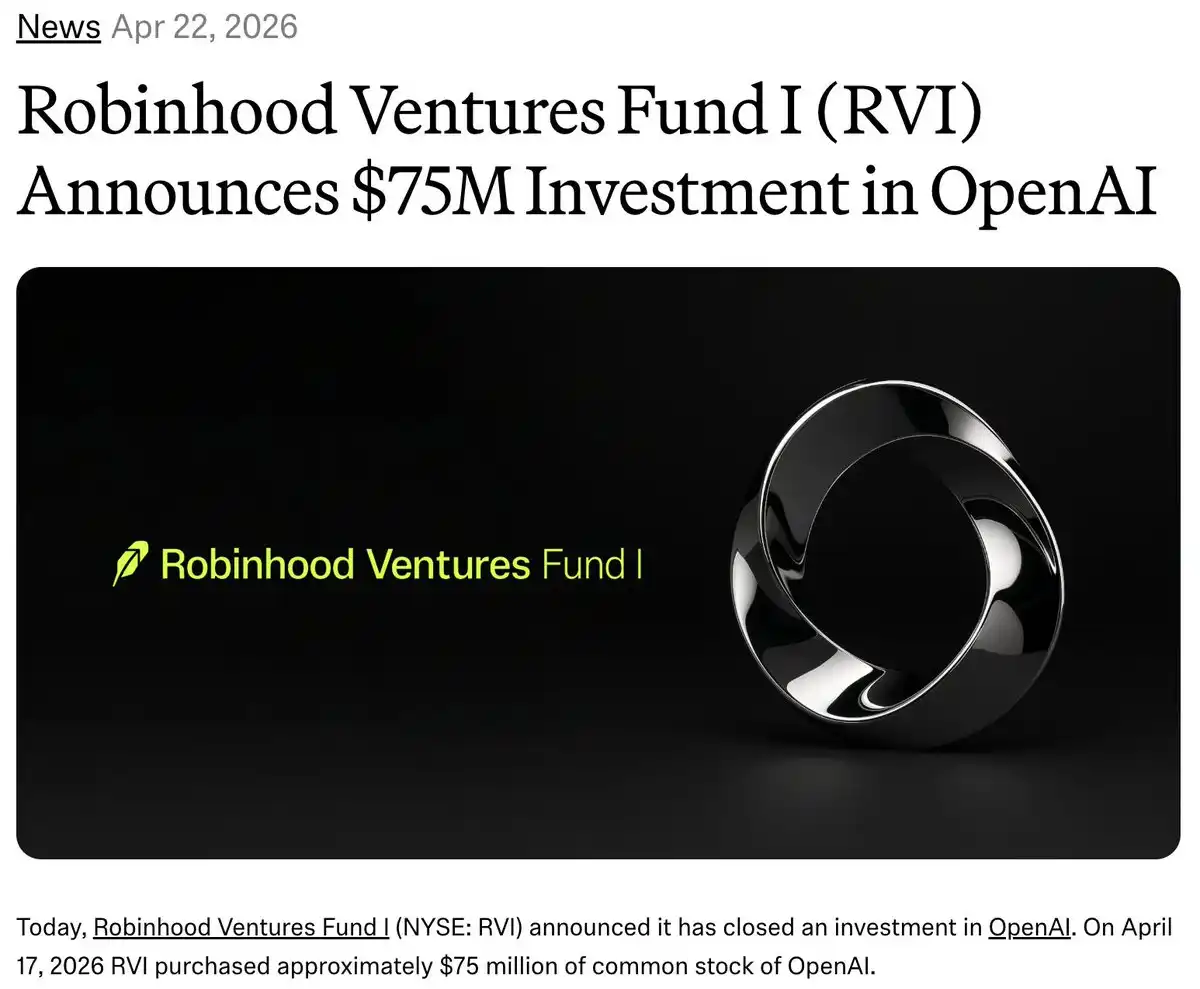
Every time the financial industry suddenly starts caring about the investment rights of ordinary people, it's often not because the situation for ordinary people has improved, but because the exit channels for insiders have narrowed.

This was true in 2021 when the crypto industry opened its doors wide to retail, and it's true in 2026 when Silicon Valley opens its doors to retail. The timing of the door opening is never decided by those who want to enter.

For ordinary people, there's a simple way to judge if an investment opportunity is meant for you.

Look at the people who got in before you. Are they buying more or are they selling right now? If they are selling, and you are being invited to buy, then you need to think clearly about one question: are you bringing capital, or are you bringing liquidity?

Preguntas relacionadas

QWhat is the main purpose of the USVC fund launched by AngelList, as per the article?

AThe main purpose of the USVC fund is to allow ordinary US investors, with a minimum investment of $500 and without accredited investor certification, to gain exposure to shares of private AI companies like OpenAI, Anthropic, and xAI. However, the article suggests it primarily functions as a mechanism for early investors and insiders to sell their shares and secure liquidity before an IPO.

QHow does the USVC fund primarily acquire shares in companies like OpenAI and xAI?

AThe USVC fund acquires shares through three main methods: investing in emerging fund managers, participating in growth-round financings, and most importantly, purchasing secondary shares from early investors, venture capital funds, and employees within the AngelList network who are looking to exit their positions.

QWhat are some of the significant drawbacks and risks for retail investors in the USVC fund, according to the article?

ASignificant drawbacks include: the fund shares are not listed on any exchange with no expectation of a secondary market; quarterly repurchases of up to 5% of shares are at the board's discretion and not guaranteed; and the estimated total annual expense ratio is 3.61%, which is much higher than the advertised 1% management fee due to layered underlying fund fees.

QWhat parallel does the article draw between the USVC fund model and a recent trend in the cryptocurrency industry?

AThe article draws a parallel to the 'low float, high fully diluted valuation (FDV)' model prevalent in crypto from 2021-2024. In this model, VCs and insiders accumulated tokens at low valuations, and when the FDV became very high at public listing, only a small percentage of the supply was released to retail market, creating an exit path for early investors.

QWhat is the implied motivation behind financial platforms like AngelList and Robinhood suddenly offering retail investors access to pre-IPO companies, as suggested by the article's conclusion?

AThe article implies that the motivation is not to improve investment opportunities for ordinary people, but rather to create an exit channel and provide liquidity for insiders and early investors (like VCs and employees) who want to cash out their highly appreciated shares before an IPO, as their own exit avenues have narrowed.

Lecturas Relacionadas

El "hecho de mercado ignorado": Intervención conjunta de EE.UU., Japón y Corea del Sur, la "inusual" participación del Departamento del Tesoro de EE.UU., ¿Bessant intervino discretamente para "salvar el mercado"?

**EE.UU., Japón y Corea del Sur lanzan una rara intervención coordinada en divisas para estabilizar los mercados aliados clave** En una acción conjunta poco frecuente, los gobiernos de Estados Unidos, Japón y Corea del Sur realizaron la mayor intervención coordinada en divisas en casi tres décadas. El objetivo fue contrarrestar la presión depreciatoria sobre el yen japonés y el won surcoreano, considerándose una medida para estabilizar los mercados financieros de estos aliados y prevenir la propagación de riesgos. Japón y Corea del Sur intervinieron vendiendo dólares para apoyar sus monedas. De manera destacada, el Tesoro de EE.UU. participó directamente en el apoyo al yen vendiendo euros y comprando yenes a través de los bancos Goldman Sachs y Morgan Stanley, la primera acción de este tipo en 30 años. Esta intervención, precedida por "consultas de tipos" del Banco de la Reserva Federal de Nueva York, empujó al yen y al won significativamente más altos desde sus mínimos recientes. Analistas sugieren que la acción va más allá de estabilizar los tipos de cambio. Estados Unidos busca proteger la estabilidad de los mercados de activos en Japón y Corea del Sur, actores cruciales en la cadena de suministro global de semiconductores e IA, para evitar que las tensiones financieras afecten a estas industrias estratégicas y al propio mercado estadounidense. La medida se interpreta como una operación para contener la volatilidad del mercado en una fase clave para la inversión en IA.

marsbitHace 3 min(s)

El "hecho de mercado ignorado": Intervención conjunta de EE.UU., Japón y Corea del Sur, la "inusual" participación del Departamento del Tesoro de EE.UU., ¿Bessant intervino discretamente para "salvar el mercado"?

marsbitHace 3 min(s)

¿La Fed subirá las tasas en septiembre? ¿Cómo soportarán la presión las criptomonedas y las acciones de EE.UU.?

En la última semana, las apuestas del mercado sobre una subida de tipos de la Reserva Federal en septiembre han aumentado drásticamente de menos del 50% a más del 80%, según datos de CME FedWatch. Este cambio refleja una creciente preocupación inflacionaria impulsada por el repunte en los precios del petróleo, vinculado a las tensiones geopolíticas en el Estrecho de Ormuz. La última reunión de la Fed mostró una división interna, con tres miembros votando a favor de una subida inmediata de 25 puntos básicos. Aunque los economistas aún prevén ciclos de bajadas para 2027, el mercado está reaccionando a los datos recientes. El próximo punto clave será el informe de IPC de julio, que determinará si la presión inflacionaria persiste y consolidará la probabilidad de una subida en septiembre. Para los criptoactivos como Bitcoin, una mayor expectativa de subidas de tipos supone presión, ya que aumenta el coste de oportunidad de mantener activos que no generan rendimiento. Históricamente, Bitcoin ha mostrado una alta sensibilidad a estos ciclos. Sin embargo, el impacto real puede ser limitado si el mercado interpreta la acción como el final del ciclo de endurecimiento monetario. En el mercado bursátil, las acciones vinculadas a las criptomonedas (como Coinbase o MicroStrategy) y las tecnológicas en general podrían experimentar una mayor volatilidad. Una subida de tipos aumenta las tasas de descuento en los modelos de valoración, presionando especialmente a las acciones de crecimiento. Esta expectativa coincide con una temporada de resultados en la que los gigantes tecnológicos están siendo evaluados por su capacidad para convertir grandes gastos de capital en IA en flujos de ingresos tangibles, un escrutinio que se intensificaría con unos costes de financiación más altos. En resumen, la probabilidad de una subida de tipos en septiembre es ahora significativa. Los inversores deberán monitorear de cerca la evolución de los precios del petróleo, los próximos datos de inflación y las declaraciones de los funcionarios de la Fed para calibrar el escenario final y su impacto en los activos de riesgo.

Odaily星球日报Hace 3 min(s)

¿La Fed subirá las tasas en septiembre? ¿Cómo soportarán la presión las criptomonedas y las acciones de EE.UU.?

Odaily星球日报Hace 3 min(s)

Intervención conjunta de Estados Unidos y Japón: ¿El inicio del nuevo "Acuerdo Plaza" y del sistema de Bretton Woods 2.0 y el fin de la era del carry trade del yen?

**Intervención conjunta de EE.UU. y Japón: ¿El fin de la era del carry trade en yen?** EE.UU. y Japón han llevado a cabo una intervención cambiaria conjunta para apoyar al yen, lo que ha desencadenado una fuerte revalorización de la moneda. El Secretario del Tesoro de EE.UU., Yellen, y el Presidente Trump han confirmado la participación estadounidense, con Yellen señalando la voluntad de seguir interviniendo para corregir la "grave infravaloración" del yen. La acción coordinada, que incluye compras directas y orientación a los bancos, hizo que el yen se fortaleciera hasta 157,40 frente al dólar. Los analistas señalan que esta medida va más allá de la gestión de tipos de cambio y podría marcar un punto de inflexión en el *carry trade* global basado en el yen barato, una práctica que ha definido los flujos de capital durante décadas. Si Japón necesita vender reservas de divisas, incluidos bonos del Tesoro de EE.UU., para defender su moneda, podría provocar una reevaluación al alza de los rendimientos de la deuda estadounidense a largo plazo. La presión sobre los bonos a largo plazo no se atribuye principalmente al riesgo de inflación, sino a factores estructurales: la posible liquidación de reservas japonesas y el cambio de rol de las grandes tecnológicas, que ahora emiten deuda masivamente para financiar inversiones en IA e infraestructura, pasando de ser proveedoras a demandantes netas de ahorro. Algunos observadores interpretan esta intervención como el posible inicio de una nueva coordinación internacional, un "Acuerdo Plaza" moderno o el comienzo de un "Bretton Woods 2.0", que reflejaría un reequilibrio de la economía global y el fin del orden financiero basado en el financiamiento barato en yenes.

marsbitHace 42 min(s)

Intervención conjunta de Estados Unidos y Japón: ¿El inicio del nuevo "Acuerdo Plaza" y del sistema de Bretton Woods 2.0 y el fin de la era del carry trade del yen?

marsbitHace 42 min(s)

¿Qué tan alta es la posibilidad de que TradeXYZ abandone Hyperliquid y siga su propio camino?

Con la expansión continua de TradeXYZ y su dominio de más del 90% del mercado HIP-3 de Hyperliquid, ha surgido un debate en la comunidad sobre la posibilidad de que TradeXYZ se independice y construya su propia plataforma. Los usuarios discuten principalmente si la plataforma buscaría capturar una mayor parte de las tarifas de transacción, ya que actualmente comparte los ingresos 50/50 con Hyperliquid, habiendo generado casi 5000 millones de dólares en volumen pero con ingresos limitados. Aunque la independencia podría ofrecer a TradeXYZ más control y beneficios, existen limitaciones significativas. Hyperliquid proporciona un rendimiento técnico superior y es un canal crucial de distribución y adquisición de usuarios. Además, existe una relación de confianza entre los fundadores de ambos proyectos. Una separación podría resultar en una situación perjudicial para ambos: Hyperliquid perdería su principal motor de crecimiento narrativo y TradeXYZ enfrentaría desafíos técnicos, la pérdida de usuarios y daños reputacionales. Por lo tanto, aunque TradeXYZ tiene un fuerte poder de negociación, es poco probable que abandone Hyperliquid en el corto plazo. La estrategia más sensata sería negociar mejores términos de colaboración mientras se mantiene la integración actual, evitando una competencia directa que beneficiaría a otros actores del mercado RWA.

marsbitHace 53 min(s)

¿Qué tan alta es la posibilidad de que TradeXYZ abandone Hyperliquid y siga su propio camino?

marsbitHace 53 min(s)

"Teletubbies" robots hacen limpieza a domicilio, 200 yuanes/hora, pura inteligencia *artificial*

La compañía de robótica Tau Robotics, con sede en San Francisco, ha presentado su nuevo servicio de limpieza doméstica utilizando robots humanoides teleoperados. Bautizados cariñosamente como "Teletubbies" por su antena similar a un router Wi-Fi en la cabeza, estos robots, llamados Chelsea, Elon y Tony, realizan tareas como limpiar cocinas, baños, recoger basura y trapear pisos. La gran revelación, y decepción para algunos, es que las demostraciones mostradas son operadas por control remoto en tiempo real ("inteligencia artificial 100% humana"). La empresa defiende este enfoque como una solución práctica para cerrar la brecha tecnológica actual, permitiendo la recolección de datos del mundo real para eventualmente desarrollar autonomía completa, similar al "modo sombra" en los coches autónomos. El servicio, disponible por invitación en el área de la Bahía de San Francisco, cuesta 30 dólares (unos 200 yuanes) por hora, un precio competitivo frente a los servicios de limpieza humana en EE.UU. El artículo analiza los desafíos de introducir robots humanoides en hogares, comparando el enfoque estadounidense con el chino, que prioriza entornos industriales más controlados. Se argumenta que la forma humanoide facilita la teleoperación intuitiva y podría ofrecer un valor emocional único, aunque su necesidad funcional frente a robots con ruedas sigue siendo objeto de debate.

marsbitHace 1 hora(s)

"Teletubbies" robots hacen limpieza a domicilio, 200 yuanes/hora, pura inteligencia *artificial*

marsbitHace 1 hora(s)

Trading

Spot
活动图片