Crypto market’s weekly winners and losers – DEXE, LIT, BONK, JUP

ambcryptoPublicado a 2026-07-12Actualizado a 2026-07-12

Resumen

This week's crypto market was driven by macro events, with Bitcoin showing resilience above $63,000. The top weekly gainers were primarily protocol-based altcoins. DeXe (DEXE) surged 73%, approaching key resistance, though signs of exhaustion emerged. Arbitrum (ARB) gained 20%, nearing a crucial technical barrier. Lighter (LIT) rose 5%, breaking above a key resistance level. Major speculative assets led the losers. Bonk (BONK) fell 18%, erasing last week's gains and hitting a new low. Audiera (BEAT) dropped 12%, testing a vital support zone. Jupiter (JUP) declined over 10% but maintained its broader uptrend structure. The week highlighted a rotation toward fundamentally stronger projects amid ongoing volatility.

This week, macro events drove the crypto market.

Renewed geopolitical tensions in the Middle East triggered a brief risk-off move, sending Bitcoin [BTC] and altcoins lower before BTC recovered and held above the $63,000 support level, highlighting its resilience.

Against this backdrop, protocol-based altcoins dominated the winners’ list with strong double-digit rallies, while most of the week’s biggest losers came from speculative assets, reflecting a clear rotation toward fundamentally stronger projects.

Weekly winners

How did DeXe [DEXE] reinforce its bullish structure?

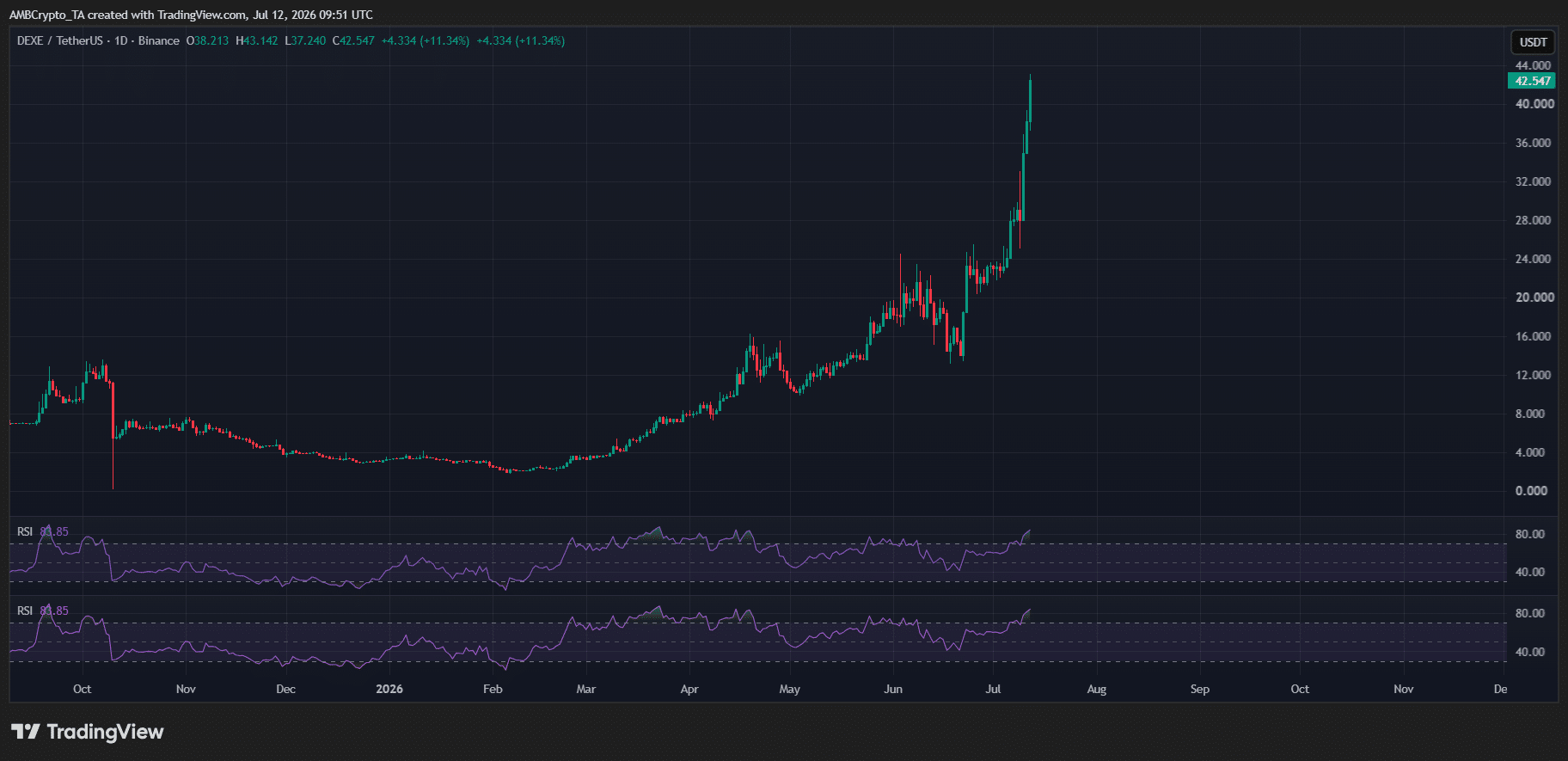
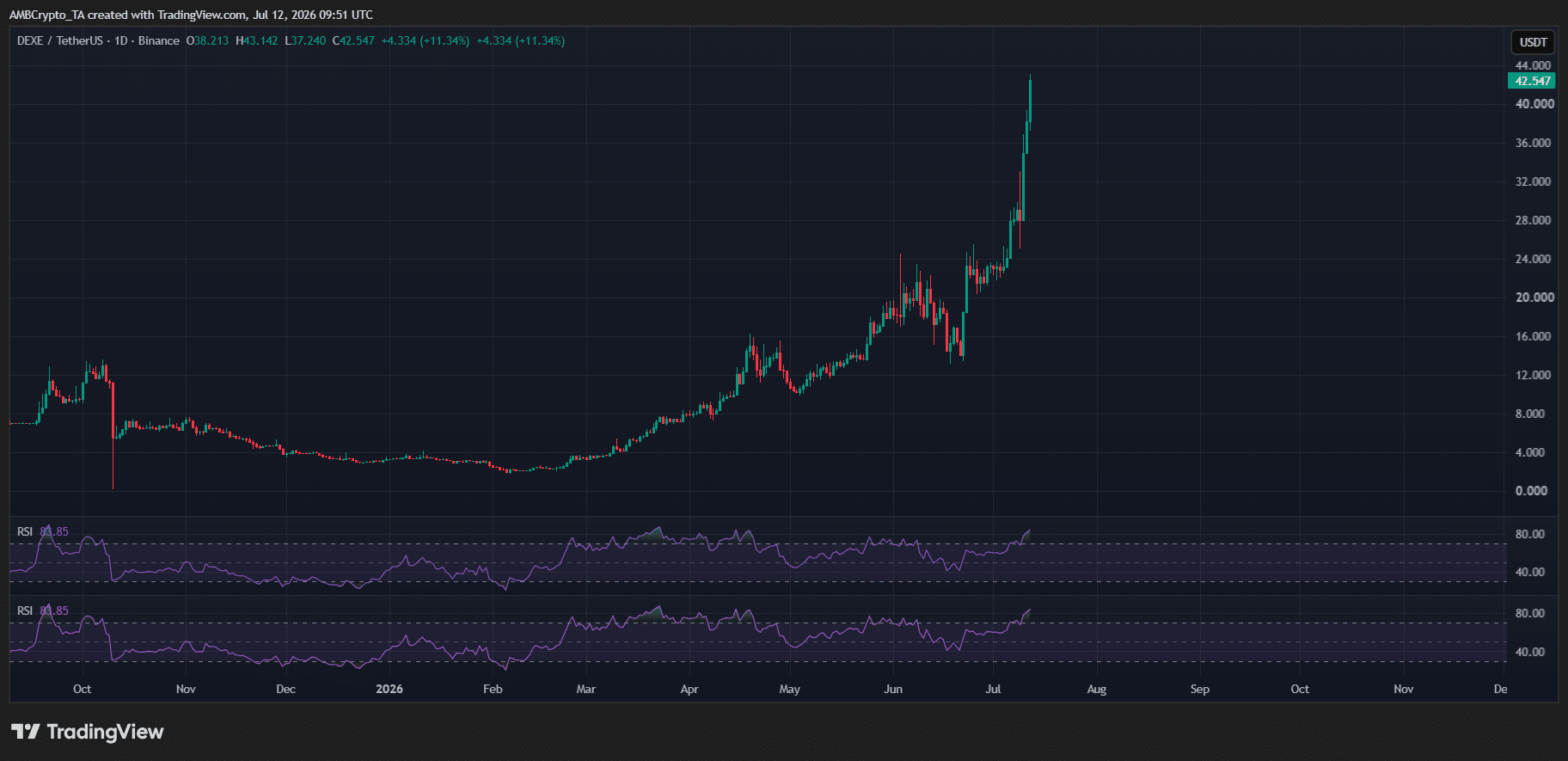
DeXe [DEXE] led this week’s gainers with a massive 73% rally, marking its strongest weekly performance on record. The move reflects strong investor demand for decentralized governance protocols despite mixed sentiment across the broader crypto market.

From a technical perspective, DEXE is now approaching the $50 resistance level, putting another breakout within reach. However, the rally is also beginning to flash signs of exhaustion. At press time, the RSI has pushed deep into overbought territory, suggesting buyers may be getting stretched.

At the same time, DEXE has gained 73% in less than four trading days, highlighting an aggressive buying spree that often precedes a period of cooling. With the broader market turning risk-off again as geopolitical tensions weigh on sentiment, short-term profit-taking could increase.
Source: TradingView (DEXE/USDT)

If that happens, $35 is the first key support level to watch. However, if buyers continue to absorb selling pressure, DEXE could still break above $50 and extend its rally.

Overall, DEXE enters the week with strong momentum but elevated risk as technicals become overextended.

Arbitrum [ARB] is approaching a KEY resistance zone

Arbitrum [ARB] was the second-biggest gainer this week, climbing 20% after posting an 8% rally the week before. The back-to-back gains suggest buyers are steadily taking control, with bullish momentum continuing to build. Technically, ARB still doesn’t look overheated.

Despite the strong move, the weekly RSI remains below overbought territory, suggesting there is still room for the rally to extend. The daily chart also continues to print higher highs, showing buyers remain in control. The next key level to watch is the $0.10 resistance zone. ARB hasn’t reclaimed this level since losing it during the late May correction, making it an important technical barrier.

If buying pressure continues at its current pace, a breakout above $0.10 looks increasingly likely. That would open the door for another leg higher, making ARB one of the stronger technical setups to watch this week.

Lighter [LIT] continues to outrun bearish control

Lighter [LIT] secured the third spot among this week’s top gainers with a 5% rally. While the gain was smaller than the week’s biggest winners, it suggests LIT has continued to hold onto its recent strength.

Technically, the more important development is that LIT has broken above the $2.70 resistance level. This comes after the token rallied more than 50% over the past two weeks, showing buyers are still willing to accumulate even after a strong uptrend.

The successful reclaim of resistance also shifts market sentiment in favor of the bulls. If buying pressure continues, the breakout could attract fresh momentum traders, increasing the chances of a move toward $3.

Other notable winners

Outside the majors, altcoin movers also stole the spotlight this week.

TCC [TCC] led the market with a staggering 66,301% gain, followed by Cash Cat [CASHCAT], which surged 3,928%, while Yei Finance [CLO] climbed 76%, rounding out the week’s top performers.

Weekly losers

How did Bonk [BONK] erase its previous week’s gains?

Bonk [BONK] led this week’s losers with an 18% decline, completely wiping out last week’s 18.6% rally. The move is another reminder of the sharp swings that are common across the meme coin sector.

What’s interesting is that the sell-off came despite 110 million BONK being burned this week. That suggests the token burn wasn’t enough to shift sentiment. Technically too, BONK looks weak. The weekly chart has been printing lower lows since the mid-Q3 2025 cycle, showing the broader downtrend remains intact.

Even though the RSI was deep in oversold territory as of writing, buyers have yet to step in with enough conviction to reverse the trend. This week’s decline also pushed BONK to a new all-time low around $0.0000039, reinforcing the bearish structure.
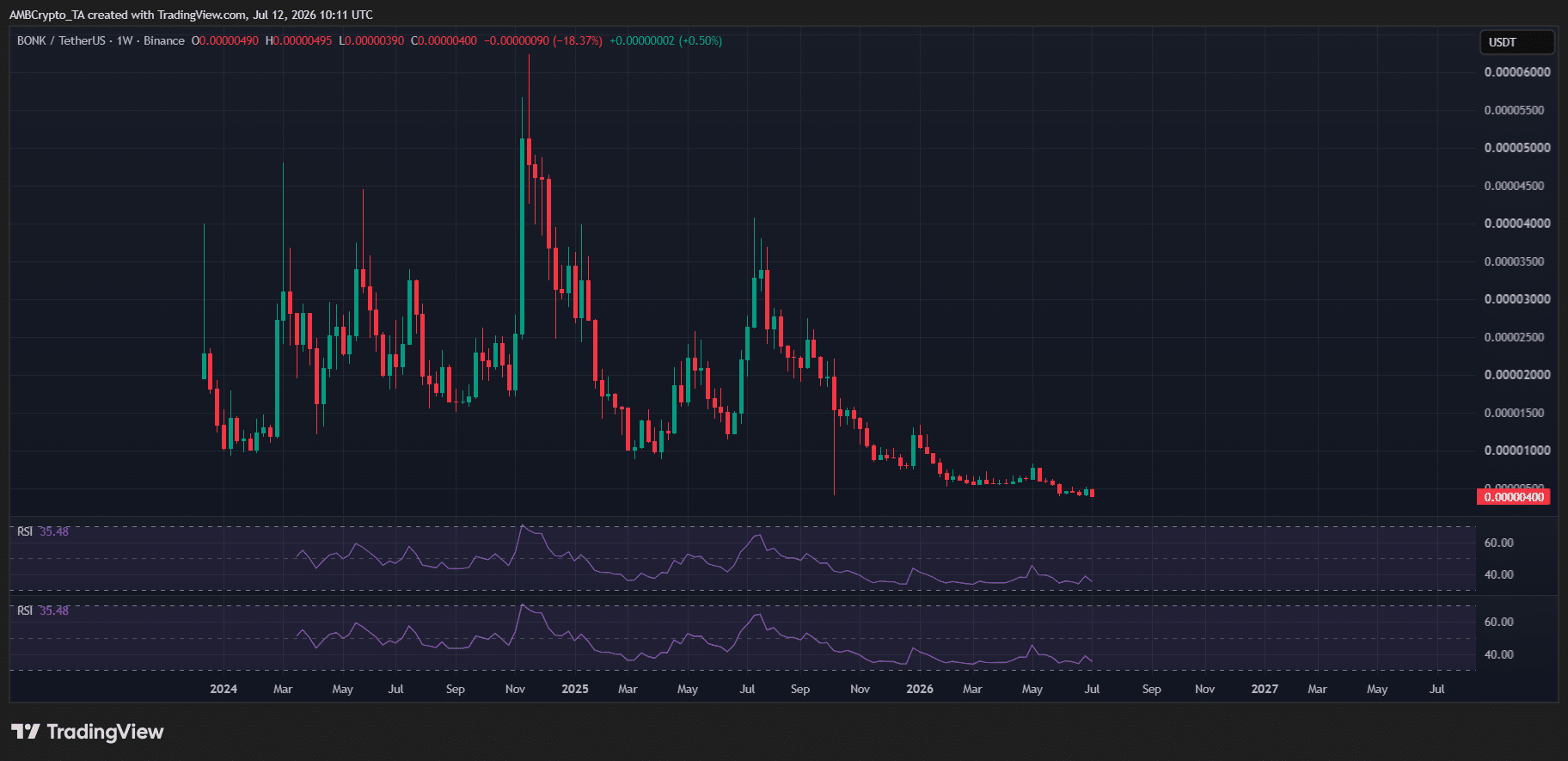
Source: TradingView (BONK/USDT)

Unless market sentiment improves or buyers reclaim key resistance levels, BONK is likely to remain under pressure, making it one of the weaker technical setups heading into next week.

Audiera [BEAT] is testing the strength of a KEY support

Audiera [BEAT] was the second-biggest loser this week, dropping 12% after posting two straight weeks of gains. Despite the pullback, BEAT is still holding above levels it reclaimed during its recent breakout, suggesting bulls haven’t lost control just yet.

Technically, the focus is now on the $2.00–$2.50 support zone. Since mid-May, buyers have consistently stepped in around this area, triggering several weekly rebounds and keeping the broader uptrend intact. That makes this week’s decline look more like a cooldown than a trend reversal.

If bulls defend support once again, BEAT could build enough momentum for another run at the $3.50 resistance. A successful breakout above that level would confirm another higher high and keep BEAT among the stronger bullish setups to watch next week.

Why did Jupiter [JUP] post its weakest weekly rally in over a month?

Jupiter [JUP] was the third-biggest loser this week, falling just over 10%. The pullback came after numerous weeks of gains and pushed the token back below the $0.25 resistance level.

Technically, though, the trend still favors the bulls. JUP continues to hold a pattern of higher highs and higher lows, suggesting the broader uptrend remains intact. The next key level to watch is $0.20, where buyers have consistently stepped in during previous pullbacks.

That puts JUP in a healthy consolidation phase rather than a full trend reversal. If bulls continue to defend support, the current pullback could provide the base for another move higher.

A reclaim of $0.25 would strengthen the bullish structure and increase the chances of another breakout, making JUP one of the key altcoins to watch heading into next week.

Other notable losers

In the broader market, downside volatility hit hard.

LAB [LAB] led the losers with a 96% decline, followed by ETHGas [GWEI], which fell 54%, while BUILDon [B] dropped 47.7% as bearish momentum intensified.

Conclusion

This week was a rollercoaster for crypto. Big pumps, sharp dips, and nonstop action. As always, stay sharp, do your own research, and trade smart.


Final Summary

  • DeXe [DEXE], Arbitrum [ARB], and Lighter [LIT] led the week in gains.
  • Bonk [BONK], Audiera [BEAT], and Jupiter [JUP] saw significant declines.

Criptos en tendencia

Preguntas relacionadas

QWhat are the main macroeconomic factors mentioned in the article that impacted the crypto market this week?

ARenewed geopolitical tensions in the Middle East triggered a brief risk-off move, which initially sent Bitcoin and altcoins lower before Bitcoin recovered.

QAccording to the article, what was the technical indicator suggesting that DeXe's (DEXE) rally might be due for a cool-down period?

AThe RSI (Relative Strength Index) had pushed deep into overbought territory, suggesting buyers may be getting stretched and that short-term profit-taking could increase.

QWhich token led the week's losers, and what key event failed to shift its negative sentiment?

ABonk (BONK) led the week's losers with an 18% decline. The negative sentiment continued despite 110 million BONK being burned, which wasn't enough to shift market dynamics.

QFor Arbitrum (ARB), what is identified as the next key resistance level to watch for a potential breakout?

AThe next key resistance level for Arbitrum (ARB) is the $0.10 zone. ARB hasn't reclaimed this level since losing it in the late May correction.

QWhat general market trend does the article describe regarding the types of altcoins that dominated the winners' list versus the losers' list?

AProtocol-based altcoins with strong fundamentals dominated the winners' list, while most of the week's biggest losers came from speculative assets (like meme coins), reflecting a clear rotation toward fundamentally stronger projects.

Lecturas Relacionadas

¿Quieres otra gran subida alcista? Bitcoin necesita que entre un billón de dólares en capital nuevo

Para lograr otra gran corrida alcista, Bitcoin necesita una entrada masiva de capital de un billón de dólares. Desde su máximo histórico de 126.000 USD en octubre de 2025, Bitcoin ha caído un 50%, cotizando ahora alrededor de 63.000 USD. Los datos on-chain revelan cambios estructurales profundos. Un informe de CryptoQuant muestra que la eficiencia del capital se ha desplomado: en 2011, 27 mil millones de USD generaron una subida del 55.436%, mientras que en el ciclo actual, 697 mil millones solo produjeron un 689%. Hoy, se necesitarían 101.000 millones para duplicar el precio, y se estima que se requiere 1 billón de USD en capital nuevo para un repunte significativo. Esto subraya la necesidad de que Bitcoin se convierta en un activo institucional clave. Por otro lado, la oferta circulante se está agotando. K33 Research informa que los holders a largo plazo poseen el 79% del suministro, un récord histórico, y la actividad de bitcoins inactivos es mínima. Esto reduce la liquidez, haciendo que el precio sea más volátil ante la entrada de capital, pero por sí solo no garantiza una recuperación. Los indicadores de ganancias/pérdidas también señalan un posible suelo. El ratio de ganancias realizadas de Bitcoin cayó a -0.35, su nivel más bajo en 43 meses, similar a los mínimos de 2022. Históricamente, niveles tan negativos han precedido a fuertes rallies alcistas. El precio actual está solo un 16% por encima del precio medio realizado, un escenario que históricamente ha llevado a rallies posteriores. Sin embargo, el entorno macroeconómico es adverso. Los ETF de Bitcoin en EE.UU. experimentaron sus mayores salidas en junio, y la incertidumbre sobre la política de la Fed presiona al mercado. Aunque la infraestructura institucional en Europa se expande, esto no impulsa flujos de capital inmediatos. En resumen, el mercado muestra señales de consolidación: la presión de venta se ha agotado, los indicadores están en extremos y la oferta flotante es escasa. No obstante, la condición decisiva para un nuevo gran ciclo alcista—la entrada de capital institucional a gran escala—aún no se ha materializado, y la baja eficiencia del capital requerirá magnitudes de financiación sin precedentes.

Foresight NewsHace 4 min(s)

¿Quieres otra gran subida alcista? Bitcoin necesita que entre un billón de dólares en capital nuevo

Foresight NewsHace 4 min(s)

Qingyan Jingzhun recauda cientos de millones de yuanes en financiación, con inversión del 'equipo nacional' de fabricación de equipos

La empresa china Qingyan Precision ha completado dos rondas de financiación de la Serie B por un total de varios cientos de millones de yuanes en junio. La ronda B2 fue liderada por Xingyuan Capital con la participación de FAW Fusheng, y la B3 fue liderada por BAIC Industry Investment con la participación de Yulon Group. También se unió el fondo estatal Guojj Industry Fund. Esta ronda destaca por la fuerte participación de capital industrial, incluyendo seis fabricantes de automóviles (BAIC, FAW, Great Wall, Shaanxi Auto, Yulon y Xingyuan), lo que indica que la plataforma de ingeniería de IA física de Qingyan Precision está integrada en la cadena de suministro central de las principales automotrices chinas. La empresa, fundada en 2018 por el Dr. Dong Han de la Universidad de Tsinghua, se especializa en verificación, pruebas y detección basadas en IA para la industria de vehículos de nueva energía. Tras ocho años de acumulación en escenarios industriales reales, la compañía ha evolucionado estratégicamente para convertirse en una "plataforma de ingeniería de IA física", posicionándose como la base para la implementación de inteligencia corporeizada (embodied AI) en entornos industriales. Su sistema central, TsingLoop, es una tubería de ingeniería de datos multimodal que transforma señales brutas de entornos industriales complejos en activos de datos estandarizados y reutilizables. Esto permite la creación de un ciclo cerrado de "recopilación-simulación-verificación-evaluación-iteración" para robots, validando estrategias en entornos de simulación antes del despliegue físico y facilitando la optimización continua basada en datos. La inversión coincide con una iniciativa gubernamental lanzada en junio de 2026 para promover la formación y aplicación práctica de robots humanoides e inteligencia corporeizada en escenarios industriales reales. Los inversores apuestan por la capacidad única de Qingyan Precision para proporcionar acceso a escenarios reales, datos de alta calidad y capacidades de ingeniería, elementos considerados cruciales para la implementación práctica de la IA física en la industria.

marsbitHace 1 hora(s)

Qingyan Jingzhun recauda cientos de millones de yuanes en financiación, con inversión del 'equipo nacional' de fabricación de equipos

marsbitHace 1 hora(s)

Ganando 10.32 millones de dólares, la imprenta de dinero del gran tiburón de Polymarket en el Mundial

**Resumen: La "Ballena" de Polymarket y su máquina de imprimir dinero durante el Mundial** Mientras los equipos luchaban por la Copa del Mundo en el campo, un actor anónimo, conocido como "swisstony", amasaba una fortuna en el mercado de predicciones Polymarket. En aproximadamente un año desde su creación en julio de 2025, esta cuenta ha obtenido ganancias históricas totales de 18.62 millones de dólares, con 10.33 millones solo en el último mes. Su estrategia combina una ejecución automatizada de alta frecuencia (con unas 380 operaciones diarias) con un enfoque dual. Por un lado, apuesta grandes cantidades (a menudo cientos de miles de dólares) en contra de los favoritos del mercado ("NO" a que ganen equipos como Alemania o Inglaterra), explotando cuotas favorablemente sesgadas cuando estos equipos no cumplen las expectativas. Por otro lado, dedica pequeñas cantidades de capital a eventos extremadamente improbables (con probabilidades de mercado del 0.2% al 1.2%), logrando ocasionalmente retornos multiplicados por 100 que aportan ganancias significativas de más de 100.000 dólares por operación. Con una tasa de acierto del 52.9% pero un volumen de operaciones masivo (más de 139,000 predicciones), este usuario, que probablemente utiliza un bot algorítmico, demuestra cómo la ventaja sistemática en la valoración de probabilidades, ejecutada a gran escala, puede generar enormes beneficios en los mercados de predicción. Su perfil se describe acertadamente como "mapache" ("trash panda"), un maestro sobreviviente que encuentra valor en los pequeños márgenes y datos del vasto "basurero" del mercado.

Foresight NewsHace 2 hora(s)

Ganando 10.32 millones de dólares, la imprenta de dinero del gran tiburón de Polymarket en el Mundial

Foresight NewsHace 2 hora(s)

Trading

Spot

Artículos destacados

Cómo comprar JUP

¡Bienvenido a HTX.com! Hemos hecho que comprar Jupiter (JUP) sea simple y conveniente. Sigue nuestra guía paso a paso para iniciar tu viaje de criptos.Paso 1: crea tu cuenta HTXUtiliza tu correo electrónico o número de teléfono para registrarte y obtener una cuenta gratuita en HTX. Experimenta un proceso de registro sin complicaciones y desbloquea todas las funciones.Obtener mi cuentaPaso 2: ve a Comprar cripto y elige tu método de pagoTarjeta de crédito/débito: usa tu Visa o Mastercard para comprar Jupiter (JUP) al instante.Saldo: utiliza fondos del saldo de tu cuenta HTX para tradear sin problemas.Terceros: hemos agregado métodos de pago populares como Google Pay y Apple Pay para mejorar la comodidad.P2P: tradear directamente con otros usuarios en HTX.Over-the-Counter (OTC): ofrecemos servicios personalizados y tipos de cambio competitivos para los traders.Paso 3: guarda tu Jupiter (JUP)Después de comprar tu Jupiter (JUP), guárdalo en tu cuenta HTX. Alternativamente, puedes enviarlo a otro lugar mediante transferencia blockchain o utilizarlo para tradear otras criptomonedas.Paso 4: tradear Jupiter (JUP)Tradear fácilmente con Jupiter (JUP) en HTX's mercado spot. Simplemente accede a tu cuenta, selecciona tu par de trading, ejecuta tus trades y monitorea en tiempo real. Ofrecemos una experiencia fácil de usar tanto para principiantes como para traders experimentados.

232 Vistas totalesPublicado en 2024.12.12Actualizado en 2026.06.02

Cómo comprar JUP

Discusiones

Bienvenido a la comunidad de HTX. Aquí puedes mantenerte informado sobre los últimos desarrollos de la plataforma y acceder a análisis profesionales del mercado. A continuación se presentan las opiniones de los usuarios sobre el precio de JUP (JUP).

活动图片