ether.fi [ETHFI] eyes $0.40 next after an 11% rally – More gains ahead IF…

ambcryptoPublicado a 2026-07-04Actualizado a 2026-07-04

Resumen

The article discusses a recent price rally for the ether.fi (ETHFI) token, which surged over 11% to trade at $0.37. Key technical indicators, including the reclaiming of the 20- and 50-day Exponential Moving Averages (EMAs), suggest strengthening bullish momentum. The uptrend is supported by strong spot market demand, evidenced by consecutive days of negative Spot Netflow, indicating more tokens are being withdrawn from exchanges than deposited—a sign of accumulation. A bullish crossover in the Directional Movement Index (DMI) further supports this positive outlook, with the potential for ETHFI to target the 100-day EMA near $0.40. However, the article notes caution in the derivatives market. Despite the spot rally, data shows significant outflows from futures positions and elevated perpetual sell volume, suggesting traders are using price strength to reduce exposure rather than open new long positions. This persistent selling pressure in derivatives poses a risk to the rally's sustainability. If it continues, ETHFI could potentially fall back to retest the $0.30 support level. The overall picture is one of conflicting signals: bullish momentum in the spot market versus cautious, selling behavior among derivative traders.

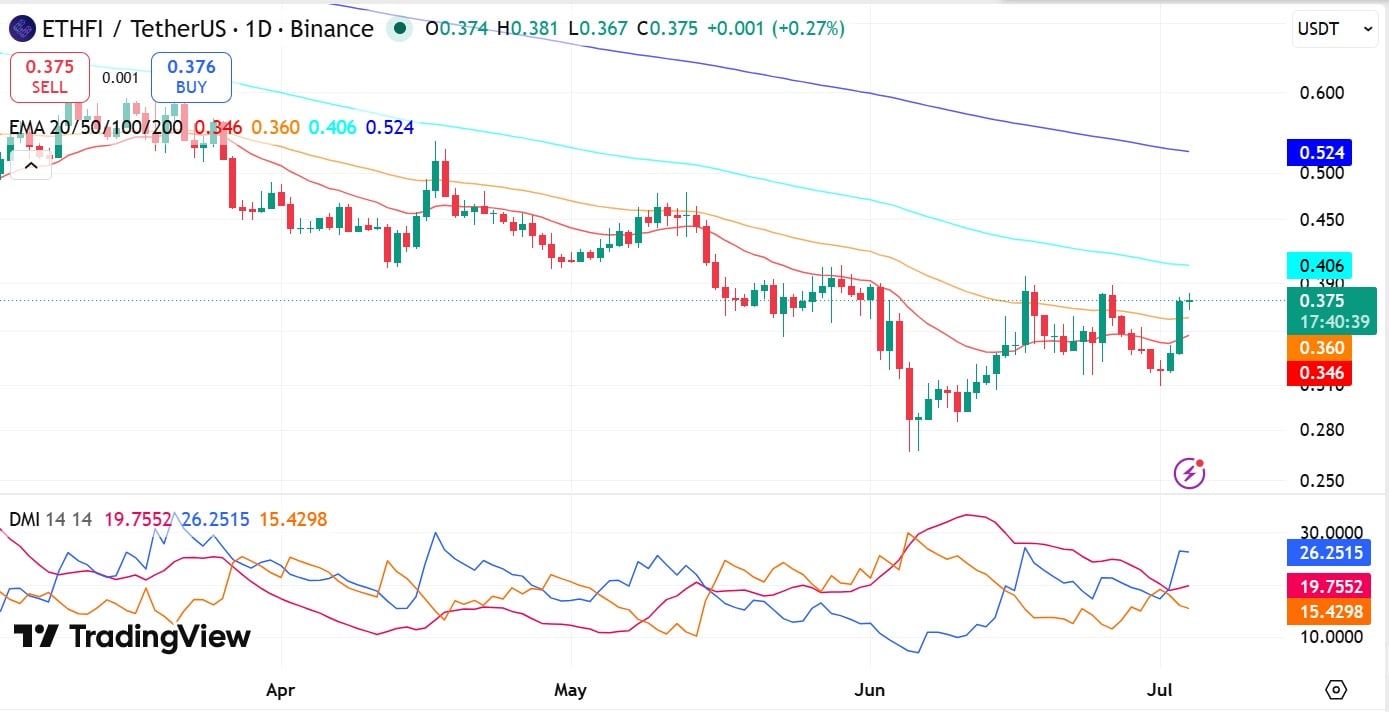
ETHFI is experiencing strong upward momentum. Since holding the $0.30 support earlier this week, the altcoin has posted consecutive higher highs, touching a local high of $0.38.

As of this writing, ether.fi [ETHFI] traded at $0.37, up 11.24% on the daily charts. At the same time, trading volume rose 72% to $58 million, while market cap climbed 12% to $346 million.

With the latest rally, the altcoin reclaimed the 20- and 50-day Exponential Moving Averages (EMAs) at $0.34 and $0.36, indicating strengthening upside momentum.

Why is THIS demand improving?

As June came to an end, ether.fi sellers showed signs of exhaustion after dominating the market during the final week of the month. That shift allowed buyers to defend the $0.30 support successfully.

Since then, buyers have outpaced sellers. According to CoinGlass data, Spot Netflow remained negative for four consecutive days.
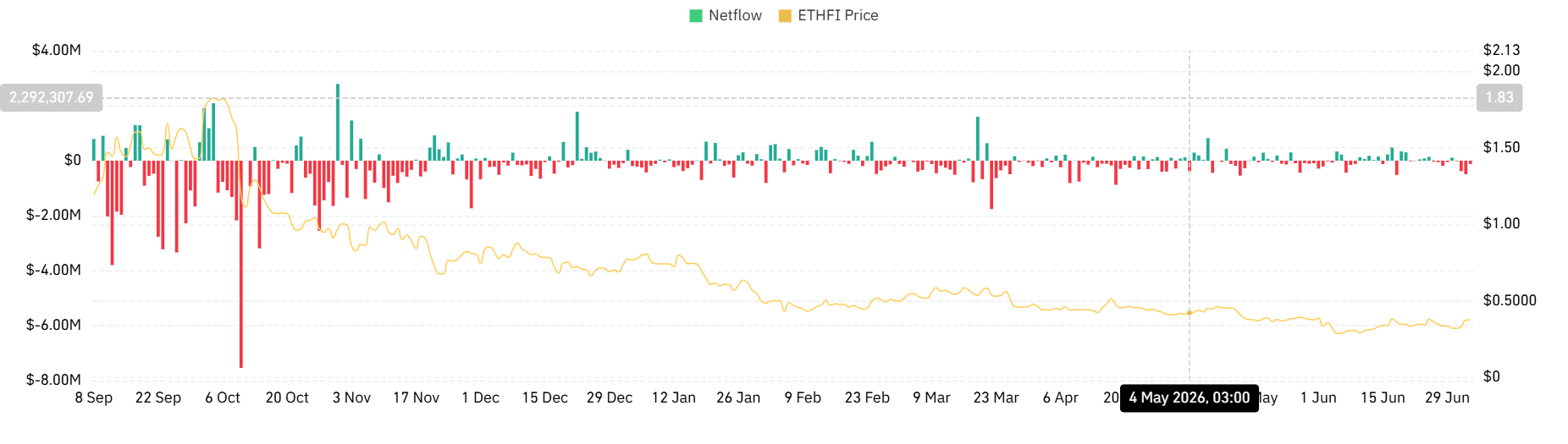
Source: CoinGlass

At press time, Spot Netflow stood at -$188k, improving from -$492k the previous day.

A sustained period of negative Spot Netflow suggested demand remained strong across the market. Historically, stronger Spot demand has supported better price performance.

In fact, momentum strengthened further over the past day.
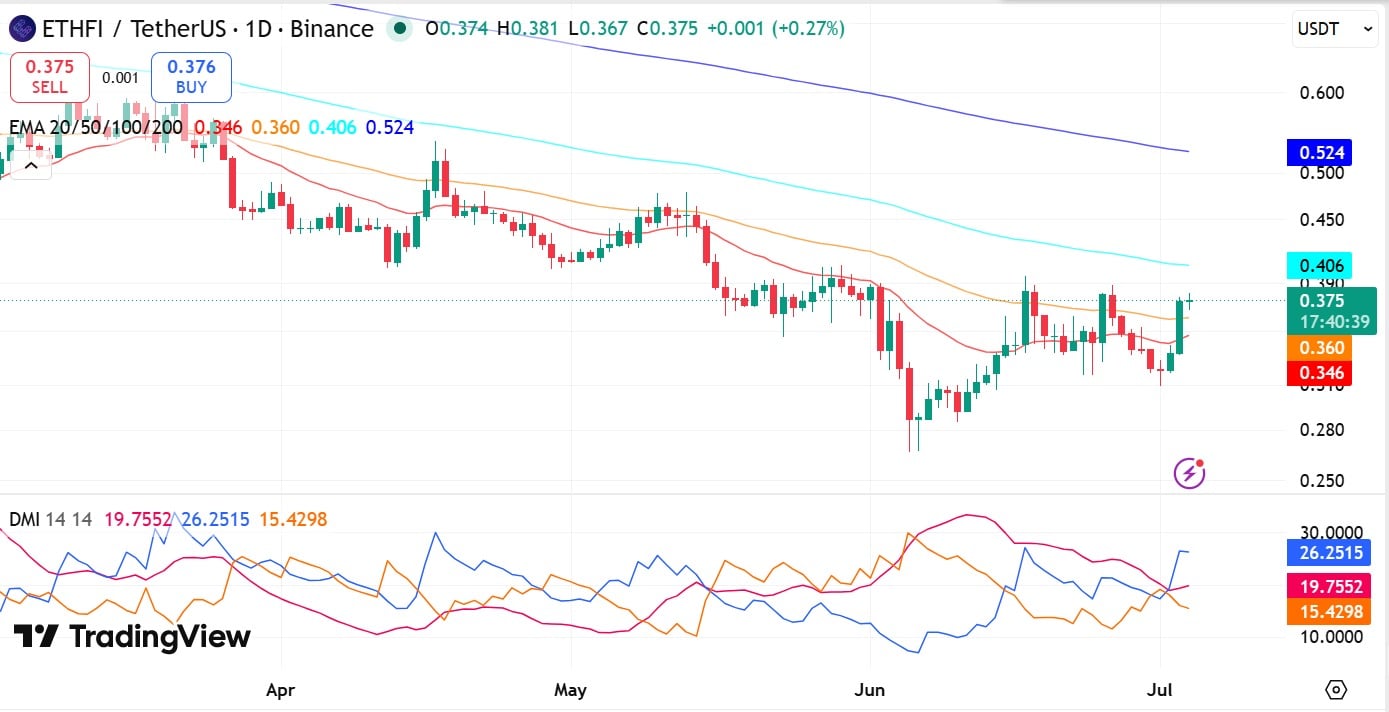
Source: TradingView

The Directional Movement Index (DMI) formed a bullish crossover, with the positive index climbing to 26.

Meanwhile, the negative index dropped to 15, while the Average Directional Index (ADX) rose to 19. That setup indicated strengthening bullish momentum as selling pressure weakened.

If buyers maintain control, ETHFI could reclaim the 100-day Exponential Moving Average (EMA) near $0.40.

Why are derivatives traders staying cautious?

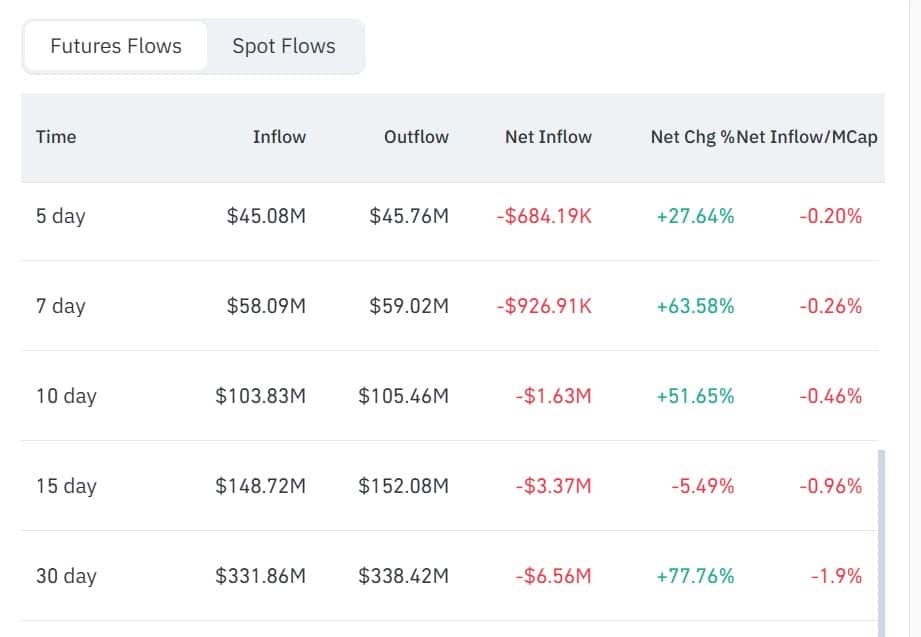
While the Spot market showed strong demand, derivatives traders continued to reduce exposure.

For starters, Futures Average Order Size data from CryptoQuant showed whales remained active throughout the recent downturn.
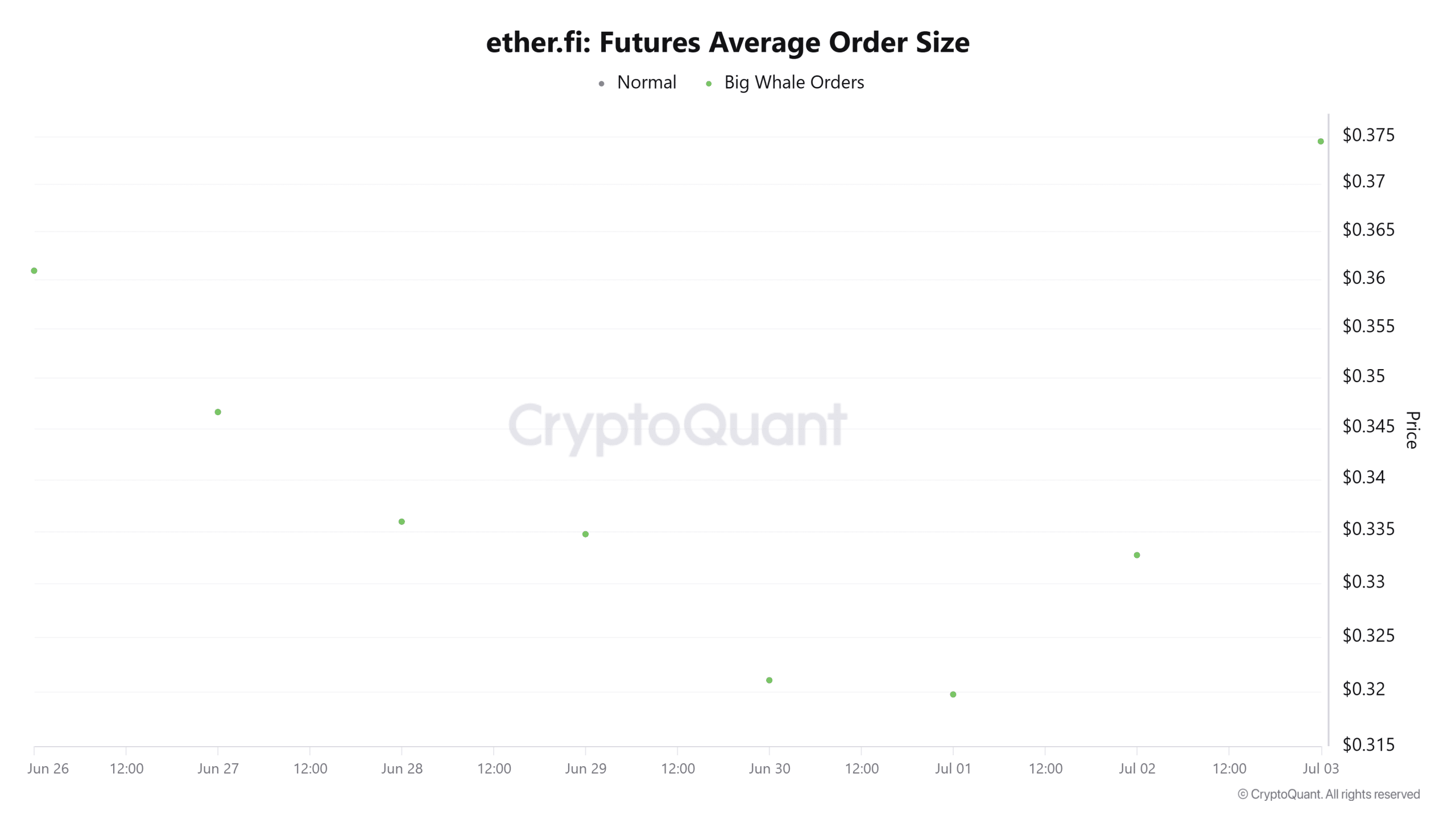
Source: CryptoQuant

Large orders suggested whales continued participating in the Futures market. However, selling pressure remained elevated.

Over the past week, $59 million worth of Futures positions closed, while $338 million flowed out over the last month.
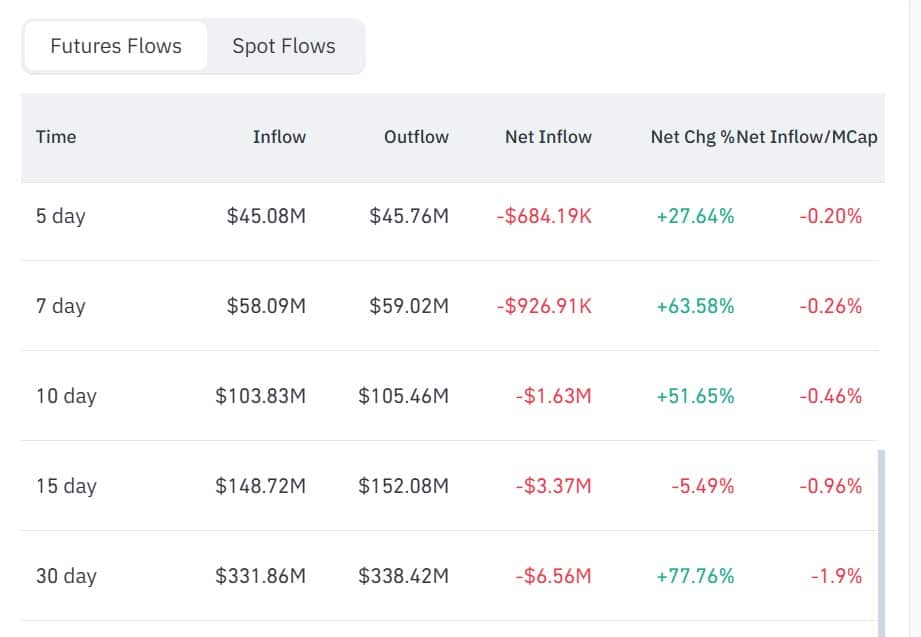
Source: CoinGlass

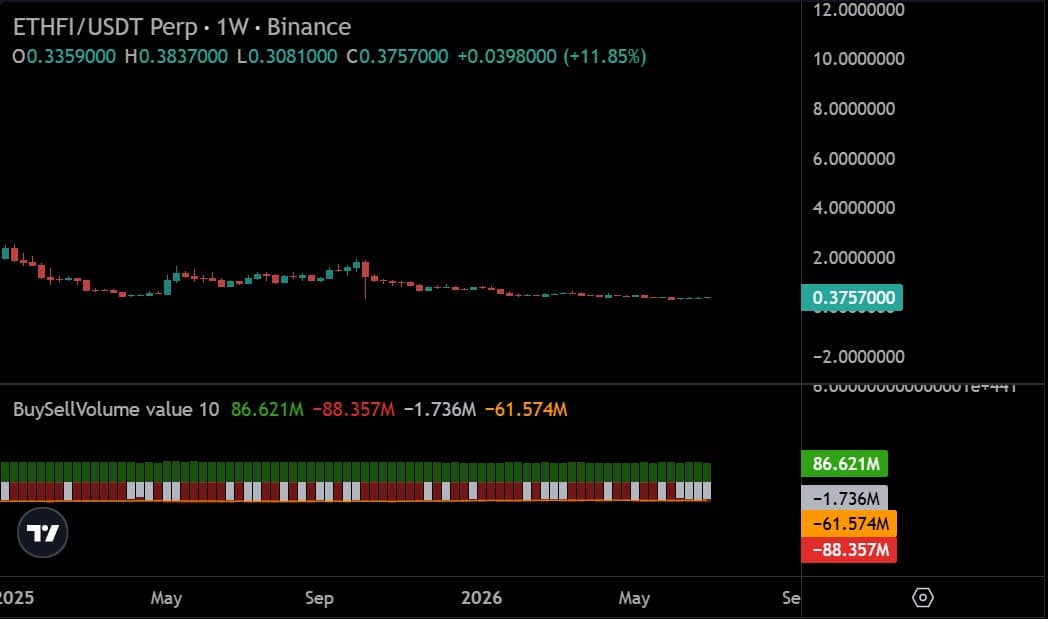
The same trend appeared in perpetual Futures.

Perpetual sell volume climbed to $88 million over the past week. Seller dominance across derivatives suggested traders remained unconvinced about a sustained recovery. Instead, many appeared to reduce exposure to strength.
Source: Coinalyze

This continued caution posed a risk to the rally’s sustainability. If selling pressure persists, Ether.fi could revisit the $0.30 support.


Final Summary

  • ETHFI gained 11% as buyers defended $0.30 and reclaimed key short-term EMAs.
  • Negative Spot Netflow signaled sustained buyer demand despite recent market volatility.

Criptos en tendencia

Preguntas relacionadas

QWhat are the key price levels mentioned for ETHFI in the article, and what is the significance of the $0.30 level?

AThe article mentions ETHFI holding the $0.30 support level and its price aiming for the $0.40 level next. The $0.30 level is significant as it served as a key support that buyers successfully defended, which was a turning point that allowed the upward momentum to begin.

QWhat technical indicators are cited in the article to support the strengthening bullish momentum for ETHFI?

AThe article cites the reclaiming of the 20-day and 50-day Exponential Moving Averages (EMAs) and a bullish crossover on the Directional Movement Index (DMI) as indicators of strengthening bullish momentum. Specifically, the positive DMI index rose to 26 while the negative index dropped to 15.

QAccording to the article, what does a sustained negative Spot Netflow indicate for ETHFI's market?

AAccording to the article, a sustained period of negative Spot Netflow indicates that demand for ETHFI remains strong across the spot market. Historically, stronger spot demand has supported better price performance for the asset.

QWhat contrasting signal is presented from the derivatives market, and why does it pose a risk to the rally?

AThe contrasting signal from the derivatives market is that traders are reducing their exposure, as evidenced by significant outflows from futures positions and high perpetual sell volume. This caution poses a risk to the rally's sustainability because persistent selling pressure could cause the price to fall back to the $0.30 support level.

QWhat is the article's final conditional outlook for ETHFI's price movement?

AThe article's final outlook is conditional. It states that if buyers maintain control, ETHFI could reclaim the 100-day EMA near $0.40. However, if selling pressure from the derivatives market persists, the price could revisit the $0.30 support level instead.

Lecturas Relacionadas

Cuenta atrás para el Día-Q: ¿La computación cuántica acabará con las criptomonedas?

**Resumen: Cuenta atrás para el Q-Day: ¿Pondrá fin la computación cuántica a las criptomonedas?** La computación cuántica supone una amenaza existencial para la criptografía de clave pública (como RSA y ECC) que sustenta Internet y las cadenas de bloques. El algoritmo de Shor podría romper estos sistemas de forma eficiente. El "Q-Day", el momento en que esto sea factible, se estima entre 2030-2045. La criptografía post-cuántica (PQC), con algoritmos basados en retículos (lattice, como ML-KEM/DSA) o hashes (como SLH-DSA), es la solución. Estándares como FIPS 203-205 ya están definidos. La migración es urgente según la "desigualdad de Mosca": el tiempo de vida de los datos más el tiempo de migración debe ser mayor que el tiempo hasta el Q-Day. Para el ecosistema blockchain, el riesgo no es uniforme. Los activos en riesgo son aquellos cuyas claves públicas ya están expuestas en la cadena (por ejemplo, antiguas direcciones BTC no gastadas). La amenaza es una prueba de presión para sus pilares: libro de contabilidad público, transferencias irreversibles y autogestión de claves. **Bitcoin** se enfrenta principalmente a un desafío de gobernanza y consenso social. Migrar requiere un soft fork y lidiar con UTXO heredados de alto valor. Las firmas PQC son mucho más grandes, lo que impacta en el tamaño de los bloques y las tarifas. **Ethereum** aborda el problema con una hoja de ruta "Lean" y agilidad criptográfica. Utiliza la abstracción de cuentas (AA) para migrar firmas de usuario de forma gradual, y explora reemplazos para las firmas BLS de consenso (como leanXMSS con compresión SNARK) y para los compromisos de datos (KZG). La ventana para una migración coordinada de todo el ecosistema (protocolos, carteras, exchanges) es de 5 a 8 años. La computación cuántica no es un "arma del juicio final", sino un catalizador para una reconstrucción criptográfica. El mayor cuello de botella no es técnico, sino la compleja coordinación y gobernanza necesarias para una transición a tiempo.

marsbitHace 6 hora(s)

Cuenta atrás para el Día-Q: ¿La computación cuántica acabará con las criptomonedas?

marsbitHace 6 hora(s)

Cuenta regresiva hacia el Q-Day: ¿Pondrá fin la computación cuántica a las criptomonedas?

**Q-Day Cuenta Atrás: ¿Pondrá la Computación Cuántica Fin a las Criptomonedas?** La computación cuántica representa una amenaza existencial para las criptomonedas, ya que el algoritmo de Shor podría romper los criptosistemas de curva elíptica (ECC/ECDSA) que protegen las claves privadas. El "Q-Day", el momento en que un ordenador cuántico a gran escala logre esto, se estima entre 2035-2045. El riesgo es particularmente grave para activos en cadena cuyas claves públicas están expuestas (como antiguos UTXO de Bitcoin), que podrían ser drenados. La migración a criptografía post-cuántica (PQC), como los algoritmos basados en retículos (ML-KEM/DSA) o hashes (SLH-DSA) estandarizados por NIST, es urgente pero compleja. **Bitcoin** enfrenta un enorme desafío de gobernanza: migrar mediante un *soft fork* a direcciones PQC, lidiar con la expansión de las firmas (de ~70 bytes a varios KB) y decidir el destino de los UTXO heredados inactivos, un dilema entre la inmutabilidad y la supervivencia. **Ethereum** sigue una hoja de ruta "Lean" más ágil, utilizando la abstracción de cuentas para la migración de usuarios y explorando firmas basadas en hash (leanXMSS) comprimidas con zkVMs para los validores, junto con la renovación de sus capas de datos y compromisos. La conclusión es clara: la computación cuántica no es un apocalipsis instantáneo, pero inicia una cuenta atrás crítica. La ventana de acción cómoda es de 5-8 años. El mayor obstáculo no es técnico, sino de coordinación de todo el ecosistema y de consenso social sobre la gobernanza de los activos heredados, poniendo a prueba los principios fundamentales de Web3.

链捕手Hace 7 hora(s)

Cuenta regresiva hacia el Q-Day: ¿Pondrá fin la computación cuántica a las criptomonedas?

链捕手Hace 7 hora(s)

Trading

Spot

Artículos destacados

Cómo comprar ETHFI

¡Bienvenido a HTX.com! Hemos hecho que comprar ether.fi (ETHFI) sea simple y conveniente. Sigue nuestra guía paso a paso para iniciar tu viaje de criptos.Paso 1: crea tu cuenta HTXUtiliza tu correo electrónico o número de teléfono para registrarte y obtener una cuenta gratuita en HTX. Experimenta un proceso de registro sin complicaciones y desbloquea todas las funciones.Obtener mi cuentaPaso 2: ve a Comprar cripto y elige tu método de pagoTarjeta de crédito/débito: usa tu Visa o Mastercard para comprar ether.fi (ETHFI) al instante.Saldo: utiliza fondos del saldo de tu cuenta HTX para tradear sin problemas.Terceros: hemos agregado métodos de pago populares como Google Pay y Apple Pay para mejorar la comodidad.P2P: tradear directamente con otros usuarios en HTX.Over-the-Counter (OTC): ofrecemos servicios personalizados y tipos de cambio competitivos para los traders.Paso 3: guarda tu ether.fi (ETHFI)Después de comprar tu ether.fi (ETHFI), guárdalo en tu cuenta HTX. Alternativamente, puedes enviarlo a otro lugar mediante transferencia blockchain o utilizarlo para tradear otras criptomonedas.Paso 4: tradear ether.fi (ETHFI)Tradear fácilmente con ether.fi (ETHFI) en HTX's mercado spot. Simplemente accede a tu cuenta, selecciona tu par de trading, ejecuta tus trades y monitorea en tiempo real. Ofrecemos una experiencia fácil de usar tanto para principiantes como para traders experimentados.

167 Vistas totalesPublicado en 2024.12.10Actualizado en 2026.06.02

Cómo comprar ETHFI

Discusiones

Bienvenido a la comunidad de HTX. Aquí puedes mantenerte informado sobre los últimos desarrollos de la plataforma y acceder a análisis profesionales del mercado. A continuación se presentan las opiniones de los usuarios sobre el precio de ETHFI (ETHFI).

活动图片