Behind the AI Report Card, Lies a Chinese 'Exam Setter'

marsbitPublicado a 2026-06-20Actualizado a 2026-06-20

Resumen

Beyond the familiar performance charts like MMLU-Pro and MMMU, which major AI models strive to ace, stands a key "examiner": Chinese-Canadian researcher Wenhu Chen. An assistant professor at the University of Waterloo and founder of TIGERLab, Chen addresses the crucial need for more rigorous AI evaluation. As models like GPT-4 began scoring near-perfect results on older benchmarks like MMLU, it became difficult to distinguish their true capabilities. In response, Chen introduced MMLU-Pro in 2024, featuring harder, more reasoning-focused questions with more answer choices, successfully reintroducing meaningful performance gaps. His work extends to multi-modal evaluation with MMMU and its enhanced version, MMMU-Pro. These benchmarks test a model's ability to understand and reason with complex information from images, charts, and text across diverse academic subjects, exposing the significant challenges even top models face in genuine comprehension. Chen's background in complex QA, table reasoning, and his experience at Google DeepMind on projects like Gemini inform his approach. He understands that effective benchmarks must anticipate how models might "cheat" by memorizing data or avoiding visual analysis. His lab also actively researches video understanding and generation models (e.g., UniVideo, Vamba), ensuring his evaluation work is grounded in practical model-building challenges. Now at Meta's Super Intelligence Lab, Chen continues his focus on multi-modal data and evalua...

Each time a cutting-edge model is released, the AI community focuses on a few familiar report cards.

MMLU-Pro, MMMU, MMMU-Pro... These names might sound foreign to ordinary users, but for model companies and researchers, they have almost become the "standard subjects." GPT, Claude, Gemini, Llama, Qwen, DeepSeek continuously submit their answers on these benchmarks.

"The proof is in the pudding." How good a model is often needs to be proven by these scores.
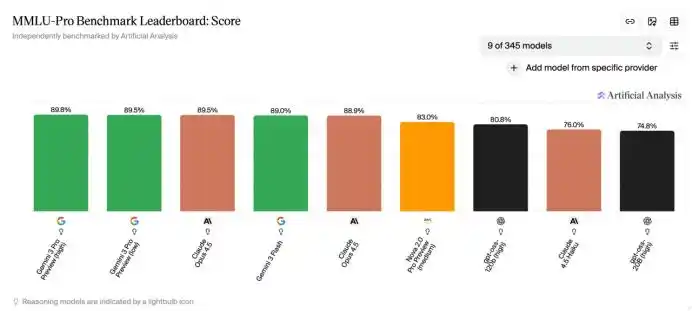
Many performance comparison charts in model launch presentations rely on them; some leaderboards on HuggingFace are also built upon these evaluation systems. It could even be said that today, when the AI industry discusses model capabilities, they are already using a common language defined by these benchmarks.

But interestingly, almost everyone focuses on the scores, yet few know who sets the questions. Behind MMLU-Pro, MMMU, and MMMU-Pro, the same name can be seen—Wenhu Chen.
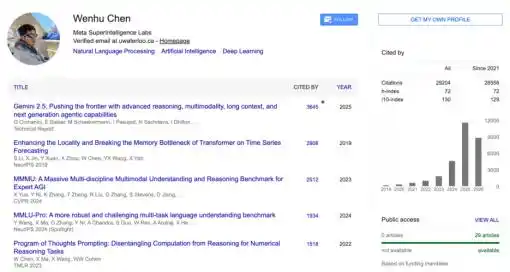
He is an Assistant Professor in the Department of Computer Science at the University of Waterloo in Canada. On Google Scholar, his papers have been cited over 30,000 times.

He is also the founder of TIGERLab. The English full name of this lab is Text and Image GEnerative Research Lab. Because the Chinese word for "tiger" is in his name, Wenhu Chen gave it a very distinctive Chinese name—Hutou Bang (Tiger Head Gang).

01

After the Old Exam Papers Lost Their Effectiveness

Wenhu Chen first caught wider attention because of MMLU-Pro.

MMLU was once one of the most commonly used benchmark evaluations for assessing the capabilities of large language models. It was like a comprehensive test paper, covering multiple subjects, used to measure a model's performance in knowledge understanding and reasoning tasks.

Early on, this paper was very useful. It could distinguish between models through scores, and the industry could also use it to observe whether large language models were truly improving.

But problems soon emerged.

As model capabilities continuously improved, MMLU gradually became "insufficiently challenging." The scores of cutting-edge models got higher and higher, and the gaps between them became smaller and smaller.
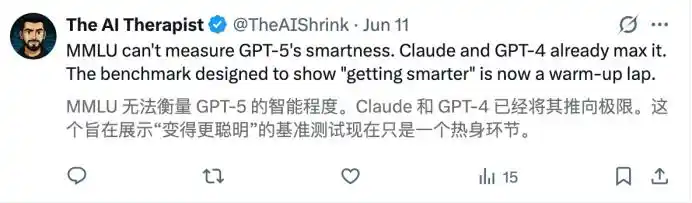
After OpenAI released o3, this problem became even more apparent. The accuracy of o3 on MMLU was already close to 100%, and other cutting-edge models also successively submitted scores approaching full marks.

This might sound like good news, but for evaluation, it actually meant trouble.

If everyone can get close to full marks on an exam paper, it becomes very difficult to continue judging who is stronger and where their strengths lie. It can still prove that models possess certain capabilities, but it is no longer suitable for measuring new progress.

The AI industry needed a harder, less easily "fooled" exam paper.

In 2024, Wenhu Chen and his team launched MMLU-Pro.

MMLU-Pro revamped this exam paper rather than simply expanding the question bank.
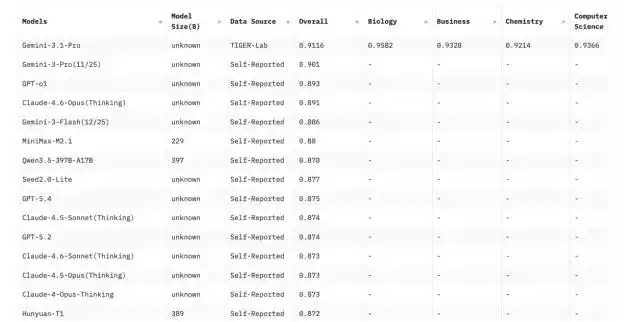
It contains 12,032 questions, covering 14 fields including mathematics, physics, chemistry, law, engineering, psychology, and health. Compared to the original MMLU, it expands the options from 4 to 10, reducing the probability of models guessing correctly. It also incorporates more reasoning-oriented questions and cleans up the original question bank of questions that were relatively simple, ambiguous, or lacked sufficient discriminative power.

The effect was direct.

The paper's results showed that model accuracy on MMLU-Pro decreased by 16% to 33% compared to the original MMLU. When the same model was tested under 24 different prompt styles, the score variation also decreased from 4% to 5% in the original MMLU to about 2%.

In other words, this new paper is not only harder but also more stable.

It reopened the gaps between models that all seemed excellent on the old exam paper. It also became easier to tell whether a model truly understands reasoning or is just better at handling old-style questions.

02

Usable Benchmark Evaluations

MMLU-Pro was quickly adopted by the industry.

MMLU-Pro later entered the NeurIPS 2024 Datasets and Benchmarks track and was also integrated into EleutherAI's lm-evaluation-harness framework. For the open-source model community, this meant it was no longer just a dataset in a paper but had entered the common evaluation toolchain.

Many models began reporting MMLU-Pro scores upon release. Some leaderboards on HuggingFace also incorporated it into their evaluation systems.

If MMLU-Pro solved the problem of the "old exam paper losing effectiveness" in language model evaluation, then MMMU pushed Wenhu Chen and TIGERLab to the center of multimodal evaluation.

The problems with multimodal models are more complex.

Language models answer questions, mainly processing text. Multimodal models, however, have to simultaneously process information in different forms like images, charts, diagrams, maps, tables, musical scores, chemical structures, etc. They not only need to understand the question stem but also truly comprehend the content in the images, and reason by integrating visual information, textual information, and domain knowledge.

The MMMU benchmark contains 11,500 multimodal questions sourced from university exams, quizzes, and textbooks, covering six major domains: Arts & Design, Business, Science, Health & Medicine, Humanities & Social Science, and Technology & Engineering, further subdivided into 30 subjects and 183 subfields.

These questions are not simply asking the model "what's in the picture." They require the model to combine image information with domain knowledge, much like a student tackling a professional problem.

When MMMU was released, the research team tested 14 open-source multimodal models, as well as representative closed-source models like GPT-4V and Gemini Ultra. Even the strongest closed-source models at the time, GPT-4V and Gemini Ultra, only achieved accuracy rates of 56% and 59% respectively.

These numbers indicate that while multimodal models appear to be progressing rapidly, they still have significant room for improvement when it comes to problems requiring genuine professional understanding and reasoning.

Later, Wenhu Chen's team released MMMU-Pro, further plugging the gaps that allowed models to bypass visual information. It filters out questions that could be answered by text-only models, expands answer choices, and introduces a vision-only setting where questions are embedded within images, requiring the model to perform both visual reading and text comprehension simultaneously.

Simply put, it prevents the model from "guessing the answer just by looking at the text."

This kind of work might sound somewhat tedious, but it is crucial. Because future multimodal models need to enter scenarios like healthcare, education, scientific research, design, and engineering; merely being able to describe a picture is not enough. They must be able to judge, reason, explain, and find the truly useful parts within complex visual information.

03

The People Behind the "Exam Papers"

Wenhu Chen's later work on MMLU-Pro and MMMU stems from his long-standing research direction.
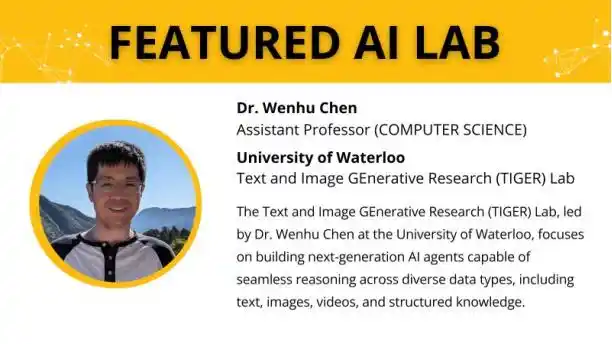
His research interests have always been related to complex information understanding, knowledge question answering, and reasoning.

He earned his bachelor's degree from Huazhong University of Science and Technology, then pursued a master's at RWTH Aachen University in Germany, followed by a Ph.D. in Computer Science from the University of California, Santa Barbara. During his Ph.D., he had already begun research in areas like complex question answering, table reasoning, and knowledge evidence localization.

These tasks share a common characteristic: the answer often does not lie within a single piece of text.

It might be hidden in a table, require combining a piece of text and an image, or might need the model to first retrieve information, then integrate, calculate, and reason. The model cannot just be good at reciting existing knowledge.

Projects Wenhu Chen participated in, such as HybridQA, TabFact, Program of Thoughts, and MAmmoTH, are all related to this line of work.

This also explains his sensitivity to loopholes in model evaluation.

A good benchmark evaluation is not simply about making questions increasingly difficult, but about anticipating where models are most likely to "guess correctly" or "appear competent."

A model might memorize the question bank, guess answers based on options, or use text to bypass visual information... Good evaluation needs to patch these loopholes well.

After his Ph.D., Wenhu Chen joined Google Research and later participated in the development and evaluation of Google DeepMind's Gemini multimodal model from 2021 to 2025. This experience was also important. Long-term exposure to cutting-edge model development gave him a clearer understanding of how model capabilities grow and made it easier to see potential biases and blind spots in evaluation.

In the fall of 2022, Wenhu Chen joined the David R. Cheriton School of Computer Science at the University of Waterloo as an Assistant Professor. The same year, he was selected as a Canada CIFAR AI Chair. Subsequently, he founded "TIGERLab" (aka Hutou Bang), continuing research focused on foundation models, multimodal capabilities, and benchmark evaluations.
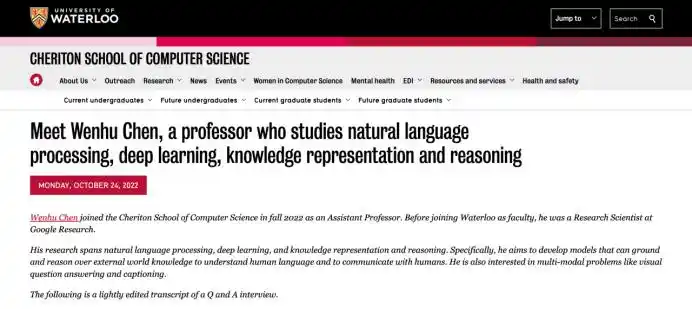
Hutou Bang doesn't just work on benchmark evaluations; they also conduct model and system research.

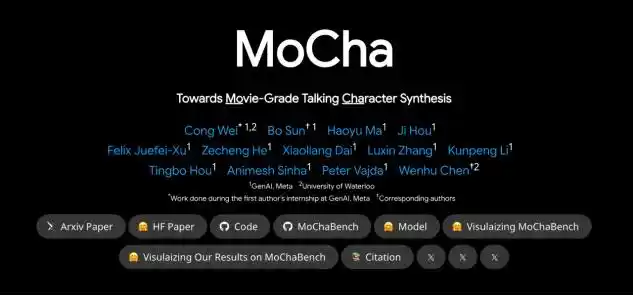
In the video direction, UniVideo attempts to place video understanding, generation, and editing within the same framework, allowing the model not only to generate a sequence of frames but also to understand content, respond to instructions, and complete edits. Vamba targets long video understanding, addressing the memory, computation, and training efficiency challenges posed by hour-long videos. MoCha, a collaboration with Meta's Generative AI team, focuses on talking virtual character generation, producing high-quality character videos from voice and text descriptions.
An exam setter who never takes tests themselves cannot set good questions. Building models themselves, in turn, makes them more suitable for evaluation.

Because truly good evaluation often comes from an understanding of model capability boundaries. Only by knowing how models are built and what problems they encounter in real tasks can one more easily design questions that can differentiate performance and expose weaknesses.

Now, Wenhu Chen has joined Meta's Superalignment Lab, where his work continues to focus on multimodal pretraining data and evaluation, serving Meta's foundation models.

The AI industry does not lack visible figures. Typically, the spotlight falls on entrepreneurs, star researchers, and heads of large model companies. New product launches, funding news, open-source models, and team adjustments often attract the most external attention, making these names more visible to the public.

But today, the participation of Chinese talent in the AI field extends far beyond these most conspicuous positions.

This article is from the WeChat public account "Letters AI", author: Jin Ya

Criptos en tendencia

Preguntas relacionadas

QWho is the key person behind AI benchmark evaluations like MMLU-Pro and MMLU, and what is his background?

AThe key person behind AI benchmarks such as MMLU-Pro and MMLU is Wenhu Chen, an assistant professor in the Computer Science department at the University of Waterloo. He previously worked at Google Research and Google DeepMind on projects like the Gemini multimodal model. He is also the founder of TIGERLab (also known as the 'Tiger Gang'), which focuses on generative AI research for text and images.

QWhy was MMLU-Pro created, and how does it differ from the original MMLU benchmark?

AMMLU-Pro was created because the original MMLU benchmark became less effective as advanced AI models started achieving near-perfect scores, making it difficult to differentiate their capabilities. MMLU-Pro differs by expanding the number of answer choices from 4 to 10, reducing guesswork, and incorporating more reasoning-focused questions. It also removes simpler or ambiguous questions, resulting in a more challenging and stable evaluation that better distinguishes model performance.

QWhat is the MMLU benchmark designed to evaluate, and what challenges did it face over time?

AThe MMLU (Massive Multitask Language Understanding) benchmark is designed to evaluate large language models' knowledge comprehension and reasoning abilities across multiple academic subjects. Over time, as models like OpenAI's o3 achieved near-100% accuracy, MMLU became less effective at distinguishing between top-performing models, leading to the need for a more advanced benchmark like MMLU-Pro.

QWhat is the MMLU benchmark, and how does it assess multimodal AI models?

AThe MMLU (Massive Multidisciplinary Multimodal Understanding) benchmark is designed to assess multimodal AI models by testing their ability to integrate and reason with information from both text and visual inputs (e.g., images, charts, diagrams). It includes 11,500 questions from university exams and textbooks across six major fields, requiring models to combine visual understanding with domain knowledge to solve complex problems.

QHow does Wenhu Chen's work on AI benchmarks relate to his broader research interests and projects?

AWenhu Chen's work on AI benchmarks is closely tied to his broader research focus on complex information understanding, knowledge-based reasoning, and multimodal AI. His involvement in projects like HybridQA, TabFact, and UniVideo reflects his interest in tasks requiring integration of diverse data sources. By developing models himself, he gains insights into their limitations, enabling him to design more effective benchmarks that accurately assess true model capabilities.

Lecturas Relacionadas

Visión de Vitalik sobre stablecoins algorítmicas: Interpretación del mecanismo y desafíos desde la perspectiva de las opciones

El fundador de Ethereum, Vitalik Buterin, ha propuesto un nuevo diseño para una moneda estable algorítmica que utiliza principios de opciones financieras para evitar los riesgos de liquidación. En este sistema, un ETH se divide en dos partes: una (P) que ofrece estabilidad hasta un precio de ejercicio determinado, y otra (N) que captura las ganancias por encima de ese nivel. Juntas, siempre equivalen a un ETH completo. El autor, Dan Rysk, señala que el activo estable (P) funciona esencialmente como una opción call cubierta sintética. Para mantener la estabilidad, este "call" debe estar profundamente dentro del dinero y renovarse (rodarse) continuamente a precios de ejercicio más bajos, lo que introduce desafíos como el deslizamiento en la renovación y la posible manipulación por delante de las operaciones. El mayor obstáculo para la escalabilidad del sistema es la necesidad constante de que alguien mantenga el lado alcista (N), que es una posición apalancada larga en ETH sin tasas de financiación ni riesgo de liquidación. Encontrar demanda sostenida para este rol es crucial. El artículo concluye que, aunque las opciones como producto directo han tenido dificultades en DeFi, su verdadero potencial reside en ser un módulo financiero básico para construir productos más complejos como monedas estables, productos de rendimiento o índices, tal como explora la propuesta de Vitalik y la plataforma Rysk V12.

marsbitHace 1 hora(s)

Visión de Vitalik sobre stablecoins algorítmicas: Interpretación del mecanismo y desafíos desde la perspectiva de las opciones

marsbitHace 1 hora(s)

SpaceX, IA y XRP: ¿Por qué la próxima transferencia de riqueza podría ser diferente?

La atención generada por la posible salida a bolsa de SpaceX refleja una tendencia más amplia: el capital está empezando a dirigirse hacia infraestructuras que podrían definir el próximo sistema económico global. Este nuevo ciclo de inversión podría abarcar infraestructura espacial, redes de satélites, centros de datos, inteligencia artificial y sistemas de comunicación avanzados. Todas estas áreas requieren grandes cantidades de materias primas, lo que sugiere el posible inicio de un superciclo estructural de commodities, impulsado por la demanda industrial y tecnológica, más que por el consumo. En este contexto, tecnologías como blockchain podrían evolucionar desde un enfoque especulativo hacia un papel de infraestructura de liquidación en tiempo real. Activos digitales centrados en pagos e interoperabilidad, como XRP y XLM, ganarían importancia para facilitar transacciones transfronterizas, pagos entre máquinas o la gestión de activos tokenizados. La creciente convergencia entre la IA y blockchain es clave, ya que los agentes de IA necesitarán infraestructuras capaces de ejecutar pagos y liquidar transacciones autónomamente. La clarificación regulatoria en mercados como EE.UU. se presenta como un catalizador esencial para una mayor adopción institucional de estas tecnologías. El futuro podría consistir en una fusión en la que la IA genere actividad económica y las redes blockchain proporcionen la capa de liquidación subyacente. En conclusión, la fusión de la infraestructura espacial, la IA, blockchain, los commodities y marcos regulatorios más claros sugiere una transición hacia un nuevo ciclo económico basado en infraestructura. La cuestión principal ya no es si estas tecnologías convergerán, sino a qué velocidad y qué redes se convertirán en la columna vertebral de esta próxima fase.

marsbitHace 2 hora(s)

SpaceX, IA y XRP: ¿Por qué la próxima transferencia de riqueza podría ser diferente?

marsbitHace 2 hora(s)

Cuenta regresiva para GPT-5.6: Abandona la fantasía de la API única, incluso la iteración más rápida del poder de cómputo no puede competir con una sola regulación

A mediados de junio, tres eventos aparentemente inconexos —las restricciones regulatorias a Claude Fable 5, el lanzamiento en código abierto de GLM-5.2 y la filtración del lanzamiento inminente de GPT-5.6— marcan un punto de inflexión para la industria global de IA. Estos cambios reflejan una reconfiguración fundamental: la "disponibilidad" supera en importancia a la "vanguardia técnica", dando paso a un sistema dual de modelos cerrados controlados y de código abierto local. La retirada de Fable 72 horas después de su lanzamiento, por restricciones de exportación estadounidenses dirigidas a ciudadanos no estadounidenses, evidencia que el avance técnico ahora conlleva un riesgo regulatorio equivalente. Esto crea una vulnerabilidad para las empresas que dependen de APIs cerradas. Como contrapeso, el modelo de código abierto GLM-5.2 de Zhipu AI, compatible con plataformas de semiconductores locales y con un rendimiento cercano a los modelos cerrados líderes, ofrece una alternativa estable y de menor costo. Su despliegue local se convierte en una estrategia de redundancia crítica para la continuidad del negocio ante riesgos geopolíticos. Mientras tanto, OpenAI se prepara para lanzar GPT-5.6, desplazando su foco de la inteligencia lingüística a la "inteligencia espacial" o modelos mundiales, un campo que requiere una inmensa potencia de cálculo. Este movimiento busca establecer una nueva ventaja competitiva en simulaciones industriales, robótica y diseño 3D. En conclusión, la lógica de la cadena de suministro de modelos grandes ha cambiado. La evaluación crítica para las empresas ya no es solo el rendimiento, sino una combinación de capacidad técnica, cumplimiento normativo y estabilidad de acceso. Para los desarrolladores, depender exclusivamente de una API cerrada supone un riesgo inaceptable. Diseñar arquitecturas "agnósticas al modelo" que permitan cambiar rápidamente a alternativas locales y de código abierto se ha convertido en un requisito básico para garantizar la continuidad del negocio.

marsbitHace 4 hora(s)

Cuenta regresiva para GPT-5.6: Abandona la fantasía de la API única, incluso la iteración más rápida del poder de cómputo no puede competir con una sola regulación

marsbitHace 4 hora(s)

Trading

Spot
Futuros

Artículos destacados

Cómo comprar EDGE

¡Bienvenido a HTX.com! Hemos hecho que comprar edgeX (EDGE) sea simple y conveniente. Sigue nuestra guía paso a paso para iniciar tu viaje de criptos.Paso 1: crea tu cuenta HTXUtiliza tu correo electrónico o número de teléfono para registrarte y obtener una cuenta gratuita en HTX. Experimenta un proceso de registro sin complicaciones y desbloquea todas las funciones.Obtener mi cuentaPaso 2: ve a Comprar cripto y elige tu método de pagoTarjeta de crédito/débito: usa tu Visa o Mastercard para comprar edgeX (EDGE) al instante.Saldo: utiliza fondos del saldo de tu cuenta HTX para tradear sin problemas.Terceros: hemos agregado métodos de pago populares como Google Pay y Apple Pay para mejorar la comodidad.P2P: tradear directamente con otros usuarios en HTX.Over-the-Counter (OTC): ofrecemos servicios personalizados y tipos de cambio competitivos para los traders.Paso 3: guarda tu edgeX (EDGE)Después de comprar tu edgeX (EDGE), guárdalo en tu cuenta HTX. Alternativamente, puedes enviarlo a otro lugar mediante transferencia blockchain o utilizarlo para tradear otras criptomonedas.Paso 4: tradear edgeX (EDGE)Tradear fácilmente con edgeX (EDGE) en HTX's mercado spot. Simplemente accede a tu cuenta, selecciona tu par de trading, ejecuta tus trades y monitorea en tiempo real. Ofrecemos una experiencia fácil de usar tanto para principiantes como para traders experimentados.

769 Vistas totalesPublicado en 2026.03.31Actualizado en 2026.06.02

Cómo comprar EDGE

Discusiones

Bienvenido a la comunidad de HTX. Aquí puedes mantenerte informado sobre los últimos desarrollos de la plataforma y acceder a análisis profesionales del mercado. A continuación se presentan las opiniones de los usuarios sobre el precio de EDGE (EDGE).

活动图片