Breaking: Google Gemini Co-Head Poached by OpenAI

marsbitPublicado a 2026-06-18Actualizado a 2026-06-18

Resumen

In a significant industry move, Noam Shazeer, a former DeepMind researcher and co-lead of Google's Gemini project, has officially joined OpenAI as the Lead for Architecture Research. Shazeer is a legendary figure in AI, best known as a core author of the seminal 2017 paper "Attention Is All You Need," which introduced the Transformer architecture foundational to modern models like GPT and Gemini. Shazeer announced his move on social media, expressing excitement to join OpenAI's team while also thanking his former colleagues at Google. His career spans over 18 years at Google, where he contributed to key technologies including the Mixture of Experts (MoE) architecture, Mesh TensorFlow, and the LaMDA model. He left Google in 2021 to co-found the conversational AI company Character.AI, which achieved a multi-billion dollar valuation. In 2024, he returned to Google's DeepMind via a major technology licensing deal to help lead the Gemini project. His departure is viewed as a substantial loss for Google and a major talent acquisition for OpenAI, which is intensifying its competition with rivals like Anthropic. At OpenAI, Shazeer will focus on exploring next-generation AI model architectures and the evolution beyond the current Transformer paradigm. The move underscores the fierce competition for top AI research talent as companies race to develop advanced AI systems.

June 19, ZHIDONGSHE News, Today, Google DeepMind researcher and Gemini co-head Noam Shazeer has officially joined OpenAI, where he will serve as the Lead for Architecture Research. He will be responsible for exploring next-generation AI model architectures and driving the further evolution of the Transformer architecture.

Shazeer himself announced his move to OpenAI in a post on the overseas social platform X, stating: "I'm thrilled to join OpenAI and look forward to working with the exceptional team here."
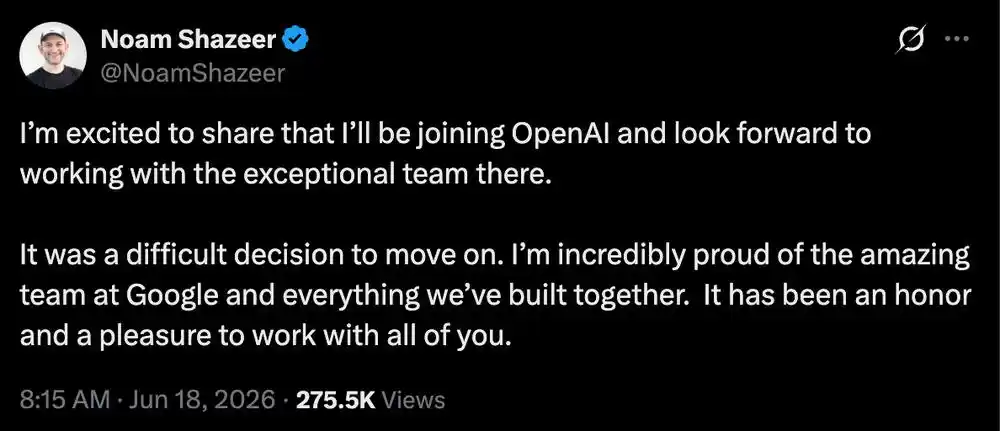
Simultaneously, he expressed gratitude to the Google team: "Leaving was a difficult decision. I'm immensely proud of the Google team and everything we've accomplished together. It has been a privilege to work with you all." A Google spokesperson, in a response to Reuters, stated that the company is grateful for Shazeer's significant contributions over the years and wishes him all the best in his future endeavors.

Noam Shazeer is one of the legendary figures in the AI field. He is one of the core authors of the seminal 2017 paper 'Attention Is All You Need', which first proposed the Transformer architecture, directly establishing the technical foundation for modern large models like the GPT series, Gemini, and Claude.
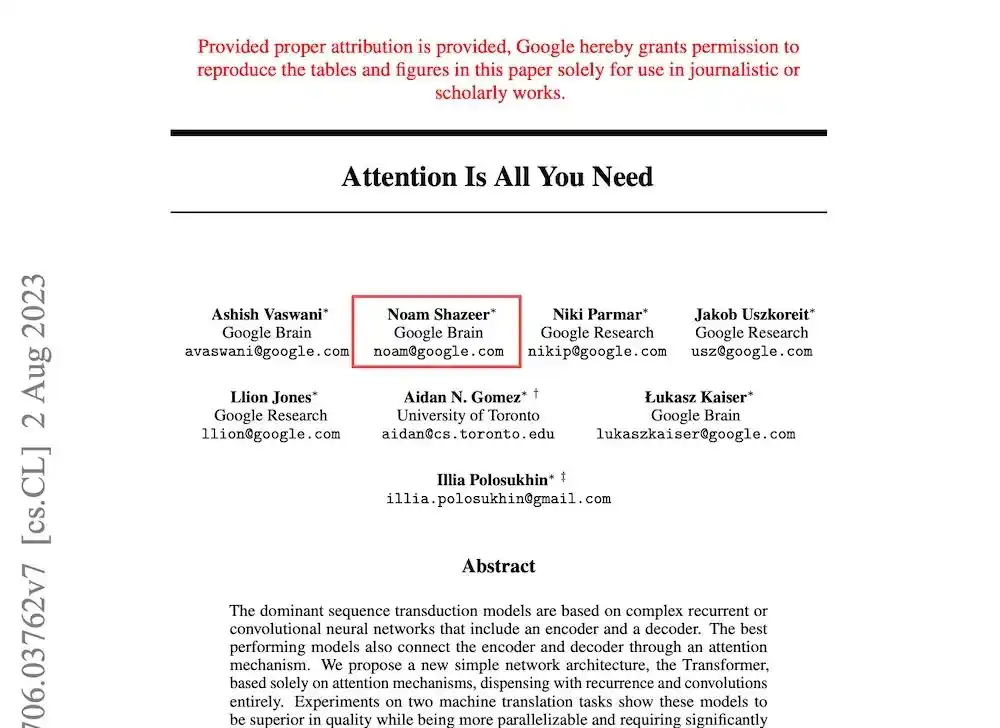
'Attention Is All You Need'

Before joining OpenAI, Shazeer had left Google in 2021 to found Character.AI. In fact, Shazeer is best known as the Co-founder and CEO of Character.AI.

This company bet on the "AI companionship"赛道 even earlier than the ChatGPT explosion, allowing users to engage in long-term conversations with various AI characters. It once became one of the fastest-growing consumer AI applications globally. By 2023, Character.AI's valuation had exceeded $1 billion (approximately RMB 6.765 billion).

In 2024, Google reached a technology licensing agreement with Character.AI valued at approximately $2.7 billion (about RMB 18.266 billion), bringing Noam Shazeer and part of the core team back into DeepMind. Noam Shazeer was appointed as a Gemini co-head, involved in the pre-training R&D of the next-generation Gemini models.

For OpenAI, which is fiercely competing with Anthropic, this is viewed externally as one of the most significant top-tier talent acquisitions in recent years. Following the announcement, OpenAI's senior leadership and several renowned researchers immediately left welcoming messages on X.

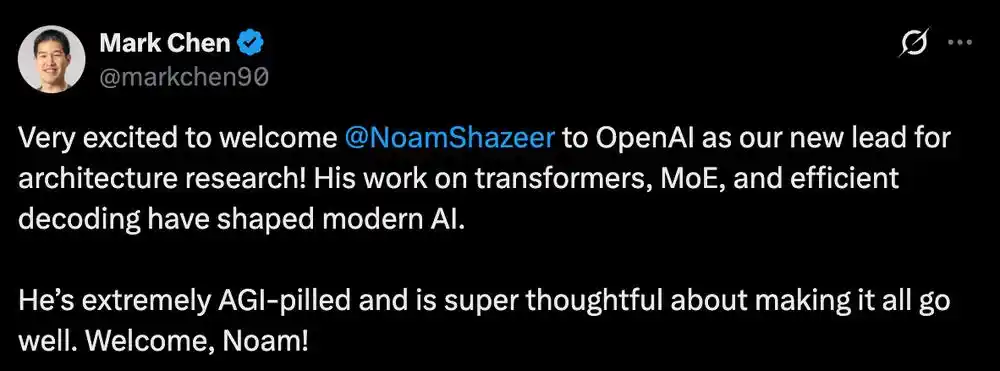
OpenAI's Chief Research Officer, Mark Chen, posted: "Very excited to welcome Noam Shazeer to OpenAI as our Lead for Architecture Research. His work on Transformers, MoE, and efficient decoding has shaped modern AI."
Subsequently, numerous AI researchers also offered congratulations in the comments section, including Google DeepMind researcher and Chinese member of the Gemini Thinking and Coding team, Yuchen Zhuang; OpenAI researcher and core contributor to the o-series reasoning models, Noam Brown; and former Microsoft AI VP, now OpenAI researcher, Sebastien Bubeck, among others.

Google DeepMind Chinese researcher Yuchen Zhuang

OpenAI o-series reasoning model core contributor Noam Brown

OpenAI researcher Sebastien Bubeck

Meanwhile, netizens lamented: "Losing a Transformer author and Gemini co-head is undoubtedly a heavy blow for Google."

01. Renowned Transformer Author, Worked at Google for Nearly 18 Years

From the perspective of the history of generative AI, Noam Shazeer has participated in nearly every key milestone. He joined Google in 2000, serving as a Software Engineer and later Principal Software Engineer, accumulating over 18 years of work experience.
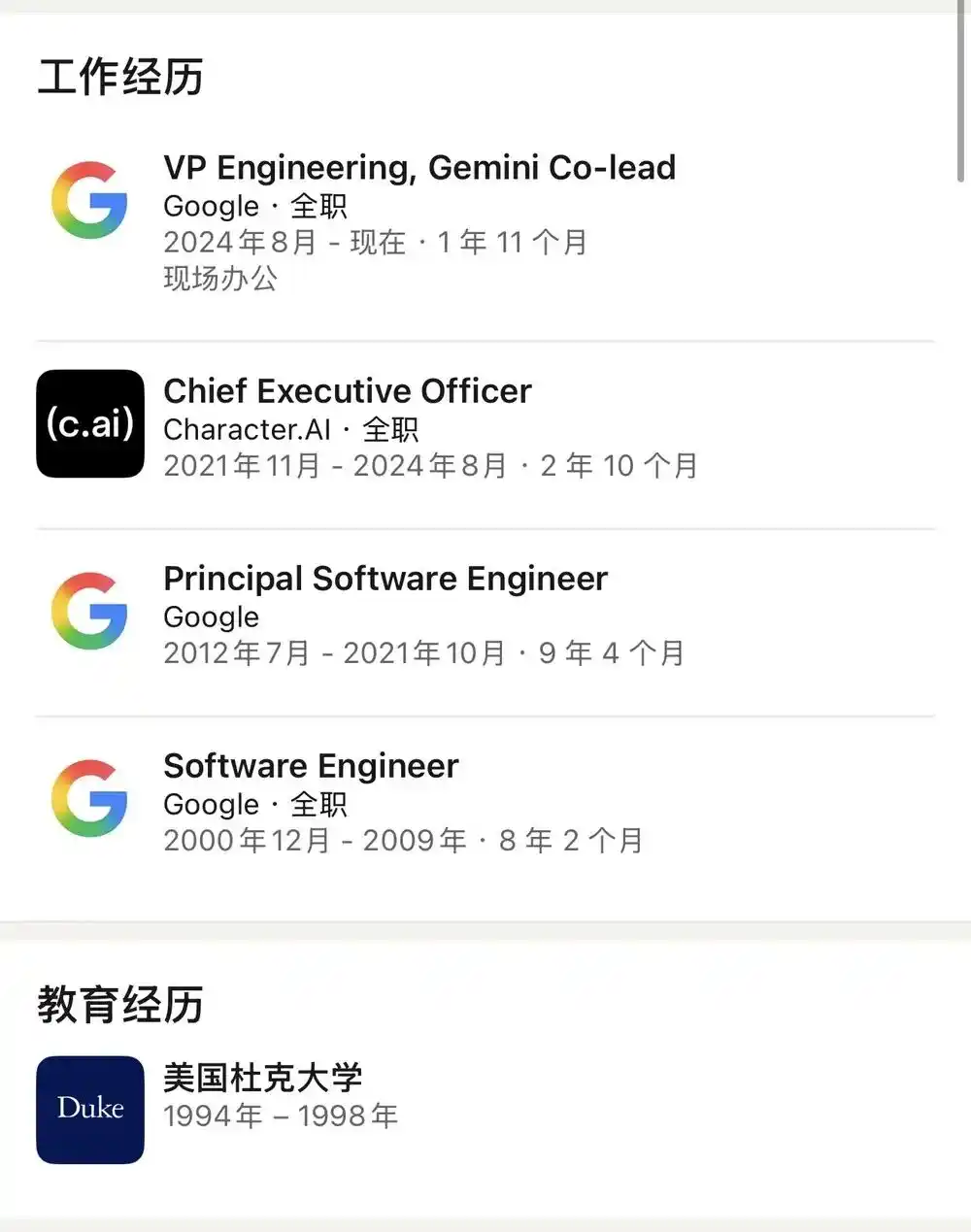
Noam Shazeer's Work Experience and Education Background (Source: LinkedIn)

In 2017, he, along with Ashish Vaswani, Jakob Uszkoreit, and six other Google researchers, co-authored the seminal paper 'Attention Is All You Need', proposing the Transformer architecture. Compared to the then-dominant RNN and LSTM models, the Transformer could process long text more efficiently and possessed greater scalability.

Over the past few years, models such as OpenAI's GPT series, Google's Gemini, Anthropic's Claude, as well as DeepSeek and Llama, are almost all built upon the Transformer architecture at their core. In other words, today's global wave of large models largely rests on the technical foundation laid by this paper.

However, the Transformer is just one of Noam Shazeer's many notable contributions.

During his tenure at Google, he also contributed to the advancement of numerous influential large model technologies. In 2017, as the first author, he proposed the Sparse Gated Mixture of Experts (MoE) architecture, providing crucial technical ideas for later models like GPT-4, Gemini, and DeepSeek-V3; in 2018, he participated in developing Mesh TensorFlow, providing foundational tools for super-large-scale Transformer training; subsequently, he was also involved in key project R&D such as the T5 model and Google's dialogue model LaMDA.

02. Left Google to Start a Company, Then Bought Back for $18.2B

In 2021, Shazeer left Google and co-founded Character.AI with Daniel De Freitas.

At that time, large language models had not yet experienced their "ChatGPT moment," but Character.AI was already pioneering efforts to bring chatbot products to the mass market, rapidly accumulating a large user base.

In 2024, Google reincorporated Shazeer and his core team into the DeepMind ecosystem through a cooperation deal worth approximately $2.7 billion (about RMB 18.266 billion). He subsequently became one of the key leaders of the Gemini project, participating in the pre-training of the next-generation Gemini models.

Shazeer's return coincided with a period of immense pressure on Google's AI business. ChatGPT had exploded in popularity, and Gemini was still in a catch-up phase. After returning to DeepMind, Shazeer participated in model R&D and eventually assumed the role of Gemini co-head, becoming one of the leading figures in Google's AI technology.

Following this, the Gemini 3 series models ranked at the forefront in multiple benchmark tests such as coding and reasoning, becoming a significant asset in Google's competition with OpenAI and Anthropic.

From Google researcher, to entrepreneur, to Gemini co-head, Shazeer has witnessed nearly every major turning point in Google's AI development over the past decade. Therefore, his departure from Google to join OpenAI is regarded by many industry insiders as one of the most significant talent loss events for Google in recent years.

03. OpenAI's Talent Battle Continues to Escalate

Shazeer's joining unfolds against the backdrop of increasingly fierce talent competition in the AI industry.

Over the past year, competition between OpenAI and Anthropic has continued to intensify. The two are not only competing over model capabilities but are also constantly vying for top researchers and core engineers.

The UK's Financial Times reported that OpenAI internally views Shazeer's addition as a major reinforcement. In the future, he will focus on researching new architectural directions beyond the Transformer, and on further enhancing model capabilities.

It's worth noting that the Transformer has dominated the AI field for nearly a decade. With the development of reasoning models, multi-agent systems, and world models, more and more researchers are beginning to ponder: Will the Transformer undergo its next major architectural upgrade?

And Shazeer is precisely one of the most qualified individuals to answer that question.

For Google, this means losing a Transformer author, a Gemini co-head, and one of its most seasoned AI architecture designers. For OpenAI, its laboratory welcomes someone who has personally shaped the modern AI technology stack.

04. Conclusion: A Significant Talent Move in the Transformer Era

As technology gradually approaches the frontier, top researchers themselves have become one of the scarcest resources. The trajectory of Noam Shazeer's career almost connects four key nodes: Transformer, Character.AI, Gemini, and OpenAI.

Now, this Transformer author's departure from Google and joining of OpenAI is not only a talent movement but also reflects the increasingly fierce competitive landscape among current AI giants.

Especially at a time when OpenAI and Anthropic are engaged in a white-hot competition over next-generation models, the enterprise market, and top research talent, and Google is also catching up through Gemini. Losing a Transformer founder and Gemini co-head at this juncture is undoubtedly a significant loss for Google.

For the entire industry, a subsequent question worth following is: When a Transformer author personally researches "architectures beyond the Transformer," where will the next generation of AI models head.

This article is from the WeChat public account "Zhixidongxi" (ID: zhidxcom), author: Jiang Yu, editor: Li Shuiqing

Preguntas relacionadas

QWho is Noam Shazeer and what is his significance in the AI field?

ANoam Shazeer is a renowned AI researcher, a core author of the seminal 2017 paper 'Attention Is All You Need' which introduced the Transformer architecture, and the former co-lead of Google's Gemini project. His work laid the technical foundation for modern large language models like GPT, Gemini, and Claude.

QWhat new role did Noam Shazeer take at OpenAI and what will he be responsible for?

ANoam Shazeer joined OpenAI as the Lead for Architecture Research. He will be responsible for exploring next-generation AI model architectures and driving the further evolution of the Transformer architecture.

QWhat was the nature of the significant deal between Google and Character.AI involving Shazeer in 2024?

AIn 2024, Google reached a technology licensing deal with Character.AI valued at approximately $2.7 billion (RMB 18.266 billion). This deal brought Noam Shazeer and part of the core team back into Google DeepMind, where he was appointed co-lead of the Gemini project.

QWhy is Shazeer's move to OpenAI considered a significant loss for Google?

AShazeer's departure is considered a significant loss for Google because he is a Transformer author, a former Gemini co-lead, and one of its most senior AI architecture designers. Losing such a key figure in the midst of intense competition with OpenAI and Anthropic is a substantial setback.

QWhat broader industry trend does Shazeer's career move highlight according to the article?

AShazeer's move highlights the increasingly fierce competition for top-tier AI research talent among major tech companies like OpenAI, Google, and Anthropic. As technology pushes the frontier, these researchers themselves become among the most scarce and valuable resources.

Lecturas Relacionadas

No solo pienses en los despidos, la nueva estructura de la Fundación Ethereum merece más atención

La Fundación Ethereum (EF) se ha reorganizado, reduciendo su personal en un 20% (54 personas) y su presupuesto en aproximadamente un 40%. El cambio principal no es la reducción, sino una redefinición estratégica de sus prioridades. La nueva estructura organizativa concentra recursos en áreas fundamentales y difíciles de externalizar. La capa de protocolo, ahora la más grande con 57 personas, se enfoca en mantener los atributos esenciales de Ethereum: resistencia a la censura, captura, seguridad y privacidad. Se priorizan líneas técnicas críticas como la seguridad post-cuántica, zkEVM, verificación formal y el desarrollo de clientes. Figuras como Vitalik Buterin y Justin Drake están involucradas en el grupo de arquitectura, señalando la alta prioridad de la evolución del protocolo a largo plazo. El objetivo es gestionar la creciente complejidad mediante nuevas herramientas como la verificación formal asistida por IA y posiblemente clientes más especializados. Financieramente, la EF busca pasar de un gasto anual promedio del 15% de sus fondos restantes a un modelo de dotación más sostenible, con un gasto anual objetivo del 5% para después de 2030. Paralelamente, la EF está descentralizando esfuerzos, apoyando el surgimiento de organizaciones externas como EthLabs, Ethereum Apps Guild (EAG) y otras. Estas entidades asumirán roles en adopción, herramientas para desarrolladores y narrativa, permitiendo a la EF concentrarse en su núcleo. El reto será garantizar una coordinación efectiva en este nuevo modelo de múltiples nodos. En resumen, la reorganización implica un repliegue estratégico de la EF hacia problemas técnicos complejos y fundamentales, delegando otras funciones al ecosistema, con el objetivo de asegurar la sostenibilidad y resistencia a largo plazo de Ethereum frente a futuros desafíos tecnológicos.

Foresight NewsHace 9 min(s)

No solo pienses en los despidos, la nueva estructura de la Fundación Ethereum merece más atención

Foresight NewsHace 9 min(s)

Interpretación del informe de investigación: Mientras CPO está en auge, ¿qué estrategias está implementando Coherent?

**Resumen del informe de investigación: Qué está tramando Coherent en la era del CPO** El analista Samik Chatterjee de J.P. Morgan reitera la calificación "Overweight" (sobreponderar) para Coherent (COHR). Se subestima su potencial de crecimiento en tres áreas clave: transceptores ópticos para centros de datos, chips CPO (Óptica en Paquete Compartido) y tecnología láser/refrigeración industrial. **Transceptores:** La demanda de sus transceptores 1.6T, estándar en centros de datos, sigue siendo fuerte, con un entorno de precios saludable. **CPO y OCS:** El CPO, una tendencia clave, representa una oportunidad mayor de lo estimado. Coherent tiene una ventaja competitiva al ofrecer un portafolio completo de componentes ópticos (láseres, aisladores, etc.) para sistemas CPO, capturando más valor por chip que en los transceptores tradicionales. Su tecnología de intercambio óptico (OCS), con un mercado potencial de $4 mil millones, ofrece ventajas de confiabilidad y bajo consumo. **Capacidad y Integración:** Su plan para cuadruplicar la capacidad de producción de componentes de InP en 2 años y la transición a obleas de 6" mejorarán la estructura de costos. La escasez de láseres de bombeo le permite avanzar en la integración vertical, pasando de vender componentes a sistemas completos, aumentando significativamente el precio medio por unidad. **Margen y Crecimiento Industrial:** La compañía apunta a un margen bruto >42%, respaldado por productos premium, reducción de costos y nuevos productos de alto margen como CPO. En el segmento industrial, mantiene un crecimiento orgánico del 5-10%, con pedidos crecientes en equipos de fabricación de semiconductores y nuevas oportunidades en sensores 3D. La creciente demanda de IA y potencia de cálculo impulsa la necesidad de interconexiones ópticas de alta velocidad, donde Coherent ocupa una posición estratégica. Las oportunidades en CPO/OCS, el crecimiento industrial estable y la mejora de márgenes respaldan la visión positiva.

marsbitHace 33 min(s)

Interpretación del informe de investigación: Mientras CPO está en auge, ¿qué estrategias está implementando Coherent?

marsbitHace 33 min(s)

Dan Koe: Cómo escapar del destino de asalariado y sobrevivir a la ola de sustitución por IA

Lanzado por Dan Koe, este texto es una respuesta a los temores sobre la IA que sustituya empleos. Argumenta que la amenaza real no es la tecnología, sino depender financieramente de otros. Para escapar de la "esclavitud salarial" y prosperar en la era de la IA, el autor propone crear un proyecto propio. Identifica cinco elementos clave para el éxito: iniciativa, buen gusto, capacidad de persuasión, perseverancia e iteración. Estos se resumen en dos habilidades: resolver problemas y adquirir experiencia relevante. La solución, según Koe, es volverse "inempleable" al construir algo propio. Recomienda dos vías dominantes: codificación y creación de contenido (medios), destacando la segunda por su naturaleza subjetiva y su resistencia a la automatización total. El plan de acción comienza con un cambio radical de entorno para forzar un cambio de mentalidad. Luego, se debe elegir un medio (como los contenidos) que proporcione retroalimentación real. El núcleo es construir un "trabajo para toda la vida" basado en la propia experiencia y perspectivas únicas, no una marca personal vacía. El autor termina con un ejercicio práctico: dedicar 15 minutos a responder preguntas clave para descubrir la propia "materia prima" intelectual y una "opinión impopular" única. La conclusión es publicar la primera pieza de contenido al día siguiente, aceptando que será imperfecta, pero iniciando el ciclo esencial de aprendizaje mediante la acción y la iteración.

marsbitHace 38 min(s)

Dan Koe: Cómo escapar del destino de asalariado y sobrevivir a la ola de sustitución por IA

marsbitHace 38 min(s)

Después de un recorte del 20%, ¿cuáles son los puntos clave de la nueva estructura de la EF?

Según medios, la Fundación Ethereum (EF) anunció el 23 de junio una reestructuración organizativa, despidiendo a 54 empleados, aproximadamente el 20% de su plantilla. La organización se ha rediseñado en cinco clústeres principales: Protocolo, Acceso, Usuario, Comunidad e Institucional. El objetivo oficial, en línea con su "Mandato" y su política de gestión de tesorería, es crear una estructura más ágil y enfocada en los principios de soberanía personal y resistencia a la captura, resumidos en el acrónimo CROPS (censorship-resistant, open-source & free, private, secure). La reestructuración busca afianzar el trabajo en el protocolo base y garantizar que los usuarios mantengan una ruta de acceso sin intermediarios. A los empleados despedidos se les ofrecerá una indemnización superior al mínimo legal y apoyo para encontrar roles dentro del ecosistema Ethereum. Aunque la EF describe el cambio como una reorientación estratégica para cumplir mejor su misión a largo plazo, coincide con un período de cambios en su liderazgo y creciente discusión externa sobre la fragmentación del ecosistema, la competencia de las L2 y la presión regulatoria. La EF no ha revelado la distribución presupuestaria detallada ni los KPI de los nuevos clústeres. La incógnita clave es cómo se reasignarán los recursos y si esto afectará el ritmo de las actualizaciones del protocolo, el apoyo al ecosistema o el enfoque ante instituciones y reguladores. La Fundación ha prometido proporcionar más detalles en las próximas semanas y meses.

marsbitHace 43 min(s)

Después de un recorte del 20%, ¿cuáles son los puntos clave de la nueva estructura de la EF?

marsbitHace 43 min(s)

El bot MEV más avanzado, robado por 7.5 millones de dólares: ¿Es la 'Aprobación' el riesgo fatal más desatendido en la cadena?

**Resumen: El ataque a un bot de MEV subraya el riesgo crítico y subestimado de las autorizaciones (Approvals) en blockchain** Un sofisticado bot de MEvalor (MEV) en Ethereum, conocido por ejecutar ataques de "sándwich", fue víctima de un ataque inverso que resultó en la pérdida de aproximadamente 7.5 millones de dólares. El atacante no explotó una vulnerabilidad tradicional, sino que diseñó una trampa a medida: durante semanas, desplegó tokens y pools de liquidez falsos que simulaban oportunidades de arbitraje. Esto engañó al sistema automatizado del bot para que otorgara autorizaciones (approvals) de ERC-20 a contratos maliciosos, permitiendo finalmente el drenaje "legal" de sus fondos. Este incidente revela el peligro fundamental de la función de autorización, un mecanismo esencial para que los contratos inteligentes interactúen con los tokens de los usuarios en DeFi. Similar a un permiso de débito automático, una vez concedida, una autorización puede permitir que un contrato retire fondos repetidamente sin más confirmaciones. Los riesgos clave incluyen: 1. **Autorizaciones ilimitadas:** Los usuarios a menudo aprueban cantidades máximas por conveniencia, exponiendo todos sus fondos presentes y futuros. 2. **Persistencia del permiso:** Las autorizaciones permanecen activas en blockchain incluso después de desconectar una cartera o dejar de usar una dApp. 3. **Evolución del riesgo:** Un contrato inicialmente legítimo puede volverse malicioso tras una actualización, un hackeo o una filtración de claves. Para gestionar este riesgo, los usuarios deben adoptar el **principio del menor privilegio** (aprobar solo el monto necesario para una transacción específica), usar **carteras separadas** para almacenamiento e interacciones de alto riesgo, y **revisar y revocar periódicamente** autorizaciones innecesarias usando herramientas como Revoke.cash o funciones integradas en carteras como imToken. Las carteras también tienen un papel crucial en la protección proactiva, implementando advertencias para interacciones riesgosas, analizando y presentando de forma legible el contenido de las firmas (firmado legible o "clear signing") para garantizar que los usuarios comprendan qué están autorizando. La seguridad en Web3 no depende solo de proteger la clave privada, sino también de gestionar activamente a quién se le concede permiso para acceder a los activos, un esfuerzo que requiere tanto conciencia del usuario como mejores herramientas.

marsbitHace 47 min(s)

El bot MEV más avanzado, robado por 7.5 millones de dólares: ¿Es la 'Aprobación' el riesgo fatal más desatendido en la cadena?

marsbitHace 47 min(s)

Trading

Spot
Futuros
活动图片