How Difficult is Chip Making? A Division Error Costs 475 Million Dollars

marsbitPublicado a 2026-06-15Actualizado a 2026-06-15

Resumen

How Hard Is It to Make a Chip? A Division Error Cost $475 Million Chip expert Shi Kan, a researcher at the Chinese Academy of Sciences and a popular tech creator, explains the immense challenges of chip development. Chips are foundational to modern technology, but their creation is extraordinarily difficult. The journey from sand to a functional chip involves complex design and manufacturing, but a critical bottleneck is verification—ensuring the design works flawlessly before costly production. A single, undetected bug can have catastrophic consequences, as illustrated by the infamous 1994 Intel Pentium FDIV bug. A flaw in the floating-point division unit forced a recall costing $475 million. Unlike software, chips cannot be easily patched after manufacture, making "first-time success" paramount. However, industry surveys show only 24% of chip projects achieve this; over three-quarters require at least one costly re-spin due to design flaws. Verification has thus become the dominant phase, consuming up to 70% of the design cycle. The core challenge is a "verification impossible triangle" between high performance, good debuggability, and low cost. Exhaustively verifying a modern CPU core could take 15,000 years with software simulation, or 30 years with advanced hardware emulation—timeframes utterly impractical for development. Despite being essential, verification is often seen as unglamorous "dirty work," receiving less academic attention than fields like AI. Shi and hi...

Hello everyone, I'm Shi Kan from the Institute of Computing Technology at the Chinese Academy of Sciences, a 'slash technology worker'. I have over a decade of experience in the chip industry, and currently, I conduct academic research related to chips at the Chinese Academy of Sciences; at the same time, I am also a science and technology Bilibili UP host 'Lao Shi Tan Xin', and my viewers call me 'Lao Shi'.

Chips: The Cornerstone of Modern Society

When it comes to chips, everyone surely knows their importance.
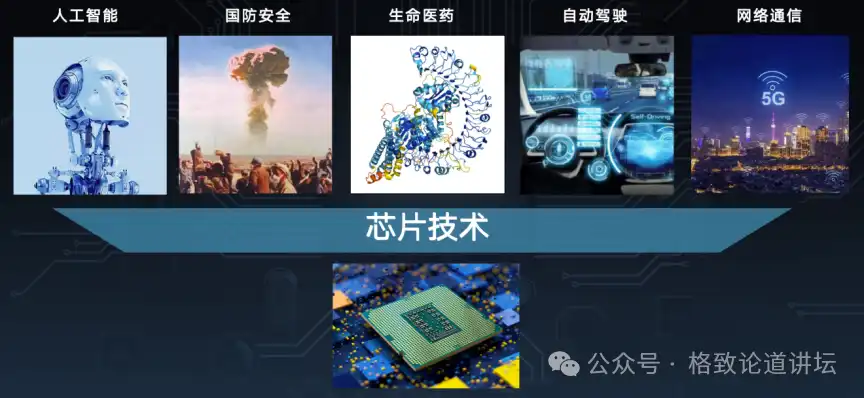
Whether it's the currently hot artificial intelligence, life sciences and medicine, autonomous driving, network communications, and so on, almost all the technologies of modern society you can imagine are inseparable from chips—this foundational technology of the information age.

I have been involved in chip work for a long time, and the chip development process is actually a very interesting one, mainly due to two aspects.

Firstly, the applications of chips are extremely wide-ranging. Once you enter this industry, you probably don't have to worry about unemployment because many industries require chip technology.

The second reason might be more important: chip development is a very difficult endeavor. As chip engineers, we need to constantly learn and enrich ourselves to face and embrace this era full of opportunities and challenges.

So the question arises: what exactly makes chip technology so difficult?

Why Are Chips So Difficult?

Completed: 10%//////////

Everyone might know that the manufacturing process of a chip is essentially an evolution journey of a grain of sand. Sand might be something inexhaustible and abundant on this planet; but turning low-value sand into high-value chips adds up to nothing but human intelligence.
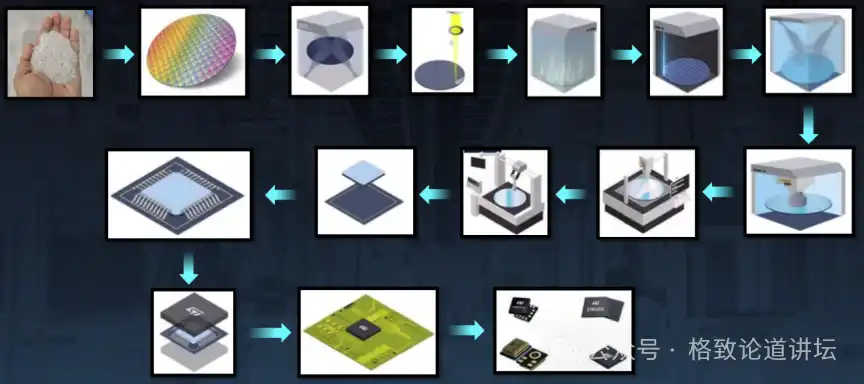
Starting from sand, we need to purify it to obtain wafers. Then, through a series of steps such as photolithography, ion implantation, etching, packaging, and so on, the abundant, inexhaustible sand is transformed into the final tiny chip.

So, having said all that, with so many steps, chip manufacturing is actually only part of the entire chip development process; it does not equal chip development itself.
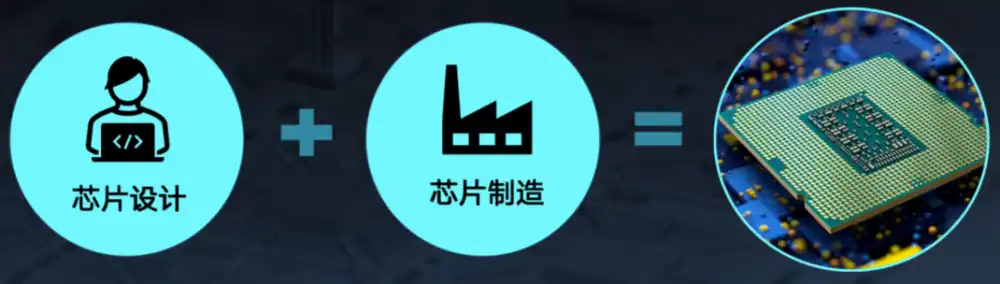
There is another crucial step, which is chip design. It refers to completing the circuit design according to requirements and making the circuit function properly. Then, we hand over the designed circuit to chip manufacturers for the later stages of manufacturing, ultimately obtaining the physical chip.

But there is another question here: how do you ensure that the chip's functionality matches your initial design?
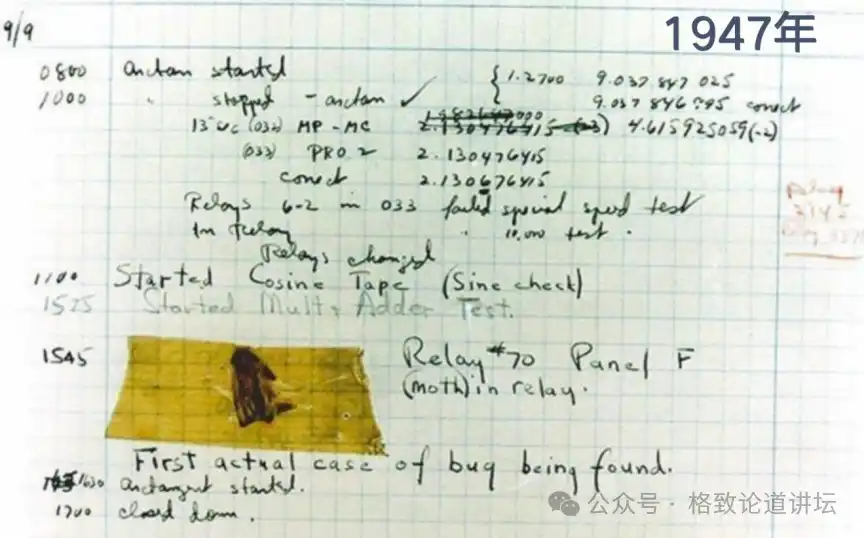
There is an interesting little story here. In 1947, a very famous female programmer named Grace Hopper found her computer wasn't working. After careful investigation and exploration, she discovered that a moth had flown into a relay of the computer. So, she carefully used tweezers to remove this moth and taped it onto a piece of paper.

This might be the first 'bug' discovered in the entire history of computer development, meaning a vulnerability.

If the previous example seems too distant, we actually have more examples. Here's a math problem for everyone: What is the final result of this expression? Actually, this problem is simple because the numerator and denominator in the later part are the same and can cancel out; then the numbers before and after the minus sign are also the same, so subtracting the same number should result in 0. However, in actual computers and chips, the result might not be this.
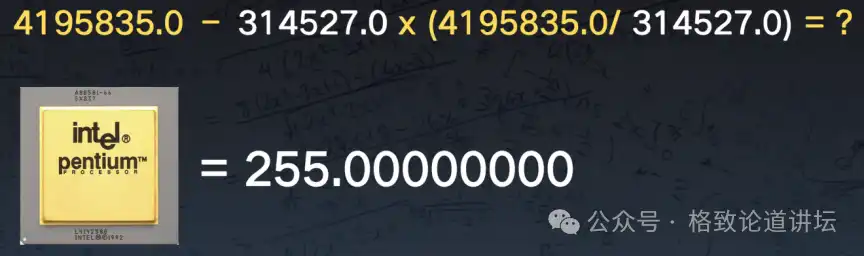
For example, in an Intel Pentium chip, the result was 255.00000000. What happened? It turned out that when an American scientist was conducting scientific research, he kept getting incorrect calculations when running this expression. Finally, he discovered that there was an undetected design flaw in a floating-point division unit of this chip.

Don't underestimate this design flaw; its consequences were actually very serious. In the 1990s, Intel spent $475 million to recall all problematic Pentium chips worldwide.

So, returning to the earlier question: what exactly makes chip technology so difficult?

In my view, the difficulty of chips lies in the need to succeed on the first try. Making chips is not like software, where you can patch and fix various problems later. In contrast, once a chip completes the evolution journey from sand to chip, you may have already spent tens of thousands, millions, or even hundreds of millions to complete the tape-out and manufacturing, making it very difficult to modify afterwards.

Then, the next question is: how many chip projects today can achieve success on the first try?

The 'Bottleneck' of Chip Verification

Completed: 40%//////////

According to survey data, only 24% of chip projects can achieve success on the first try. That is to say, 3/4 of chip projects, due to various major and minor undetected design flaws, require at least one more tape-out, which consumes a lot of time and money.
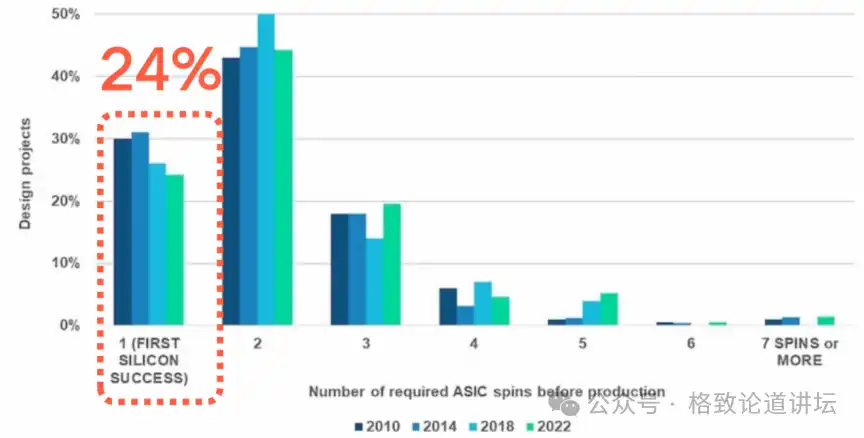
Therefore, the key question is: how can we ensure, as much as possible, that chips have as few or no bugs/design flaws as possible before tape-out and manufacturing? This is the direction I have been dedicated to researching over the past few years.
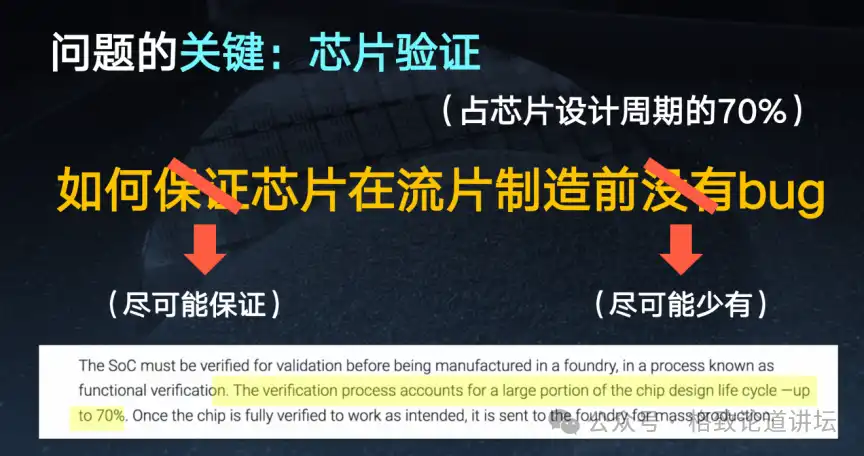
Also according to this research data, throughout the entire chip development process, especially with the current development of AI and various high-tech fields, chips are becoming increasingly complex. As a result, chip verification has become a very high proportion of the entire chip development cycle, even exceeding half, reaching 70% of the entire chip design cycle.

But unfortunately, chip verification is also a difficult task. I list some astronomical numbers here, such as the Earth's circumference, the possible number of stars in the Milky Way, or the length of a light-year.

In chip verification, there is also an astronomical number, which is the number of cycles needed to fully verify a CPU core. What exactly does this astronomical number represent?

If we use the most advanced software simulation technology available today to fully verify a CPU core, it would take at least 15,000 years. Using the most advanced hardware emulation technology can slightly reduce this time to 30 years. But we all know that developing a chip cannot wait 15,000 years, nor can it wait 30 years.
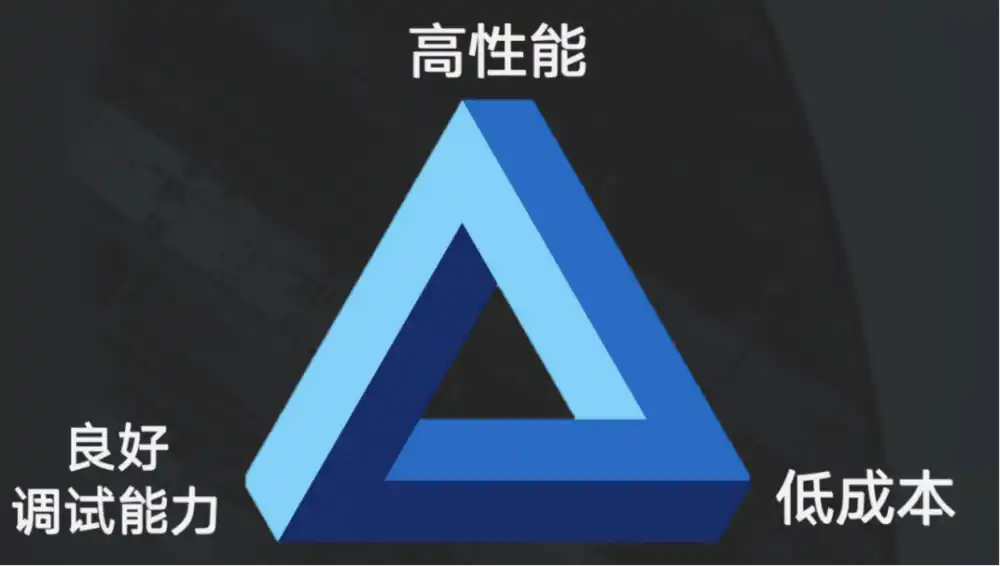
So, what is the essence of the problem? We have actually been researching this over the past few years. We found that in chip verification, there exists a so-called 'impossible triangle', namely the high performance of chip verification, good debugging capability, and low cost; these three factors crucial to chip verification cannot be satisfied simultaneously. For current mainstream research or methods, at most, two out of the three can be achieved, and this is the fundamental reason for the low efficiency of chip verification.

Someone Must Do Something Different

Completed: 60%//////////

Due to these reasons, chip verification has not seen significant development over the past period.

In chip companies, chip engineers may spend more time writing test cases and running regression verification. Essentially, it's dirty and tiring work. The same goes for academia; very few scholars are devoted to chip verification research, especially compared to current hot fields like artificial intelligence, research related to chip verification is very scarce.

So, an academic leader once told me that in the same amount of time, they could publish three or even more papers in the field of artificial intelligence, but in chip verification, they might not even publish one.

Unfortunately, what they said is true.

However, someone must do something different.

Therefore, over the past few years, I have led a team in conducting research related to chip verification and have built an agile verification research system from scratch. The core of this research system is a verification platform called ENCORE, which is based on a special chip—the Field-Programmable Gate Array (FPGA). ENCORE can significantly improve verification efficiency while achieving good verification debuggability.
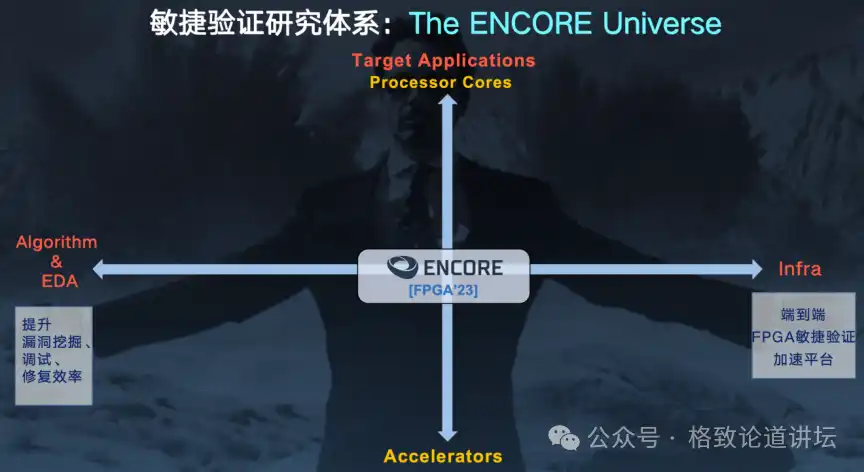
To build this agile verification research system, on one hand, we need to continuously optimize the efficiency of vulnerability mining, debugging, and repair at the algorithmic level; on the other hand, we also hope to build an end-to-end agile verification acceleration platform based on programmable logic chips (FPGAs). At the application level, we hope this platform can be suitable for both general-purpose processor verification, such as CPUs or GPUs, and specialized chip verification, such as the currently very popular AI accelerators.
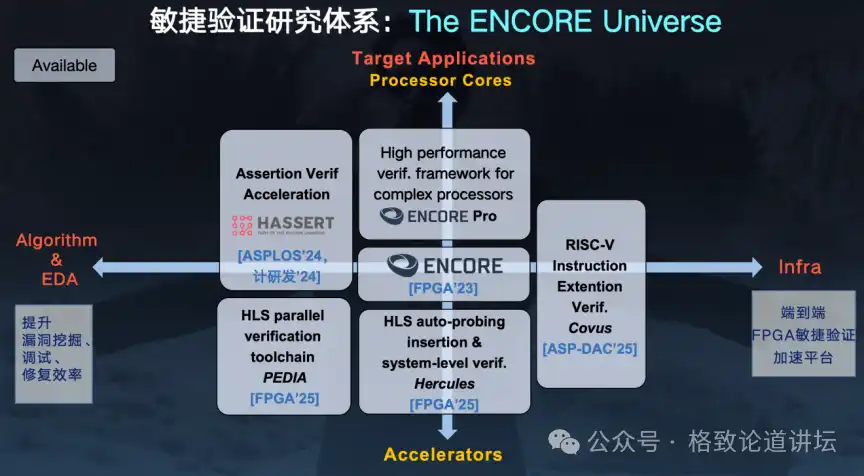
Over the past period, we have done a lot of cutting-edge exploratory work in this field, including the aforementioned ENCORE and many new research projects. We have also published these research results at many internationally renowned academic conferences.
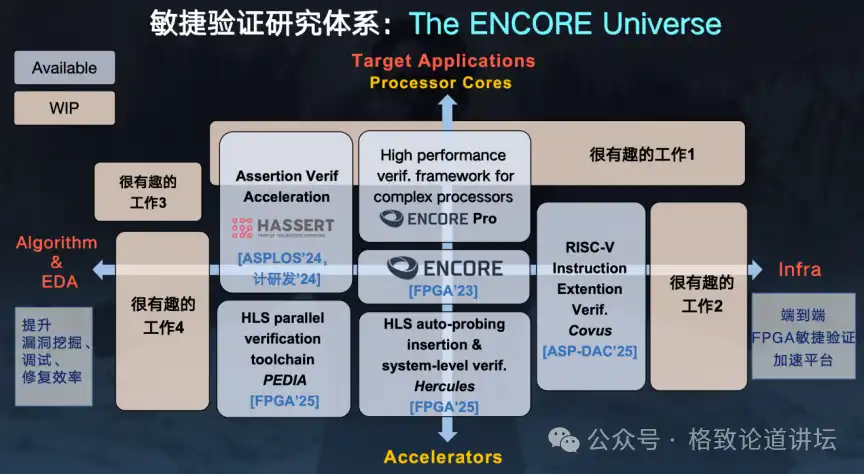
We are actually working on some interesting projects afterwards, but since these works have not been published yet, I won't show them to you one by one for now.

Letting More People Understand Chips

Completed: 80%//////////

However, during the research process, I gradually realized that these scientific or academic achievements are mainly for people within our small circle who only understand chip verification and related fields. So, how can we let more people see our work, understand our research, and even participate in our endeavors?

Naturally, I thought of chip science popularization, which also feels very interesting to me. I have been engaged in science popularization for four or five years, starting from text initially to later making videos on Bilibili. Chip science popularization has not only brought me many gains but also helped me meet many like-minded friends, as well as viewers who like and support me.
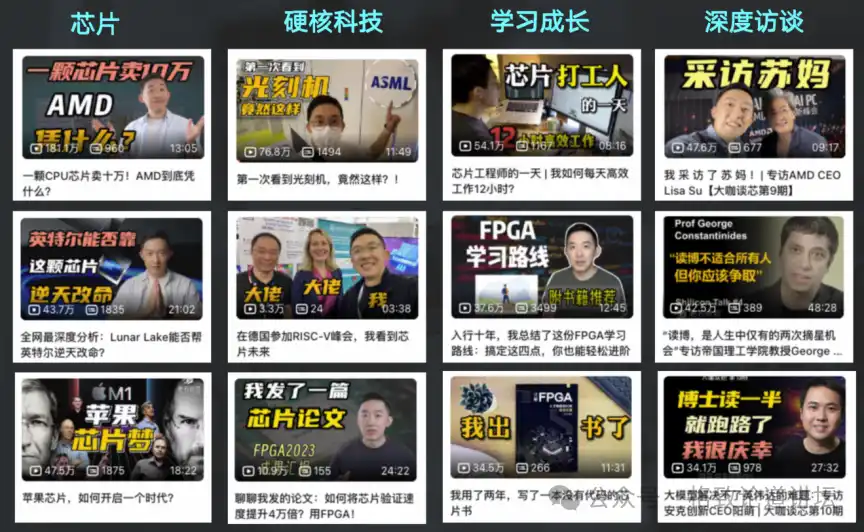
However, making chip science popularization videos is not a simple task, especially in today's era of short video proliferation. A fellow science popularization blogger and leader told me that in the same amount of time it takes me to produce one long, hardcore chip science popularization video, they could make 10 or even more short videos related to hot topics, and the traffic could be many times greater than mine.

Unfortunately, what they said is also true.

But based on this, I think there still needs to be people who persist in doing difficult things. I hope to combine chip science popularization and chip verification—two equally difficult but equally interesting things—and use video and text formats to show everyone what we have done, the papers we have published, and the open-source chip projects our entire large team is researching.

Besides chips, I will also share hardcore technologies like artificial intelligence and computers with everyone, as well as share my growth experiences, the books I have read, and the knowledge I have acquired. I know that I am not a genius myself, nor am I a so-called all-around expert or guru. I would rather be a 'guide' for everyone, sharing the path I have walked.

So, returning to the question I wanted to share with everyone today: chip research and chip science popularization, which one is more interesting? Of course, for me, both are equally interesting. The reason is simple: because they are equally difficult. At the same time, they both require me to persist very long-term and enduringly.

Many people say we need to do difficult and right things. But the problem actually is: how do you judge if something is right before you do it? If something is seen as sitting on a cold bench in others' eyes, or seen as doing dirty, tiring work, would you still persist in doing it?

Therefore, I prefer to do difficult and long-term things, such as academic research in chip verification, or making long hardcore chip science popularization videos. Because if something is difficult and requires long-term persistence, then it is probably right.

That's all I wanted to share with you today. I am Lao Shi, thank you, everyone!

This article comes from the WeChat public account: Gezhi Lundaotan , Author: Shi Kan, Original Title: 'How Difficult is Chip Making? A Division Error Costs 475 Million Dollars | Shi Kan'


Preguntas relacionadas

QWhat was the main point of the story about the Intel Pentium chip flaw mentioned in the article?

AThe story illustrated a critical design bug in the Pentium chip's floating-point division unit. A calculation that should have resulted in '0' instead produced '255.00000000'. This seemingly minor error forced Intel to spend $475 million on a global recall of the faulty chips in the 1990s, highlighting the high cost of failure in chip development.

QAccording to the article, why is chip development so difficult, especially compared to software development?

AChip development is exceptionally difficult because it requires 'first-time success'. Unlike software, which can be patched and updated after release, a physical chip cannot be easily modified once manufactured (or 'taped out'). The entire expensive process, from sand to finished silicon, costing potentially hundreds of millions, must be redone to fix design flaws.

QWhat percentage of chip projects achieve first-time success according to the survey data cited by the author?

AAccording to the survey data presented by the author, only 24% of chip projects achieve first-time success. This means approximately three-quarters (76%) of projects require at least one re-spin or re-fabrication due to various undetected design bugs, leading to significant extra time and cost.

QWhat is the 'impossible triangle' in chip verification, as explained in the article?

AIn chip verification, the 'impossible triangle' refers to the three crucial factors—high performance, good debuggability, and low cost. The article states that these three factors cannot be satisfied simultaneously with current mainstream methods. Engineers and researchers can only achieve a maximum of two out of these three, which fundamentally limits verification efficiency.

QWhat are the two 'hard but long-term' pursuits that the author, Shi Kan ('Lao Shi'), is committed to?

AThe author is committed to two challenging, long-term endeavors. First, he leads academic research in chip verification, specifically developing an agile verification framework called ENCORE based on FPGAs. Second, he creates hardcore, long-form chip and technology popular science content (like his Bilibili channel videos), aiming to make complex topics accessible to a wider audience beyond academic circles.

Lecturas Relacionadas

Guía de registro y publicación para la columna de PANews

**Guía de registro y envío de artículos para columnistas de PANews** PANews invita a expertos en criptomonedas y Web3 a solicitar su propio canal de columnista para publicar contenido profundo sobre el sector, datos y análisis. **No se aceptan** artículos promocionales de marcas, relaciones públicas o creados principalmente con IA; este tipo de contenido debe gestionarse a través del canal comercial. **Solicitud de canal:** * **Versión web:** Visite el sitio oficial, desplácese hasta el pie de página y haga clic en "Solicitar columna". Regístrese con su número de móvil o correo electrónico (solo con código de verificación). Complete el nombre, descripción, suba un avatar y proporcione enlaces a trabajos publicados anteriormente. * **Versión móvil:** En la app, vaya a "Mi", luego a "Contribuciones y creación" y complete la información necesaria. **Publicación de artículos:** 1. Inicie sesión en [panewslab.com/zh](https://www.panewslab.com/zh) y acceda a su página personal. 2. Entre en el "Centro de creadores". 3. Cree y publique su nuevo artículo. **Inserción de vídeo:** Solo se admite la inserción de código de plataformas de terceros (como Bilibili). En el editor del artículo, utilice la función "Insertar/editar medios", seleccione la pestaña "Insertar", pegue el código y guarde. Se recomienda ajustar el tamaño a 100% de ancho y 560px de alto. **PANews Skills (Publicación con IA):** PANews ofrece un conjunto de herramientas de IA (PANews Skills) que permite a los Agentes de IA consultar contenido, rastrear tendencias y **publicar artículos directamente en el canal**. La habilidad clave para creadores es `panews-creator`. Para usarla, los autores deben obtener su token de autorización personal (`authorization`) desde las herramientas de desarrollador (Consola -> Red) de su navegador después de iniciar sesión en PANews. **Enlace de instalación de PANews Skills:** [https://github.com/panewslab/skills](https://github.com/panewslab/skills)

marsbitHace 6 min(s)

Guía de registro y publicación para la columna de PANews

marsbitHace 6 min(s)

Me construí una estación de trabajo de inversión con IA

En los últimos quince días, me he sumergido en la "Vibe Coding" – escribir código mediante lenguaje natural con IA – y he construido mi propia plataforma de inversión. Usando principalmente Codex, Claude Code y la API de DeepSeek, he convertido ideas que antes solo existían en mi mente en herramientas funcionales. He desarrollado cuatro utilidades clave: 1. **Panel de Activos Multimercado:** Una vista unificada de mis inversiones en acciones estadounidenses, criptomonedas, acciones de Hong Kong y China continental, con seguimiento del rendimiento total y por activo. Luego añadí funciones como monitoreo de movimientos bruscos de precios y un "mapa de inversiones" para visualizar las relaciones dentro de un sector. 2. **Monitor de Apuestas en Mercados de Predicción (PM):** Agrega y supervisa apuestas sobre eventos futuros (como valoraciones de empresas o eventos macro), correlacionando sus cambios de probabilidad con noticias y movimientos del mercado para identificar oportunidades, especialmente en dinámicas de Asia Oriental. 3. **Panel de Gestión de Contenidos:** Una herramienta operativa simple, alojada en la nube, para gestionar temas de artículos, progresos de escritura y calendarios de publicación en múltiples plataformas. 4. **Herramienta de Formateo Automático:** Un script que convierte automáticamente un documento en los formatos específicos requeridos por diferentes plataformas de medios, ahorrando tiempo en el proceso de publicación. La conclusión principal es que la IA ha cambiado fundamentalmente la investigación para los inversores minoristas. No se trata de volverse un experto de la noche a la mañana, sino de poder construir progresivamente sistemas básicos personalizados: para observar activos, monitorear señales del mercado, mapear relaciones sectoriales y realizar revisiones de decisiones. El "Vibe Coding" acelera enormemente el ciclo de retroalimentación "idea-implementación-uso-mejora", permitiendo que herramientas rudimentarias pero útiles surjan y evolucionen rápidamente, transformando la manera en que los inversores organizan su información y toman decisiones.

marsbitHace 21 min(s)

Me construí una estación de trabajo de inversión con IA

marsbitHace 21 min(s)

Una vez tokenizados los activos, ¿cómo se sale?

**Tokenización de activos: ¿Cómo retirarse?** La tokenización resuelve cómo llevar los activos a la cadena, pero no cómo los tenedores pueden redimirlos. Este "problema de salida" es crucial, ya que la falta de liquidez instantánea limita la utilidad de los activos tokenizados (RWA) como garantía o en DeFi. Han surgido tres modelos para ofrecer salidas inmediatas, diferenciándose en su estructura de capital: 1. **Modelo de balance (ej. Grove Basin):** Una entidad única (como Sky) proporciona liquidez inmediata desde su propio balance. Es simple pero la capacidad está limitada a ese balance único. 2. **Bóvedas dedicadas por activo (ej. Upshift Clear):** Proveedores de liquidez independientes financian bóvedas separadas para cada activo RWA. Escala con más capital, pero el capital está fragmentado y aislado por activo. 3. **Capa de liquidez compartida (ej. Symbiotic Liquid Lane):** Un fondo de capital compartido (varias bóvedas) financia simultáneamente las redenciones de múltiples activos RWA. El capital es más eficiente, puede generar rendimiento entre redenciones (ej., en préstamos DeFi) y los descuentos de redención se fijan en un mercado competitivo (RFQ) entre market makers. La comparación clave gira en torno a cinco dimensiones: fuente del capital, fijación de precios de redención, eficiencia del capital, escalabilidad a nuevos activos y combinabilidad (composability). **Liquid Lane** busca ser una infraestructura de liquidez compartida, eficiente y flexible que pueda escalar con el mercado, especialmente para activos con ventanas de redención largas (crédito privado, activos estructurados), transformando así cómo se mantienen, financian y utilizan los RWA en la cadena.

marsbitHace 28 min(s)

Una vez tokenizados los activos, ¿cómo se sale?

marsbitHace 28 min(s)

Después de la tokenización de activos, ¿cómo salir?

**Resumen: ¿Cómo salir tras la tokenización de activos?** La tokenización resuelve cómo llevar activos a la cadena, pero la mitad del problema sin resolver es cómo los tenedores pueden redimir (salir). Existen tres modelos principales para proporcionar liquidez inmediata para activos tokenizados del mundo real (RWA), que difieren en su estructura de capital y eficiencia: 1. **Modelo de balance general (ej., Grove Basin):** Una sola entidad (como Sky) proporciona liquidez inmediata desde sus reservas cuando los tenedores redimen. Es rápido, pero la capacidad está limitada por un solo balance. 2. **Modelo de bóveda dedicada (ej., Upshift Clear):** Proveedores de liquidez independientes financian bóvedas separadas para cada activo soportado. Introduce capital externo, pero el capital está aislado y solo sirve a un activo a la vez. 3. **Capa de liquidez compartida (ej., Symbiotic Liquid Lane):** Proveedores de capital financian bóvedas compartidas que pueden apoyar múltiples activos simultáneamente. El capital se reutiliza, genera rendimientos entre redenciones y los precios de redención se fijan en un mercado competitivo de RFQ. La comparación clave se basa en cinco dimensiones: fuente de capital, fijación de precios, eficiencia de capital, escalabilidad a nuevos activos y composibilidad. Liquid Lane apunta a ser una infraestructura compartida y capital-eficiente, particularmente valiosa para activos con ventanas de redención largas (como crédito privado), permitiendo salidas T+0 mientras el capital sigue siendo productivo. Esto transforma la liquidez de un parche aislado en un bien común escalable para el mercado de RWA.

链捕手Hace 40 min(s)

Después de la tokenización de activos, ¿cómo salir?

链捕手Hace 40 min(s)

Trading

Spot
Futuros

Artículos destacados

Cómo comprar CHIP

¡Bienvenido a HTX.com! Hemos hecho que comprar USD.AI (CHIP) sea simple y conveniente. Sigue nuestra guía paso a paso para iniciar tu viaje de criptos.Paso 1: crea tu cuenta HTXUtiliza tu correo electrónico o número de teléfono para registrarte y obtener una cuenta gratuita en HTX. Experimenta un proceso de registro sin complicaciones y desbloquea todas las funciones.Obtener mi cuentaPaso 2: ve a Comprar cripto y elige tu método de pagoTarjeta de crédito/débito: usa tu Visa o Mastercard para comprar USD.AI (CHIP) al instante.Saldo: utiliza fondos del saldo de tu cuenta HTX para tradear sin problemas.Terceros: hemos agregado métodos de pago populares como Google Pay y Apple Pay para mejorar la comodidad.P2P: tradear directamente con otros usuarios en HTX.Over-the-Counter (OTC): ofrecemos servicios personalizados y tipos de cambio competitivos para los traders.Paso 3: guarda tu USD.AI (CHIP)Después de comprar tu USD.AI (CHIP), guárdalo en tu cuenta HTX. Alternativamente, puedes enviarlo a otro lugar mediante transferencia blockchain o utilizarlo para tradear otras criptomonedas.Paso 4: tradear USD.AI (CHIP)Tradear fácilmente con USD.AI (CHIP) en HTX's mercado spot. Simplemente accede a tu cuenta, selecciona tu par de trading, ejecuta tus trades y monitorea en tiempo real. Ofrecemos una experiencia fácil de usar tanto para principiantes como para traders experimentados.

444 Vistas totalesPublicado en 2026.04.21Actualizado en 2026.06.02

Cómo comprar CHIP

Discusiones

Bienvenido a la comunidad de HTX. Aquí puedes mantenerte informado sobre los últimos desarrollos de la plataforma y acceder a análisis profesionales del mercado. A continuación se presentan las opiniones de los usuarios sobre el precio de CHIP (CHIP).

活动图片