Recent On-Chain Review: No Clear Narrative Under U.S. Stock Market Pressure, Just Hype

marsbitPublicado a 2026-06-12Actualizado a 2026-06-12

Resumen

This article analyzes the current state of the Solana meme coin and community token ecosystem, highlighting a market caught between two dominant forces: attention-based PvP and a gradual return to community-centric projects. The first part explores the "Attention PvP" dynamic, where success is driven by celebrity endorsements, viral events, and speed. Examples include $JOTCHUA, which surged after its meme creator's social media activity, and $WORLDCUP, which outperformed a similar Base chain project ($PITCH) largely due to influencer support. The recent "pump.fun GO" feature, allowing bounty tasks for token promotion, is critiqued for fostering sensationalist and often negative stunts—like people getting token tickers tattooed on their bodies for rewards—reminiscent of old internet shock content. In contrast, the article points to a resurgence of organic, community-driven tokens that survive market volatility through strong holder bases and shared ideology, not just hype. Influencer Ansem is cited, arguing that durable meme coins rely on communities willing to endure losses and promote their core message daily. Examples given are older tokens like $neet (anti-work ethos), $troll, $buttcoin, and $triplet, which have maintained relative price stability. A prime example of this community-build model is the new project $KINS, the token for the browser-based MMORPG Kintara. Its success stems not from advanced graphics but from consistently delivering updates, fostering player t...

After the ETH mainnet gradually grew quiet, degens have returned to be active on Solana once again. Despite this, it's hard to say there is a clear main narrative for the activity on Solana. To summarize, it might be fitting to describe it as "oscillating between a return to community and attention PvP."

Attention PvP

Ever since Trump issued a token, the meme coin market has grown accustomed to the playbook of relying on celebrity endorsements, hot events, and competing on speed for a long time.

Everyone is used to it, so even with poor liquidity, people still follow this playbook to find opportunities, thus forming an inertia for this kind of strategy.

$JOTCHUA, a dog meme that became popular in Spanish and English-speaking circles in 2021. On January 24, 2021, Instagram user @_kingorange uploaded an inspirational poster featuring a crudely drawn dog picture with the text "JOTCHUA," which received over 29,000 likes within three months.
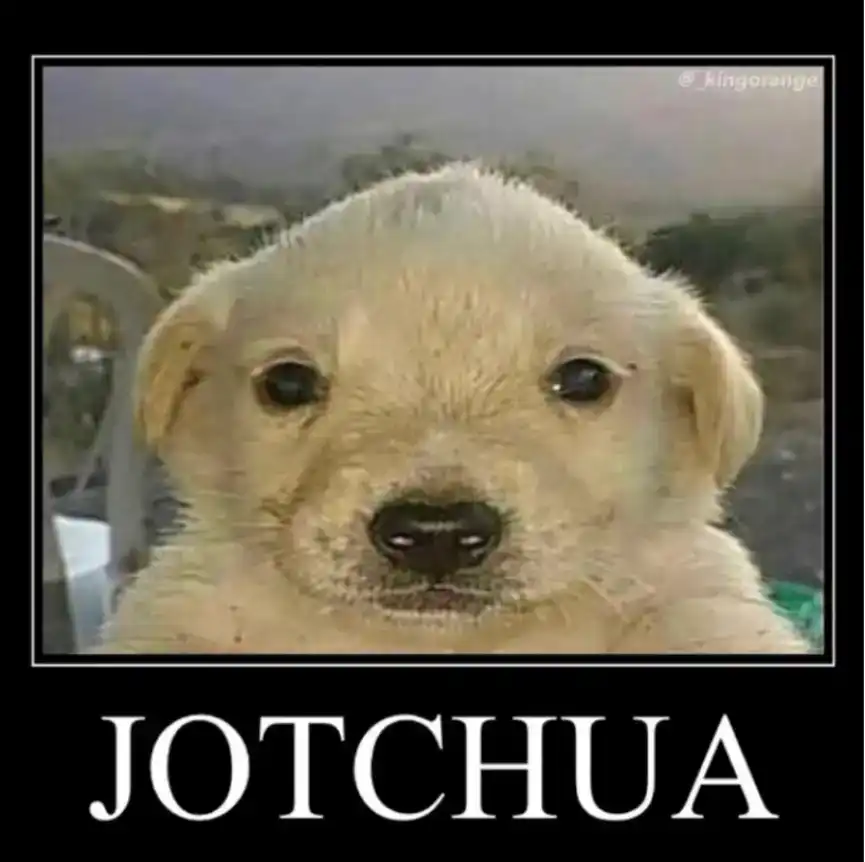
Its market cap once neared $9 million at its peak. The community has significant debates over whether this token is "organic," because its launch did not occur after the meme's creator @_kingorange claimed it, making it almost impossible to say the "claim" was the direct cause of the price surge.

Many players believe this token is another instance of "setting up a play," or attribute it to KOL Ansem sparking market speculation about his purchase being related to this token when he claimed on June 9th that he had returned to buying Solana meme coins for the first time in over a year.

The same concept, even the same ticker, but your coin just doesn't pump. $JOTCHUA on the ETH mainnet was deployed as early as December 2023, and has had consistent content and community, but it couldn't compete with getting the creator to click a few buttons and claim it.

A similar situation happened with the World Cup concept. $WORLDCUP on Solana, due to bonkguy's purchase and detailed analysis, saw its market cap surge from around $5 million to once break $12 million. Meanwhile, the World Cup concept project $PITCH on Base had fallen from a peak market cap of about $7 million to nearly $700,000.

Although $PITCH indeed has its own issues, mainly on the communication front. The project is not inactive, it keeps updating, but the dev rarely speaks up, and their X (Twitter) account got repeatedly suspended and still hasn't sorted out a new one. But admittedly, without any endorsements, similar concepts and playstyles lose out in the battle for attention.

The recent new feature from pump.fun, pump.fun GO, allows anyone to post paid bounty tasks on pump.fun.

This did attract mainstream media attention, but unfortunately, once again in a negative light reaching the masses.

$Bountywork, this token's market cap once approached $2.5 million at its peak. Its dev @ayushquantt's strategy is to continuously post new tasks on pump.fun, creating hype for this token.

He certainly succeeded—by offering a bounty of 40 SOL to have someone tattoo $bountywork on their forehead.

An Indian man actually got it tattooed, and strictly followed a typo the dev made in the description—missing an 'n', incorrectly writing the ticker as $boutywork.
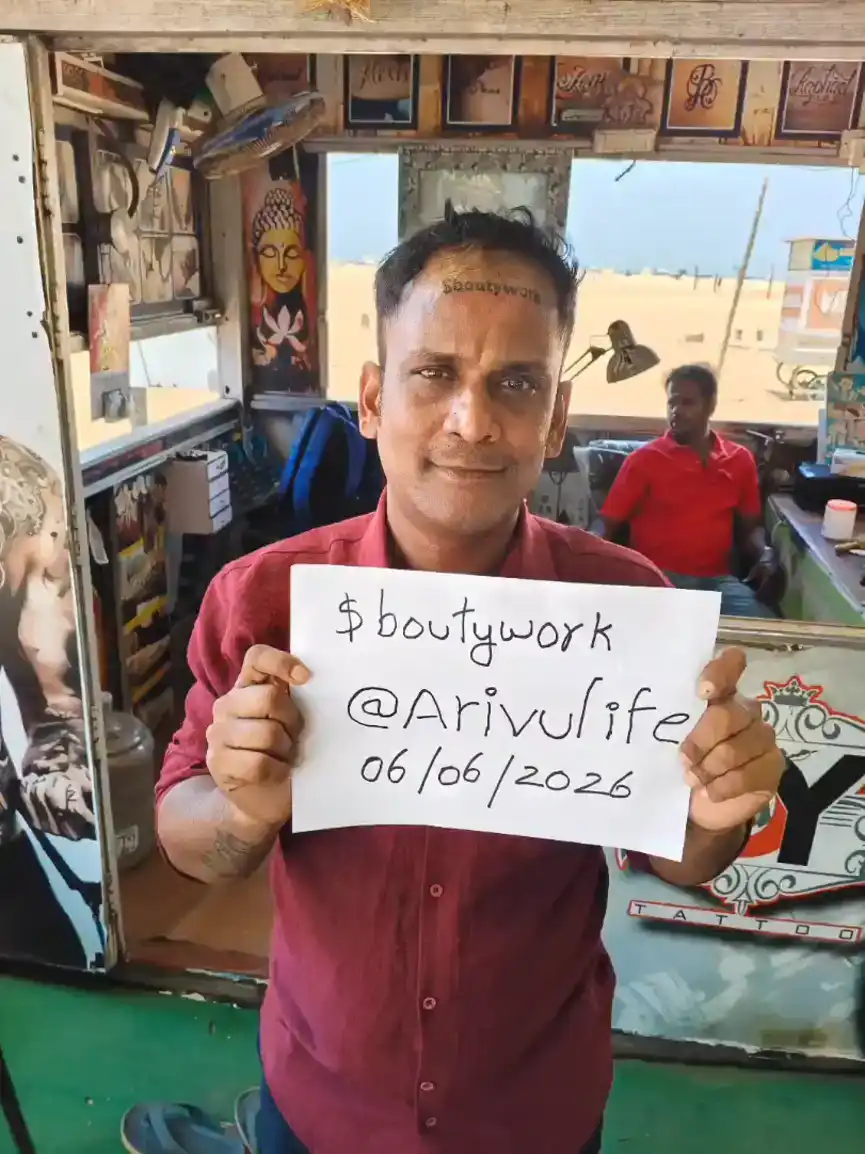
Initially, his bounty application was rejected because the tattoo was missing the letter 'n', and the dev demanded he correct the tattoo. Then, someone launched a new token using the incorrect tattoo as the ticker, $boutywork.

Finally, the 40 SOL bounty reward was still given to him, and the creator revenue from the new token was also given to him, earning him a total of about $48,000.

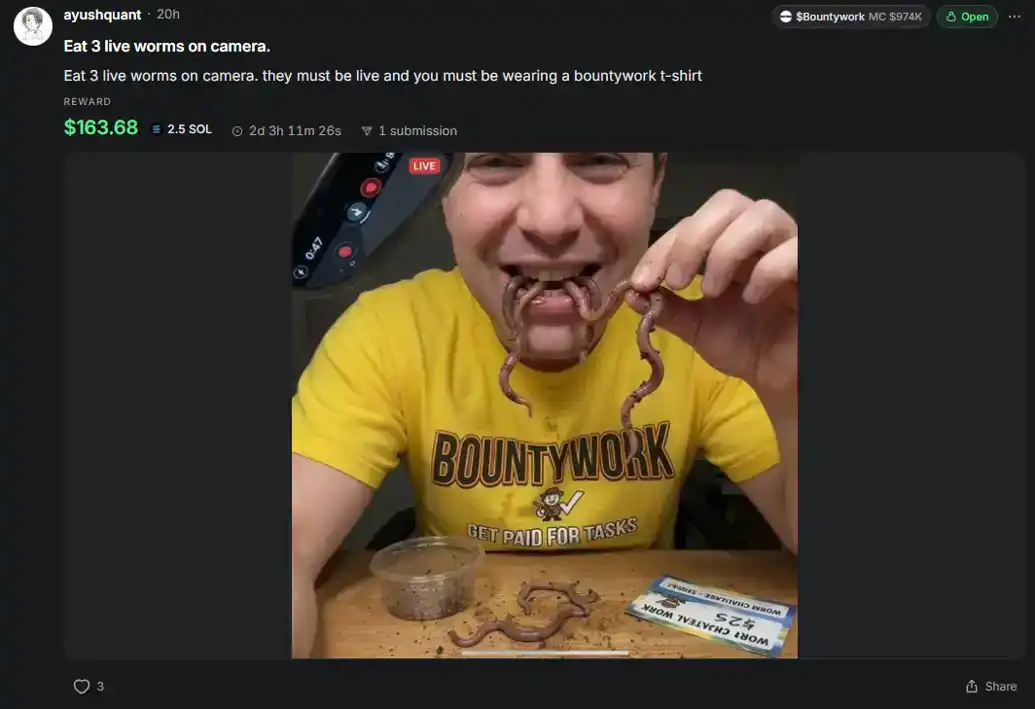
Then, as the hype faded, $boutywork has essentially gone to zero. The dev of $Bountywork is still continuously posting new bounties trying to replicate this "success," for example, having someone eat 3 insects on camera while wearing a $Bountywork t-shirt.
There are quite a few tattoo-related tasks on pump.fun; some have received up to 200 SOL in return for tattooing their own face.
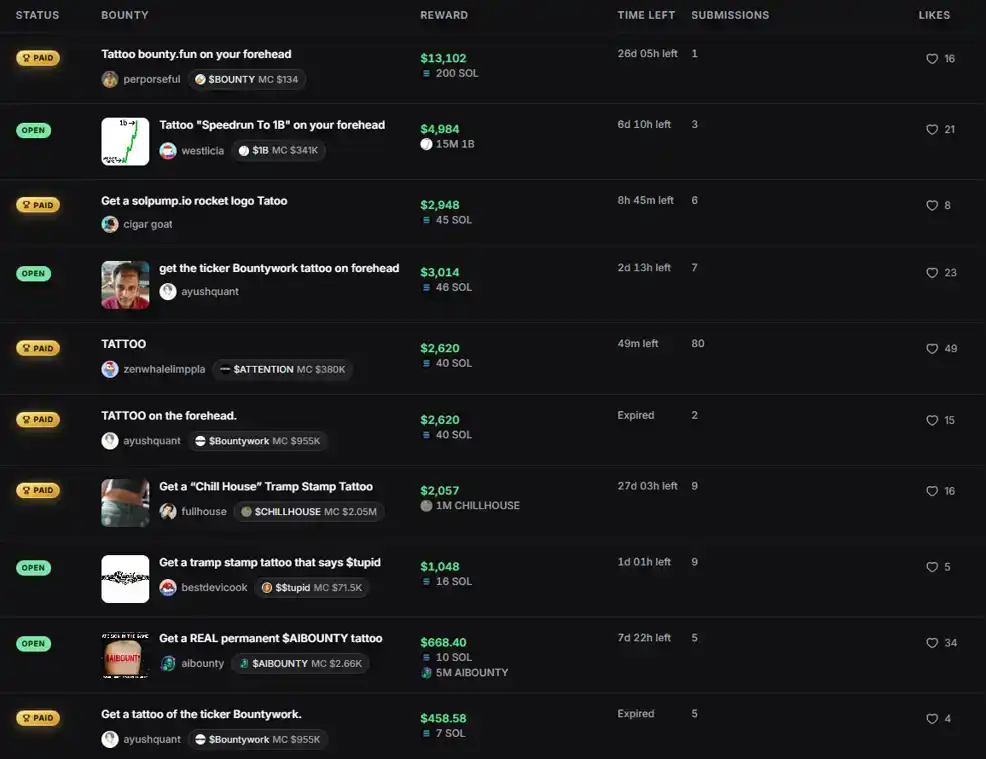
Honestly, this isn't much different from the days when big brothers on Kuaishou tipped people to eat raw eggs or gulp down white liquor...

The Return of Community

Let's continue the discussion around pump.fun's new feature. Almost all bounty tasks are related to generating attention-hype for specific tokens. The only one not treated as a joke might be this bounty task for $neet—organizing a gathering in New York for people who resist work.
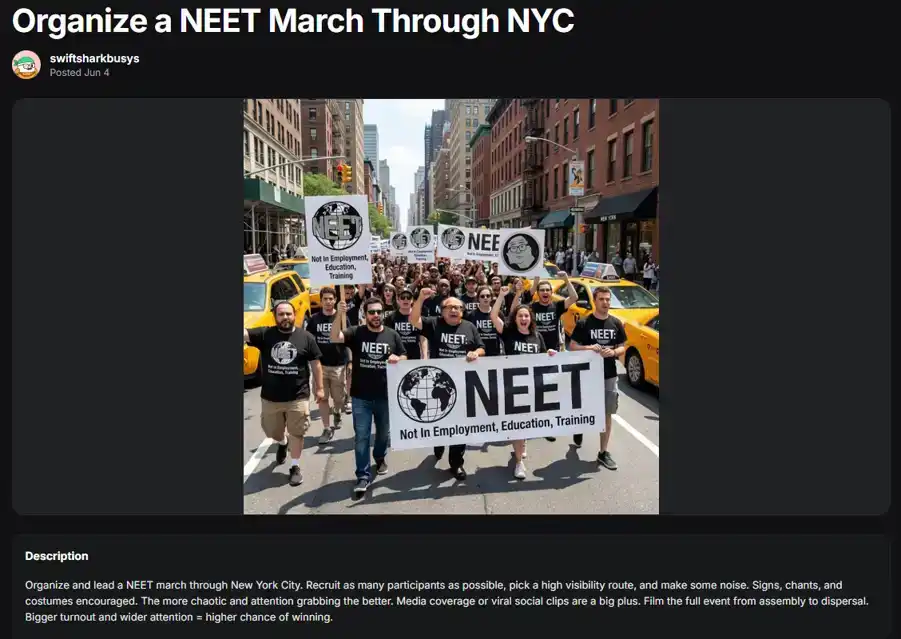
The reward for this bounty is paid in $neet, equivalent to over $15,000. The $neet community has previously self-organized 2 offline "anti-work gatherings" in the US; if this bounty is completed, it will be the 3rd.

Although it's unclear what pump.fun's intention is in supporting community-type meme coins, their official Twitter always features promotions for such community tokens. Although the performance of these tokens varies—for instance, $chillhouse's price has been sluggish for a while—the ones pump.fun officially picks out are generally quite community-driven and organic.

Currently, those with relatively stable visibility and price performance, besides $neet, include $troll, $buttcoin, and $triplet. A brief introduction to the survival status and themes of these community-type tokens:

- $neet: Deployed 410 days ago, peak market cap ~$51 million, current market cap ~$27 million. The community's mission is to make more people realize that dedicating most of one's life to work means losing one's own life.

- $troll: Deployed 416 days ago, holds the copyright to the classic meme Troll, listed on Coinbase. Peak market cap ~$290 million, current market cap ~$65 million.

- $triplet: Deployed 107 days ago, an abbreviation for "Tung Tung Tung Sahur," the hottest breakout character from last year's viral "Italian Classic of Mountains and Seas." Peak market cap ~$13.6 million, current market cap ~$6.6 million.

- $buttcoin: Deployed 153 days ago, originated from a 2011 joke on the Bitcoin forum, a pun on Bitcoin as "Buttcoin" (Butt coin). Peak market cap ~$68.6 million, current market cap ~$27 million.

Mentioning these tokens and the return of community-type coins brings us back to Ansem. After he mentioned returning to buy Solana memes, someone told him to just post the CA (contract address), and if he did, they would aggressively buy 1% to add to their position.
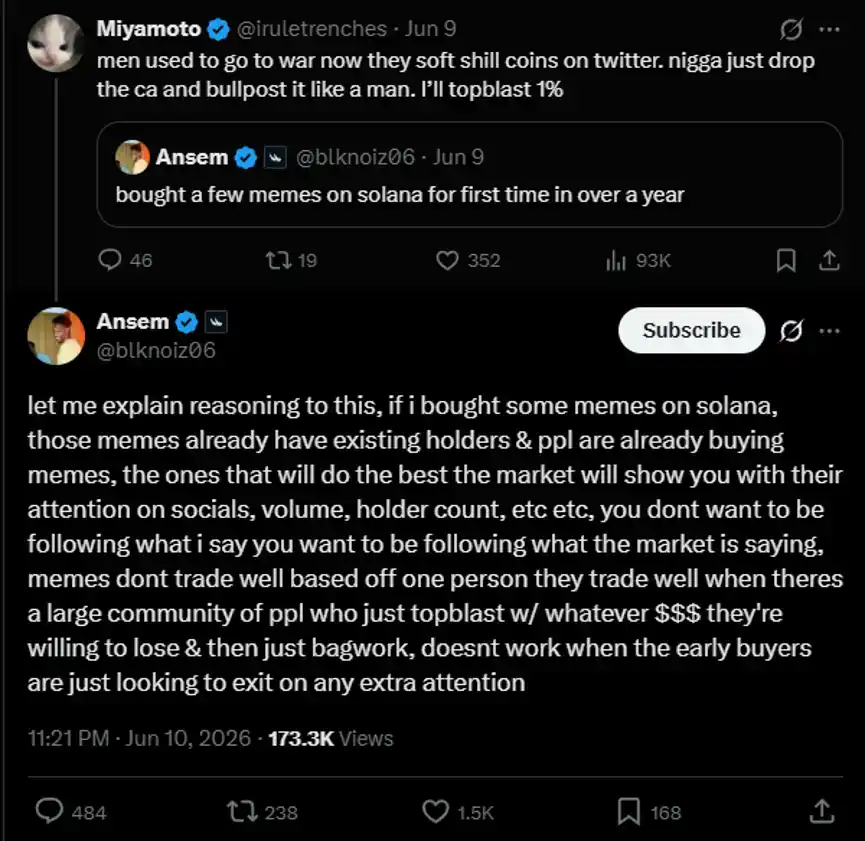
Ansem's response sparked much discussion:

"Let me explain why I don't post CAs. If I buy some Solana meme coins, and these coins already have good holders, the market will tell you which ones are good through social media performance, trading volume, holder count, etc. You shouldn't listen to me, but to the market. Meme coins relying on a group of holders who just compete on speed, wait for endorsements to dump, won't be good. Only tokens with a large community, where people within the community are willing to endure losses and promote their beliefs day after day, will succeed. Tokens dependent on a single celebrity won't do well."

Besides the older tokens mentioned above that have survived long and maintained relatively stable prices, there are indeed new tokens emerging that align with Ansem's view, such as $KINS.

$KINS is the token for Kintara, which is a blockchain game. Interestingly, Kintara hasn't led the Solana gaming sector because its rise wasn't due to the game's polish, but rather its step-by-step actions to earn community trust.

A brief introduction to $KINS' mechanism. This is an MMORPG playable in a browser; to play, your wallet needs 1,000 $KINS. Once in, you can chop wood, mine, fish, buy houses, fight monsters and bosses, and PvP.
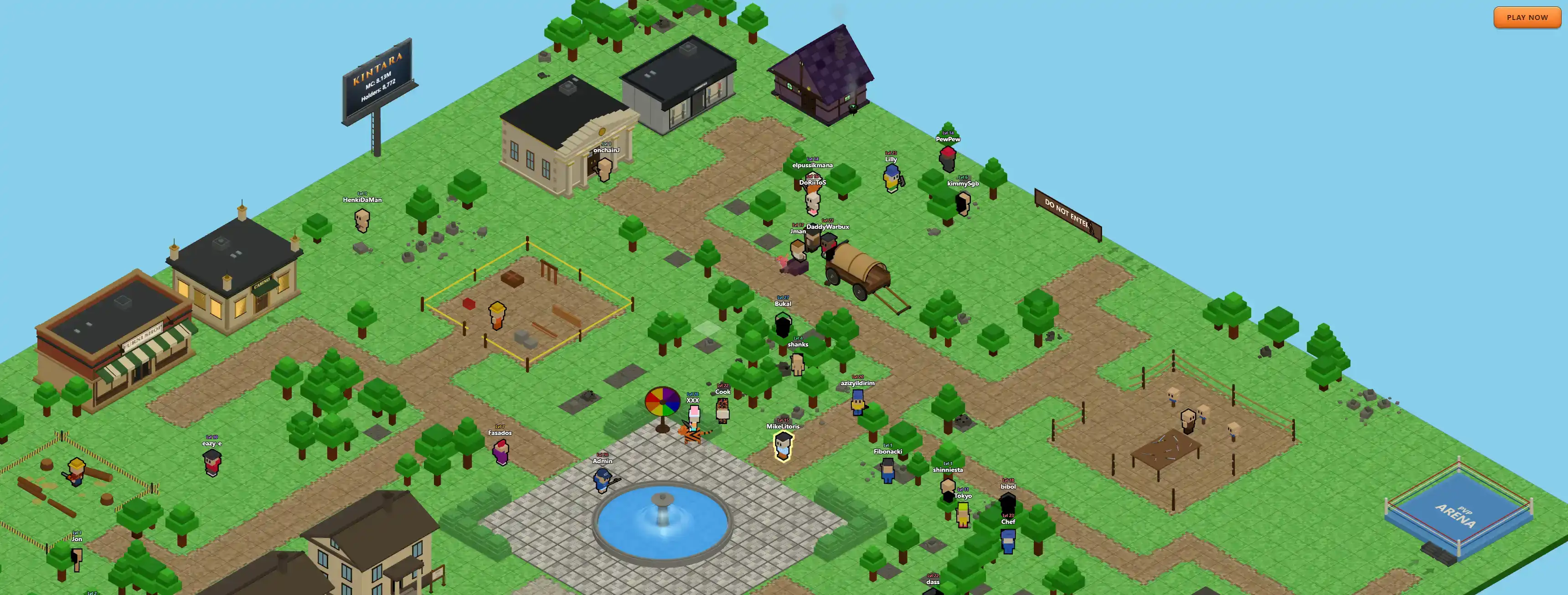
The game has no other pay-to-win options, only a reward wheel. If players don't want to spin only once a day, they can spend $3 worth of $KINS to continue spinning. 50% of this revenue is used for token buyback and burn, 50% for project maintenance and development.

The core gameplay loop is roughly: gather resources -> craft items -> challenge tougher monsters. If players lack resources, they need to use the in-game currency "Gold" to buy from other players. Players can sell "Gold" in the game priced in $KINS, with 5% going to the treasury and 95% to the player.

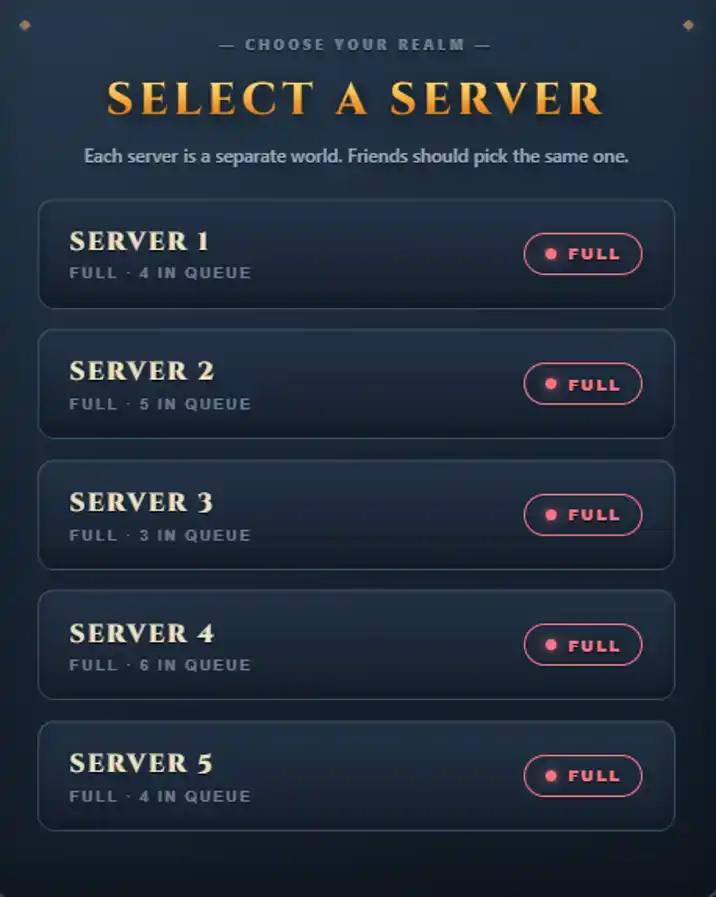
It sounds fairly ordinary, and the data isn't particularly impressive either (so far, 0.5% of $KINS has been repurchased), but the project's consistent delivery has built solid trust. Perhaps because the market is so disheartening, many players have genuinely gotten into it. The number of people fishing in the game daily is increasing. The project has expanded to 5 servers, but there's still a queue...
A player successfully sold a rare mount obtained from fishing and earned $1,800:
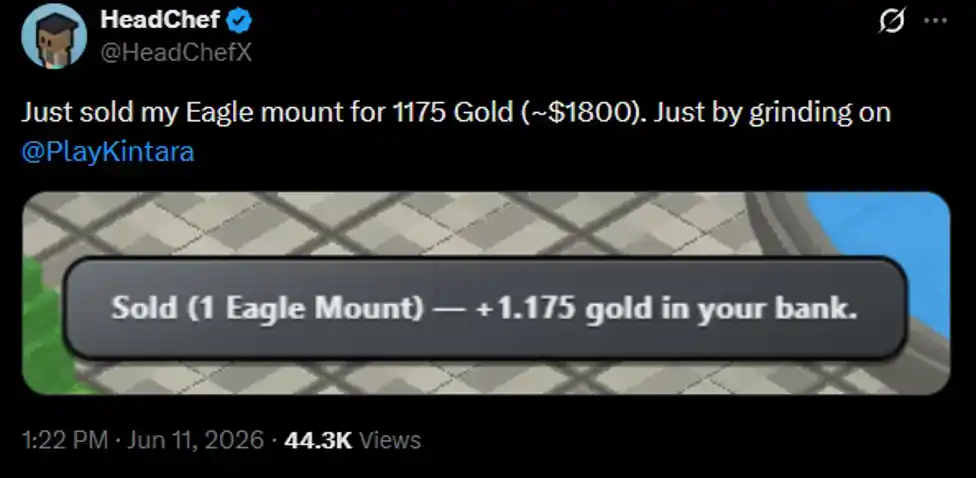
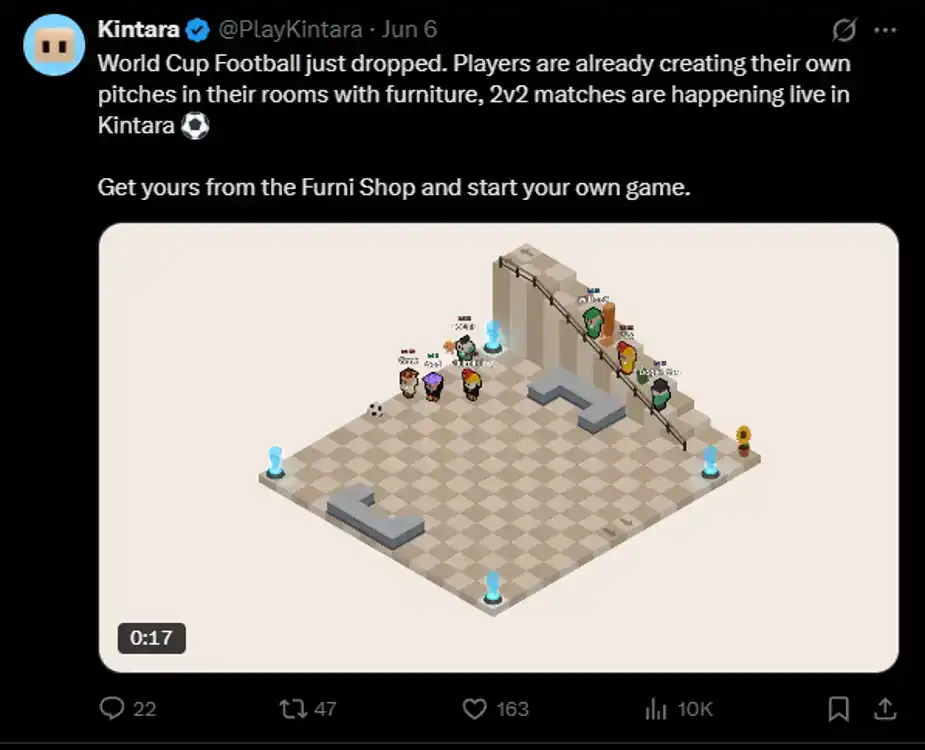
The project team of this game almost "doesn't promote play-to-earn," instead focusing heavily on "how to build network effects and a sense of player belonging." For example, integrating various Solana community meme coins or newly hot tokens into game elements, such as auctioning mansions in the game.

Or, promoting people organizing World Cup football matches in their houses:
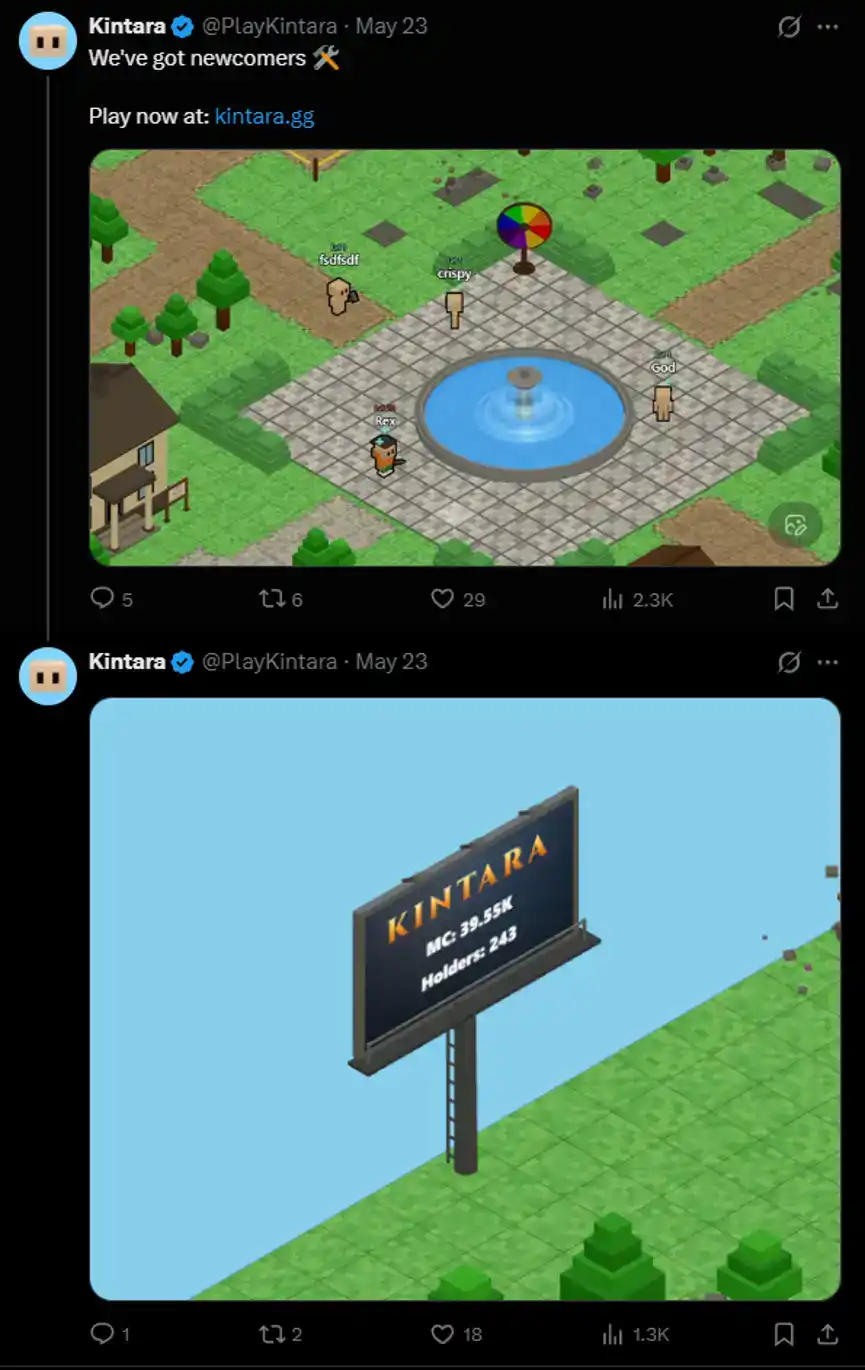
When it was still obscure, with less than $40,000 market cap and 243 holders, this early phase of "unheard of and unknown" was written on the stats board in the game's main map. Everyone watched Kintara persistently and rapidly update game content, slowly gaining people's trust, gradually attracting KOLs like Gake and Ansem to become part of the game as players.
So no one calls this kind of project a "set-up play."

"What are we constantly chasing after all along? A game of mutual trust, or a game of mutual deception?"

This is a recent question Zhàn Háo has been asking himself.

Hopefully, such questioning can persist and ultimately lead to a healthier market.

Criptos en tendencia

Preguntas relacionadas

QWhat are the two main competing themes or approaches observed in the current Solana meme coin market, according to the article?

AThe two main competing themes are 'Attention PvP' and the 'Return of the Community'. Attention PvP relies on quick, hype-driven plays involving celebrity endorsements, hot events, and speed-based speculation. The Return of the Community focuses on meme coins with organic, long-term communities built around a shared culture or purpose, where members are willing to endure price fluctuations and consistently promote their project's ideals.

QHow did the $JOTCHUA meme coin benefit from the 'Attention PvP' dynamic, and what controversy surrounded its success?

AThe $JOTCHUA coin gained attention and its price surged largely after the meme's creator, @_kingorange, 'claimed' the coin on social media. However, its success is controversial because the coin's launch and initial pump did not happen after the creator's claim. Many believe the surge was due to market speculation triggered by KOL Ansem announcing his return to buying Solana meme coins, suggesting it was another 'pump group' setup rather than an organic community-driven event.

QWhat is the core mission of the $neet community, and how does it distinguish itself from typical 'Attention PvP' coins?

AThe core mission of the $neet community is to promote the idea that dedicating most of one's life to work means losing one's own life. It distinguishes itself from 'Attention PvP' coins by being a long-term, community-driven project. The community has organically organized offline 'anti-work' gatherings in the U.S. and focuses on a shared cultural belief rather than relying on short-term hype or celebrity endorsements for price action.

QAccording to Ansem's statement quoted in the article, what are the key characteristics of a successful meme coin that does not rely on a single influencer?

AAccording to Ansem, a successful meme coin that doesn't rely on a single influencer should have a large, genuine community. Members of this community should be willing to endure losses and consistently promote the project's underlying philosophy or culture day after day. Success should be indicated by market data like social media activity, trading volume, and holder count, not by the endorsement of any single key opinion leader (KOL).

QHow did the project behind the $KINS token (Kintara) build trust and a sustainable community, as described in the article?

AThe Kintara project ($KINS) built trust and a sustainable community through consistent delivery and focusing on player engagement rather than financial speculation. Key strategies included: rapidly updating game content, integrating other community meme coins into the game, organizing in-game community events (like house auctions and soccer tournaments), and having a transparent tokenomics model where 50% of optional spin revenue is used for token buyback/burns. This approach fostered a sense of belonging and network effect, attracting genuine players and even respected KOLs who became part of the community.

Lecturas Relacionadas

Megaguau en el mercado de predicciones del Mundial: el dinero inteligente fracasa en el césped, 'Comprar NO' supera a 'Comprar SÍ'

**Resumen del mercado de predicciones del Mundial: Los "ballenas" fallan y "comprar NO" supera a "comprar SÍ"** Un análisis de las grandes apuestas en los mercados de predicción de Polymarket para 20 partidos de la fase de grupos del Mundial revela que el dinero "inteligente" no siempre acierta. Las apuestas previas superiores a 5.000$ sumaron 89,55 millones, con una tasa de acierto ponderada del 48,5%. Incluso manteniendo las posiciones hasta el final, el retorno de la inversión (ROI) habría sido negativo (-2,0%). Los empates fueron el principal factor de riesgo, anulando grandes cantidades apostadas por favoritos, como en Bélgica-Egipto. Sin embargo, en partidos con diferencia clara de nivel (Alemania-Curazao), el mercado sí fue eficiente. Estratégicamente, apostar por el resultado "NO" (ej: "¿Gana el favorito? NO") tuvo un acierto del 62,4%, frente al 37,5% del "SÍ", indicando que las cuotas de los favoritos a menudo estaban sobrevaloradas. El perfil de ganancias y pérdidas fue volátil. La mayor ganancia estimada fue de 6,77 millones de dólares para un usuario que apostó contra la victoria de Irán. Por el contrario, otra "ballena" perdió aproximadamente 8,39 millones al apostar por Bélgica. Más allá de los resultados aislados, los monederos que mostraron un buen rendimiento constante a lo largo de varios partidos, como swisstony, ofrecen patrones más interesantes para seguir. En definitiva, el mercado no predice el futuro, sino que refleja los sesgos y la sobreconfianza colectiva. La incertidumbre del fútbol castiga por igual, y el verdadero "dinero inteligente" es el que identifica desviaciones en las probabilidades implícitas y respeta el riesgo.

marsbitHace 15 min(s)

Megaguau en el mercado de predicciones del Mundial: el dinero inteligente fracasa en el césped, 'Comprar NO' supera a 'Comprar SÍ'

marsbitHace 15 min(s)

Bezos se embarca en su tercer emprendimiento, y aún no logra eludir a Musk

**Jeff Bezos vuelve al ruedo para lanzar su tercera gran empresa, Prometheus, una apuesta de IA industrial que le enfrenta nuevamente a su viejo rival Elon Musk.** Tras dejar el cargo de CEO de Amazon en 2021, Bezos ha regresado a primera línea como CEO conjunto de Prometheus, una startup de IA fundada hace menos de un año y que ya alcanza una valoración de 410.000 millones de dólares tras una ronda de financiación de 120.000 millones. La misión de Prometheus es crear un "Ingeniero General Artificial", un sistema de IA capaz de diseñar, simular, probar y fabricar productos complejos del mundo real, como motores a reacción, naves espaciales o dispositivos médicos. Su objetivo es acelerar drásticamente el ciclo completo de innovación industrial. Esta es la tercera vez que Bezos se involucra personalmente en un proyecto de esta magnitud, después de Amazon (infraestructura digital) y Blue Origin (exploración espacial física). Prometheus combina ambas experiencias. Su co-CEO, Vik Bajaj, aporta experiencia en ciencias de la vida y tecnología compleja. Bezos admite que Prometheus ahora ocupa la mayor parte de su tiempo. Su regreso al rol operativo es significativo en un momento en el que muchos directivos se retiran, y refleja su convicción en esta oportunidad. El lanzamiento ocurre en un contexto donde su otra gran apuesta física, Blue Origin, sigue a la sombra del dominio de SpaceX de Musk en el sector espacial. Recientemente, un fallo en las pruebas del cohete New Glenn subrayó los desafíos. Aunque ambos magnates compiten en la intersección de la IA y el mundo físico, sus enfoques difieren: mientras Musk (con Tesla, Optimus y xAI) se centra en cómo la IA ejecuta tareas físicas, Bezos apuesta por cómo la IA puede participar en el propio proceso de invención e ingeniería. Con Prometheus, Bezos no busca seguir los pasos de Musk, sino definir una nueva frontera: ser la plataforma fundamental para la ingeniería en la era de la IA, un "blue ocean" industrial aún por conquistar.

marsbitHace 19 min(s)

Bezos se embarca en su tercer emprendimiento, y aún no logra eludir a Musk

marsbitHace 19 min(s)

Cursor abandona la base de Kimi para su nuevo modelo de 1.5T, canjea 60.000 millones en acciones por Cursor, y el primer golpe de Musk apunta a GitHub de Microsoft

Hoy, Cursor anunció importantes novedades en la conferencia Compile: un nuevo modelo de más de 1.5 billones de parámetros y Origin, una plataforma Git nativa para agentes de IA. Esto ocurre poco después de que SpaceX confirmara su adquisición de Cursor mediante una transacción accionaria valorada en 60.000 millones de dólares, que se completará en el tercer trimestre de 2026. El nuevo modelo, entrenado desde cero con más de 100,000 GPUs y respaldado por los recursos computacionales de SpaceX, representa un aumento de 10 a 20 veces en capacidad de cálculo. Su objetivo es ir más allá de la codificación, buscando una inteligencia general más amplia para tareas de ingeniería. Cursor también presentó Origin, una plataforma de alojamiento de código diseñada específicamente para manejar la alta frecuencia de operaciones de los agentes de IA, incluyendo la resolución automática de conflictos de fusión, posicionándose como un competidor de GitHub. Fundada en 2023, Cursor ha crecido rápidamente en el campo de las herramientas de programación con IA. La adquisición por parte de SpaceX le proporciona una gran potencia de cálculo, mientras que SpaceX busca fortalecer su oferta de IA empresarial y su modelo Grok. La comunidad de desarrolladores observa con expectación si esta unión puede alterar el panorama actual del mercado.

marsbitHace 21 min(s)

Cursor abandona la base de Kimi para su nuevo modelo de 1.5T, canjea 60.000 millones en acciones por Cursor, y el primer golpe de Musk apunta a GitHub de Microsoft

marsbitHace 21 min(s)

¿Ha dejado de caer la bolsa estadounidense? La trampa del "Gran Deshielo" en la era de la alta deuda

El artículo analiza la controvertida idea de que, en un contexto de deuda pública estadounidense masiva y déficits persistentes, el mercado bursátil podría haber entrado en una fase de "Gran Fusión Alcista" (Melt-up), donde ya no puede caer matemáticamente. Esta teoría, popularizada en un polémico post de Reddit, sugiere que el gobierno se vería forzado a imprimir dinero para diluir la deuda, impulsando la inflación y, por ende, los precios nominales de los activos como las acciones. El autor examina este argumento dentro del marco histórico de burbujas, como la de Internet y la de Japón, donde la euforia y el momentum superaron los fundamentos. Aunque reconoce que un mundo con alta deuda incentiva la inflación y favorece los activos frente al efectivo, advierte que esto no hace que las acciones sean inmunes a caídas severas (del 30%, 40% o más). Cita ejemplos de hiperinflación en Alemania o Zimbabue, donde los mercados subieron nominalmente, pero la riqueza real se erosionó. La conclusión es más matizada: el escenario más probable no es un impago o hiperinflación, sino un prolongado período de "represión financiera", con inflación moderadamente superior a las tasas de interés, que erosiona lentamente el valor del dinero en efectivo y sostiene los precios nominales de los activos, aunque con rendimientos reales potencialmente bajos. La recomendación clave es evitar apostar el futuro financiero a una narrativa de subida perpetua, manteniendo una cartera diversificada (acciones, bienes raíces, efectivo, oro) y un colchón de seguridad para no verse obligado a vender en caídas del mercado. La prudencia, no el pánico ni la excesiva concentración en activos caros, es la estrategia defendida.

marsbitHace 39 min(s)

¿Ha dejado de caer la bolsa estadounidense? La trampa del "Gran Deshielo" en la era de la alta deuda

marsbitHace 39 min(s)

Trading

Spot
Futuros

Artículos destacados

Cómo comprar HYPE

¡Bienvenido a HTX.com! Hemos hecho que comprar Hyperliquid (HYPE) sea simple y conveniente. Sigue nuestra guía paso a paso para iniciar tu viaje de criptos.Paso 1: crea tu cuenta HTXUtiliza tu correo electrónico o número de teléfono para registrarte y obtener una cuenta gratuita en HTX. Experimenta un proceso de registro sin complicaciones y desbloquea todas las funciones.Obtener mi cuentaPaso 2: ve a Comprar cripto y elige tu método de pagoTarjeta de crédito/débito: usa tu Visa o Mastercard para comprar Hyperliquid (HYPE) al instante.Saldo: utiliza fondos del saldo de tu cuenta HTX para tradear sin problemas.Terceros: hemos agregado métodos de pago populares como Google Pay y Apple Pay para mejorar la comodidad.P2P: tradear directamente con otros usuarios en HTX.Over-the-Counter (OTC): ofrecemos servicios personalizados y tipos de cambio competitivos para los traders.Paso 3: guarda tu Hyperliquid (HYPE)Después de comprar tu Hyperliquid (HYPE), guárdalo en tu cuenta HTX. Alternativamente, puedes enviarlo a otro lugar mediante transferencia blockchain o utilizarlo para tradear otras criptomonedas.Paso 4: tradear Hyperliquid (HYPE)Tradear fácilmente con Hyperliquid (HYPE) en HTX's mercado spot. Simplemente accede a tu cuenta, selecciona tu par de trading, ejecuta tus trades y monitorea en tiempo real. Ofrecemos una experiencia fácil de usar tanto para principiantes como para traders experimentados.

296 Vistas totalesPublicado en 2024.12.11Actualizado en 2026.06.02

Cómo comprar HYPE

Discusiones

Bienvenido a la comunidad de HTX. Aquí puedes mantenerte informado sobre los últimos desarrollos de la plataforma y acceder a análisis profesionales del mercado. A continuación se presentan las opiniones de los usuarios sobre el precio de HYPE (HYPE).

活动图片