[Key interpretation] giant whale raised 17000 BTC, and the unconfirmed transactions of eth dropped to 149000

HuobiPublicado a 2022-08-24Actualizado a 2022-08-25

Resumen

BTC giant whale has attracted a small amount of funds, and the key support has been confirmed.

1. BTC horizontal plate finishing

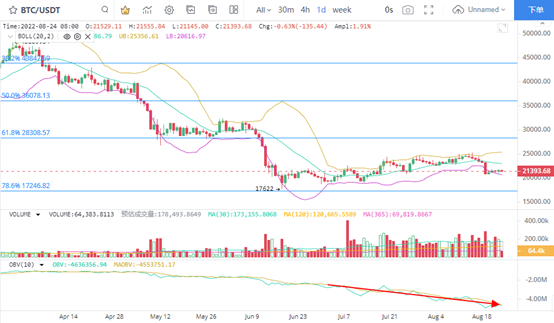
The daily hour K-line chart shows that the BTC price has obvious horizontal adjustment characteristics, and the price has not rebounded strongly in the horizontal stage, which means that the adjustment may still last for a long time. The obv indicator shows that the value of this indicator has been moving back from the beginning of July. The falling of the indicator means that BTC has accumulated more trading volume during the falling period. This shows that BTC will have greater pressure to rebound after more falling traders continue to increase their volume and increase their turnover. After the current 21000 US dollars has locked in short-term investors.
2. The number of giant whale addresses increased slightly

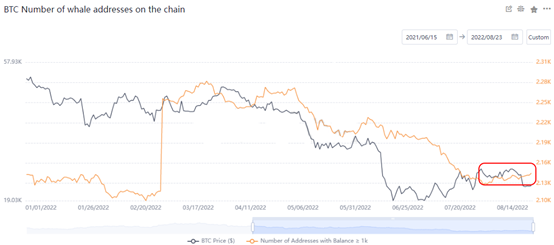
With the continuation of the BTC shock, the decreasing trend of the number of giant whale addresses tends to ease. The number of addresses increased from the recent low of 2128 to 2145 on August 23, an increase of 17. Based on 1000 BTCs per address, 17000 BTCs are absorbed by the giant whale. Compared with the number of giant whale addresses on March 21 in the previous period, the number of giant whale addresses is still relatively down. That is to say, the number of BTCs tends to diverge, and further low absorption opportunities can be considered after the main force further confirms its entry into the market.
3. The realized price is $21669

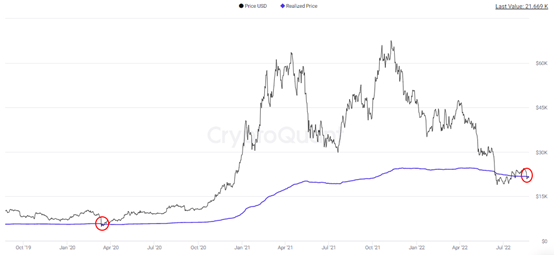
The realized price of BTC is calculated as the realized upper limit divided by the total coin supply. It measures the supply weighted average price paid by the entire market participants for their coins. It can be interpreted as support or resistance price on the chain.

When the BTC price retreats to the realized price, the corresponding support will be reflected. At the beginning of 2020, BTC completed the bottom form below the realized price of $5400, which is a typical low absorption trading signal.

On August 23, the realized price of BTC fell to US $21669, and the current price of BTC is close to the realized price of US $21300. According to this judgment, BTC can effectively verify the bullish signal if it can rebound above the realized price.
4. Eth rebounded slightly

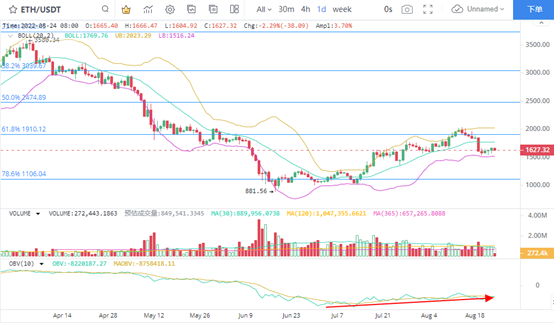
In the recent trend of eth in the past two months, the trading volume rebounded during the price rebound period, and the obv index value rebounded slightly, which means that the trading volume during the rise period is higher. Therefore, unlike BTC, ETH has recently been actively bought by more investors. In terms of price performance, ETH operates around us $1627, which is still lower than the corresponding US $1769 of the middle rail of brin line. According to this judgment, ETH is in a relatively weak operating state, and the price performance still tends to fall.
5. The number of unconfirmed transactions in eth is low

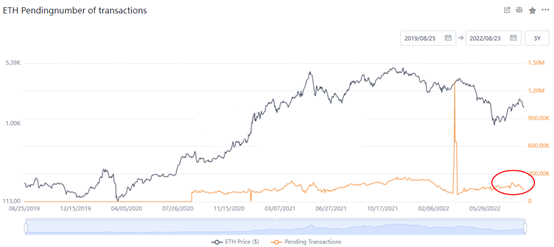
The unconfirmed transactions of eth maintain a downward trend, which indicates that the trading heat is relatively low in the current market, which means that there are few opportunities for the ETH price to further strengthen. Before and after March 25, there was a large rebound space, and the number of unconfirmed transactions reached the peak of 1.3 million. At present, the number of unconfirmed transactions is not only sluggish, but also in a callback state. On August 24, the number of unconfirmed transactions dropped to the low of 149000, which is unlikely to boost the price.

Lecturas Relacionadas

¿Sigue girando la máquina perpetua de Strategy? La acción preferente STRC se desancla un 11%

**Resumen: La Acción Preferente STRC de MicroStrategy se desancla un 11%, ¿sigue girando su "máquina de movimiento perpetuo"?** La acción preferente perpetua STRC de MicroStrategy, diseñada para operar cerca de su valor nominal objetivo de 100 dólares, se está negociando con un descuento significativo, superando el 11%. Este "desanclaje" pone a prueba el núcleo del modelo de capital de la empresa. STRC es el motor clave del "volante de capital" de MicroStrategy. Permite a la compañía recaudar fondos en efectivo (a través de emisiones en el mercado secundario) para comprar Bitcoin, sin diluir a los accionistas comunes (MSTR) ni asumir deuda con vencimiento. Este ciclo depende crucialmente de que STRC se mantenga cerca de los 100$. Para anclar el precio, MicroStrategy ajusta dinámicamente el dividendo. Sin embargo, a pesar de aumentar la tasa al 11.5% y pagar semanalmente, el descuento persiste. Esto sugiere que el mercado está valorando riesgos más allá del rendimiento por dividendos. Las razones incluyen: 1) Posibles ventas forzadas de fondos arbitrajistas con apalancamiento, creando una espiral de ventas. 2) Preocupaciones más profundas sobre la liquidez y la solvencia de MicroStrategy. Un informe de JPMorgan señaló que las reservas de efectivo solo cubren unos 6 meses de obligaciones de dividendos preferentes. Aunque MicroStrategy afirma que sus reservas de Bitcoin podrían cubrir décadas de pagos, esto supone vender BTC, rompiendo su narrativa clave de "acumulación a largo plazo sin ventas". La primera venta simbólica de Bitcoin por parte de MicroStrategy a principios de mayo alimentó estos temores. Si STRC sigue desanclada, la capacidad de financiación de la compañía se verá afectada. En un escenario extremo, si los flujos de efectivo se tensan, podría verse obligada a vender más Bitcoin para pagar dividendos, transformándose de un comprador clave del mercado en un vendedor, con posibles implicaciones negativas significativas para el precio de Bitcoin.

marsbitHace 43 min(s)

¿Sigue girando la máquina perpetua de Strategy? La acción preferente STRC se desancla un 11%

marsbitHace 43 min(s)

Apenas ahora, un ganador del Premio Nobel se convierte en nuevo empleado de Anthropic

El premio Nobel John Jumper, líder clave de AlphaFold, ha anunciado su salida de Google DeepMind tras casi 9 años para unirse a Anthropic. Este movimiento se produce apenas dos días después de que Noam Shazeer, coautor del famoso artículo 'Attention Is All You Need' y exdirector de Gemini, dejara Google por OpenAI, representando una pérdida significativa de talento para la compañía. Jumper, quien se doctoró en 2017, fue puesto al frente del equipo de AlphaFold poco después de unirse a DeepMind. Bajo su liderazgo, AlphaFold 2 resolvió en 2020 el problema del plegamiento de proteínas, un desafío de 50 años, y posteriormente generó estructuras para casi 200 millones de proteínas, multiplicando por 1000 el conocimiento anterior. En 2024, recibió el Premio Nobel de Química junto a Demis Hassabis. La partida de figuras como Jumper y Shazeer (este último reclutado por 2700 millones de dólares) plantea preguntas sobre la retención de talento en Google. Mientras tanto, Anthropic fortalece su apuesta en ciencias de la vida, tras adquirir la startup Coefficient Bio y desarrollar herramientas como Claude for Life Sciences. Este sector se ha convertido en un campo de batalla clave, con OpenAI lanzando GPT-Rosalind para biomedicina y Google DeepMind impulsando Isomorphic Labs. La contratación de Jumper marca un nuevo paso en esta carrera por revolucionar la biología con IA.

marsbitHace 48 min(s)

Apenas ahora, un ganador del Premio Nobel se convierte en nuevo empleado de Anthropic

marsbitHace 48 min(s)

Trading

Spot
Futuros
活动图片