Aave Is Surrendering the Throne of DeFi Lending Due to Its Own Stupidity

marsbitPublicado a 2026-04-24Actualizado a 2026-04-24

Resumen

An article titled "Aave Is Giving Up Its Throne in DeFi Lending Due to Its Own Foolishness" discusses how Aave mishandled a crisis following a $292 million hack of rsETH from Kelp DAO, leading to significant outflows and reputational damage. After the hack, Aave failed to promptly reassure users or commit to covering potential bad debt—estimated between $123.7 million and $230.1 million—despite having sufficient reserves. This hesitation triggered panic, resulting in $17.2 billion in outflows and liquidity crises across multiple pools. The author argues that Aave’s poor crisis management and reluctance to act quickly exacerbated the situation, damaging its reputation as the "safest DeFi" platform. Meanwhile, competitor Spark, a fork of Aave V3, capitalized on the situation by attracting fleeing funds, growing its TVL by nearly $2 billion. Spark had previously delisted rsETH, avoiding any exposure to the hack. Its proactive communication and strategic positioning contrast sharply with Aave’s delayed response. Although Aave’s founder later announced a relief plan (DeFi United) with multiple partners and a personal donation, the damage to user trust and liquidity may be lasting. The article concludes that Aave’s missteps have allowed competitors like Spark, Morpho, and Jupiter Lend to challenge its dominant position in DeFi lending.

Original | Odaily Planet Daily (@OdailyChina)

Author | Azuma (@azuma_eth)

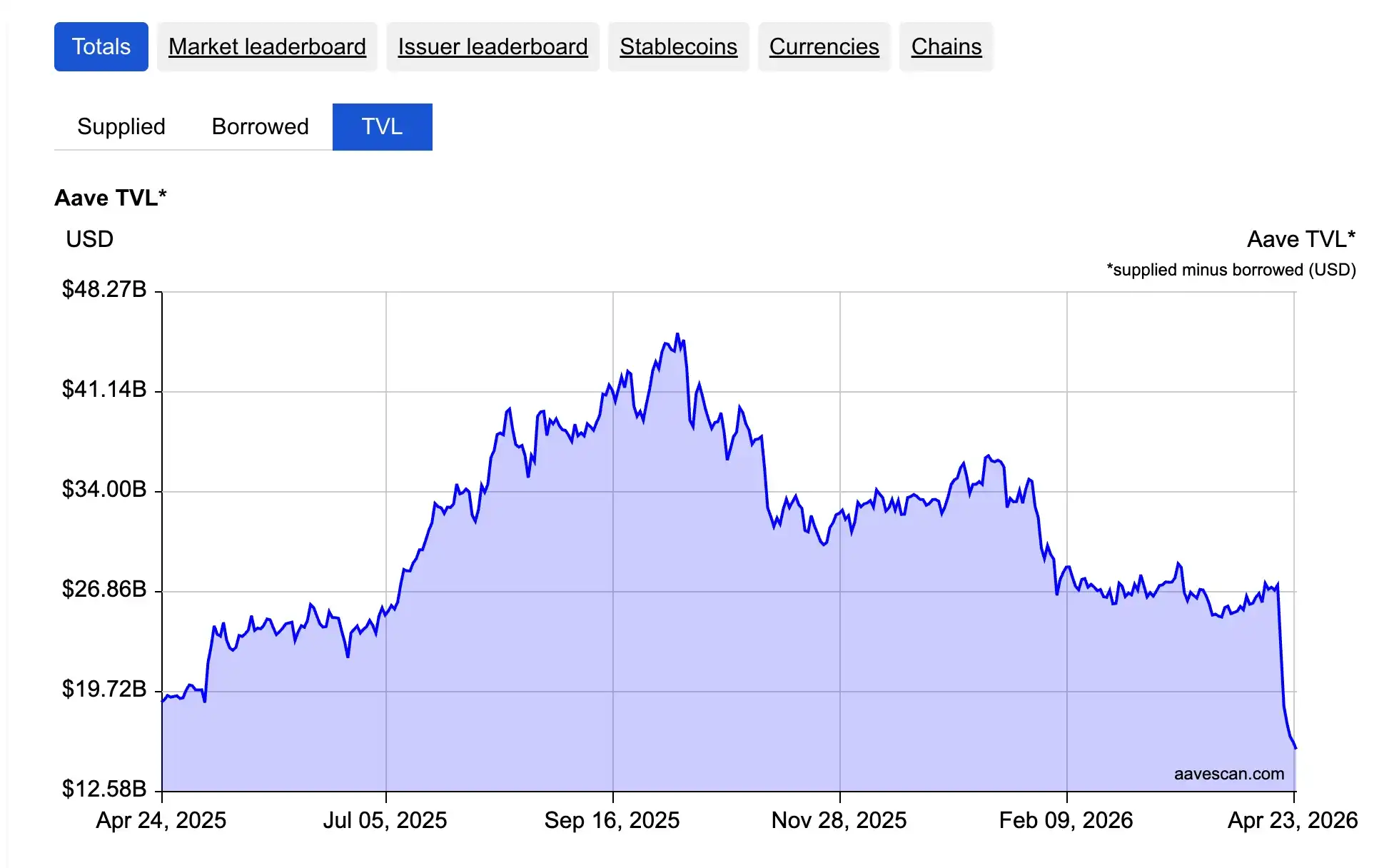
$292 million, this is the total amount of rsETH funds stolen from Kelp DAO; $17.2 billion, this is the scale of funds that have flowed out of Aave since the incident.

Aave is watching the community's panic sentiment ferment for several consecutive days due to its extremely foolish crisis PR strategy, thereby losing its once greatest advantage in the lending track—hundreds of billions of dollars in deposited funds and the user mindset label of "the safest DeFi".
  • Odaily Note: For background, please refer to "DeFi Hacked Again for $292 Million, Is Aave No Longer Safe?" and "The Tripartite Game Under the $290 Million Hole: Who Will Pay the Bill—Aave, L0, or Kelp?".

What Did Aave Do Wrong?

The details of the Kelp DAO hack need not be repeated; blaming Aave for why it granted rsETH such a high LTV is meaningless now. Here, I mainly want to discuss Aave's response strategy after the incident from the perspective of a long-term AAVE user.

First is the bad debt scale issue; Aave itself has done the math. Depending on the different handling of rsETH, there might be two possible bad debt scenarios—if the stolen loss is written off from all rsETH in circulation, it is expected to generate $123.7 million in bad debt; if the value of mainnet rsETH is protected and the loss is fully recorded in the mapped version of rsETH on Layer2, it is expected to generate $230.1 million in bad debt.

In either case, Aave has the capability to cover it with its reserves from Umbrella, the DAO treasury, and the team. I understand that Aave is unwilling to pay this money itself and wants the main responsible party, Kelp DAO, and the secondary responsible party, LayerZero, to contribute as much as possible. But the problem is that the other parties will think the same way—"Aave is so rich, the situation is so awkward, it should bear more." Therefore, in the short term, it is difficult for these three parties to reach a consensus, which implies that a solution that satisfies everyone is temporarily impossible.

But users cannot wait that long—Aave's yield levels have never been very competitive in the industry. Users who choose to deposit with Aave are all attracted by its reputation, security, and liquidity. However, the situation now is that in the most critical days after the incident, Aave consistently failed to give users some kind of bottom-line guarantee promise, but instead kept emphasizing "our code has no problems" and "how rsETH is accounted for is beyond Aave's control" to shift blame.

This is why panic sentiment kept fermenting within the community. Users tried every means to escape and avoid risk: those who could withdraw directly did so, and those who couldn't went to borrow from other pools first, causing the impact to gradually expand. So Aave's current situation is: on one hand, it faces continuous fund outflows; on the other hand, multiple pools are experiencing liquidity drying up due to utilization rates being maxed out.

This awkward situation could have been avoided (or at least not been this bad)... Since Aave can afford the money, why didn't it inject a dose of reassurance into the community from the beginning to prevent a bank run? At most, it's $230 million in bad debt (possibly less), and this money wouldn't necessarily be paid by Aave alone;后续 could continue to dispute with LayerZero and Kelp DAO.

Now, it's done. For the sake of a promised relief of at most $230 million, Aave watched $17.2 billion in deposited funds flow out (the number may continue to grow), and this doesn't even include the decline in AAVE's price these days... No matter how you calculate it, it's a huge loss.

What makes Aave even more uncomfortable is that the worse its situation becomes, the more relaxed opponents like LayerZero and Kelp DAO will be, because they will judge that Aave will be more motivated to solve the problem as soon as possible, which only puts Aave at a disadvantage in the game.

Having reached this point, Aave has brought this upon itself.

Behind Aave, Spark Is Watching Covetously

While Aave is suffering from headaches, the situation of its competitor Spark is booming and extremely positive. What is even more lamentable is that Spark is actually a competitor "personally incubated" by Aave.

Spark was originally a lending protocol forked and developed by Sky (formerly MakerDAO) based on the open-source code of Aave V3; both sides actually use the same underlying code logic. In return, there was once a profit-sharing agreement between Spark and Aave, but later Aave accused Spark of涉嫌 breaching the contract, and coupled with route differences, the two are now purely competitive.

Three months before the Kelp DAO theft, Spark had just removed support for rsETH (for details, please refer to "Same Day, Different Fate: Aave Embraces rsETH and Loses Nearly $200 Million, Spark Exits Unscathed"). You call it strategic conservatism or rigorous risk control, or even attribute it entirely to luck, but the result is that Spark was not affected at all in this incident—on this point alone, Spark can wantonly attack Aave's former "safest DeFi" label.

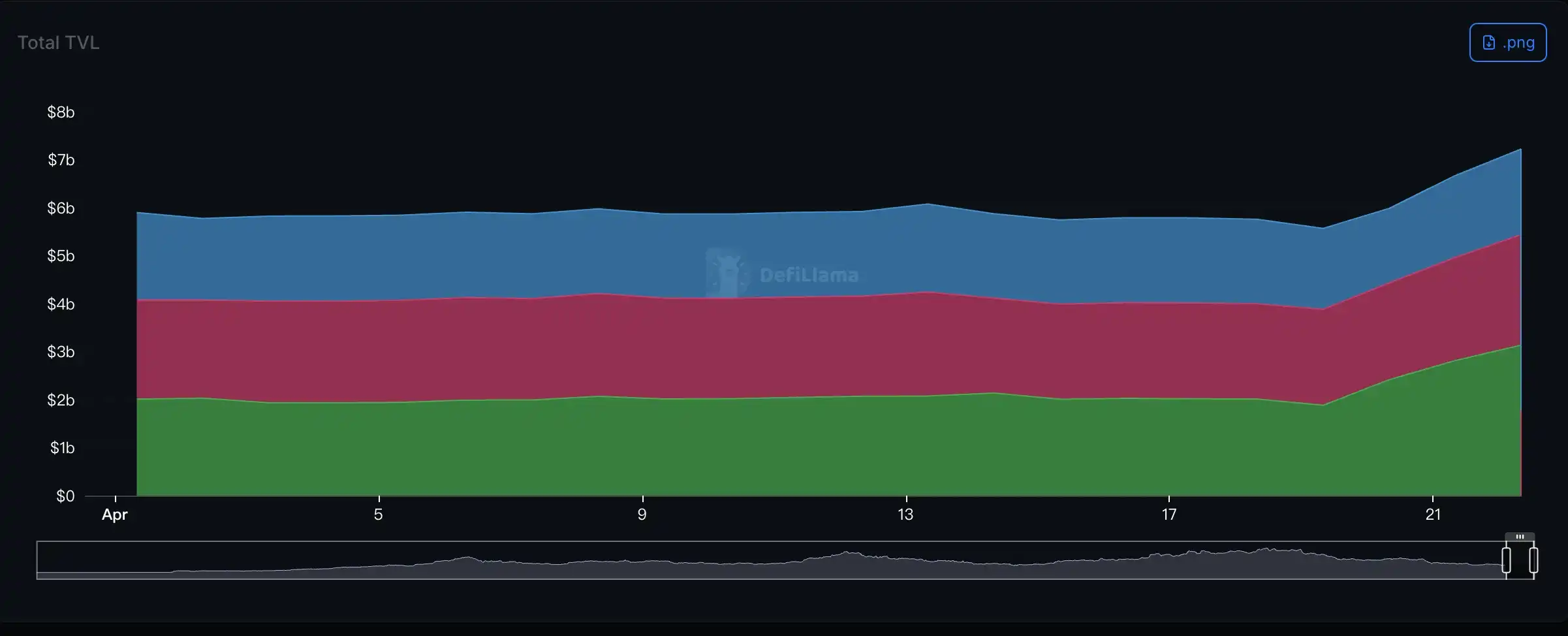
Thus, Spark became one of the safe havens for funds fleeing Aave. Since the incident, Spark's TVL has grown by nearly $2 billion (green part in the chart below). On the day of the incident, Justin Sun withdrew 53,665 ETH (worth $124 million) from Aave and subsequently deposited it into Spark. After continued accumulation in recent days, the total deposit has reached $1.3 billion—in the DeFi world, Brother Sun's operations are really something to learn.
On April 23, Upbit officially announced the launch of the Spark (SPK) Korean Won trading market. SPK, stimulated by this positive news, rose over 80% in a single day, significantly narrowing the market value gap between itself and AAVE.

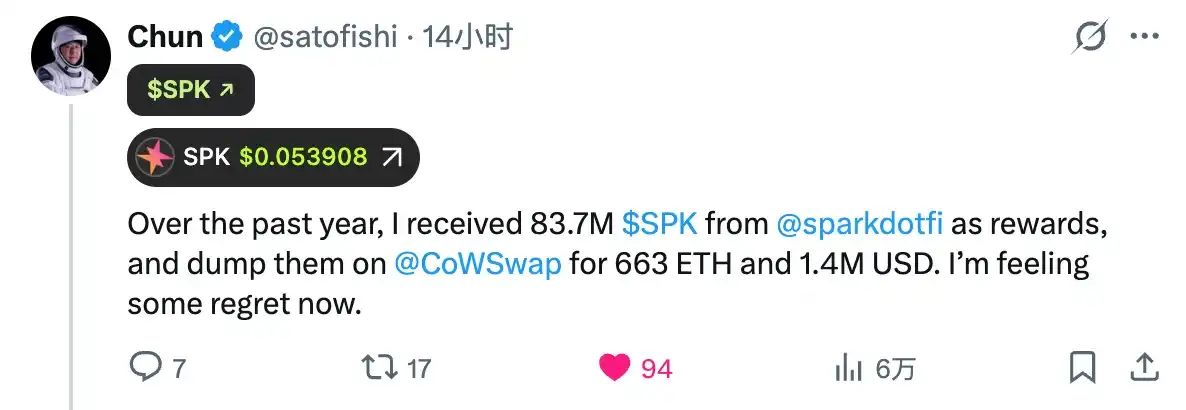
Even Wang Chun, founder of F2Pool, lamented on X: "In the past year, I received 83.7 million SPK rewards from Spark and sold them on CoWSwap for 663 ETH and $1.4 million. Now I kind of regret it."
Spark clearly realizes that this is a perfect opportunity to seize market share from Aave's mouth. Since the incident, Spark's Strategy Lead, MonetSupply, has almost become the most frequent KOL speaking out on this matter, posting dozens of times a day. Although his发言 can indeed help the public understand what happened, it objectively also加剧 the panic sentiment surrounding Aave.

But this is the purest商业 competition; MonetSupply just made the most correct choice.

Aave Is Losing the Throne of DeFi Lending

In the early morning of April 24, perhaps realizing the严峻 situation, Aave founder Stani announced on X the launch of a relief plan called DeFi United. Cooperative participants include LayerZero, Ethena, ether.fi, Ink Foundation, Golem Foundation, Trydo, etc. Stani personally will also donate 5,000 ETH to solve the current problem.

But the funds have already flowed out, and user trust has been severely damaged. Relying solely on this belated statement, Aave will find it difficult to regain deposited funds and user trust in the short term.

The DeFi lending track has long presented a pattern of "one superpower, multiple great powers," with Aave一直以来 having seemingly extremely solid leading advantages. But now, Aave is拱手 surrendering the throne. Behind it, challengers are coming aggressively; besides the booming Spark, other opponents like Morpho and Jupiter Lend also hope to take a bite out of Aave's share.

Last year, Stani bought a five-story luxury house in London for approximately $30 million, one of the most expensive transactions in the UK's sluggish luxury real estate market in the past year. I don't know if there is something like a "jinx," but with precedents like Su Zhu and others, it seems that big shots who consume conspicuously within the circle always run into some倒霉事.

I can't guess what Stani is thinking right now in his five-story luxury house.

Criptos en tendencia

Preguntas relacionadas

QWhat was the main reason for the massive outflow of funds from Aave following the Kelp DAO hack?

AAave's extremely poor crisis management strategy, which failed to provide a timely and reassuring commitment to cover the potential bad debt, led to widespread community panic and a user rush to withdraw funds.

QWhat are the two potential bad debt scenarios calculated by Aave after the rsETH exploit?

AIf the stolen loss is written off from all rsETH in circulation, it would result in approximately $123.7 million in bad debt. If the value of mainnet rsETH is protected and the loss is fully attributed to the mapped version of rsETH on Layer 2, it would result in approximately $230.1 million in bad debt.

QWhich competitor protocol directly benefited from the funds flowing out of Aave, and what was a significant factor in its immunity to the hack?

ASpark Protocol directly benefited, with its TVL growing by nearly $2 billion. A significant factor was that Spark had removed support for rsETH three months prior to the hack, avoiding any exposure to the incident.

QWhat was the name of the key initiative announced by Aave founder Stani Kulechov in a belated attempt to address the crisis?

AStani Kulechov announced an initiative called 'DeFi United,' a relief plan involving partners like LayerZero and Ethena, to which he also personally pledged a donation of 5,000 ETH.

QAccording to the author, what is the fundamental reason users traditionally deposited funds into Aave, given its uncompetitive yield rates?

AUsers traditionally deposited into Aave due to its reputation for safety, security, and deep liquidity, not for competitive yield rates.

Lecturas Relacionadas

Megaguau en el mercado de predicciones del Mundial: el dinero inteligente fracasa en el césped, 'Comprar NO' supera a 'Comprar SÍ'

**Resumen del mercado de predicciones del Mundial: Los "ballenas" fallan y "comprar NO" supera a "comprar SÍ"** Un análisis de las grandes apuestas en los mercados de predicción de Polymarket para 20 partidos de la fase de grupos del Mundial revela que el dinero "inteligente" no siempre acierta. Las apuestas previas superiores a 5.000$ sumaron 89,55 millones, con una tasa de acierto ponderada del 48,5%. Incluso manteniendo las posiciones hasta el final, el retorno de la inversión (ROI) habría sido negativo (-2,0%). Los empates fueron el principal factor de riesgo, anulando grandes cantidades apostadas por favoritos, como en Bélgica-Egipto. Sin embargo, en partidos con diferencia clara de nivel (Alemania-Curazao), el mercado sí fue eficiente. Estratégicamente, apostar por el resultado "NO" (ej: "¿Gana el favorito? NO") tuvo un acierto del 62,4%, frente al 37,5% del "SÍ", indicando que las cuotas de los favoritos a menudo estaban sobrevaloradas. El perfil de ganancias y pérdidas fue volátil. La mayor ganancia estimada fue de 6,77 millones de dólares para un usuario que apostó contra la victoria de Irán. Por el contrario, otra "ballena" perdió aproximadamente 8,39 millones al apostar por Bélgica. Más allá de los resultados aislados, los monederos que mostraron un buen rendimiento constante a lo largo de varios partidos, como swisstony, ofrecen patrones más interesantes para seguir. En definitiva, el mercado no predice el futuro, sino que refleja los sesgos y la sobreconfianza colectiva. La incertidumbre del fútbol castiga por igual, y el verdadero "dinero inteligente" es el que identifica desviaciones en las probabilidades implícitas y respeta el riesgo.

marsbitHace 15 min(s)

Megaguau en el mercado de predicciones del Mundial: el dinero inteligente fracasa en el césped, 'Comprar NO' supera a 'Comprar SÍ'

marsbitHace 15 min(s)

Bezos se embarca en su tercer emprendimiento, y aún no logra eludir a Musk

**Jeff Bezos vuelve al ruedo para lanzar su tercera gran empresa, Prometheus, una apuesta de IA industrial que le enfrenta nuevamente a su viejo rival Elon Musk.** Tras dejar el cargo de CEO de Amazon en 2021, Bezos ha regresado a primera línea como CEO conjunto de Prometheus, una startup de IA fundada hace menos de un año y que ya alcanza una valoración de 410.000 millones de dólares tras una ronda de financiación de 120.000 millones. La misión de Prometheus es crear un "Ingeniero General Artificial", un sistema de IA capaz de diseñar, simular, probar y fabricar productos complejos del mundo real, como motores a reacción, naves espaciales o dispositivos médicos. Su objetivo es acelerar drásticamente el ciclo completo de innovación industrial. Esta es la tercera vez que Bezos se involucra personalmente en un proyecto de esta magnitud, después de Amazon (infraestructura digital) y Blue Origin (exploración espacial física). Prometheus combina ambas experiencias. Su co-CEO, Vik Bajaj, aporta experiencia en ciencias de la vida y tecnología compleja. Bezos admite que Prometheus ahora ocupa la mayor parte de su tiempo. Su regreso al rol operativo es significativo en un momento en el que muchos directivos se retiran, y refleja su convicción en esta oportunidad. El lanzamiento ocurre en un contexto donde su otra gran apuesta física, Blue Origin, sigue a la sombra del dominio de SpaceX de Musk en el sector espacial. Recientemente, un fallo en las pruebas del cohete New Glenn subrayó los desafíos. Aunque ambos magnates compiten en la intersección de la IA y el mundo físico, sus enfoques difieren: mientras Musk (con Tesla, Optimus y xAI) se centra en cómo la IA ejecuta tareas físicas, Bezos apuesta por cómo la IA puede participar en el propio proceso de invención e ingeniería. Con Prometheus, Bezos no busca seguir los pasos de Musk, sino definir una nueva frontera: ser la plataforma fundamental para la ingeniería en la era de la IA, un "blue ocean" industrial aún por conquistar.

marsbitHace 19 min(s)

Bezos se embarca en su tercer emprendimiento, y aún no logra eludir a Musk

marsbitHace 19 min(s)

Cursor abandona la base de Kimi para su nuevo modelo de 1.5T, canjea 60.000 millones en acciones por Cursor, y el primer golpe de Musk apunta a GitHub de Microsoft

Hoy, Cursor anunció importantes novedades en la conferencia Compile: un nuevo modelo de más de 1.5 billones de parámetros y Origin, una plataforma Git nativa para agentes de IA. Esto ocurre poco después de que SpaceX confirmara su adquisición de Cursor mediante una transacción accionaria valorada en 60.000 millones de dólares, que se completará en el tercer trimestre de 2026. El nuevo modelo, entrenado desde cero con más de 100,000 GPUs y respaldado por los recursos computacionales de SpaceX, representa un aumento de 10 a 20 veces en capacidad de cálculo. Su objetivo es ir más allá de la codificación, buscando una inteligencia general más amplia para tareas de ingeniería. Cursor también presentó Origin, una plataforma de alojamiento de código diseñada específicamente para manejar la alta frecuencia de operaciones de los agentes de IA, incluyendo la resolución automática de conflictos de fusión, posicionándose como un competidor de GitHub. Fundada en 2023, Cursor ha crecido rápidamente en el campo de las herramientas de programación con IA. La adquisición por parte de SpaceX le proporciona una gran potencia de cálculo, mientras que SpaceX busca fortalecer su oferta de IA empresarial y su modelo Grok. La comunidad de desarrolladores observa con expectación si esta unión puede alterar el panorama actual del mercado.

marsbitHace 21 min(s)

Cursor abandona la base de Kimi para su nuevo modelo de 1.5T, canjea 60.000 millones en acciones por Cursor, y el primer golpe de Musk apunta a GitHub de Microsoft

marsbitHace 21 min(s)

¿Ha dejado de caer la bolsa estadounidense? La trampa del "Gran Deshielo" en la era de la alta deuda

El artículo analiza la controvertida idea de que, en un contexto de deuda pública estadounidense masiva y déficits persistentes, el mercado bursátil podría haber entrado en una fase de "Gran Fusión Alcista" (Melt-up), donde ya no puede caer matemáticamente. Esta teoría, popularizada en un polémico post de Reddit, sugiere que el gobierno se vería forzado a imprimir dinero para diluir la deuda, impulsando la inflación y, por ende, los precios nominales de los activos como las acciones. El autor examina este argumento dentro del marco histórico de burbujas, como la de Internet y la de Japón, donde la euforia y el momentum superaron los fundamentos. Aunque reconoce que un mundo con alta deuda incentiva la inflación y favorece los activos frente al efectivo, advierte que esto no hace que las acciones sean inmunes a caídas severas (del 30%, 40% o más). Cita ejemplos de hiperinflación en Alemania o Zimbabue, donde los mercados subieron nominalmente, pero la riqueza real se erosionó. La conclusión es más matizada: el escenario más probable no es un impago o hiperinflación, sino un prolongado período de "represión financiera", con inflación moderadamente superior a las tasas de interés, que erosiona lentamente el valor del dinero en efectivo y sostiene los precios nominales de los activos, aunque con rendimientos reales potencialmente bajos. La recomendación clave es evitar apostar el futuro financiero a una narrativa de subida perpetua, manteniendo una cartera diversificada (acciones, bienes raíces, efectivo, oro) y un colchón de seguridad para no verse obligado a vender en caídas del mercado. La prudencia, no el pánico ni la excesiva concentración en activos caros, es la estrategia defendida.

marsbitHace 38 min(s)

¿Ha dejado de caer la bolsa estadounidense? La trampa del "Gran Deshielo" en la era de la alta deuda

marsbitHace 38 min(s)

Trading

Spot
Futuros

Artículos destacados

Cómo comprar AAVE

¡Bienvenido a HTX.com! Hemos hecho que comprar Aave Protocol (AAVE) sea simple y conveniente. Sigue nuestra guía paso a paso para iniciar tu viaje de criptos.Paso 1: crea tu cuenta HTXUtiliza tu correo electrónico o número de teléfono para registrarte y obtener una cuenta gratuita en HTX. Experimenta un proceso de registro sin complicaciones y desbloquea todas las funciones.Obtener mi cuentaPaso 2: ve a Comprar cripto y elige tu método de pagoTarjeta de crédito/débito: usa tu Visa o Mastercard para comprar Aave Protocol (AAVE) al instante.Saldo: utiliza fondos del saldo de tu cuenta HTX para tradear sin problemas.Terceros: hemos agregado métodos de pago populares como Google Pay y Apple Pay para mejorar la comodidad.P2P: tradear directamente con otros usuarios en HTX.Over-the-Counter (OTC): ofrecemos servicios personalizados y tipos de cambio competitivos para los traders.Paso 3: guarda tu Aave Protocol (AAVE)Después de comprar tu Aave Protocol (AAVE), guárdalo en tu cuenta HTX. Alternativamente, puedes enviarlo a otro lugar mediante transferencia blockchain o utilizarlo para tradear otras criptomonedas.Paso 4: tradear Aave Protocol (AAVE)Tradear fácilmente con Aave Protocol (AAVE) en HTX's mercado spot. Simplemente accede a tu cuenta, selecciona tu par de trading, ejecuta tus trades y monitorea en tiempo real. Ofrecemos una experiencia fácil de usar tanto para principiantes como para traders experimentados.

532 Vistas totalesPublicado en 2024.12.11Actualizado en 2026.06.02

Cómo comprar AAVE

Discusiones

Bienvenido a la comunidad de HTX. Aquí puedes mantenerte informado sobre los últimos desarrollos de la plataforma y acceder a análisis profesionales del mercado. A continuación se presentan las opiniones de los usuarios sobre el precio de AAVE (AAVE).

活动图片