Bitcoin traders anticipate new yearly lows after BTC’s $25K rejection — Data disagrees

CointelegraphPublicado a 2022-08-17Actualizado a 2022-08-17

Resumen

Should traders expect further downside after BTC failed to hold above $25,000?

Bitcoin (BTC) showed weakness on Aug. 15, posting a 5% loss after testing the $25,000 resistance. The move liquidated over $150 million worth of leverage long positions and has led some traders to predict a move back toward the yearly low in the $18,000 range.

The price action coincided with worsening conditions for tech stocks, including Chinese giant Tencent, which is expected to post its first-ever quarterly revenue decline. According to analysts, the Chinese gaming and social media conglomerate is expected to post quarterly earnings around $19.5 billion, which is 4% lower than the previous year.

Moreover, on Aug. 16, Citi investment bank slashed Zoom Video Communications (ZM) recommendation to sell, adding that the stock is "high risk." Analysts explained that a challenging post-COVID dynamic, plus additional competition from Microsoft Teams, potentially caused a 20% drop in ZM shares.

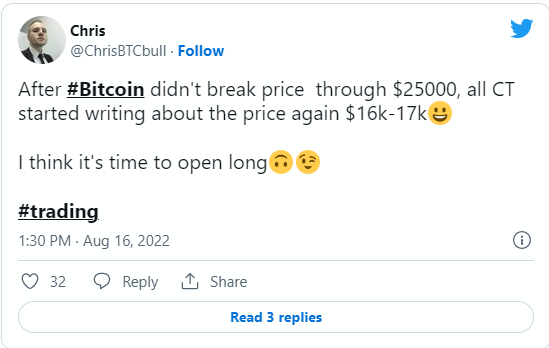
The overall bearish sentiment continues to plague crypto investors, a movement described by influencer and trader @ChrisBTCbull, who mentioned that a simple rejection at $25,000 caused traders to post sub-$17,000 targets.

Margin traders remain bullish despite the $25,000 rejection

Monitoring margin and options markets provides excellent insights into understanding how professional traders are positioned. For instance, a negative read would happen if whales and market makers reduced their exposure as BTC approached the $25,000 resistance.

Margin trading allows investors to borrow cryptocurrency to leverage their trading position, increasing returns. For example, one can increase exposure by borrowing stablecoins to buy an additional Bitcoin position.

On the other hand, Bitcoin borrowers can only short the cryptocurrency as they bet on its price declining. Unlike futures contracts, the balance between margin longs and shorts isn't always matched.

The above chart shows that traders' margin lending ratio has remained relatively stable near 14 while Bitcoin price jumped 6.3% in two days only to be rejected after hitting the $25,200 resistance.

Furthermore, the metric remains bullish by favoring stablecoin borrowing by a wide margin. As a result, pro traders have been holding their bullish positions, and no additional bearish margin trades emerged as Bitcoin retraced 5.5% on Aug. 16.

Option markets hold a neutral stance

There’s uncertainty on whether Bitcoin will make another run towards the $25,000 resistance but the 25% delta skew is a telling sign whenever arbitrage desks and market makers overcharge for upside or downside protection.

The indicator compares similar call (buy) and put (sell) options and will turn positive when fear is prevalent because the protective put options premium is higher than risk call options.

The skew indicator will move above 10% if traders fear a Bitcoin price crash. On the other hand, generalized excitement reflects a negative 10% skew.

Bitcoin 30-day options show 25% delta skew: Source: Laevitas.ch

As displayed above, the 25% delta skew has barely moved since Aug. 11, oscillating between 5% and 7% most of the time. This range is considered neutral because options traders are pricing a similar risk of unexpected pumps or dumps.

If pro traders entered a "fear" sentiment, this metric would have moved above 10%, reflecting a lack of interest in offering downside protection.

Despite the neutral Bitcoin options indicator, whales and market makers maintaining their bullish bets after a 5.5% BTC price decline on Aug. 16. For this reason, investors should expect another retest of the $25,000 resistance as soon as the global macroeconomic conditions improve.


Lecturas Relacionadas

¿Sigue girando la máquina perpetua de Strategy? La acción preferente STRC se desancla un 11%

**Resumen: La Acción Preferente STRC de MicroStrategy se desancla un 11%, ¿sigue girando su "máquina de movimiento perpetuo"?** La acción preferente perpetua STRC de MicroStrategy, diseñada para operar cerca de su valor nominal objetivo de 100 dólares, se está negociando con un descuento significativo, superando el 11%. Este "desanclaje" pone a prueba el núcleo del modelo de capital de la empresa. STRC es el motor clave del "volante de capital" de MicroStrategy. Permite a la compañía recaudar fondos en efectivo (a través de emisiones en el mercado secundario) para comprar Bitcoin, sin diluir a los accionistas comunes (MSTR) ni asumir deuda con vencimiento. Este ciclo depende crucialmente de que STRC se mantenga cerca de los 100$. Para anclar el precio, MicroStrategy ajusta dinámicamente el dividendo. Sin embargo, a pesar de aumentar la tasa al 11.5% y pagar semanalmente, el descuento persiste. Esto sugiere que el mercado está valorando riesgos más allá del rendimiento por dividendos. Las razones incluyen: 1) Posibles ventas forzadas de fondos arbitrajistas con apalancamiento, creando una espiral de ventas. 2) Preocupaciones más profundas sobre la liquidez y la solvencia de MicroStrategy. Un informe de JPMorgan señaló que las reservas de efectivo solo cubren unos 6 meses de obligaciones de dividendos preferentes. Aunque MicroStrategy afirma que sus reservas de Bitcoin podrían cubrir décadas de pagos, esto supone vender BTC, rompiendo su narrativa clave de "acumulación a largo plazo sin ventas". La primera venta simbólica de Bitcoin por parte de MicroStrategy a principios de mayo alimentó estos temores. Si STRC sigue desanclada, la capacidad de financiación de la compañía se verá afectada. En un escenario extremo, si los flujos de efectivo se tensan, podría verse obligada a vender más Bitcoin para pagar dividendos, transformándose de un comprador clave del mercado en un vendedor, con posibles implicaciones negativas significativas para el precio de Bitcoin.

marsbitHace 16 min(s)

¿Sigue girando la máquina perpetua de Strategy? La acción preferente STRC se desancla un 11%

marsbitHace 16 min(s)

Apenas ahora, un ganador del Premio Nobel se convierte en nuevo empleado de Anthropic

El premio Nobel John Jumper, líder clave de AlphaFold, ha anunciado su salida de Google DeepMind tras casi 9 años para unirse a Anthropic. Este movimiento se produce apenas dos días después de que Noam Shazeer, coautor del famoso artículo 'Attention Is All You Need' y exdirector de Gemini, dejara Google por OpenAI, representando una pérdida significativa de talento para la compañía. Jumper, quien se doctoró en 2017, fue puesto al frente del equipo de AlphaFold poco después de unirse a DeepMind. Bajo su liderazgo, AlphaFold 2 resolvió en 2020 el problema del plegamiento de proteínas, un desafío de 50 años, y posteriormente generó estructuras para casi 200 millones de proteínas, multiplicando por 1000 el conocimiento anterior. En 2024, recibió el Premio Nobel de Química junto a Demis Hassabis. La partida de figuras como Jumper y Shazeer (este último reclutado por 2700 millones de dólares) plantea preguntas sobre la retención de talento en Google. Mientras tanto, Anthropic fortalece su apuesta en ciencias de la vida, tras adquirir la startup Coefficient Bio y desarrollar herramientas como Claude for Life Sciences. Este sector se ha convertido en un campo de batalla clave, con OpenAI lanzando GPT-Rosalind para biomedicina y Google DeepMind impulsando Isomorphic Labs. La contratación de Jumper marca un nuevo paso en esta carrera por revolucionar la biología con IA.

marsbitHace 22 min(s)

Apenas ahora, un ganador del Premio Nobel se convierte en nuevo empleado de Anthropic

marsbitHace 22 min(s)

Trading

Spot
Futuros
活动图片