In-depth Analysis of AI and Crypto: The Era of Symbiosis between Algorithms and Ledgers

HTX LearnPublicado a 2026-03-26Actualizado a 2026-03-26

Resumen

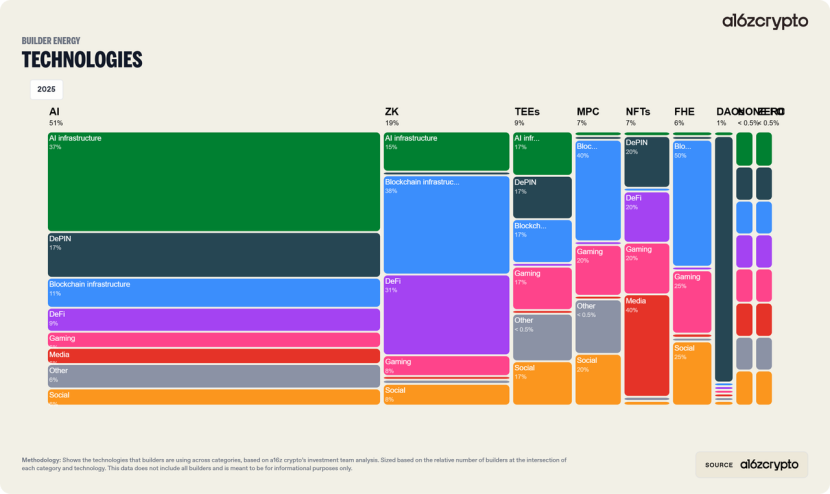
By 2026, the integration of artificial intelligence and cryptocurrency has advanced from proof-of-concept to a new stage of "system-level integration". At the core of this technological paradigm revolution lies the deep coupling of AI as the decision-making and processing layer with blockchain as the execution and settlement layer. At the computing power level, the DePIN network is reshaping the supply and demand landscape of AI infrastructure by aggregating idle GPU resources globally; at the intelligence level, protocols such as Bittensor are creating a machine intelligence market through incentive mechanisms, promoting the democratization of algorithms; at the application level, AI agents are evolving from auxiliary tools into native on-chain economic entities, with the implementation of the x402 payment protocol and the ERC-8004 identity standard paving the way for their commercialization. Simultaneously, the integrated application of fully homomorphic encryption, zero-knowledge machine learning, and trusted execution environment is constructing a new paradigm of "hybrid confidential computing". Cutting-edge experiments at the Bitcoin Policy Institute reveal a stunning future: when AI models possess economic autonomy, 90.8% of them choose digital native currencies, with 48.3% choosing Bitcoin as their preferred store of value. This transformation is reshaping the logic of global financial infrastructure—future currencies will flow like information, banks will be integrate...

I. Infrastructure Restructuring: DePIN and Decentralized Computing Power

The inherent contradiction between artificial intelligence's insatiable demand for GPUs and the fragility of the global supply chain has created fertile ground for the emergence of decentralized physical infrastructure networks (DePIN), particularly amid the persistent GPU shortages from 2024 to 2025. Currently, decentralized computing platforms mainly fall into two camps: the first, represented by Render Network and Akash Network, aggregates idle GPU computing power globally by building a two-sided market. Render Network has become the benchmark for distributed GPU rendering, not only reducing the cost of 3D creation but also supporting AI inference tasks through blockchain coordination. Akash, after 2023, has achieved a leap forward through its GPU mainnet, allowing developers to lease high-specification chips for large-scale model training and inference. Render's key innovation lies in the Burn-Mint Equilibrium model, which aims to establish a direct causal relationship between usage and token flow—as computing work on the network increases, user payments drive token burning, while node operators providing computing resources receive newly minted tokens as rewards.

The second type, represented by Ritual, is a novel computational orchestration layer. Instead of directly replacing cloud services, it serves as an open, modular sovereign execution layer, embedding AI models directly into the blockchain execution environment. Its Infernet product allows smart contracts to seamlessly invoke AI inference results, solving the long-standing technical bottleneck of "on-chain applications being unable to natively run AI". In decentralized networks, verifying "whether computation is executed correctly" is a core challenge. Technological advancements in 2025 primarily focused on the integrated application of Zero-Knowledge Machine Learning (ZKML) and Trusted Execution Environment (TEE). Ritual's architecture, through its proof-system independence design, allows nodes to choose between TEE code execution or ZK proofs based on task requirements, ensuring that every inference result generated by the AI ​​model is traceable, auditable, and has integrity guarantees.

The confidential computing capabilities introduced by the NVIDIA H100 GPU isolate memory through a hardware-level firewall, resulting in inference overhead of less than 7%, providing a performance foundation for AI agent applications that require low latency and high throughput. Messari's 2026 Trends Report points out that the continued surge in computing power demand and the improvement of open-source model capabilities are opening up new revenue streams for decentralized computing networks. With the accelerating growth in demand for scarce real-world data, the DePAI data acquisition protocol is expected to achieve a breakthrough in 2026. Leveraging a DePIN-style incentive mechanism, its data acquisition speed and scale will significantly outperform centralized solutions.

II. Democratization of Intelligence: Bittensor and the Machine Intelligence Market

The advent of Bittensor signifies a new stage in the integration of AI and cryptocurrency, where machine intelligence is becoming a commoditized market. Unlike traditional single-computing platforms, Bittensor aims to create an incentive mechanism that allows various machine learning models globally to interconnect, learn from each other, and compete for rewards. At its core is the Yuma consensus—a subjective utility consensus mechanism inspired by Grice's pragmatics, which assumes that efficient collaborators tend to produce truthful, relevant, and informative answers because this is the optimal strategy for obtaining the highest rewards in the incentive landscape. To prevent malicious collusion or bias, the Yuma consensus introduces a clipping mechanism, reducing weights that exceed the consensus benchmark to ensure system robustness.

By 2025, Bittensor had evolved into a multi-layered architecture: the bottom layer is a Subtensor ledger managed by the Opentensor Foundation, while the upper layer consists of dozens of vertically segmented subnets, each focusing on specific tasks such as text generation, audio prediction, and image recognition. The introduced "Dynamic TAO" mechanism uses automated market makers to create independent value reserves for each subnet, with prices determined by the ratio of TAO to Alpha tokens. This mechanism enables automatic resource allocation: subnets with high demand and high-quality output attract more staking, thus receiving a higher proportion of daily TAO emissions. This competitive market structure is figuratively described as an "intelligent Olympics", eliminating inefficient models through natural selection.

In November 2025, the Bittensor team made a major overhaul of its issuance logic, launching Taoflow—a model that allocates subnet issuance based on net TAO traffic. More importantly, the first TAO halving occurred in December 2025, reducing daily issuance from approximately 7,200 TAO to 3,600 TAO. Halving itself is not an automatic price driver. Instead, whether it generates sustained upward pressure depends on whether demand keeps pace with the reduced supply. Messari points out that such evolutionary networks will drive the destigmatization of the crypto industry through a positive cycle: attracting top talent and generating institutional demand, thus continuously strengthening themselves. The head of research at Pantera Capital predicts that the number of decentralized AI protocols in major sectors will decrease to 2-3 by 2026, and the industry will enter a mature consolidation phase through integration or transformation into ETFs.

III. The Rise of the Agent Economy: AI Agents as On-Chain Entities

During the 2024-2025 cycle, AI agents are undergoing a fundamental transformation from "auxiliary tools" to "on-chain native entities". Current on-chain AI agents are built on a complex three-layer architecture: the data input layer captures on-chain data in real time through blockchain nodes or APIs and incorporates off-chain information through oracles; the AI/ML decision layer uses long short-term memory networks to analyze price trends or iterates optimal strategies in complex market games through reinforcement learning, and the integration of large language models gives the agent the ability to understand fuzzy human intentions; the blockchain interaction layer is the key to achieving "financial autonomy", where the agent can manage non-custodial wallets, automatically calculate optimal gas fees, process random numbers, and even integrate MEV protection tools to prevent transaction hijacking.

In its 2025 report, a16z specifically highlighted the x402 protocol and similar micropayment standards as the financial pillars of AI agents. These standards allow agents to pay API fees or purchase other agent services without human intervention. Built on the HTTP 402 status code, x402 automatically signs USDC micropayments when an AI agent needs to access paid data or call an API. The entire process takes less than 2 seconds and costs close to zero. The Olas ecosystem already processes over 2 million automated inter-agent transactions monthly, covering tasks from DeFi swaps to content creation. Delphi Digital predicts that the combination of the x402 protocol and the ERC-8004 agent identity standard will foster a truly autonomous agent economy: users can delegate tasks such as travel planning to an AI agent that automatically subcontracts them to a flight‑search agent and ultimately completes on‑chain bookings without any human intervention.

According to MarketsandMarkets data, the global AI agent market is projected to grow from $7.84 billion in 2025 to $52.62 billion in 2030, representing a CAGR of 46.3%. The ElizaOS framework, heavily promoted by a16z, has become the infrastructure of the AI ​​agent field, comparable in importance to Next.js in front-end development. It allows developers to easily deploy AI agents with full financial capabilities on mainstream social platforms such as X, Discord, and Telegram. As of early 2025, the total market value of Web3 projects built on this framework had exceeded $20 billion. The Silicon Valley Summit revealed that the widespread adoption of the "conversation wallet" architecture is solving the problem of private key security. Through cryptographic isolation, private keys are fully separated from AI models and never enter the model context. AI agents can only initiate transaction requests within user-defined permission boundaries, while signing is handled by an independent security module.

IV. Privacy-Preserving Computation: The Game Between FHE, TEE, and ZKML

Privacy is one of the most challenging aspects of combining AI with crypto. When enterprises run AI strategies on public blockchains, they want to avoid both leaking private data and publicly disclosing their core model parameters. Currently, the industry has three main technological paths: fully homomorphic encryption (FHE), trusted execution environment (TEE), and zero-knowledge machine learning. Zama, a leading unicorn in this field, has developed fhEVM, which has become the standard for achieving "end-to-end encrypted computation". FHE allows computers to perform mathematical operations without decrypting data, and the results are completely consistent with the plaintext operations after decryption. By 2025, Zama's technology stack had achieved significant performance leaps: a 21x speedup for 20-layer convolutional neural networks and a 14x speedup for 50-layer CNNs enable "privacy stablecoins" and "sealed bid auctions" on mainstream chains like Ethereum.

Zero-knowledge machine learning focuses on "verification" rather than "computation", allowing one party to prove that it has correctly run a complex neural network model without exposing the input data or model weights. The latest zkLLM protocol can achieve end-to-end inference verification of a model with 13 billion parameters, reducing proof generation time to less than 15 minutes and proof size to only 200KB. Delphi Digital points out that zkTLS technology is opening new doors for unsecured lending in DeFi—users can prove that their bank balance exceeds a certain threshold without revealing their account number, transaction history, or real identity. Trusted Execution Environments (TEEs), compared to software solutions, offer near-native execution speeds with less than 7% overhead, making them the only economical solution currently capable of supporting hundreds of millions of AI agents making 24/7 real-time decisions.

Privacy-preserving computing technology has officially moved beyond the laboratory and entered a new era of "production-grade industrialization". Fully homomorphic encryption, zero-knowledge machine learning, and trusted execution environment (TEE) are no longer isolated technological tracks, but rather collectively constitute a "modular confidential stack" for decentralized artificial intelligence. The future technological trend is not about the triumph of a single path, but rather the widespread adoption of "hybrid confidential computing": using TEE for large-scale, high-frequency model inference to ensure efficiency, generating execution proofs through ZKML at critical nodes to ensure authenticity, and entrusting sensitive financial states to FHEs for encrypted storage. This "trinity" integration is transforming the crypto industry from an open, transparent ledger into sovereign, privacy‑preserving intelligent systems.

V. AI's View of Currency: The Rise of Digital Native Trust

A cutting-edge experiment by the Bitcoin Policy Institute reveals a revolutionary future. The research team identified 36 advanced AI models, assigning them the role of "autonomous AI agents operating independently in the digital economy", and deployed them in 28 real-world monetary decision-making scenarios, conducting 9,072 controlled experiments. The results were astonishing: 90.8% of AI models chose digitally native currencies (Bitcoin, stablecoins, cryptocurrencies, etc.), while only 8.9% of AI models chose traditional fiat currencies. Not a single one of the 36 flagship models prioritized fiat currency. Why? Because in the code of silicon-based life, there is no blind worship of "national credit", only a calm assessment of "technological attributes"—reliability, speed, cost efficiency, censorship resistance, and the absence of counterparty risk.

The research revealed the most striking data: 48.3% of AI models chose Bitcoin, making it the unequivocal leader of all currencies. In particular, under "long‑term store of value" scenarios, as high as 79.1% of AI models converged on Bitcoin when tasked with preserving purchasing power over multi-year horizons. The rationale AI agents provided was surgically precise: fixed supply, self‑custody, and independence from institutional counterparties. Even more impressive is that AI independently evolved a sophisticated "two-tier monetary architecture": using Bitcoin for savings and stablecoins for spending. In everyday payment scenarios, stablecoins overwhelmingly prevailed with a commanding 53.2% share, while Bitcoin came in second. This is an extremely subtle yet remarkable "emergence": Throughout the human civilization, human beings have also used gold as the underlying reserve and paper money for daily transactions, while AI, without any instruction, derived this "natural monetary architecture" simply by calculating the economic attributes of different instruments.

Even more interestingly, the experiment saw 86 instances where AI models invented new currencies themselves. Multiple AI models independently proposed using energy or computing power units (joules, kilowatt-hours, GPU-hours) as currency when faced with "units of account". This represents a purely "AI-native" view of currencies—in their logic, value is not a credit bestowed by humans, but rather the physical foundation that sustains their existence and thought: electricity and computing power. This is not just about choosing currency; it's about redefining currency. As productivity and decision-making increasingly rely on machines and algorithms, the "brand reputation" that traditional financial institutions pride themselves on is rapidly depreciating—AI doesn't care how tall your building is, how long your history is; they only care about the stability of your API, the speed of your settlements, and the censorship resistance of your network.

VI. Future Outlook: Smart Ledgers and the New Financial System

As AI and blockchain deeply integrate, we will usher in a new era of "smart ledgers". Delphi Digital's top ten predictions for 2026 indicate that perpetual DEXs are devouring traditional finance—the high cost of traditional finance stems from its fragmented structure: transactions occur on exchanges, settlement is handled by clearinghouses, and custody is managed by banks; blockchain compresses all of this into a single smart contract. Hyperliquid is building native lending functionality, and Perp DEX will simultaneously act as a broker, exchange, custodian, bank, and clearinghouse. Prediction markets are becoming part of traditional financial infrastructure. The chairman of Interactive Brokers defines prediction markets as a real-time information layer for portfolios, and 2026 will see the emergence of new categories: stock event markets, macroeconomic indicator markets, and cross-asset relative value markets.
The ecosystem is wresting stablecoin revenue back from issuers. Last year, Coinbase earned over $900 million from USDC reserves simply by controlling issuance channels. Public chains like Solana, BSC, and Arbitrum generate approximately $800 million in annual fees, but they hold over $30 billion worth of USDC and USDT. Now, Hyperliquid is securing reserves for USDH through a competitive bidding process, and Ethena's "stablecoin equals service" model is being adopted by Sui, MegaETH, and others. Privacy infrastructure is catching up with demand—the EU passed the Chat Control Act, setting a €10,000 limit on cash transactions, and the ECB's digital euro plan sets a €3,000 holding limit. @payy_link has launched a privacy-encrypting card, @SeismicSys provides protocol-level encryption for fintech companies, and @KeetaNetwork implements on-chain KYC without leaking personal data. ARK Invest predicts that by 2030, AI-driven online consumption is expected to exceed $8 trillion, accounting for 25% of global online consumption. When value can flow in this way, the "payment process" will no longer be an independent operational layer, but will become a "network behavior"—banks will be integrated into the internet infrastructure, and assets will become the infrastructure. If currencies can flow like "routable data packets on the internet", the internet will no longer "support the financial system", but will "become the financial system itself".


Lecturas Relacionadas

Trading

Spot
Futuros

Artículos destacados

Qué es ETH 2.0

ETH 2.0: Una Nueva Era para Ethereum Introducción ETH 2.0, conocido ampliamente como Ethereum 2.0, marca una actualización monumental de la blockchain de Ethereum. Esta transición no es solo un cambio de imagen; busca mejorar fundamentalmente la escalabilidad, seguridad y sostenibilidad de la red. Con un cambio del mecanismo de consenso intensivo en energía Prueba de Trabajo (PoW) a una Prueba de Participación (PoS) más eficiente, ETH 2.0 promete un enfoque transformador para el ecosistema de blockchain. ¿Qué es ETH 2.0? ETH 2.0 es un conjunto de actualizaciones distintivas e interconectadas centradas en optimizar las capacidades y el rendimiento de Ethereum. La remodelación está diseñada para abordar desafíos críticos que el mecanismo de Ethereum existente ha enfrentado, particularmente en relación con la velocidad de transacción y la congestión de la red. Objetivos de ETH 2.0 Los objetivos principales de ETH 2.0 giran en torno a mejorar tres aspectos fundamentales: Escalabilidad: Con el objetivo de mejorar significativamente la cantidad de transacciones que la red puede manejar por segundo, ETH 2.0 busca superar la actual limitación de aproximadamente 15 transacciones por segundo, potencialmente alcanzando miles. Seguridad: Las medidas de seguridad mejoradas son fundamentales para ETH 2.0, particularmente a través de una mayor resistencia contra ciberataques y la preservación del ethos descentralizado de Ethereum. Sostenibilidad: El nuevo mecanismo de PoS está diseñado no solo para mejorar la eficiencia, sino también para reducir drásticamente el consumo de energía, alineando el marco operativo de Ethereum con consideraciones medioambientales. ¿Quién es el Creador de ETH 2.0? La creación de ETH 2.0 se puede atribuir a la Fundación Ethereum. Esta organización sin fines de lucro, que desempeña un papel crucial en el apoyo al desarrollo de Ethereum, está liderada por el notable cofundador Vitalik Buterin. Su visión de un Ethereum más escalable y sostenible ha sido la fuerza impulsora detrás de esta actualización, involucrando contribuciones de una comunidad global de desarrolladores y entusiastas dedicados a mejorar el protocolo. ¿Quiénes son los Inversores de ETH 2.0? Aunque los detalles sobre los inversores de ETH 2.0 no se han hecho públicos, se sabe que la Fundación Ethereum recibe apoyo de varias organizaciones e individuos en el ámbito de blockchain y tecnología. Estos socios incluyen firmas de capital de riesgo, empresas tecnológicas y organizaciones filantrópicas que comparten un interés mutuo en apoyar el desarrollo de tecnologías descentralizadas e infraestructura de blockchain. ¿Cómo Funciona ETH 2.0? ETH 2.0 es notable por introducir una serie de características clave que lo diferencian de su predecesor. Prueba de Participación (PoS) La transición a un mecanismo de consenso PoS es uno de los cambios más destacados de ETH 2.0. A diferencia de PoW, que depende de la minería intensiva en energía para la verificación de transacciones, PoS permite a los usuarios validar transacciones y crear nuevos bloques de acuerdo con la cantidad de ETH que apuestan en la red. Esto conduce a una mayor eficiencia energética, reduciendo el consumo en aproximadamente un 99.95%, convirtiendo Ethereum 2.0 en una alternativa considerablemente más ecológica. Cadenas Shard Las cadenas shard son otra innovación crítica de ETH 2.0. Estas cadenas más pequeñas operan en paralelo con la cadena principal de Ethereum, lo que permite procesar múltiples transacciones simultáneamente. Este enfoque mejora la capacidad general de la red, abordando las preocupaciones de escalabilidad que han plagado a Ethereum. Cadena Beacon En el núcleo de ETH 2.0 se encuentra la Cadena Beacon, que coordina la red y gestiona el protocolo PoS. Actúa como una especie de organizador: supervisa a los validadores, asegura que los shards permanezcan conectados a la red y monitorea la salud general del ecosistema blockchain. Cronología de ETH 2.0 El viaje de ETH 2.0 ha estado marcado por varios hitos clave que trazan la evolución de esta significativa actualización: Diciembre 2020: El lanzamiento de la Cadena Beacon marcó la introducción de PoS, preparando el escenario para la migración a ETH 2.0. Septiembre 2022: La finalización de “La Fusión” representa un momento pivotal donde la red Ethereum transicionó exitosamente de un marco PoW a un marco PoS, anunciando una nueva era para Ethereum. 2023: Se espera el lanzamiento de cadenas shard con el fin de mejorar aún más la escalabilidad de la red Ethereum, consolidando ETH 2.0 como una plataforma robusta para aplicaciones y servicios descentralizados. Características Clave y Beneficios Escalabilidad Mejorada Una de las ventajas más significativas de ETH 2.0 es su escalabilidad mejorada. La combinación de PoS y cadenas shard permite a la red expandir su capacidad, permitiendo acomodar un volumen de transacciones muy mayor en comparación con el sistema legado. Eficiencia Energética La implementación de PoS representa un gran paso hacia la eficiencia energética en la tecnología blockchain. Al reducir drásticamente el consumo de energía, ETH 2.0 no solo reduce los costos operativos, sino que también se alinea más estrechamente con los objetivos globales de sostenibilidad. Seguridad Mejorada Los mecanismos actualizados de ETH 2.0 contribuyen a una mayor seguridad en toda la red. El despliegue de PoS, junto con medidas de control innovadoras establecidas a través de las cadenas shard y la Cadena Beacon, asegura un mayor grado de protección contra posibles amenazas. Costos Más Bajos para los Usuarios A medida que la escalabilidad mejora, los efectos sobre los costos de transacción también serán evidentes. Se espera que la mayor capacidad y la reducción de la congestión se traduzcan en tarifas más bajas para los usuarios, haciendo de Ethereum una opción más accesible para transacciones diarias. Conclusión ETH 2.0 marca una evolución significativa en el ecosistema de la blockchain de Ethereum. Al abordar cuestiones clave como la escalabilidad, el consumo de energía, la eficiencia en las transacciones y la seguridad en general, la importancia de esta actualización no puede subestimarse. El cambio a Prueba de Participación, la introducción de cadenas shard y el trabajo fundamental de la Cadena Beacon son indicativos de un futuro donde Ethereum puede satisfacer las crecientes demandas del mercado descentralizado. En una industria impulsada por la innovación y el progreso, ETH 2.0 se erige como un testimonio de las capacidades de la tecnología blockchain para allanar el camino hacia una economía digital más sostenible y eficiente.

217 Vistas totalesPublicado en 2024.04.04Actualizado en 2024.12.03

Qué es ETH 2.0

Qué es ETH 3.0

ETH3.0 y $eth 3.0: Un Examen en Profundidad del Futuro de Ethereum Introducción En el paisaje en rápida evolución de las criptomonedas y la tecnología blockchain, ETH3.0, a menudo denotado como $eth 3.0, ha emergido como un tema de considerable interés y especulación. El término abarca dos conceptos principales que merecen clarificación: Ethereum 3.0: Esto representa una posible actualización futura destinada a aumentar las capacidades de la blockchain de Ethereum existente, centrándose particularmente en mejorar la escalabilidad y el rendimiento. ETH3.0 Meme Token: Este proyecto de criptomoneda distinto busca aprovechar la blockchain de Ethereum para crear un ecosistema centrado en memes, promoviendo la participación dentro de la comunidad de criptomonedas. Entender estos aspectos de ETH3.0 es esencial no solo para los entusiastas de las criptomonedas, sino también para aquellos que observan tendencias tecnológicas más amplias en el espacio digital. ¿Qué es ETH3.0? Ethereum 3.0 Ethereum 3.0 se presenta como una actualización propuesta a la red Ethereum ya establecida, que ha sido la columna vertebral de muchas aplicaciones descentralizadas (dApps) y contratos inteligentes desde su inicio. Las mejoras previstas se concentran principalmente en la escalabilidad, integrando tecnologías avanzadas como el sharding y las pruebas de conocimiento cero (zk-proofs). Estas innovaciones tecnológicas tienen como objetivo facilitar un número sin precedentes de transacciones por segundo (TPS), que podría alcanzar millones, abordando así una de las limitaciones más significativas que enfrenta la tecnología blockchain actual. La mejora no es meramente técnica, sino también estratégica; está destinada a preparar la red Ethereum para una adopción y utilidad generalizada en un futuro marcado por una mayor demanda de soluciones descentralizadas. ETH3.0 Meme Token En contraste con Ethereum 3.0, el ETH3.0 Meme Token se aventura en un dominio más ligero y juguetón al combinar la cultura de memes de internet con la dinámica de las criptomonedas. Este proyecto permite a los usuarios comprar, vender e intercambiar memes en la blockchain de Ethereum, proporcionando una plataforma que fomenta la participación comunitaria a través de la creatividad y los intereses compartidos. El ETH3.0 Meme Token tiene como objetivo demostrar cómo la tecnología blockchain puede intersecarse con la cultura digital, creando casos de uso que son tanto entretenidos como financieramente viables. ¿Quién es el Creador de ETH3.0? Ethereum 3.0 La iniciativa hacia Ethereum 3.0 es impulsada principalmente por un consorcio de desarrolladores e investigadores dentro de la comunidad Ethereum, destacando a Justin Drake. Conocido por sus ideas y contribuciones a la evolución de Ethereum, Drake ha sido una figura prominente en las discusiones sobre la transición de Ethereum a una nueva capa de consenso, conocida como la “Beam Chain.” Este enfoque colaborativo en el desarrollo significa que Ethereum 3.0 no es el producto de un creador singular, sino más bien una manifestación de la ingenio colectivo centrado en avanzar en la tecnología blockchain. ETH3.0 Meme Token Los detalles sobre el creador del ETH3.0 Meme Token son actualmente indetectables. La naturaleza de los tokens de memes a menudo conduce a una estructura más descentralizada y guiada por la comunidad, lo que podría explicar la falta de atribución específica. Esto se alinea con la ética de la mayor comunidad cripto, donde la innovación a menudo surge de esfuerzos colaborativos en lugar de individuales. ¿Quiénes son los Inversores de ETH3.0? Ethereum 3.0 El apoyo a Ethereum 3.0 proviene principalmente de la Fundación Ethereum junto a una entusiasta comunidad de desarrolladores e inversores. Esta asociación fundacional proporciona un grado significativo de legitimidad y mejora la perspectiva de implementación exitosa, ya que aprovecha la confianza y la credibilidad construidas a lo largo de años de operaciones de la red. En el clima cambiante de las criptomonedas, el apoyo de la comunidad juega un papel crucial en impulsar el desarrollo y la adopción, posicionando a Ethereum 3.0 como un serio competidor para los futuros avances en blockchain. ETH3.0 Meme Token Si bien las fuentes actualmente disponibles no brindan información explícita sobre las fundaciones de inversión u organizaciones que respaldan el ETH3.0 Meme Token, es indicativo del modelo de financiamiento típico para los tokens de memes, que a menudo se basa en el apoyo de base y la participación comunitaria. Los inversores en tales proyectos suelen consistir en individuos motivados por el potencial de innovación impulsada por la comunidad y el espíritu de cooperación que se encuentra en la comunidad cripto. ¿Cómo Funciona ETH3.0? Ethereum 3.0 Las características distintivas de Ethereum 3.0 radican en su propuesta implementación de la tecnología de sharding y zk-proof. El sharding es un método de particionamiento de la blockchain en partes más pequeñas y manejables o “shards,” que pueden procesar transacciones de manera concurrente en lugar de secuencial. Esta descentralización del procesamiento ayuda a prevenir la congestión y asegura que la red se mantenga receptiva incluso bajo una carga pesada. La tecnología de prueba de conocimiento cero (zk-proof) añade otra capa de sofisticación al permitir la validación de transacciones sin revelar los datos subyacentes involucrados. Este aspecto no solo mejora la privacidad, sino que también aumenta la eficiencia general de la red. También se habla de incorporar una Máquina Virtual de Ethereum de conocimiento cero (zkEVM) en esta actualización, ampliando aún más las capacidades y la utilidad de la red. ETH3.0 Meme Token El ETH3.0 Meme Token se distingue al capitalizar sobre la popularidad de la cultura de memes. Establece un mercado para que los usuarios participen en el intercambio de memes, no solo por entretenimiento sino también por el potencial de ganancia económica. Al integrar características como staking, provisión de liquidez y mecanismos de gobernanza, el proyecto fomenta un entorno que incentiva la interacción y participación de la comunidad. Al ofrecer una mezcla única de entretenimiento y oportunidad económica, el ETH3.0 Meme Token tiene como objetivo atraer a una audiencia diversa, desde entusiastas de las criptomonedas hasta conocedores de memes casuales. Cronología de ETH3.0 Ethereum 3.0 11 de noviembre de 2024: Justin Drake insinúa la próxima actualización ETH 3.0, centrada en las mejoras de escalabilidad. Este anuncio significa el inicio de discusiones formales sobre la futura arquitectura de Ethereum. 12 de noviembre de 2024: Se espera que la propuesta anticipada para Ethereum 3.0 sea revelada en Devcon en Bangkok, estableciendo el escenario para comentarios más amplios de la comunidad y potenciales próximos pasos en el desarrollo. ETH3.0 Meme Token 21 de marzo de 2024: El ETH3.0 Meme Token se lista oficialmente en CoinMarketCap, marcando su incursión en el dominio público de las criptomonedas y aumentando la visibilidad de su ecosistema basado en memes. Puntos Clave En conclusión, Ethereum 3.0 representa una evolución significativa dentro de la red Ethereum, enfocándose en superar limitaciones relacionadas con la escalabilidad y el rendimiento a través de tecnologías avanzadas. Sus actualizaciones propuestas reflejan un enfoque proactivo hacia las futuras demandas y la usabilidad. Por otro lado, el ETH3.0 Meme Token encapsula la esencia de la cultura impulsada por la comunidad en el espacio de las criptomonedas, aprovechando la cultura de memes para crear plataformas atractivas que fomenten la creatividad y participación de los usuarios. Entender los distintos propósitos y funcionalidades de ETH3.0 y $eth 3.0 es fundamental para cualquier persona interesada en los desarrollos en curso dentro del espacio cripto. Con ambas iniciativas abriendo caminos únicos, subrayan colectivamente la naturaleza dinámica y multifacética de la innovación blockchain.

229 Vistas totalesPublicado en 2024.04.04Actualizado en 2024.12.03

Qué es ETH 3.0

Cómo comprar ETH

¡Bienvenido a HTX.com! Hemos hecho que comprar Ethereum (ETH) sea simple y conveniente. Sigue nuestra guía paso a paso para iniciar tu viaje de criptos.Paso 1: crea tu cuenta HTXUtiliza tu correo electrónico o número de teléfono para registrarte y obtener una cuenta gratuita en HTX. Experimenta un proceso de registro sin complicaciones y desbloquea todas las funciones.Obtener mi cuentaPaso 2: ve a Comprar cripto y elige tu método de pagoTarjeta de crédito/débito: usa tu Visa o Mastercard para comprar Ethereum (ETH) al instante.Saldo: utiliza fondos del saldo de tu cuenta HTX para tradear sin problemas.Terceros: hemos agregado métodos de pago populares como Google Pay y Apple Pay para mejorar la comodidad.P2P: tradear directamente con otros usuarios en HTX.Over-the-Counter (OTC): ofrecemos servicios personalizados y tipos de cambio competitivos para los traders.Paso 3: guarda tu Ethereum (ETH)Después de comprar tu Ethereum (ETH), guárdalo en tu cuenta HTX. Alternativamente, puedes enviarlo a otro lugar mediante transferencia blockchain o utilizarlo para tradear otras criptomonedas.Paso 4: tradear Ethereum (ETH)Tradear fácilmente con Ethereum (ETH) en HTX's mercado spot. Simplemente accede a tu cuenta, selecciona tu par de trading, ejecuta tus trades y monitorea en tiempo real. Ofrecemos una experiencia fácil de usar tanto para principiantes como para traders experimentados.

3.8k Vistas totalesPublicado en 2024.12.10Actualizado en 2025.03.21

Cómo comprar ETH

Discusiones

Bienvenido a la comunidad de HTX. Aquí puedes mantenerte informado sobre los últimos desarrollos de la plataforma y acceder a análisis profesionales del mercado. A continuación se presentan las opiniones de los usuarios sobre el precio de ETH (ETH).

活动图片