Tracking 'Insider Signals' from Public Data: Screening Strategies for High-Win-Rate Addresses on Polymarket

比推Publicado a 2026-03-02Actualizado a 2026-03-02

Resumen

Title: Tracking "Insider Signals" from Public Data: Strategies for Identifying High-Accuracy Addresses on Polymarket Polymarket, a blockchain-based prediction market platform, offers fully transparent on-chain data, enabling users to analyze trading behaviors and identify addresses with potentially significant informational advantages. Unlike traditional financial markets, all transactions, positions, and timing are publicly accessible, but the key challenge lies in interpreting meaningful signals from vast datasets. High-performing addresses often exhibit distinct patterns: - New addresses making large, concentrated bets in low-liquidity markets. - Specialization in specific sectors (e.g., politics, crypto) rather than diversified trading. - Sudden increases in position sizes, indicating heightened conviction. - Repeatedly accurate timing, entering positions hours before major public news breaks. A systematic approach to identifying such addresses involves: 1. **Screening via Polymarket Analytics**: Filter addresses with consistent 30-day profitability, >55% win rates, and significant net gains in liquid markets. 2. **Analyzing Event-Specific Holdings**: Examine top holders in active markets, focusing on addresses that repeatedly build large positions before full market pricing. 3. **Scrutinizing Trading Behavior**: Assess entry timing (pre-news vs. post-news), concentration of buys, holding duration, and sector focus. Advanced strategies include mo...

Author: Aleiah

Compiled by: Asher

Original title: How to Systematically Track High-Win-Rate Addresses on Polymarket?


An address on Polymarket rolled $35,000 into $442,000, achieving a 12.6x return. Notably, the position was established hours before a major market movement, with the trade largely completed and cashed out before the news spread to mainstream channels. This is not an isolated incident; before the news of the "Venezuela Raid" political event became public, three addresses made early moves and collectively profited $630,000 from the same event.

If such trading occurred in traditional financial markets, one might easily think of information asymmetry. But in prediction markets, all fund flows and position changes are recorded on the public blockchain—there are no hidden accounts or private transactions.

Public does not mean without gaps. The key is not whether the trades can be seen, but whether one can discern the truly informative signals from the vast amount of data.
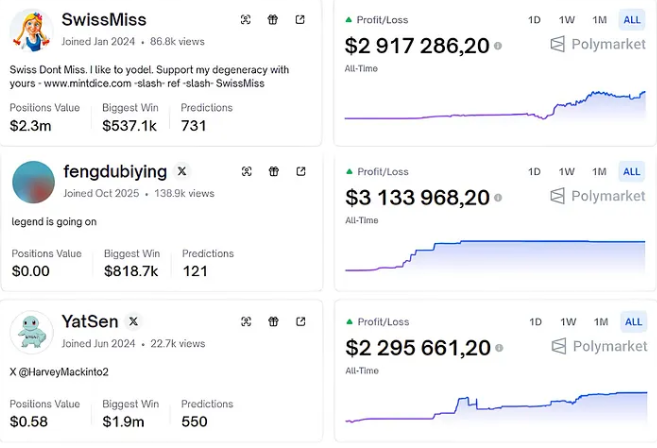
Every Trade on Polymarket is Public Data

Many prediction market participants still view Polymarket as a traditional betting platform: watch the odds, choose a direction, and bet on the outcome. But Polymarket's underlying structure is completely different from DraftKings or ordinary sports betting. All transactions occur on-chain; fund flows, position sizes, and entry/exit times are all publicly viewable. The operational paths of the most accurate and timely addresses are not post-hoc speculation but real-time on-chain records.
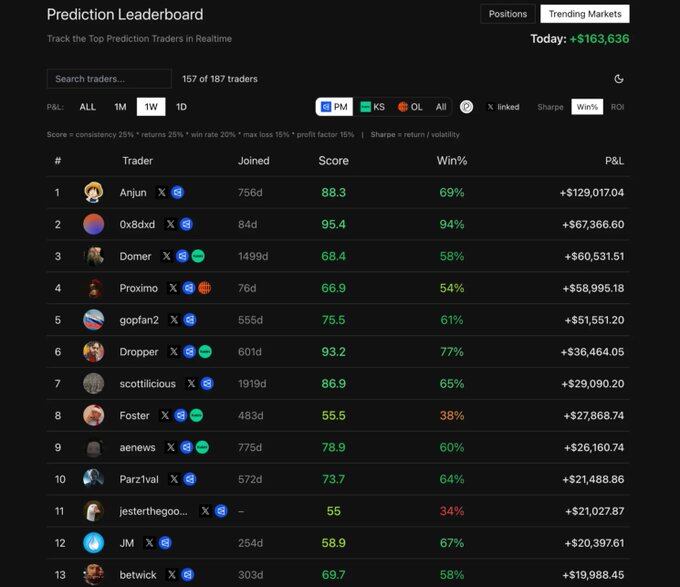
Polymarket's API is also open. Transaction records, market data, historical trades—anyone can directly call it; there is no permission barrier.

Therefore, the gap is not about who can see the data, but about who can extract meaning from it. On-chain information is public, but what is truly valuable are the wallets worth tracking continuously and the ability to recognize behavioral changes before prices fully reflect them.

What Characteristics Do True "Insider Addresses" Typically Have?

It is important to emphasize that not all profitable wallets imply insider information. Some traders have solid research capabilities, while others rely on quantitative models and algorithmic advantages. But when profitability is repeatedly combined with specific behavioral patterns, one can observe structural features that distinguish them from "luck."

First Type: New Addresses Combined with Unusually Large Bets

A wallet created just days ago, with very few transactions, suddenly invests a large amount of capital in a low-liquidity niche market—this behavior is not common. Especially in the absence of public catalysts, large, concentrated positions often carry stronger informational significance.

Second Type: Highly Vertical Trading Focus

Some addresses do not operate across markets but focus long-term on a specific niche, maintaining a stable and significant win rate in that area. They do not diversify across crypto prices, elections, sports, and other sectors but concentrate their firepower on a single theme, with more decisive position decisions.

Third Type: Abnormal Changes in Position Size

When an address that has been betting medium-sized amounts for a long time suddenly significantly increases its position in a certain market, this behavior often indicates a change in the strength of conviction. Position size itself is an attitude; a sudden change in scale usually reflects an upgrade in information or belief.

Fourth Type: Excessively Precise Timing

Occasional early moves can be attributed to coincidence, but if an address repeatedly completes position building hours before major news announcements, with highly consistent direction, such timing lead is difficult to simply explain as luck. Once is random; repeated occurrences are more likely to reflect an information advantage.

How to Systematically Screen for Potential "Information-Advantaged Addresses"

Step 1: Analyze Polymarket Leaderboard Performance

Start with the Polymarket Analytics leaderboard (link: https://polymarketanalytics.com/traders), sorted by 30-day P&L, using recent stable profitability as the first filter. Focus on wallet addresses with overall positive returns for 30 consecutive days, a win rate above 55%, and total profits significantly higher than total losses. Also, confirm that their trading is concentrated in markets with real liquidity, not low-volume prediction events with little participation.
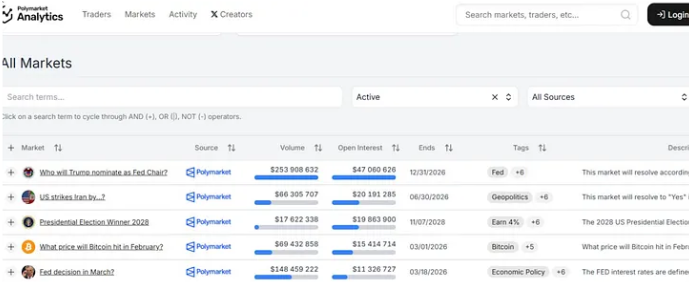
The goal at this stage is not to directly judge whether they have an information advantage, but to establish a watchlist of addresses with sustained profitability. A stable profit record is the foundation for subsequent behavioral analysis.

Step 2: Analyze Position Structure in Specific Events

After the initial screening, drill down into specific trading events. Enter active prediction markets and check the Top Holders list for that event. Polymarket publicly displays the addresses with the largest current positions; these large positions often represent stronger conviction.
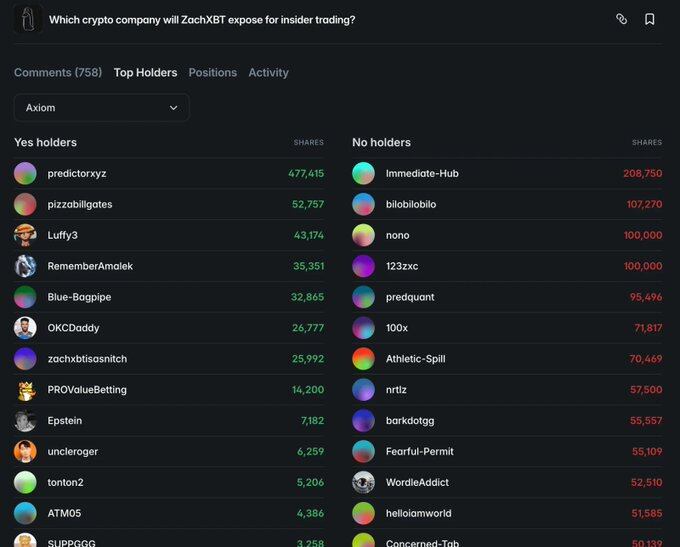
The key is not whether an address hits a single large bet, but whether its behavior is sustained. If a wallet repeatedly appears in the top holder lists of multiple important events, and these positions are built before the market has fully priced them in, then this repetition itself constitutes a signal.

A single successful bet might be偶然, but repeatedly making large, early-stage positions with consistent direction and validated outcomes often indicates a stable advantage in their judgment system.

Step 3: Analyze Trading Behavior and Position Timing

After identifying candidate addresses, further回溯 their on-chain transaction history, focusing on entry timing, position structure, and holding rhythm.
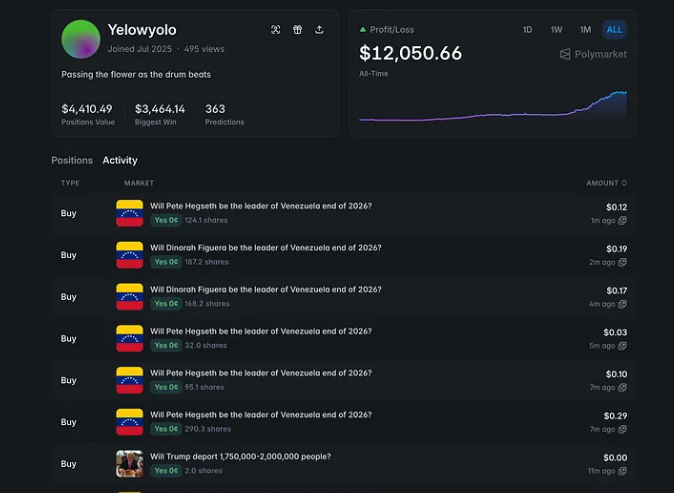
First, observe the entry time. If the purchase occurs hours before the official news release and repeats multiple times, the timing advantage itself becomes an important variable; entering after media reports is more likely to be just information following.

Second, analyze the position building method. Mature traders typically build positions in batches and add gradually, while wallets with strong information judgment often complete concentrated布局 quickly in a short time because their window is limited.

Third, pay attention to the holding period. Some high-quality addresses choose to exit during the mid-stage of行情发酵, rather than waiting for the tail end of extreme volatility, indicating their goal is to lock in the main trend rather than gamble on marginal profits.

Finally, observe their trading scope. Addresses that are highly vertical and long-term focused on a single niche are more likely to form stable information advantages; addresses that frequently operate across sectors are more likely to rely on market sentiment rather than specific domain judgment.

Advanced Address Tracking Strategies

After mastering the basic screening methods, what truly makes the difference is the further decomposition of details in fund behavior.

First, focus on exit behavior, not just entry timing. Addresses with information advantages often not only enter early but also actively reduce positions before potential negative news emerges. When a large address with long-term stable holdings suddenly significantly reduces its position without obvious catalysts, the information content is often higher than the initial buying behavior. Especially when the reduction reaches a significant proportion, this change itself is a signal.

Second, perform wallet clustering analysis using on-chain data. The relationships between addresses are not completely untraceable. Identical funding sources, similar Gas usage patterns, and transactions occurring consecutively within a very short time may reveal relationships between addresses. Many seemingly "brand new" accounts can often be traced back to a long-active old address through 2-3 fund transfers. Tracking along the fund flow path helps identify new potential high-quality accounts before the market notices.

Additionally, pay attention to abnormal volume changes in冷门 markets. If a market with usually small daily trading volume suddenly experiences significant fund inflows without public news, this structural volume increase often means some participants have already acted early. Analyzing the specific addresses driving the volume change can help build a new watchlist.

Finally, cross-verify on-chain behavior with external public information. The so-called "Pizza Index" once used abnormal order volume changes at pizza shops near the Pentagon to speculate on potential military actions. Similarly, flight tracking data, social media activity of key figures, public schedule adjustments, and other information can provide corroboration or反向验证 for on-chain position behavior. The联动 between on-chain fund flows and real-world signals can often strengthen the reliability of judgment.


Twitter:https://twitter.com/BitpushNewsCN

Bitpush TG Discussion Group:https://t.me/BitPushCommunity

Bitpush TG Subscription: https://t.me/bitpush

Original link:https://www.bitpush.news/articles/7615846

Preguntas relacionadas

QWhat are the key characteristics of potentially high-performing addresses on Polymarket?

AKey characteristics include: new addresses making unusually large bets, addresses highly specialized in specific trading niches, abnormal changes in position sizes, and extremely precise timing of trades before major news breaks.

QHow can one systematically identify addresses with potential information advantages on Polymarket?

AThe process involves three steps: analyzing the Polymarket Analytics leaderboard for consistently profitable addresses, examining top holders in specific event markets for repeated early large positions, and scrutinizing on-chain transaction history for entry timing, position structure, and holding patterns.

QWhat is the fundamental difference between Polymarket and traditional betting platforms like DraftKings regarding data?

AAll transactions on Polymarket occur on-chain, making fund flows, position sizes, and entry/exit timestamps completely public and verifiable, unlike traditional platforms where such data is not transparent.

QWhat advanced strategies are suggested for tracking these addresses beyond basic screening?

AAdvanced strategies include monitoring exit behavior (not just entry), performing on-chain wallet clustering to find linked addresses, watching for abnormal volume in niche markets, and cross-referencing on-chain activity with external real-world signals.

QWhy is the timing of a trade, relative to news announcements, a significant factor in identifying an 'informed address'?

AIf an address consistently places trades hours before major news becomes public and this pattern repeats, it is less likely to be coincidental and more likely to indicate an information advantage, as opposed to trading after news dissemination which is just following public information.

Lecturas Relacionadas

Pronóstico final para 2029: Cuando la criptomoneda se vuelva completamente "invisible", ¿quién podrá quedarse en este gran cambio financiero?

**Resumen: Predicción del fin del juego para 2029: Cuando la criptomoneda se vuelva "invisible"** Estamos al borde de la mayor transformación en la historia de las criptomonedas. Este análisis, basado en restricciones del mundo real en startups, regulación y capital de riesgo, traza un camino concreto hasta 2029, haciendo predicciones falsables sobre la evolución del sector. **Hacia 2026: El giro hacia activos reales** Para mediados de 2026, el mercado busca desesperadamente activos de calidad. Los contratos perpetuos sintéticos para acciones no cotizadas de empresas como SpaceX y OpenAI, popularizados en plataformas como Hyperliquid, se convierten en el principal referente de valor, superando a la mayoría de los tokens especulativos. A finales de año, el sector se divide: un ecosistema ruidoso centrado en apuestas sobre IA y otro silencioso donde la tokenización de activos tradicionales (fondos del mercado monetario, crédito privado) avanza dentro del marco regulatorio. **2027: La encrucijada de las blockchains y los límites del crecimiento** Las fundaciones de las cadenas de bloques de propósito general eligen enfocarse en servicios institucionales y cumplimiento normativo, preparando la infraestructura para futuros inversores minoristas. Sin embargo, tres mercados clave chocan con sus límites: los contratos perpetuos por restricciones legales de comercialización, las stablecoins por la incertidumbre política preelectoral en EE.UU., y la tokenización por un exceso de cautela institucional. El crecimiento es constante, pero limitado por fuerzas externas. **2028: El catalizador regulatorio y un nuevo mercado principal** Tras las elecciones en EE.UU., se disipa el pánico regulatorio. Un evento clave (una liquidación en cascada en contratos perpetuos sin un activo subyacente) demuestra los riesgos de los mercados sintéticos. La respuesta regulatoria es decisiva: se permite la comercialización pública de participaciones secundarias en capital privado para **inversores acreditados**. Esto crea un mercado legal, profundo y anhelado para activos empresariales reales, desplazando a los contratos perpetuos como principal vía de exposición. **2029: La "invisibilidad" y el mercado como núcleo** Para 2029, emerge un mercado alcista único, impulsado por participaciones directas (tokenizadas) en empresas tecnológicas de alto crecimiento. La barrera de inversor acreditado se ha relajado tanto que permite el acceso generalizado. Los tokens que no confieren derechos ejecutables sobre activos reales pierden toda liquidez. Las stablecoins crecen de forma estable. La infraestructura blockchain para la liquidación y custodia se vuelve omnipresente pero "invisible", como la utilidad de una empresa de compensación. El legado duradero de las criptomonedas no es la especulación, sino la creación de un **nuevo mercado de capitales global y accesible** para activos privados. La prueba crítica de esta tesis es si, para finales de 2028, existe un camino regulatorio claro para que los inversores minoristas accedan legalmente a estos activos.

marsbitHace 38 min(s)

Pronóstico final para 2029: Cuando la criptomoneda se vuelva completamente "invisible", ¿quién podrá quedarse en este gran cambio financiero?

marsbitHace 38 min(s)

Las acciones de Zhipu se disparan un 47% después de que EE. UU. prohibiera Fable 5

El 15 de junio, las acciones de Zhipu AI se dispararon hasta un 47.6% en la Bolsa de Hong Kong, cerrando con un alza del 32.82% y una capitalización de mercado que superó los 649.600 millones de HKD. Este repunte fue una reacción directa a dos noticias recientes de la industria. El 12 de junio, Anthropic suspendió el acceso global a sus modelos emblemáticos Claude Fable 5 y Claude Mythos 5 para cumplir con una orden de control de exportaciones del gobierno de EE. UU., lo que interrumpió bruscamente los flujos de trabajo de muchos desarrolladores. Al día siguiente, Zhipu AI anunció que su último modelo de código abierto, GLM-5.2, estaba disponible para todos los usuarios de su Coding Plan, con planes de lanzar su API y pesos bajo la licencia MIT la semana siguiente. El incidente de Anthropic destacó un riesgo previamente subestimado: incluso los modelos más avanzados pueden volverse inaccesibles de manera imprevista debido a factores externos, como regulaciones. Esto ha desplazado parte del enfoque de la industria, de competir solo por la capacidad del modelo a priorizar también la estabilidad, el acceso sostenible y el control autónomo de la tecnología. GLM-5.2, que ofrece una ventana de contexto de 1 millón de tokens y está optimizado para tareas de codificación de larga duración, se presenta como una alternativa abierta y confiable. Los analistas sugieren que este evento podría acelerar la migración de empresas hacia modelos base locales y despliegues internos, valorando no solo el rendimiento, sino también la garantía de acceso a largo plazo. La apertura y la disponibilidad se están convirtiendo en nuevas ventajas clave en la competencia global de IA.

marsbitHace 44 min(s)

Las acciones de Zhipu se disparan un 47% después de que EE. UU. prohibiera Fable 5

marsbitHace 44 min(s)

Guía de registro y publicación para la columna de PANews

**Guía de registro y envío de artículos para columnistas de PANews** PANews invita a expertos en criptomonedas y Web3 a solicitar su propio canal de columnista para publicar contenido profundo sobre el sector, datos y análisis. **No se aceptan** artículos promocionales de marcas, relaciones públicas o creados principalmente con IA; este tipo de contenido debe gestionarse a través del canal comercial. **Solicitud de canal:** * **Versión web:** Visite el sitio oficial, desplácese hasta el pie de página y haga clic en "Solicitar columna". Regístrese con su número de móvil o correo electrónico (solo con código de verificación). Complete el nombre, descripción, suba un avatar y proporcione enlaces a trabajos publicados anteriormente. * **Versión móvil:** En la app, vaya a "Mi", luego a "Contribuciones y creación" y complete la información necesaria. **Publicación de artículos:** 1. Inicie sesión en [panewslab.com/zh](https://www.panewslab.com/zh) y acceda a su página personal. 2. Entre en el "Centro de creadores". 3. Cree y publique su nuevo artículo. **Inserción de vídeo:** Solo se admite la inserción de código de plataformas de terceros (como Bilibili). En el editor del artículo, utilice la función "Insertar/editar medios", seleccione la pestaña "Insertar", pegue el código y guarde. Se recomienda ajustar el tamaño a 100% de ancho y 560px de alto. **PANews Skills (Publicación con IA):** PANews ofrece un conjunto de herramientas de IA (PANews Skills) que permite a los Agentes de IA consultar contenido, rastrear tendencias y **publicar artículos directamente en el canal**. La habilidad clave para creadores es `panews-creator`. Para usarla, los autores deben obtener su token de autorización personal (`authorization`) desde las herramientas de desarrollador (Consola -> Red) de su navegador después de iniciar sesión en PANews. **Enlace de instalación de PANews Skills:** [https://github.com/panewslab/skills](https://github.com/panewslab/skills)

marsbitHace 54 min(s)

Guía de registro y publicación para la columna de PANews

marsbitHace 54 min(s)

Me construí una estación de trabajo de inversión con IA

En los últimos quince días, me he sumergido en la "Vibe Coding" – escribir código mediante lenguaje natural con IA – y he construido mi propia plataforma de inversión. Usando principalmente Codex, Claude Code y la API de DeepSeek, he convertido ideas que antes solo existían en mi mente en herramientas funcionales. He desarrollado cuatro utilidades clave: 1. **Panel de Activos Multimercado:** Una vista unificada de mis inversiones en acciones estadounidenses, criptomonedas, acciones de Hong Kong y China continental, con seguimiento del rendimiento total y por activo. Luego añadí funciones como monitoreo de movimientos bruscos de precios y un "mapa de inversiones" para visualizar las relaciones dentro de un sector. 2. **Monitor de Apuestas en Mercados de Predicción (PM):** Agrega y supervisa apuestas sobre eventos futuros (como valoraciones de empresas o eventos macro), correlacionando sus cambios de probabilidad con noticias y movimientos del mercado para identificar oportunidades, especialmente en dinámicas de Asia Oriental. 3. **Panel de Gestión de Contenidos:** Una herramienta operativa simple, alojada en la nube, para gestionar temas de artículos, progresos de escritura y calendarios de publicación en múltiples plataformas. 4. **Herramienta de Formateo Automático:** Un script que convierte automáticamente un documento en los formatos específicos requeridos por diferentes plataformas de medios, ahorrando tiempo en el proceso de publicación. La conclusión principal es que la IA ha cambiado fundamentalmente la investigación para los inversores minoristas. No se trata de volverse un experto de la noche a la mañana, sino de poder construir progresivamente sistemas básicos personalizados: para observar activos, monitorear señales del mercado, mapear relaciones sectoriales y realizar revisiones de decisiones. El "Vibe Coding" acelera enormemente el ciclo de retroalimentación "idea-implementación-uso-mejora", permitiendo que herramientas rudimentarias pero útiles surjan y evolucionen rápidamente, transformando la manera en que los inversores organizan su información y toman decisiones.

marsbitHace 1 hora(s)

Me construí una estación de trabajo de inversión con IA

marsbitHace 1 hora(s)

Trading

Spot
Futuros

Artículos destacados

Cómo comprar WIN

¡Bienvenido a HTX.com! Hemos hecho que comprar WINkLink (WIN) sea simple y conveniente. Sigue nuestra guía paso a paso para iniciar tu viaje de criptos.Paso 1: crea tu cuenta HTXUtiliza tu correo electrónico o número de teléfono para registrarte y obtener una cuenta gratuita en HTX. Experimenta un proceso de registro sin complicaciones y desbloquea todas las funciones.Obtener mi cuentaPaso 2: ve a Comprar cripto y elige tu método de pagoTarjeta de crédito/débito: usa tu Visa o Mastercard para comprar WINkLink (WIN) al instante.Saldo: utiliza fondos del saldo de tu cuenta HTX para tradear sin problemas.Terceros: hemos agregado métodos de pago populares como Google Pay y Apple Pay para mejorar la comodidad.P2P: tradear directamente con otros usuarios en HTX.Over-the-Counter (OTC): ofrecemos servicios personalizados y tipos de cambio competitivos para los traders.Paso 3: guarda tu WINkLink (WIN)Después de comprar tu WINkLink (WIN), guárdalo en tu cuenta HTX. Alternativamente, puedes enviarlo a otro lugar mediante transferencia blockchain o utilizarlo para tradear otras criptomonedas.Paso 4: tradear WINkLink (WIN)Tradear fácilmente con WINkLink (WIN) en HTX's mercado spot. Simplemente accede a tu cuenta, selecciona tu par de trading, ejecuta tus trades y monitorea en tiempo real. Ofrecemos una experiencia fácil de usar tanto para principiantes como para traders experimentados.

436 Vistas totalesPublicado en 2024.12.11Actualizado en 2025.03.21

Cómo comprar WIN

Discusiones

Bienvenido a la comunidad de HTX. Aquí puedes mantenerte informado sobre los últimos desarrollos de la plataforma y acceder a análisis profesionales del mercado. A continuación se presentan las opiniones de los usuarios sobre el precio de WIN (WIN).

活动图片