1. BTC volume stagflation
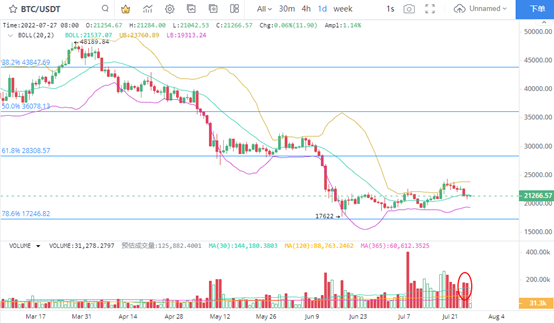
In the daily K-line of BTC, with the continuation of the adjustment, the BTC price operates below the medium rail of brin line, and the trading volume remains stable. This shows that the long and short has not yet reached the showdown stage, and the large-scale operation shows that the trading heat remains at a short-term high.
Judging from the direction of trading, from March to July 2022, when the trading volume rebounded, investors changed hands at a low level relatively fully, which has a lot to do with the decline of BTC price. As the peak value of BTC intra day trading volume is not at a new high, the longer the adjustment time, the greater the possibility of cooling the low trading heat. BTC investors have completed many transactions in more than half a year, and $17600 has become a strong support point for BTC. Low absorption can still refer to US $1.76 to buy BTC.
2. The number of BTC giant whale addresses shows signs of decreasing
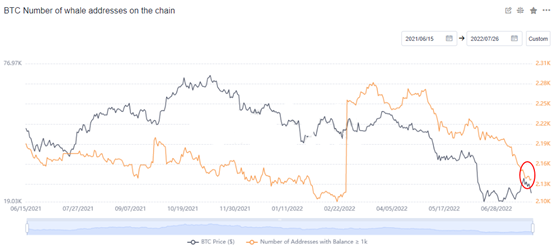
The number of giant whale addresses in BTC has not reached a new low, but the downward trend is very obvious. As of July 26, the number of BTC giant whales was 2138, a decrease of 144 from the peak of 2282 in the year. In terms of quantity, the number of 114 megawhale addresses disappears, and the corresponding number of BTCs is 114000. The number of giant whale addresses not only shows a downward trend, but also in a state of accelerated reduction, indicating that the possibility of capital flight increases. Although the BTC point has not reached a new low since June 18, it does not rule out the possibility of retreating to a short-term low during the period of price shocks.
3. The number of unconfirmed transactions of BTC is low
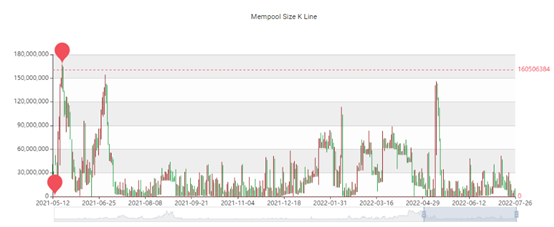
The low number of unconfirmed transactions of BTC indicates that the current trading heat is not high. Most of them are investors with small capital volume who buy and sell BTC, so the transaction speed is relatively fast. Since the number of unconfirmed transactions fell from the peak on May 12, there has never been a significant rebound in the near future. The small number of unconfirmed transactions indicates that investors buy and sell BTC relatively smoothly. The data from the number of active addresses also showed that although BTC remained active in the daily trading volume, the number of active addresses did not continue to increase significantly, indicating that BTC price rebound is not a real price reversal signal.
On the news side, the market generally expects the Federal Reserve to raise interest rates by 75 basis points on July 28, pushing the benchmark interest rate back to 2.5%. Therefore, in judging the direction of BTC change, the possibility of price signs callback is greater.
4. Eth continued technical rebound
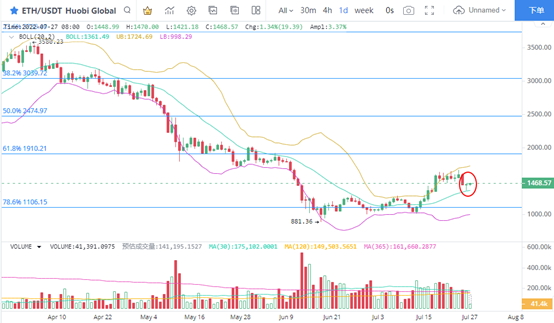
In the daily K line of eth, the price continued the performance of technical rebound, and the starting point of the rebound began from the $1349 corresponding to the brin line. In terms of trading volume, the intraday trading volume of eth has shrunk to the vicinity of the equivalent line, and there is no chance of further contraction in the short term. Therefore, the rebound trend continued, raising the price strength. The abnormal data on the chain also indicates the possible change expectation of eth.
5. The number of eth daily active addresses soared
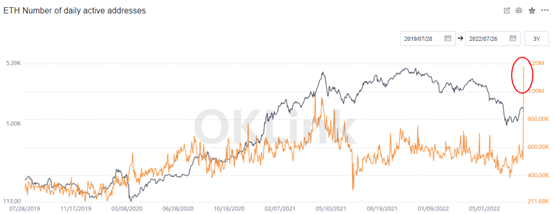
The number of daily active addresses of eth soared significantly, reaching a peak of 1.178 million on July 26, which means that the trading heat shows signs of rapid warming. The soaring number of active addresses may be an important signal of disk change. At least from the middle of 2021, the number of eth daily active addresses has not exceeded the maximum 979000. At present, the number of active addresses has rebounded. If the data is accurate, ETH will have more opportunities to rise in this price change.