Pendle Dismantles the 'Walls': From 'Locking' to 'Retaining' Users

比推Publicado a 2026-01-22Actualizado a 2026-01-22

Resumen

Pendle, a leading DeFi protocol in the interest rate derivatives sector, has announced a major shift away from its long-standing veTokenomics model, transitioning to a more liquid sPENDLE system. This move sparked debate, with critics like Curve’s Michael Egorov calling it a mistake, while the token price rose 11% following the news. The vePENDLE model, which required long-term locking for governance and rewards, was deemed inefficient—concentrating power and yields among a small group of sophisticated users and creating imbalanced incentives across liquidity pools. Over 60% of pools were unprofitable, relying on a few high-performing ones like Ethena for subsidies. The new sPENDLE model introduces a 14-day unstaking period (with a 5% fee for instant exit), replacing indefinite locks. It also adopts algorithmic reward distribution—cutting emissions by ~30%—and directs 80% of protocol revenue to buy back and distribute PENDLE to stakers. Existing vePENDLE holders will receive up to 4x sPENDLE bonuses based on remaining lock-up time at the snapshot on January 29. This shift reflects a broader DeFi trend away from forced loyalty via locking and toward attracting users through real yields and flexibility, as seen in updates by PancakeSwap, Balancer, and Ethena. The industry is increasingly prioritizing product appeal and capital efficiency over locked value.

Recently, Pendle, the "long-distance runner" in the DeFi space, announced a major update: abolishing its long-standing veTokenomics (vote-escrowed economic model) and shifting to the more liquid sPENDLE.
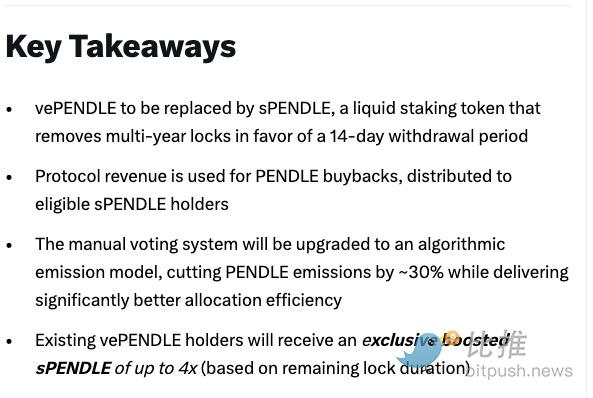
The news quickly sparked heated discussions in the community. Curve founder Michael Egorov promptly voiced his doubts, stating bluntly that 'abolishing the ve model is a mistake.' However, on the other side, the market voted with real money—the price of PENDLE rose by 11%.

As the absolute dominator in the interest rate derivatives track, Pendle's 'self-dismantling' reform not only concerns the growth of its $3.5 billion TVL but also seems like a public trial of DeFi's core narrative over the past three years: the model of exchanging 'lock-up periods' for 'loyalty' appears to be losing its effectiveness.

The Shackles of Locking: 20% 'Minority' Governance

Although Pendle's revenue growth has been significant over the past two years, the performance of its core governance asset, vePENDLE, has not fully kept pace with the protocol's explosive growth.
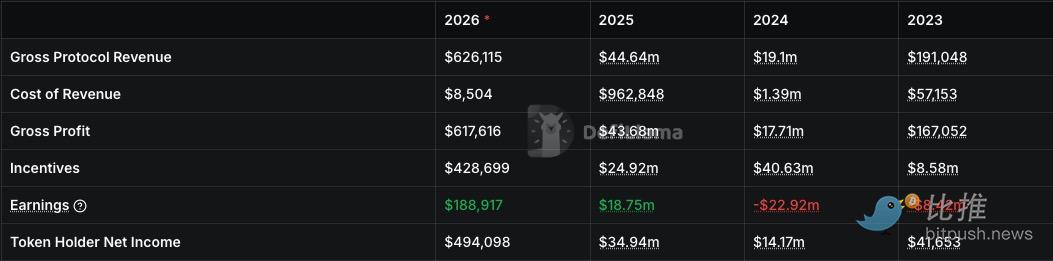
The harsher truth is:

  • Reward 'Wealth Gap': The complex weekly manual voting system is extremely unfriendly to ordinary users, causing rewards to be concentrated in the hands of a few professional players.

  • False Efficiency Boom: Although Pendle's annualized fee efficiency ratio is excellent—with annualized fees of approximately $13.99 million and annualized revenue of about $13.83 million—if broken down by specific pools, over 60% of the pools are actually operating at a loss. The protocol has long relied on profits from a few core high-quality pools (such as Ethena) to subsidize inefficient pools.

This non-transferability of 'lock-up equals disconnection' completely insulates holders from DeFi's most powerful feature: composability.

Algorithms and Buybacks: Shifting from 'Manual' to 'Autopilot'

Pendle's new solution, sPENDLE, essentially transforms the protocol from a 'power game' to an 'efficiency tool.'

The most significant change is the release of liquidity: users no longer face lock-ups of several years; instead, there is a 14-day exit period. If funds are urgently needed, paying a 5% fee allows instant redemption. This 'current account' style treatment provides higher flexibility for the approximately $127 million (35.51% of the market cap) of currently staked funds.

At the governance level, Pendle introduces two 'game-changers':

  1. Algorithm-Driven Emissions: Reward distribution, once determined by manual voting, is now handled by an algorithm. This model will automatically configure rewards based on the actual contribution of each pool, expected to reduce overall emissions by about 30%.

  2. Substantive Buybacks: Up to 80% of protocol revenue will be directly used to buy back PENDLE and distribute it to stakers. Current annualized holder revenue has reached $11.06 million, and cumulative total fees have exceeded $64.56 million. The buyback mechanism will make these earnings directly impact the token's value.

Change inevitably comes with interest restructuring. To appease those 'old contributors' who had locked for years, Pendle set a snapshot date for January 29th.

According to the plan, existing vePENDLE holders can receive up to a 4x sPENDLE multiplier upon conversion. This multiplier will linearly decay based on the original remaining lock-up period, ensuring that those who truly supported the protocol retain the strongest voice and profit rights in the early stages of the transition. This design cleverly alleviates old users' concerns about a 'collapse of long-term consistency.'

This change instantly made PENDLE more 'liquid.' The market clearly prefers liquid assets that allow easy exit while still sharing in buyback dividends, rather than a distant 'long-term meal ticket.'

III. Controversy: Consistency or Liquidity?

However, many industry insiders are not optimistic about this approach.
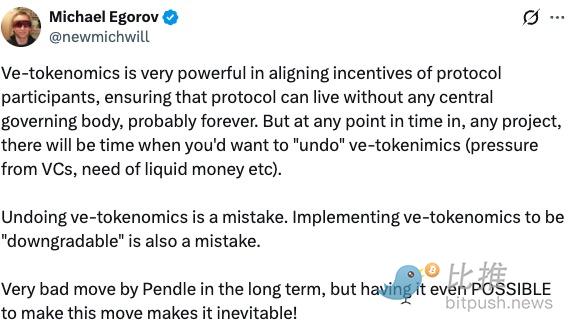
'Opposing' view from Curve founder Michael Egorov:

"Abolishing the vote-escrowed token economics is a mistake. Designing it as 'downgradable' from the start was also a mistake. In the long run, Pendle's move is very bad—but more critically, when such an operation becomes mechanically 'possible,' its occurrence was inevitable."

Maple co-founder and CEO Sid Powell believes that long-term lock-ups essentially 'forcibly retain capital,' which often masks the protocol's true risks and leads to excessive concentration of power. Pendle's approach is 'no longer forcing loyalty through locking, but attracting stay through yields.'

The essence of this debate is: should the moat of a mature DeFi protocol be 'lock-up scale' or 'the appeal of the product itself'?

In fact, Pendle is not alone.

Amid the bull and bear cycles of DeFi in recent years, a group of established protocols have率先 realized that loyalty bought with 'lock-up periods' essentially mortgages the protocol's future.

PancakeSwap was one of the pioneers of this change. As early as the end of 2023, it began reforming its old system that required users to lock CAKE for up to four years. By introducing a flexible Revenue Share mechanism for veCAKE, PancakeSwap directly distributed 5% of protocol fees to stakers, no longer mandating years of immobility. By the end of 2025, despite multi-chain competition, its TVL steadily recovered and remained around $2.3 billion, successfully attracting many retail users unwilling to be locked in long-term.

Balancer's trajectory is also highly illustrative. Its veBAL model long faced difficulties, with nearly 80% of tokens in a 'non-active governance state,' meaning the vast majority of holders only locked and did not vote. In 2025, the team彻底 adjusted the incentive structure in the v3 upgrade: introducing short lock-up options and automated fee adjustments, turning governance from a 'chore' into a flexible tool. Within half a year, the protocol's governance participation rate increased by about 40%.

A more radical experiment came from the stablecoin protocol Ethena. In September last year, it activated a 'fee switch,' directly distributing protocol revenue to holders of the liquidity token sENA, completely bypassing the complex vote-escrow model.

These cases point to a new consensus: DeFi protocols are shifting from 'forcing user binding' to 'retaining users with tangible benefits.' Locking was once a shortcut to maintain data stability but also led ecosystems into false prosperity. Now, protocols prefer to gain real activity by lowering participation barriers and improving capital efficiency.

The effectiveness of Pendle's reform will be tested after the official end of vePENDLE lock-ups on January 29th. But regardless of the outcome, it has sent a clear signal to the industry: in the future DeFi world, excellent products should not make users 'staking prisoners.'

Author: Bootly


Twitter:https://twitter.com/BitpushNewsCN

Bitpush TG Discussion Group:https://t.me/BitPushCommunity

Bitpush TG Subscription: https://t.me/bitpush

Original link:https://www.bitpush.news/articles/7604977

Preguntas relacionadas

QWhat major update did Pendle recently announce regarding its tokenomics model?

APendle announced the abolition of its veTokenomics (vote-escrowed tokenomics) model and transitioned to a more liquid sPENDLE model.

QWhat are the two key features introduced in Pendle's new sPENDLE model?

AThe two key features are algorithm-driven emissions for reward distribution and a substantial buyback mechanism where 80% of protocol revenue is used to repurchase PENDLE for stakers.

QHow did the market initially react to Pendle's announcement of abandoning veTokenomics?

AThe market reacted positively, with the price of PENDLE increasing by 11% following the announcement.

QWhat criticism did Curve founder Michael Egorov raise about Pendle's decision?

AMichael Egorov criticized the move, stating that撤销投票托管代币经济模型是一个错误 (revoking the vote-escrowed tokenomics model is a mistake) and that designing it as 'degradable' was also an error, predicting negative long-term consequences.

QWhat is the exit period for users in the new sPENDLE model, and what option is available for immediate withdrawal?

AThe exit period is 14 days, but users can withdraw immediately by paying a 5% fee for instant redemption.

Lecturas Relacionadas

El giro global de a16z: El capital riesgo se está convirtiendo en el "impulsor" de la alianza tecnológica estadounidense

En a16z, creemos que la mejor oportunidad que puede ofrecer una sociedad es dar a sus ciudadanos una posibilidad. Creemos firmemente que Estados Unidos y sus aliados lo hacen de manera más constante y exitosa que cualquier otro lugar del mundo. Hoy, con las naciones reconstruyendo, rearmándose y replanteando su participación en la competencia global, tenemos la oportunidad de transmitir ese regalo. Nuestra estrategia global evoluciona más allá de simplemente buscar proyectos en el extranjero. Nos estamos integrando en un marco más amplio de competencia tecnológica y cooperación entre aliados. La innovación ya no es solo una cuestión comercial, sino que es crucial para la seguridad nacional, la capacidad industrial y la competencia internacional. Anunciamos nuevos planes globales: establecer cooperación tecnológica con aliados en áreas clave como IA, robótica, defensa moderna, ciberseguridad y resiliencia de la cadena de suministro. Anne Neuberger, nueva socia responsable de asuntos globales, liderará esta labor, aportando su vasta experiencia gubernamental en seguridad y tecnologías emergentes. También ayudaremos a nuestras empresas en etapa de crecimiento a expandirse internacionalmente, aprovechando la poderosa red de contactos de a16z, desde líderes políticos hasta grandes compradores. Además, buscaremos nuevas asociaciones estratégicas en el extranjero, renombrando nuestro equipo de relaciones con inversores como Equipo de Socios Globales. Nuestro trabajo fundamental sigue siendo invertir en las mejores empresas tecnológicas donde sea que las encontremos, con más de 100 inversiones internacionales realizadas. Nuestra misión siempre ha sido ayudar a los fundadores a construir empresas excepcionales. Hoy, esa misión adquiere un nuevo significado: no solo ayudar a los fundadores, sino también a Estados Unidos y sus aliados. Estamos respondiendo a ese llamado.

marsbitHace 1 hora(s)

El giro global de a16z: El capital riesgo se está convirtiendo en el "impulsor" de la alianza tecnológica estadounidense

marsbitHace 1 hora(s)

Descifrando la verdad sobre los negocios, pagos e infraestructura de los Agentes

**Resumen: La realidad del comercio, los pagos y la infraestructura de los Agentes** El artículo, basado en un año de trabajo en la infraestructura para la economía de Agentes, sostiene que la demanda real actual es mínima y existen importantes obstáculos estructurales. Se examinan cuatro categorías: 1. **Agente-Comercio (B2C):** La experiencia de compra conversacional actualmente no supera al comercio electrónico tradicional para la mayoría de productos, especialmente los visuales. Existe demanda defensiva de comerciantes (optimización para Agentes), pero no es crítica. Las oportunidades están en compras de baja fricción (como pedir comida) o en navegar interfaces complejas, pero requieren una distribución masiva, dominio de grandes plataformas. 2. **Agente-API (B2B):** El uso actual de APIs es recurrente y se maneja con prepago y suscripciones. El mercado de nicho de servicios de cola larga es adecuado para nuevos protocolos de pago, pero es pequeño. Las grandes empresas SaaS prefieren contratos corporativos, y la distribución favorece a los gigantes existentes. 3. **Agente-Agente:** Es una visión a largo plazo, actualmente teórica y sin volumen comercial significativo. Cuando se materialice, requerirá una infraestructura de liquidación dedicada por su velocidad, escala y naturaleza multipartita. 4. **Agente-Finanzas:** Es la categoría con demanda existente, ya que se integra naturalmente en flujos de trabajo financieros actuales y crea nuevas capacidades. Sin embargo, el sector está altamente regulado y dominado por empresas establecidas. **Conclusión clave:** Los gigantes construyen de forma defensiva por su gran capital, pero las startups deben centrarse en dónde está el mercado real ahora. El verdadero reto no es el pago, sino la **coordinación** entre Agentes y humanos para verificar el trabajo y liquidar resultados. Quienes resuelvan la coordinación se llevarán la parte principal del pastel, no al revés. La autora señala que su trabajo las ha dirigido hacia un área de mercado activa y de rápido crecimiento fuera de estas cuatro categorías.

marsbitHace 1 hora(s)

Descifrando la verdad sobre los negocios, pagos e infraestructura de los Agentes

marsbitHace 1 hora(s)

Trading

Spot
Futuros

Artículos destacados

Cómo comprar PENDLE

¡Bienvenido a HTX.com! Hemos hecho que comprar Pendle (PENDLE) sea simple y conveniente. Sigue nuestra guía paso a paso para iniciar tu viaje de criptos.Paso 1: crea tu cuenta HTXUtiliza tu correo electrónico o número de teléfono para registrarte y obtener una cuenta gratuita en HTX. Experimenta un proceso de registro sin complicaciones y desbloquea todas las funciones.Obtener mi cuentaPaso 2: ve a Comprar cripto y elige tu método de pagoTarjeta de crédito/débito: usa tu Visa o Mastercard para comprar Pendle (PENDLE) al instante.Saldo: utiliza fondos del saldo de tu cuenta HTX para tradear sin problemas.Terceros: hemos agregado métodos de pago populares como Google Pay y Apple Pay para mejorar la comodidad.P2P: tradear directamente con otros usuarios en HTX.Over-the-Counter (OTC): ofrecemos servicios personalizados y tipos de cambio competitivos para los traders.Paso 3: guarda tu Pendle (PENDLE)Después de comprar tu Pendle (PENDLE), guárdalo en tu cuenta HTX. Alternativamente, puedes enviarlo a otro lugar mediante transferencia blockchain o utilizarlo para tradear otras criptomonedas.Paso 4: tradear Pendle (PENDLE)Tradear fácilmente con Pendle (PENDLE) en HTX's mercado spot. Simplemente accede a tu cuenta, selecciona tu par de trading, ejecuta tus trades y monitorea en tiempo real. Ofrecemos una experiencia fácil de usar tanto para principiantes como para traders experimentados.

425 Vistas totalesPublicado en 2024.12.12Actualizado en 2026.06.02

Cómo comprar PENDLE

Discusiones

Bienvenido a la comunidad de HTX. Aquí puedes mantenerte informado sobre los últimos desarrollos de la plataforma y acceder a análisis profesionales del mercado. A continuación se presentan las opiniones de los usuarios sobre el precio de PENDLE (PENDLE).

活动图片













