[Key interpretation] USDT users have decreased significantly, and BTC has accelerated to fall below the recent investor cost price

Huobi ResearchPublicado a 2022-07-26Actualizado a 2022-07-27

Resumen

The supply of stable currency fell by $35.1 billion, and usdt users decreased significantly, putting short-term pressure on the market.

1. BTC volume stagflation

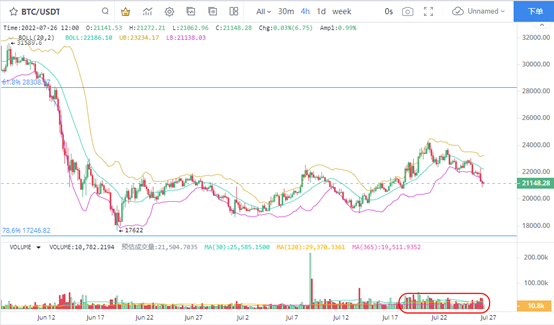
BTC's 4-hour K-line chart hours. With the price adjustment, BTC, which currently maintains a high-volume state, has continued its decline for several trading days. Since July 20, BTC has fallen below the middle rail of the brin line after falling back from the high US $24200. BTC's short-term decline expanded to 12.5%, and the Bollinger line expansion trend continued. In the case of high trading volume, the possibility of BTC falling beyond expectations has significantly increased.

Recently, BTC has accumulated more chips below US $24000. The large volume of spot BTC transactions and the increase in the number of online transfers have increased the concentration of chips in this price range. In terms of support, we are concerned about the possibility that BTC will rebound at US $19000 and US $20000.
2. BTC high-level operation of large transactions

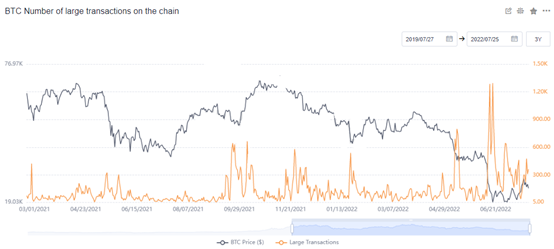
The number of large transactions with more than 500 BTCs is running at a high level, and the current value has frequently reached 500, indicating that the main force is highly active. The activity of the main players in the low price zone has increased, which represents the growth trend of the number of low turnover BTCs. A large number of BTCs transfer money in the low price zone, and it is difficult for BTCs to get out of the price range below $24000 at present. However, after the change of hands is completed, considering that the volatility of BTC price rebounded on July 25, it seems to be preparing for a downward break. In the short term, we can prepare for emergencies, and the important $19000 may be used as the key support point.
3. BTC estimated high leverage operation

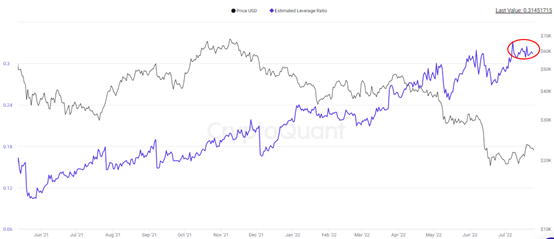
BTC estimates that the leverage ratio is running at a high level, and there has been no significant growth since June. Nevertheless, judging from the growth trend of leverage ratio, it is still the highest level in history. It is estimated that the high leverage ratio means that the stock of BTC in the exchange decreases, the trading leverage ratio of investors is high, and BTC still has high volatility potential.

Numerically, the leverage ratio was estimated to be around 0.315 on July 24, with a significant increase of 43% during the year. In terms of trading, pay attention to the intra day amplitude performance of BTC, and pay attention to the expectation of high-intensity fluctuations caused by price changes.
4. Eth continuous adjustment signal

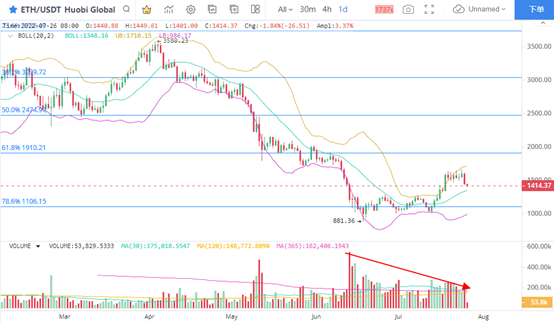
The daily K-line chart of eth shows that after the price fell from the high platform, the trading volume maintained a shrinking trend. At present, the trading volume is close to falling below the equivalent line, and the ETH price is close to the brin line medium rail. According to the price operation rhythm, ETH implementation will seek the support of $1348 corresponding to the brin line medium rail, so as to further verify the price long and short rhythm.
5. Decrease in stable currency users

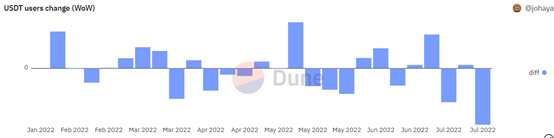
The decreasing trend of stable currency users continued, especially the number of users of usdt with the highest market value continued to decline, and the decline was significantly increased. The data showed that the number of usdt users fell by 80884 on July 25, the largest decline in the year. Judging from the downward trend of usdt users, investors' trading enthusiasm for the current mainstream currencies is obviously at a low level. The decline in the number of users means that more investors are less willing to copy the bottom of the market. Although mainstream currencies such as BTC and eth retreated, it may be difficult to support the short-term rebound, so the recent trend is not optimistic.

Lecturas Relacionadas

¿Oportunidad o trampa? El ETF de Renta de Bitcoin de BlackRock promete un rendimiento anualizado del 15%-25%

La gestora de activos más grande del mundo, BlackRock, lanzará su ETF de ingresos por Bitcoin (BITA), que busca generar un rendimiento anual del 15% al 25% mediante la venta de opciones de compra cubiertas sobre su fondo de Bitcoin físico IBIT. Este producto, dirigido a inversores que buscan flujo de caja, sacrifica parte de la apreciación potencial del Bitcoin a cambio de ingresos por primas. Los defensores argumentan que el ETF convertirá el capital de alto rendimiento en demanda incremental de Bitcoin, impulsando el precio. Señalan las fuertes entradas en IBIT, patrones cíclicos y predicciones alcistas de instituciones como JPMorgan y VanEck. El inversor Michael Terpin ve un potencial de crecimiento masivo a medida que la adopción supera un umbral crítico. Los críticos advierten que es una "trampa de rendimiento". Paolo Ardoino de Bitfinex sostiene que la concentración de BTC en ETF perjudica el ecosistema descentralizado. Otros señalan que el producto no atrae nuevo capital, solo redistribuye el existente, limitando las ganancias en subidas pero no protegiendo en bajadas. El impacto en el precio de Bitcoin dependerá de si BITA atrae capital nuevo o solo cannibaliza a IBIT. Mientras algunos analistas ven el rango de $65,000 como un suelo, otros pronostican posibles correcciones. El producto llega en un momento crucial para evaluar la demanda institucional real.

Foresight NewsHace 49 min(s)

¿Oportunidad o trampa? El ETF de Renta de Bitcoin de BlackRock promete un rendimiento anualizado del 15%-25%

Foresight NewsHace 49 min(s)

Gate Research Institute: Análisis de Formaciones Gráficas y Estrategia de Trading por Ruptura

"Gate Research: Análisis de Patrones Gráficos y Estrategias de Trading por Ruptura Los patrones gráficos son herramientas esenciales del análisis técnico para observar cambios en la oferta y la demanda, y posibles continuaciones o reversiones de tendencia. Su análisis requiere una evaluación integral de la tendencia, volumen, soportes/resistencias, ciclos temporales y la validez de las rupturas, no solo la memorización de formas. Los patrones se dividen principalmente en dos categorías: de reversión (como doble techo/doble suelo, cabeza y hombros) y de continuación (como banderas, triángulos, rectángulos). Una ruptura efectiva suele basarse en niveles claros de soporte/resistencia, una consolidación prolongada, el contexto de la tendencia y la confirmación del volumen. Sin embargo, una ruptura no garantiza una tendencia nueva, ya que las falsas rupturas son frecuentes. Los traders deben gestionar el riesgo mediante el control de la posición, stop-loss, confirmación por retroceso y toma parcial de ganancias. La estrategia de trading por ruptura se centra en la salida del precio de un rango o patrón consolidado. La entrada puede realizarse en el momento de la ruptura o tras una confirmación por retroceso. Es crucial definir niveles claros de entrada, stop-loss (colocándolo fuera de la estructura del patrón) y objetivos de beneficio (a menudo basados en la altura del patrón). La gestión de posiciones puede incluir tomar ganancias parciales en objetivos medibles y seguir el resto con un stop-loss móvil. Existen tres tipos principales de comportamiento tras una ruptura: ruptura efectiva (avance sostenido), ruptura con retroceso (que ofrece una segunda oportunidad de entrada) y falsa ruptura (que revierte rápidamente). Indicadores como el volumen, la conversión de soporte/resistencia, ATR, medias móviles, Bandas de Bollinger y RSI pueden ayudar a validar la solidez de una ruptura. En conclusión, los patrones y las rupturas proporcionan un marco útil, pero su eficacia depende de múltiples factores que converjan. Deben integrarse en un sistema de trading más amplio que incluya gestión de riesgo y gestión monetaria disciplinada."

marsbitHace 1 hora(s)

Gate Research Institute: Análisis de Formaciones Gráficas y Estrategia de Trading por Ruptura

marsbitHace 1 hora(s)

Trading

Spot
Futuros
活动图片