Curve Governance Upheaval: 17 Million CRV Funding Proposal Rejected, Capital Entities Become New Decision-Making Core

marsbitPublicado a 2025-12-26Actualizado a 2025-12-26

Resumen

A significant governance proposal within the Curve DAO, requesting 17 million CRV in funding for development team Swiss Stake AG, was recently rejected. Major veCRV holders, including Convex and Yearn, voted against the proposal, effectively blocking its passage. The rejection reflects two key concerns within the community: a demand for greater transparency and accountability regarding the use of previous grants and future spending plans, and a reluctance from large token holders to dilute the value of their veCRV holdings without a clear, direct return on investment. The article highlights a shift in DeFi governance, moving away from a model of automatic funding approval. It contrasts the veToken model, used by Curve, with standard governance systems. The ve model binds voting power to long-term token lock-ups, attracting capital-heavy players focused on long-term gains. This, combined with the prevalence of vote-aggregating protocols like Convex, is centralizing decision-making power with large capital providers rather than the broader community or even project founders. The outcome of this vote suggests that future governance power in Curve may lie primarily with these major stakeholders.

Original Author: CM(X:@cmdefi)

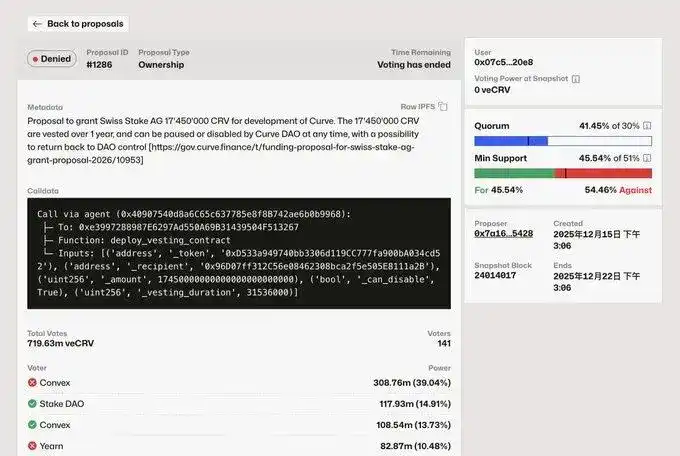
A few days ago, a funding proposal on Curve was rejected. It involved allocating 17M $CRV in development funds to the development team (Swiss Stake AG). Both Convex and Yearn voted against it, and their voting power was sufficient to influence the final outcome.

Since the governance issues at Aave began to gain attention, governance has started to be scrutinized by the market, and the habitual practice of approving funding requests is being broken. Behind this Curve proposal lie two key points:

1. Some voices in the community are not opposed to funding AG, but they want clarity on how previous funds were used, future plans for usage, sustainability, and whether the projects have generated returns for the protocol. Simultaneously, this primitive grant model means that once funds are disbursed, there are no constraints. In the future, the DAO needs to establish a Treasury, ensure transparent revenue and expenditure, or add governance constraints.

2. The large veCRV holders do not want to dilute their value. This is a clear conflict of interest. If the projects supported by CRV grants cannot foreseeably create benefits for veCRV holders, they likely won't receive support. Of course, Convex and Yearn also have their own private interests and agendas, but we won't delve into those issues here.

This proposal was initiated by Curve founder Mich. AG is also one of the teams that has been maintaining the core codebase since 2020. For this funding round, AG's presented roadmap included continuing to advance llamalend, including support for PT and LP, as well as expansion into on-chain foreign exchange markets and crvUSD. These seem like worthwhile endeavors, but whether they justify a 17M $CRV grant is another calculation. Particularly because Curve's governance differs significantly from Aave's; its power is distributed among several teams with distinct stances.

Let's compare the ve model with conventional governance models:

First, the conclusion: most conventional governance models currently have essentially no design advantages. Of course, if a DAO is mature enough, traditional structures can also function well, but unfortunately, no project in Crypto has yet matured to that level, as evidenced by the problems even at market-consensus leaders like Aave.

So, if we talk specifically about model design, the ve model has some advanced aspects. Firstly, it has cash flow; it is backed by liquidity control rights. When there is external demand for liquidity, this power is "bribed." Therefore, even if you don't want to lock your tokens long-term, you can delegate them to proxy projects like Convex/Yearn to earn收益 (yield).

Thus, the ve model binds voting rights with cash flow. Its future evolution will likely follow the path of "governance capitalism." The vetoken binds voting rights with "long-term locking," essentially筛选 (screening for) those with large capital, the ability to bear liquidity loss, and the capacity for long-term博弈 (game theory). Over time, the result is that governors gradually shift from ordinary users to the "capital class."

Furthermore, due to the existence of proxy layers like Convex/Yearn, many ordinary users, even loyal ones, who wish to gain yield without losing liquidity and flexibility, will increasingly choose to delegate their governance power to these projects.

This vote also reveals some clues. In the future, Mich may not be the main character in Curve's governance; instead, power lies with these large vote holders. When governance issues arose at Aave, some proposed ideas of "delegated governance/elite governance," which is quite similar to the current structure of Curve. As for whether this is good or bad, it will take time to tell.
Criptos en tendencia

Preguntas relacionadas

QWhat was the main reason for the rejection of the 17M CRV grant proposal for Swiss Stake AG?

AThe proposal was rejected primarily because major veCRV holders, such as Convex and Yearn, voted against it. They were concerned about the dilution of their token value and the lack of a clear, sustainable plan for how the funds would be used to generate tangible benefits for veCRV holders.

QHow does the ve (vote-escrowed) tokenomics model differ from conventional governance models according to the article?

AThe ve model binds voting rights to long-term token lock-ups, which inherently attracts large capital providers who can afford illiquidity and engage in long-term planning. This contrasts with conventional governance models, which the article argues have few inherent design advantages and often struggle without a highly mature DAO structure. The ve model also provides direct cash flow to holders through 'bribes' from protocols seeking liquidity.

QWhat role do proxy platforms like Convex and Yearn play in the Curve ecosystem?

AProxy platforms like Convex and Yearn allow ordinary CRV holders to delegate their voting power and locked tokens to them. In return, the users receive a share of the platform's revenue (e.g., from bribes) while maintaining liquidity and flexibility, as they are not locking tokens directly with Curve. This consolidation of voting power makes these platforms major decision-makers in governance.

QWhat does the article suggest about the future of Curve's governance power dynamics?

AThe article suggests that future governance power in Curve will increasingly reside with large capital holders and proxy platforms like Convex and Yearn, rather than with the founder, Michael Egorov, or the broader community. This shift represents a move towards 'governance capitalism,' where decision-making is concentrated among those with significant financial stakes.

QWhat were the key community concerns regarding the grant proposal, beyond simple opposition to funding?

ABeyond simply rejecting the grant, a part of the community wanted greater transparency and accountability. Their concerns included how previous funds had been used, the sustainability of the development plan, whether the projects would generate measurable returns for the protocol, and a desire for a more structured Treasury with transparent revenue and expenditure reporting, rather than an open-ended grant model.

Lecturas Relacionadas

¿Es bueno o malo que las empresas de criptomonedas sean adquiridas a un ritmo frenético por los gigantes?

**Resumen: Adquisiciones masivas en la industria cripto: ¿buena o mala señal?** El mercado bajista está siendo aprovechado por grandes corporaciones para realizar adquisiciones estratégicas en el sector cripto a bajo coste. En el último mes, se han destacado varias operaciones: - **Blockworks compra Messari**: El analista de datos Messari, valorado en 300 millones de dólares en 2022, fue vendido por poco más de 10 millones, una caída del 90%, mostrando la presión sobre startups cripto. - **Entrada en mercados regulados**: Firmas como Robinhood (comprando WonderFi en Canadá) o Samsung Securities (adquiriendo parte de Dunamu/Upbit en Corea) buscan acceso rápido a mercados con licencias locales ya establecidas. - **Adopción institucional y RWA (Activos del Mundo Real)**: Figure invirtió 717 millones en Kiavi, integrando préstamos hipotecarios en blockchain. Franklin Templeton lanzó "Franklin Crypto" apuntando a fondos de pensiones y soberanos, mostrando una creciente aceptación institucional. **Conclusión**: Para los gigantes financieros, el mercado bajista es una oportunidad para adquirir tecnología, equipos y licencias a precios reducidos, preparándose para la próxima expansión del sector. Esta ola de adquisiciones marca una transición de la etapa inicial caótica del cripto hacia una era de infraestructura regulada e institucional.

marsbitHace 40 min(s)

¿Es bueno o malo que las empresas de criptomonedas sean adquiridas a un ritmo frenético por los gigantes?

marsbitHace 40 min(s)

La advertencia de las enormes pérdidas de Strive: la presión de las acciones preferentes de Strategy ya se extiende por toda la industria de los tesoros de Bitcoin

El artículo analiza la advertencia que supone la gran pérdida contable de Strive: la presión de las acciones preferentes de Strategy ya se extiende por todo el sector de los tesoros de Bitcoin. Strive, la séptima empresa que más Bitcoin posee, reveló que el valor justo de mercado de su participación de 505.000 acciones de STRC (Strategy) cayó 7,08 millones de dólares en 8 días, pasando de 88,59 a 74,57 dólares por acción, aunque la cantidad de acciones se mantuvo igual. Esto expone el riesgo de contagio por tenencias cruzadas entre empresas de reserva de Bitcoin. Strategy respondió con un nuevo marco de gestión crediticia digital, que incluye una reserva en efectivo de 25.500 millones de dólares, un aumento del dividendo anual de STRC al 12%, y planes de recompra de acciones y potencial venta de Bitcoin (autorizada hasta 12.500 millones de dólares) para estabilizar su estructura de capital. Una calculadora de valoración de terceros (Farside) estima el valor actual neto de STRC en solo 49,887 dólares por acción, destacando que la valoración depende críticamente de la sostenibilidad de los dividendos. Con el precio del Bitcoin (~62.000 dólares) por debajo del coste promedio de Strategy (75.651 dólares), la atención se centra en la capacidad de cobertura de dividendos. El mercado observa dos escenarios: 1) El riesgo se limita a Strategy, o 2) Se propaga a todo el sector si los descuentos de STRC y las acciones preferentes de Strive (SATA) persisten, desencadenando ventas de Bitcoin. Los indicadores clave serán la profundidad del descuento, la cobertura de dividendos y las posibles ventas de activos. La próxima divulgación de Strive será crucial para determinar si su pérdida por STRC es un caso aislado o la primera señal de un riesgo crediticio sistémico en el sector.

Foresight NewsHace 1 hora(s)

La advertencia de las enormes pérdidas de Strive: la presión de las acciones preferentes de Strategy ya se extiende por toda la industria de los tesoros de Bitcoin

Foresight NewsHace 1 hora(s)

Trading

Spot

Artículos destacados

Cómo comprar CRV

¡Bienvenido a HTX.com! Hemos hecho que comprar Curve DAO Token (CRV) sea simple y conveniente. Sigue nuestra guía paso a paso para iniciar tu viaje de criptos.Paso 1: crea tu cuenta HTXUtiliza tu correo electrónico o número de teléfono para registrarte y obtener una cuenta gratuita en HTX. Experimenta un proceso de registro sin complicaciones y desbloquea todas las funciones.Obtener mi cuentaPaso 2: ve a Comprar cripto y elige tu método de pagoTarjeta de crédito/débito: usa tu Visa o Mastercard para comprar Curve DAO Token (CRV) al instante.Saldo: utiliza fondos del saldo de tu cuenta HTX para tradear sin problemas.Terceros: hemos agregado métodos de pago populares como Google Pay y Apple Pay para mejorar la comodidad.P2P: tradear directamente con otros usuarios en HTX.Over-the-Counter (OTC): ofrecemos servicios personalizados y tipos de cambio competitivos para los traders.Paso 3: guarda tu Curve DAO Token (CRV)Después de comprar tu Curve DAO Token (CRV), guárdalo en tu cuenta HTX. Alternativamente, puedes enviarlo a otro lugar mediante transferencia blockchain o utilizarlo para tradear otras criptomonedas.Paso 4: tradear Curve DAO Token (CRV)Tradear fácilmente con Curve DAO Token (CRV) en HTX's mercado spot. Simplemente accede a tu cuenta, selecciona tu par de trading, ejecuta tus trades y monitorea en tiempo real. Ofrecemos una experiencia fácil de usar tanto para principiantes como para traders experimentados.

397 Vistas totalesPublicado en 2024.12.11Actualizado en 2026.06.02

Cómo comprar CRV

Discusiones

Bienvenido a la comunidad de HTX. Aquí puedes mantenerte informado sobre los últimos desarrollos de la plataforma y acceder a análisis profesionales del mercado. A continuación se presentan las opiniones de los usuarios sobre el precio de CRV (CRV).

活动图片