When Curators Become a Risk Variable in DeFi Lending, How Can Algorithms Reshape the Market?

比推Publicado a 2025-12-10Actualizado a 2025-12-10

Resumen

The article argues that the current "Curator" model in DeFi lending, as seen in protocols like Morpho and Euler, reintroduces human moral risk and inefficiency. It traces the evolution of lending markets, highlighting that early pooled models (e.g., Compound, Aave) sacrificed lender risk control for borrower convenience, while isolated markets (e.g., Morpho Blue) fragmented liquidity. Curator vaults attempted to bridge this gap but reintroduced trust assumptions and discretionary decision-making. The author proposes a new paradigm inspired by traditional order books: a two-tier architecture separating risk definition from order matching. In this model (exemplified by Avon), lenders deposit into isolated, parameter-defined "strategies" (retaining full risk control), while a shared order book algorithmically aggregates and routes borrower requests across compatible strategies atomically. This eliminates the need for human curators, enhances transparency, and improves liquidity utilization. The approach also benefits RWA by allowing compliance at the strategy level while pooling global liquidity. Built on high-performance chains like MegaETH, this CLOB-based system aims to automate lending coordination without sacrificing lender autonomy or borrower experience.

Original Author: @0xJaehaerys, Gelora Research

Original Compilation: EeeVee, SpecialistXBT, BlockBeats

Original Title: Lending Markets Do Not Need the Curator Model


Editor's Note: After the successive blowups of Stream Finance and USDX, the DeFi community is undergoing a painful disenchantment. The "Curator" model introduced by protocols like Morpho and Euler was originally intended to solve liquidity fragmentation but inadvertently reintroduced the moral hazard of "human" factors on-chain. The author of this article points out that current lending protocols mistakenly bundle "risk definition" with "order matching." By drawing on the order book model from traditional finance, this article constructs a new paradigm that eliminates the need for curators and relies on algorithmic automatic routing.

The Evolutionary Logic of Lending Markets

Reviewing the evolution of on-chain trading provides a reference for understanding lending market.

AMMs based on constant functions (like Uniswap) solved a fundamental problem: how to create a market without active market makers? The answer was to use an invariant function to preset the "shape" of liquidity. Liquidity providers pre-agree to a set of strategies, and the protocol handles execution automatically.

This works well in trading because trading is relatively simple: buyers and sellers meet at a price. But lending is much more complex. A loan involves multiple dimensions:

Interest rate

Collateral type

Loan-to-Value ratio (LTV)

Term (fixed vs. demand)

Liquidation mechanism

Matching a loan requires satisfying constraints across all these dimensions simultaneously.

Early DeFi lending directly adopted solutions similar to AMMs. Protocols like Compound and Aave preset interest rate curves, with lenders joining a shared pool. This allowed lending markets to function without active lenders.

But this analogy has a fatal flaw. In DEX trading, the shape of the constant function curve affects execution quality (slippage, depth); in lending, the shape of the interest rate curve directly determines risk. When all lenders share a single pool, they also share the risk of all collateral accepted by the pool. Lenders cannot express their desire to bear only specific types of risk.

In the trading space, order books solved this problem: they allow market makers to define their own "curve shape." Each market maker quotes at their preferred price, the order book aggregates these quotes into a unified market, but each market maker still controls their own risk exposure.

Can lending adopt the same approach? A project named Avon attempts to answer this question.

The Liquidity Fragmentation Problem

To give lenders control, DeFi's first attempt was market isolation.

Protocols like Morpho Blue and Euler allow anyone to create lending markets with specific parameters: designated collateral, borrowed asset, fixed liquidation LTV, and interest rate curve. Lenders deposit into markets that match their risk preferences. Bad debt in one market never spills over to another.
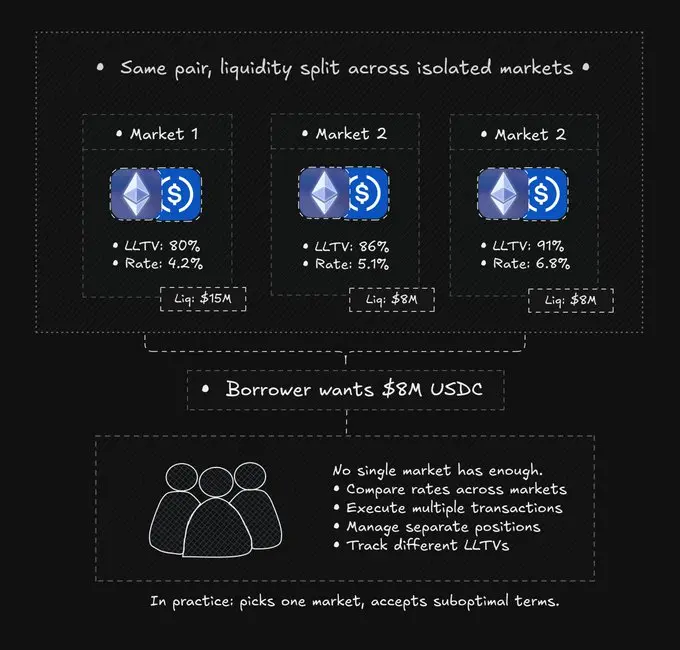
This is perfect for lenders; they get the risk isolation they want.

But for borrowers, this creates fragmentation.

Take ETH-USDC lending as an example. There might be a dozen different markets:

Market B: $3M liquidity, 86% LTV, 5.1% interest rate

Market C: $2M liquidity, 91% LTV, 6.8% interest rate

... and 9 other markets with lower liquidity

A user wanting to borrow $8 million cannot be satisfied from a single market. They must manually compare prices, execute multiple transactions, manage分散的头寸, and track different liquidation thresholds. The theoretical optimal solution requires splitting the loan across four or more markets.

In practice, no one does this. Borrowers typically just pick one market. Capital utilization is low in fragmented pools.

Market risk isolation solved the lender's problem but created a borrower's problem.

The Limitations of Curator Vaults

The curator vault model attempts to bridge this gap.
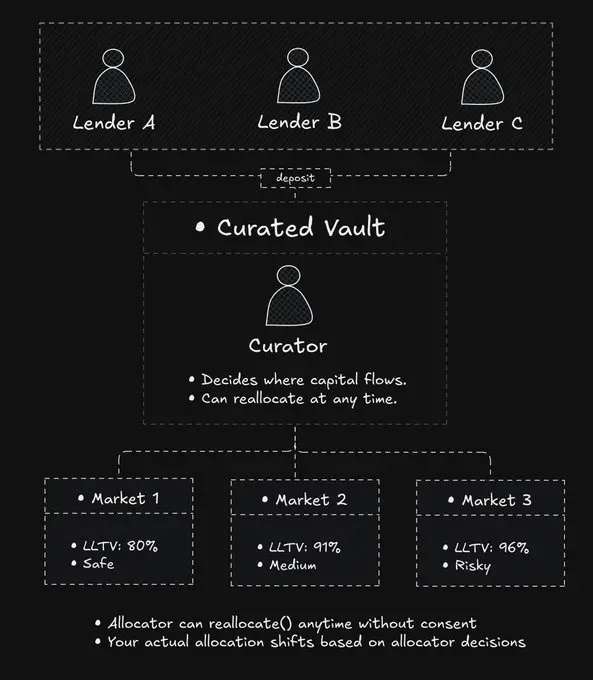
The idea is: professional curators manage capital allocation. Lenders deposit into vaults, and curators allocate funds to underlying markets, optimizing yield and managing risk. Borrowers still face fragmented markets, but at least lenders don't have to manually rebalance.

This helps lenders who want to "set and forget," but it introduces something DeFi aimed to eliminate: discretionary power.
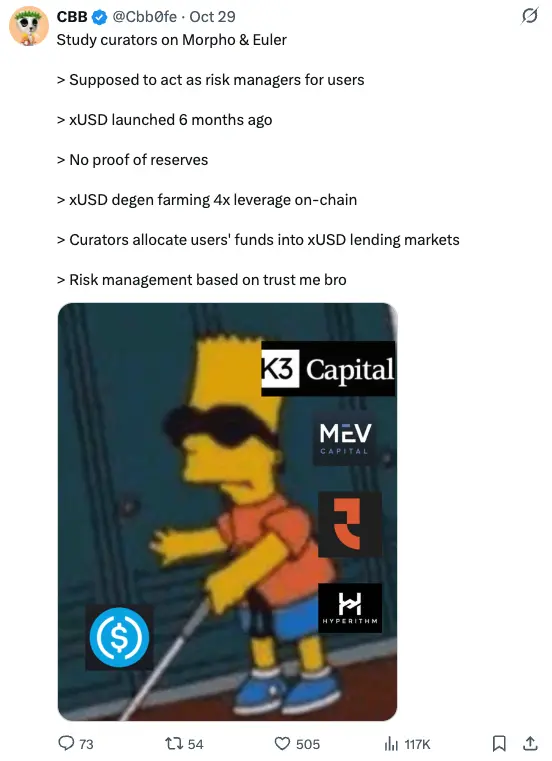
Curators decide which markets get capital and can reallocate at any time. The lender's risk exposure changes with the curator's decisions, unpredictably and uncontrollably. As one Twitter user put it: "The curator is PvPing the borrower, but the borrower doesn't even know they are being farmed."

This asymmetry is not only in strategy but also in the accuracy of the basic interface. Morpho's UI sometimes shows "$3 million available liquidity," but in practice, funds at low interest rates are scarce, with most capital located in higher rate tiers.

When liquidity coordination relies on human decisions, transparency suffers.

Capital allocators adjust market liquidity on their schedule, not based on the market's immediate needs. Vaults try to solve borrower fragmentation through "rebalancing," but rebalancing requires gas fees, depends on the curator's willingness, and often lags. Borrowers still face suboptimal rates.

Separating Risk from Matching

Lending protocols conflate two distinct modules.

User definition of risk: Different lenders have different views on collateral quality, leverage ratios.

The protocol's method of matching loans: This is mechanical. It doesn't require user subjectivity, just efficient routing.

The pooled model bundles these two, lenders lose control.

The isolated pool model separates risk definition but abandons matching, forcing borrowers to manually find the optimal path.

The curator vault model adds matching back through the curator role but introduces a trust assumption in the curator.

Can matching be automated without introducing discretion (human intervention)?

Order books in trading did this. Market makers define quotes, the order book aggregates depth, matching is deterministic (best price first). No one decides where orders go, the mechanism decides everything.

CLOB lending applies the same principle to credit markets:

Lenders define risk through isolated strategies.

Strategies post quotes to a shared order book.

Borrowers interact with unified liquidity.

Matching happens automatically, without curator intervention.

Risk stays with the lender, coordination becomes mechanical. No trust in a third party is needed at any point.

Two-Tier Architecture

Avon implements order book lending through two unique tiers.
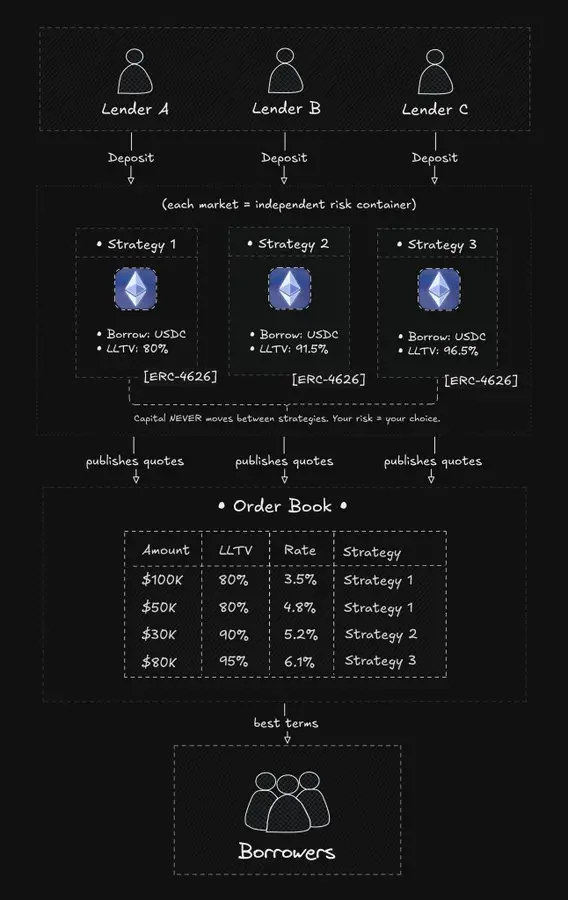
Strategy Layer

A "Strategy" is an isolated lending market with fixed parameters.

The strategy creator defines the following parameters: Collateral/Borrowed Asset, Liquidation LTV, Interest Rate Curve, Oracle, Liquidation Mechanism.

Once deployed, the shape of the interest rate curve cannot be changed. Lenders know the rules exactly before depositing.

Funds never move between strategies.

If you deposit into Strategy A, your money stays in Strategy A until you withdraw. No curators, no rebalancing, no sudden changes in risk exposure.

Although someone (the strategy manager) sets the parameters, they are fundamentally different from a curator: Curators are capital allocators (deciding where money goes), strategy managers are true risk managers (defining rules but not moving money), analogous to Aave DAO. The decision-making power for capital allocation always remains with the lender.

How does the system adapt to market changes? Through competition, not parameter modification. If the risk-free rate soars, this forces old strategies to become obsolete (funds flow out), and new strategies are created (funds flow in). "Discretion" shifts from "where should capital go?" (curator's decision) to "which strategy should I choose?" (lender's decision).

Matching Layer

Strategies do not serve borrowers directly; instead, they post quotes to a shared order book.

The order book aggregates quotes from all strategies into a unified view. Borrowers see the combined depth of all strategies that accept their collateral.

When a borrower places an order, the matching engine:

Filters quotes by compatibility (collateral type, LTV requirements).

Sorts by interest rate.

Executes starting from the cheapest.

Settles within an atomic transaction.

If one strategy can fulfill the entire order, it takes it all; if not, the order is automatically split across multiple strategies. The borrower only perceives one transaction.

Important note: The order book only reads strategy states; it cannot modify them. It is only responsible for coordinating access, not allocating capital.

A Boon for RWA

DeFi has always faced a structural contradiction in institutional adoption: compliance requires isolation, but isolation kills liquidity.
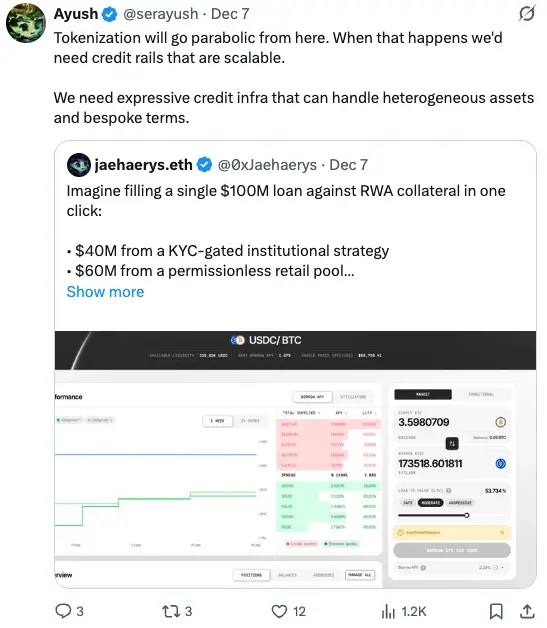
Aave Arc tried the "walled garden" model, where compliant participants have their own pool. The result was shallow liquidity and poor rates. Aave Horizon tried a "semi-open" model (RWA issuers require KYC, but lending is permissionless). This is progress, but institutional borrowers still cannot access the $32 billion liquidity in Aave's main pool. Some projects explored permissioned rollups. The KYC process is completed at the infrastructure level. This approach works for some use cases but fragments liquidity at the network layer. Compliant users on Chain A cannot access liquidity on Chain B.

The order book model offers a third way.

The strategy layer can enforce any access control (KYC, geographic restrictions, accredited investor checks). The matching engine is only responsible for matching.

If a compliant strategy and a permissionless strategy both offer compatible terms, they can simultaneously fill the same loan.

Imagine a corporate treasury抵押代币化国债 borrowing $100 million:

$30 million from a strategy requiring institutional KYC (pension fund LPs)

$20 million from a strategy requiring accredited investor certification (family office LPs)

$50 million from a completely permissionless strategy (retail LPs)

Funds are never mixed at the source, institutions remain compliant, but liquidity is unified globally. This breaks the deadlock of "compliance equals isolation."

Mechanisms for Multi-Dimensional Matching

Order books match on only one dimension: price. The highest bid and lowest ask match.
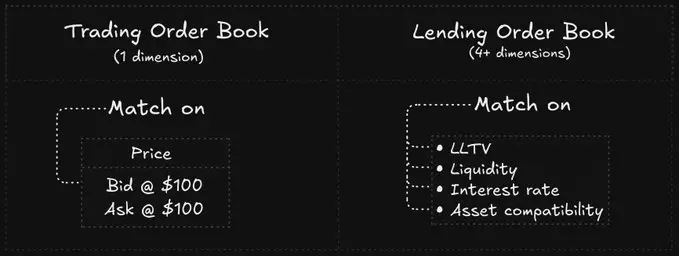
Lending order books must match across multiple dimensions simultaneously:

Interest Rate: Must be below the borrower's acceptable上限.

LTV: The borrower's collateral ratio must meet the strategy's requirements.

Asset Compatibility: Currency match.

Liquidity: Sufficient market liquidity.

Borrowers who provide more collateral (lower LTV) or accept higher interest rates can match with more strategies. The engine finds the cheapest path within this constraint space.

A note for large borrowers. In Aave, $10 billion in liquidity is a monolithic pool. In order book lending, $10 billion might be分散在数百种策略中. A $100 million loan would quickly consume the entire order book, filling from the cheapest strategies first, progressively moving to the most expensive ones. Slippage is visible.

Pool-based systems also have slippage, just manifested differently: a surge in utilization pushes up interest rates. The difference is transparency. In the order book, slippage is visible upfront. In the pool, slippage only becomes apparent after the trade executes.

Floating Rates and Re-quoting

DeFi lending uses floating rates. As utilization changes, so does the interest rate.

This creates a synchronization challenge: if the strategy utilization changes but the quote on the order book isn't updated, the borrower executes at the wrong price.

Solution: Continuous re-quoting.

As soon as the strategy state changes, immediately post a new quote to the order book. This requires extremely high infrastructure performance:

Very fast block times.

Extremely cheap transaction costs.

Atomic state reads.

This is why Avon chose to build on MegaETH. On Ethereum Mainnet, this architecture is prohibitively expensive due to gas fees.

Existing friction:

If market rates move but the strategy's fixed curve doesn't adapt, a "Dead Zone" appears – borrowers find it too expensive to borrow, and lenders earn no yield. In Aave, the curve adjusts automatically, whereas in CLOB mode, this requires lenders to manually withdraw and migrate to new strategies. This is the price paid for control.

Multi-Strategy Position Management

When a loan is filled by multiple strategies, the borrower effectively holds a multi-strategy position.

Although it looks like one loan on the interface, the underlying components are independent:

Independent Interest Rates: Component A's rate might rise due to increased utilization in Strategy A, while Component B remains unchanged.

Independent Health Ratios: When the token price drops, components with stricter LTV limits are liquidated first locally. You don't get liquidated all at once but experience a series of partial liquidations, like being "nibbled away."

To simplify the experience, Avon provides unified position management (one-click add collateral, automatically distributed by weight) and one-click refinancing功能 (automatically borrow new to repay old via flash loans, always locking in the market's best rate).

Conclusion

DeFi lending has gone through several stages:

Pooled Protocols: Gave borrowers depth but剥夺了放贷人的控制权.

Isolated Markets: Gave lenders control but fragmented the borrower experience.

Curator Vaults: Attempted to bridge the two but introduced human decision-making risk.

Order Book Lending (CLOB): Decouples the above models. Risk definition rights return to lenders; matching is achieved through an order book engine.

The design principle is clear: when matching can be achieved through code, human intervention is no longer needed. Markets can self-regulate.


Twitter:https://twitter.com/BitpushNewsCN

Bitpush TG Discussion Group:https://t.me/BitPushCommunity

Bitpush TG Subscription: https://t.me/bitpush

Original Link:https://www.bitpush.news/articles/7594633

Preguntas relacionadas

QWhat is the core problem with the 'Curator' model in DeFi lending protocols like Morpho and Euler?

AThe Curator model reintroduces human discretion and moral risk into the system. Curators decide where capital is allocated, which can change lenders' risk exposure unpredictably and create information asymmetry, undermining the trustless and transparent ideals of DeFi.

QHow does the proposed CLOB (Central Limit Order Book) model for lending separate risk from matching?

AThe CLOB model separates risk definition and order matching into two distinct layers. The Strategy Layer allows lenders to define risk in isolated, fixed-parameter markets. The Matching Layer is a shared order book that automatically and deterministically routes borrower orders to the best available strategies without any human intervention.

QWhat advantage does the order book model offer for Real-World Assets (RWA) in DeFi?

AIt allows for compliance at the strategy level (e.g., KYC, accreditation checks) while aggregating liquidity at the matching layer. This enables compliant and permissionless strategies to simultaneously serve the same borrower, unifying global capital without mixing it at the source and breaking the 'compliance equals isolation' dilemma.

QWhat is a key infrastructural requirement for a CLOB lending system to function effectively?

AIt requires extremely high-performance infrastructure with fast block times, very low transaction costs, and atomic state reads. This is necessary for strategies to continuously re-quote their rates on the order book in response to market changes, ensuring borrowers get accurate, up-to-date pricing.

QHow does the CLOB model change the experience for a large borrower compared to a pooled model like Aave?

AIn a pooled model, a large borrower interacts with a single pool, and slippage manifests as a sharp increase in the interest rate due to higher utilization. In a CLOB model, liquidity is fragmented across many pools (strategies). Slippage for a large loan is visible upfront as the order is filled progressively from the cheapest to the most expensive strategies, offering more predictable execution.

Lecturas Relacionadas

Con una Financiación Previa a la Venta que ya Supera los 7 Millones de Dólares, Ozak AI Entra en una Nueva Fase de Crecimiento Marcada por Entradas Constantes de Capital

Ozak AI ($OZ) ha entrado en una nueva fase de crecimiento tras superar los 7 millones de dólares en su preventa, consolidándose como una de las campañas de financiación en IA más rápidas del año. El proyecto, que combina tecnología de Inteligencia Artificial con redes de infraestructura física descentralizadas (DePIN), está atrayendo un flujo de capital constante, indicando una creciente confianza de los inversores en su propuesta de valor. La demanda se refleja en el avance de la preventa, con tokens disponibles disminuyendo y un precio actual fijado en 0,014 dólares por OZ. Este interés sostenido, alejado de la especulación típica de las memecoins, sugiere que los inversores ven a Ozak AI como una apuesta de infraestructura con utilidad real. El token OZ está diseñado para funciones como staking, gobernanza y el crecimiento de la red, dentro de un ecosistema que promete análisis inteligentes y automatización en sistemas descentralizados. El hito de financiación marca un cambio en el sentimiento del mercado hacia proyectos cripto centrados en utilidades con base en IA. A medida que se acerca su posible listado en intercambios públicos, Ozak AI se posiciona como una oportunidad de inversión fundamentada para quienes buscan exposición antes de su llegada al mercado abierto.

TheNewsCryptoHace 5 hora(s)

Con una Financiación Previa a la Venta que ya Supera los 7 Millones de Dólares, Ozak AI Entra en una Nueva Fase de Crecimiento Marcada por Entradas Constantes de Capital

TheNewsCryptoHace 5 hora(s)

Ocho departamentos lanzan una contundente campaña contra las casas de bolsa transfronterizas, ¿qué opinas?

El 22 de mayo de 2026, las autoridades reguladoras chinas, lideradas por la Comisión Reguladora de Valores de China (CSRC), junto con otros siete departamentos, lanzaron una acción de supervisión integral contra los corredores transfronterizos ilegales. Se emitió un plan para regular las operaciones transfronterizas ilegales de valores, futuros y fondos, y se notificaron sanciones administrativas a las principales plataformas de corretaje en línea como Futu, Tiger Brokers y Longbridge. Se planea confiscar todos los ingresos ilícitos obtenidos de sus actividades en China y aplicar multas severas. La base legal de esta represión es el principio de que las operaciones con valores requieren una licencia, y las licencias extranjeras no son válidas para realizar actividades comerciales en China sin la aprobación de la CSRC. Estas plataformas, al ofrecer servicios completos (como marketing, apertura de cuentas y procesamiento de operaciones) a inversores chinos sin la licencia correspondiente, han estado operando ilegalmente. La medida busca abordar varios riesgos clave: 1) Controlar los flujos de capital no regulados que evaden los límites de cambio de divisas y debilitan la efectividad de la política monetaria, protegiendo la estabilidad financiera. 2) Proteger a los inversores minoristas, quienes enfrentaban riesgos como congelación de cuentas o uso indebido de fondos sin acceso a mecanismos legales locales. 3) Salvaguardar los datos personales y financieros de los usuarios, que estaban fuera del alcance de las leyes de seguridad de datos chinas. El impacto es inmediato y significativo. Las acciones de Futu y Tiger cayeron más del 40% en el mercado extrabursátil. Se estima que entre 900.000 y 950.000 usuarios chinos con activos en estas plataformas (representando entre 250 y 280 mil millones de RMB) deberán liquidar sus posiciones en un plazo de dos años, permitiendo solo ventas. Esto podría generar presión de venta sostenida sobre las acciones de Hong Kong y las acciones chinas en el extranjero (ADRs), especialmente en sectores tecnológicos y de internet, afectando potencialmente sus valoraciones. Para el mercado interno, la represión cierra los canales de inversión directa ilegales. Los inversores que busquen exposición internacional deberán utilizar canales regulados como el Stock Connect con Hong Kong (con un alto umbral de entrada) o fondos QDII. Sin embargo, la oferta limitada de cuotas QDII podría generar primas de precios elevadas y persistentes en los fondos cotizados relacionados con el mercado estadounidense. Parte del capital que regrese podría fluir hacia sectores de alto crecimiento en el mercado A, como la IA y los semiconductores, pero existe el riesgo de inflar aún más las valoraciones ya elevadas. En conclusión, esta acción no pretende cerrar la inversión transfronteriza, sino regular el mercado, controlar riesgos sistémicos y proteger a los inversores, guiando la participación hacia canales seguros y legales bajo la supervisión regulatoria china.

链捕手Hace 7 hora(s)

Ocho departamentos lanzan una contundente campaña contra las casas de bolsa transfronterizas, ¿qué opinas?

链捕手Hace 7 hora(s)

Anthropic publica con gran impacto el «Manual del Fundador»: las 4 etapas del emprendimiento, completamente reestructuradas con IA

Anthropic ha publicado "The Founder's Playbook", una guía para construir startups nativas de IA que redefine el proceso empresarial en cuatro etapas, con el fundador como arquitecto que dirige agentes de IA. **Las 4 etapas y el papel de la IA:** 1. **Idea:** Validar el problema, no la solución. Usar Claude (Chat/Cowork) como "abogado del diablo" para desafiar suposiciones, investigar el mercado y analizar entrevistas con usuarios. 2. **MVP:** Buscar señales tempranas de Product-Market Fit. Usar Claude Code para desarrollar con una arquitectía clara (documentada en CLAUDE.md) y evitar deuda técnica. Automatizar la recogida de feedback. 3. **Lanzamiento:** Enfocarse en crecimiento y operaciones. Implementar un "sistema operativo" con flujos de trabajo de IA (Claude Cowork) para tareas repetitivas (CRM, informes) y usar Claude Code para auditorías de seguridad. El fundador se centra en decisiones clave. 4. **Escalado:** Lograr sostenibilidad. La IA permite que equipos pequeños (ej. 10 personas) logren una gran producción. Usar IA para marketing diferenciado, optimización de operaciones y crear mecanismos de fidelización. **Conclusión clave:** Con la IA, la capacidad de construir ya no es la ventaja clave. La ventaja competitiva vuelve a la **capacidad de juicio, la perspicacia y la comprensión profunda de un problema y sus usuarios.**

marsbitHace 7 hora(s)

Anthropic publica con gran impacto el «Manual del Fundador»: las 4 etapas del emprendimiento, completamente reestructuradas con IA

marsbitHace 7 hora(s)

Trading

Spot
Futuros

Artículos destacados

Qué es GENIUS

I. Introducción al Proyecto1. ¿Qué es Genius?Genius (GENIUS) se posiciona como el “terminal en cadena definitivo”, una plataforma de trading descentralizada centrada en la privacidad y la velocidad. Al integrar tecnología de privacidad de primer nivel, tiene como objetivo construir una infraestructura de trading en privacidad de próxima generación a través de redes como BNB Chain, permitiendo a los usuarios interactuar en cadena con una experiencia fluida comparable a los intercambios centralizados.2. ¿Cómo Funciona Genius?La arquitectura técnica central de Genius está estructurada de la siguiente manera:(1) Invisible en la cadena: Los usuarios no necesitan manejar manualmente aprobaciones de múltiples pasos para operaciones entre cadenas, envoltura de activos o gestión compleja de gas.(2) Trading sin Firma: A través de integraciones como Turnkey, Genius permite trading instantáneo sin confirmaciones emergentes ni autorización por transacción.(3) Agregador de Agregadores: Genius está impulsado por una pila de agregación de clase mundial integrada con más de 150 DEXs, reclamando una eficiencia de cotización superior en comparación con productos competidores.(4) Gestión de Cuentas: La plataforma adopta una arquitectura no custodial y aprovecha Turnkey y Lit Protocol para la gestión de claves, permitiendo a los usuarios acceder de forma segura a sus cuentas a través de claves de acceso.3. ¿Quién Creó Genius?Según sus Términos de Servicio oficiales, Genius fue desarrollado por Shuttle Labs, Inc. Basado en la cuenta oficial de X del proyecto, Ryan Myher es uno de los contribuyentes clave que impulsa la iteración del producto, incluyendo desarrollos como el lanzamiento del protocolo Ghost, así como un mayor compromiso de la comunidad.El fundador de Binance, CZ, se ha unido oficialmente al proyecto como asesor, con el objetivo de ayudar al equipo a construir una experiencia de trading en cadena más rápida y que preserve la privacidad.Además, el proyecto ha recibido un fuerte respaldo de YZi Labs, que ha invertido en Genius y trabaja junto a la Genius Foundation, responsable de mantener el Protocolo Genius Bridge (GBP).4. Tokenómica de GeniusGENIUS es el token nativo del ecosistema Genius. Hasta ahora, el proyecto no ha publicado un documento completo de tokenómica.Según las últimas divulgaciones oficiales, Genius incorpora un mecanismo deflacionario, y el 4.6% del suministro total de tokens ya había sido quemado durante la fase de lanzamiento inicial.Sistema de Puntos Genius (GP):(1) Comercio para Ganar: La plataforma ha establecido un fondo de recompensas de 200 millones de Puntos Genius, y los usuarios ganan GP por cada comercio ejecutado a través del terminal.(2) Clasificación y Insignias: Genius presenta un sistema de insignias basado en la progresión que va desde Smart hasta God, con niveles más altos desbloqueando beneficios y ventajas adicionales.(3) Rendimiento Nativo: Los usuarios que posean activos designados como usdGG en el panel pueden ganar rendimiento nativo directamente sin pasar por un staking complejo.(4) Incentivos por Referidos: Los referidores pueden ganar reembolsos de tarifas de más del 45% pagados en USDC, junto con GP adicionales.5. Cronograma y Hitos ClaveMarzo de 2020: Se creó la cuenta oficial de X del proyecto, marcando el inicio de su fase de preparación temprana.13 de enero de 2026: Genius anunció una inversión multimillonaria de YZi Labs y simultáneamente confirmó a CZ como asesor para acelerar la construcción de su infraestructura de trading en privacidad.18 de abril de 2026: El proyecto anunció que el protocolo de privacidad Ghost se lanzaría pronto.29 de abril de 2026: El protocolo Ghost se abrió oficialmente a sus primeros 50 testers, marcando el inicio de una nueva era para el trading en privacidad en BNB Chain. Al mismo tiempo, el equipo confirmó que el 4.6% de los tokens han sido quemados.​II. Información del Token1) Información BásicaNombre del token: GENIUS (Genius)III. Enlaces RelacionadosSitio web: https://www.tradegenius.com/homeExploradores: https://bscscan.com/address/0x1f12b85aac097e43aa1555b2881e98a51090e9a6Redes Sociales: https://x.com/GeniusTerminalNota: La introducción del proyecto proviene de los materiales publicados o proporcionados por el equipo oficial del proyecto, que es solo para referencia y no constituye asesoramiento de inversión. HTX no se hace responsable de ninguna pérdida directa o indirecta resultante.

273 Vistas totalesPublicado en 2026.04.29Actualizado en 2026.05.12

Qué es GENIUS

Cómo comprar GENIUS

¡Bienvenido a HTX.com! Hemos hecho que comprar Genius (GENIUS) sea simple y conveniente. Sigue nuestra guía paso a paso para iniciar tu viaje de criptos.Paso 1: crea tu cuenta HTXUtiliza tu correo electrónico o número de teléfono para registrarte y obtener una cuenta gratuita en HTX. Experimenta un proceso de registro sin complicaciones y desbloquea todas las funciones.Obtener mi cuentaPaso 2: ve a Comprar cripto y elige tu método de pagoTarjeta de crédito/débito: usa tu Visa o Mastercard para comprar Genius (GENIUS) al instante.Saldo: utiliza fondos del saldo de tu cuenta HTX para tradear sin problemas.Terceros: hemos agregado métodos de pago populares como Google Pay y Apple Pay para mejorar la comodidad.P2P: tradear directamente con otros usuarios en HTX.Over-the-Counter (OTC): ofrecemos servicios personalizados y tipos de cambio competitivos para los traders.Paso 3: guarda tu Genius (GENIUS)Después de comprar tu Genius (GENIUS), guárdalo en tu cuenta HTX. Alternativamente, puedes enviarlo a otro lugar mediante transferencia blockchain o utilizarlo para tradear otras criptomonedas.Paso 4: tradear Genius (GENIUS)Tradear fácilmente con Genius (GENIUS) en HTX's mercado spot. Simplemente accede a tu cuenta, selecciona tu par de trading, ejecuta tus trades y monitorea en tiempo real. Ofrecemos una experiencia fácil de usar tanto para principiantes como para traders experimentados.

195 Vistas totalesPublicado en 2026.04.29Actualizado en 2026.05.12

Cómo comprar GENIUS

Cómo comprar MEGA

¡Bienvenido a HTX.com! Hemos hecho que comprar MegaETH (MEGA) sea simple y conveniente. Sigue nuestra guía paso a paso para iniciar tu viaje de criptos.Paso 1: crea tu cuenta HTXUtiliza tu correo electrónico o número de teléfono para registrarte y obtener una cuenta gratuita en HTX. Experimenta un proceso de registro sin complicaciones y desbloquea todas las funciones.Obtener mi cuentaPaso 2: ve a Comprar cripto y elige tu método de pagoTarjeta de crédito/débito: usa tu Visa o Mastercard para comprar MegaETH (MEGA) al instante.Saldo: utiliza fondos del saldo de tu cuenta HTX para tradear sin problemas.Terceros: hemos agregado métodos de pago populares como Google Pay y Apple Pay para mejorar la comodidad.P2P: tradear directamente con otros usuarios en HTX.Over-the-Counter (OTC): ofrecemos servicios personalizados y tipos de cambio competitivos para los traders.Paso 3: guarda tu MegaETH (MEGA)Después de comprar tu MegaETH (MEGA), guárdalo en tu cuenta HTX. Alternativamente, puedes enviarlo a otro lugar mediante transferencia blockchain o utilizarlo para tradear otras criptomonedas.Paso 4: tradear MegaETH (MEGA)Tradear fácilmente con MegaETH (MEGA) en HTX's mercado spot. Simplemente accede a tu cuenta, selecciona tu par de trading, ejecuta tus trades y monitorea en tiempo real. Ofrecemos una experiencia fácil de usar tanto para principiantes como para traders experimentados.

190 Vistas totalesPublicado en 2026.04.30Actualizado en 2026.04.30

Cómo comprar MEGA

Discusiones

Bienvenido a la comunidad de HTX. Aquí puedes mantenerte informado sobre los últimos desarrollos de la plataforma y acceder a análisis profesionales del mercado. A continuación se presentan las opiniones de los usuarios sobre el precio de A (A).

活动图片