Bitcoin All-Time High At $125,700 Was A Trap, Warns Analyst

bitcoinistPublicado a 2025-10-06Actualizado a 2025-10-07

Resumen

Bitcoin’s dramatic weekend spike to a fresh all-time high of $125,700 lacked real spot demand and was largely the product...

Trusted Editorial content, reviewed by leading industry experts and seasoned editors. Ad Disclosure

Bitcoin’s dramatic weekend spike to a fresh all-time high of $125,700 lacked real spot demand and was largely the product of leveraged speculation in thin conditions, according to crypto analyst Maartun, who characterized the move as a classic fakeout rather than a durable breakout. “Bitcoin prints a brand new all-time high, $125,700… But hold on a second. The price almost immediately reversed,” he said, framing the question that followed: “Was that move for real?”

The Truth Behind Bitcoin’s Weekend Surge

Maartun argues the answer sits in the futures market. Open interest—capital tied up in outstanding derivatives positions—“didn’t just go up, it absolutely exploded,” rising by more than $2.1 billion during the rally. In his telling, that surge came “over a weekend, which is a time when there are way fewer buyers and sellers around,” amplifying the impact of leveraged positioning in a low-liquidity window. “This whole move was driven by futures, by bets,” he said, adding that the jump in open interest, roughly 5%, turned the market into “a house of cards ready to fall over at the slightest touch.”

Equally important, Maartun says, is what did not happen: an influx of committed spot buyers to underpin the advance. Earlier in the week, he notes, Coinbase showed aggressive spot demand, trading about $110 above other venues—evidence of “real buyers… snapping up Bitcoin.” During the weekend push, that premium vanished. “The gamblers were placing their bets,” Maartun said, “but the investors, the people actually buying Bitcoin, they were sitting this one out.”

With those two “clues”—a derivatives-led surge and the absence of spot confirmation—Maartun’s verdict is unambiguous. “You can call it a fake out, you can call it a swing failure pattern, or you can even call it the head of a head and shoulders pattern… It was a trap. A move that was designed to look like the real deal, but had absolutely no substance behind it.” After the brief print at $125,700, price swiftly retraced “right back down to where the whole move started,” he added.

From here, Maartun identifies a single inflection point: $123,000. “This is the level… that is going to tell us whether the bulls or the bears take control from here,” he said. On confirmation criteria, he is explicit: “What we need to see is a strong, confident close above that $123K mark. That would signal acceptance… and a true breakout is probably coming.”

Failure to reclaim and hold that area, in his view, likely hands momentum back to sellers with an initial drawdown target around $117,500. He also cautions against expecting a repeat head-fake at the same level: “Fakeouts don’t usually happen twice in a row. The second attempt to break a level like this is very often the real deal one way or the other.”

The broader context to Maartun’s assessment is the unusual timing and texture of the move. Weekends in crypto “are normally kind of sleepy,” he said, yet this one delivered “the best weekend performance we’ve seen in four whole months”—a signal, in his analysis, not of rekindled spot enthusiasm but of how quickly leverage can dominate price in quiet order books. Without renewed spot leadership—such as a return of the Coinbase premium or other evidence of net spot accumulation—he sees the market “on a knife’s edge” at the $123,000 line in the sand: “Break out or pull back?”

At press time, Bitcoin held above $124,216.
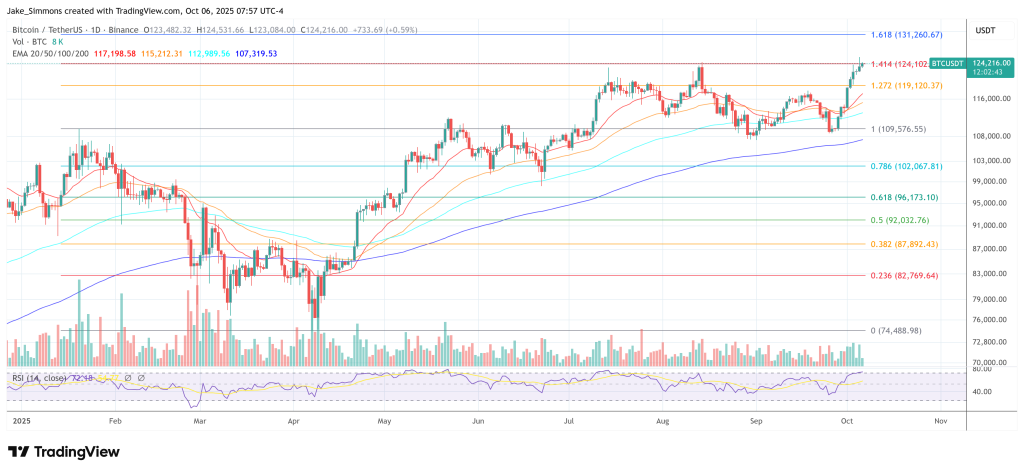
Bitcoin price
BTC remains above $124,000, 1-day chart | Source: BTCUSDT on TradingView.com
Featured image created with DALL.E, chart from TradingView.com
Editorial Process for bitcoinist is centered on delivering thoroughly researched, accurate, and unbiased content. We uphold strict sourcing standards, and each page undergoes diligent review by our team of top technology experts and seasoned editors. This process ensures the integrity, relevance, and value of our content for our readers.

Jake Simmons has been a Bitcoin enthusiast since 2016. Ever since he heard about Bitcoin, he has been studying the topic every day and trying to share his knowledge with others. His goal is to contribute to Bitcoin's financial revolution, which will replace the fiat money system. Besides BTC and crypto, Jake studied Business Informatics at a university. After graduation in 2017, he has been working in the blockchain and crypto sector. You can follow Jake on Twitter at @realJakeSimmons.

Lecturas Relacionadas

El secreto del alza de BTC: La nueva rueda de MSTR — STRC

El secreto del alza de BTC: La nueva rueda de MSTR, STRC BTC ha mantenido una fortaleza absoluta en un mercado macroeconómico volátil, y la activa negociación de STRC podría ser una de las razones. La semana pasada, el volumen diario promedio de negociación de las acciones preferentes STRC de MSTR superó los 300 millones de dólares, con un máximo de 750 millones en un solo día, convirtiéndose casi en la acción preferente con mayor liquidez en el mercado estadounidense. Según el mecanismo de STRC, este volumen de negociación podría haber generado una compra neta potencial de aproximadamente 700 millones de dólares para BTC. STRC es un instrumento de capital similar a la deuda, que descompone la volatilidad de Bitcoin en un producto crediticio con flujos de efectivo fijos. Sus características clave incluyen: alto rendimiento a corto plazo (tasa de dividendos anualizada del 11.5%), estructura perpetua, prioridad en la estructura de capital y sin riesgo de incumplimiento. MSTR ancla el precio de STRC alrededor de 100 dólares mediante herramientas como el ajuste dinámico de dividendos, emisiones ATM (a 100 dólares) y cláusulas de recompra (a 101 dólares). Cuando el precio de STRC alcanza los 100 dólares, la empresa emite nuevas acciones a través del plan ATM, convirtiendo el exceso de demanda en poder de compra de BTC. Por cada dólar de STRC emitido, la empresa compra aproximadamente 3 dólares en BTC para mantener un apalancamiento objetivo del 33%. Este mecanismo convierte el volumen de negociación de STRC en una poderosa fuerza compradora de BTC. Sin embargo, el "vuelo" tiene limitaciones: 1) STRC debe cotizar a 100 dólares para activar las emisiones. 2) El mNAV (valor neto ajustado) de las acciones ordinarias MSTR debe ser mayor a 1x. 3) El rendimiento a largo plazo de BTC es fundamental; un mercado bajista prolongado podría forzar la venta de reservas de BTC para pagar dividendos. Saylor ha posicionado a MSTR no como una simple empresa de tenencia de BTC, sino como una empresa de finanzas estructuradas respaldadas por Bitcoin, utilizando ingenio financiero para acumular BTC de manera constante.

marsbitHace 1 hora(s)

El secreto del alza de BTC: La nueva rueda de MSTR — STRC

marsbitHace 1 hora(s)

Trading

Spot
Futuros
活动图片