Altcoin OI Crash Signals Market Stress Beyond Bitcoin – $8B Wiped Out

bitcoinistPublicado a 2025-09-23Actualizado a 2025-09-23

Resumen

Altcoins are facing a crucial test after the broader crypto market experienced a sharp selloff triggered by leveraged liquidations. Ethereum,...

Trusted Editorial content, reviewed by leading industry experts and seasoned editors. Ad Disclosure

Altcoins are facing a crucial test after the broader crypto market experienced a sharp selloff triggered by leveraged liquidations. Ethereum, the second-largest cryptocurrency, slipped below the $4,200 level, signaling weakness across the sector. Meanwhile, Solana and several other major altcoins shed more than 10% of their value within hours, underscoring the speed and intensity of the correction.

This wave of liquidations has fueled debate among investors and analysts about whether the market is entering a deeper corrective phase or simply resetting before another leg higher. With billions of dollars wiped from altcoin valuations in a single session, the event has heightened uncertainty and left traders on edge.

Top analyst Maartunn highlighted that the Altcoin flush accelerates, pointing to the scale of liquidations as evidence that overleveraged positions are being forced out of the market. While painful in the short term, such resets are often viewed as healthy for long-term price stability, flushing out excess speculation.

Altcoin Open Interest Wipeout

According to data shared by top analyst Maartunn, altcoins faced one of their most severe flushes in months as $8.0 billion in open interest was wiped out in a matter of hours. By comparison, Bitcoin saw a much smaller reduction of around $1.5 billion, highlighting the disproportionate impact the selloff had on altcoins. This means that traders, many of whom were highly leveraged, bore the brunt of the liquidation event.
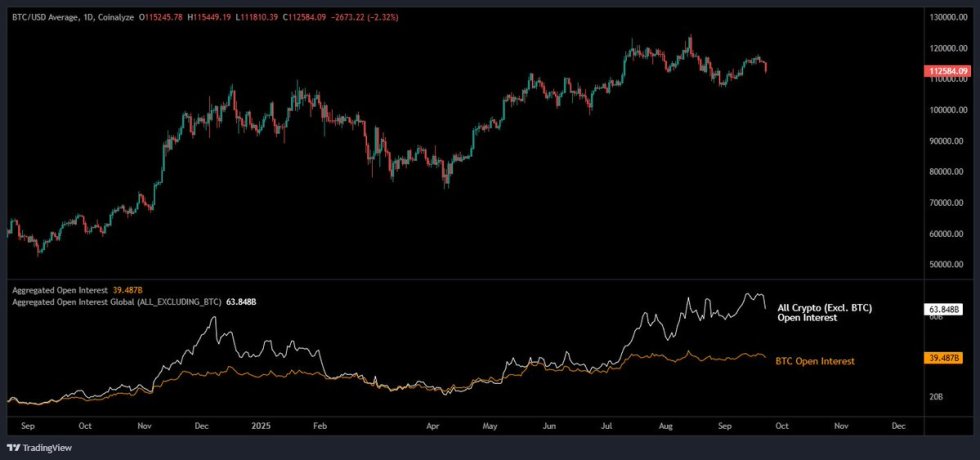
$8.0B in Altcoin Open Interest wiped out | Source: Maartunn

The scale of the wipeout is telling. Altcoin open interest losses were more than five times greater than Bitcoin’s, suggesting that speculative positions in the sector were far riskier and more vulnerable to sharp downside moves. While Bitcoin remains the market’s anchor, the gap between Bitcoin and the broader altcoin market is beginning to close, reflecting a shift in positioning and risk exposure.

For investors, this raises important questions. On one hand, such a dramatic flush often clears excess leverage from the system, paving the way for healthier price action in the medium term. On the other hand, the sheer scale of the altcoin losses could signal lingering fragility and the potential for further volatility if confidence does not return quickly.

The coming days will be decisive. Analysts are watching closely to see whether altcoins can stabilize around key support levels or whether bearish pressure will drive another leg lower. With Bitcoin showing relative resilience, altcoins must now prove they can withstand the shock and rebuild momentum in a market still reeling from billions in liquidations.

Total Market Cap Excluding Top 10 Analysis

The chart of the total crypto market cap excluding the top 10 coins shows that the altcoin sector is at a decisive moment. Currently valued at around $305 billion, the market has recovered significantly from the lows of 2022 and 2023 but remains far from its historical peak above $600 billion.
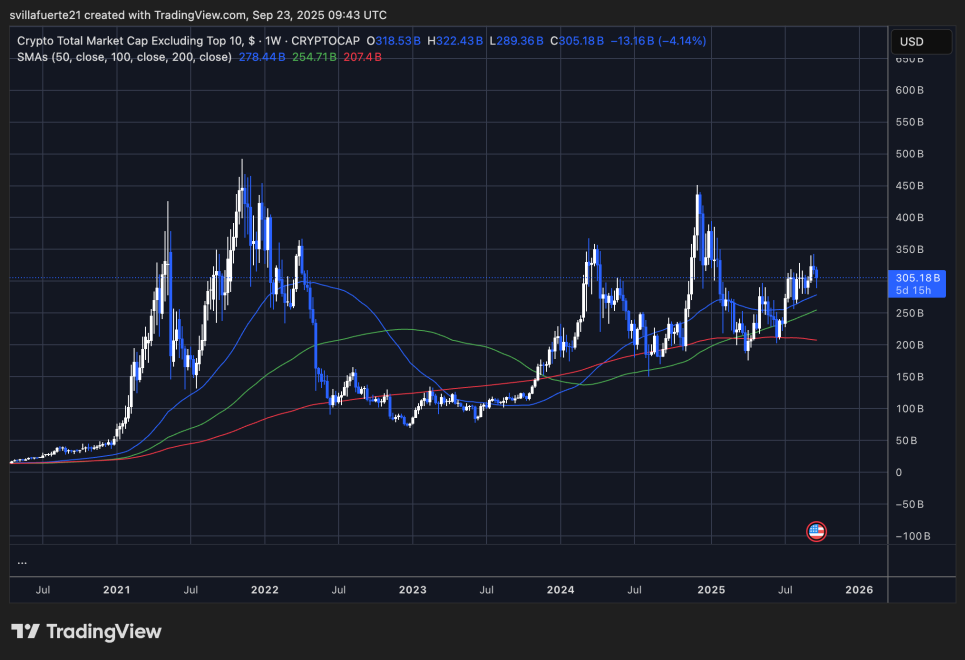
Crypto Total Market Cap Excluding Top 10 | Source: OTHERS chart on TradingView

Price action highlights that after a prolonged consolidation, altcoins have established a steady uptrend, supported by the 50-day and 100-day moving averages, which are now sloping upward. The 200-day moving average has flattened and begun to turn positive, further signaling improving structure in the broader market. Still, the recent rejection near the $320 billion resistance shows sellers remain active at higher levels.

The market’s ability to sustain above $280 billion will be critical for maintaining bullish momentum. A break below could trigger deeper retracements, but holding above this zone suggests strength and potential for expansion.

Excluding top assets like Bitcoin and Ethereum, this index reflects rising investor appetite for smaller-cap projects. The resilience of this sector despite recent volatility signals that risk appetite is returning. If broader conditions improve, altcoins outside the top 10 could lead the next phase of market growth.

Featured image from Dall-E, chart from TradingView

Editorial Process for bitcoinist is centered on delivering thoroughly researched, accurate, and unbiased content. We uphold strict sourcing standards, and each page undergoes diligent review by our team of top technology experts and seasoned editors. This process ensures the integrity, relevance, and value of our content for our readers.

Sebastian's journey into the world of crypto began four years ago, driven by a fascination with the potential of blockchain technology to revolutionize financial systems. His initial exploration focused on understanding the intricacies of various crypto projects, particularly those focused on building innovative financial solutions. Through countless hours of research and learning, Sebastian developed a deep understanding of the underlying technologies, market dynamics, and potential applications of cryptocurrencies. As his knowledge grew, Sebastian felt compelled to share his insights with others. He began actively contributing to online discussions on platforms like X and LinkedIn, focusing on fintech and crypto-related content. His goal was to expose valuable trends and insights to a wider audience, fostering a deeper understanding of the rapidly evolving crypto landscape. Sebastian's contributions quickly gained recognition, and he became a trusted voice in the online crypto community. To further enhance his expertise, Sebastian pursued a UC Berkeley Fintech: Frameworks, Applications, and Strategies certification. This rigorous program equipped him with valuable skills and knowledge regarding Financial Technology, bridging the gap between traditional finance (TradFi) and decentralized finance (DeFi). The certification deepened his understanding of the broader financial landscape and its intersection with blockchain technology. Sebastian's passion for finance and writing is evident in his work. He enjoys delving into financial research, analyzing market trends, and exploring the latest developments in the crypto space. In his spare time, Sebastian can often be found immersed in charts, studying 10-K forms, or engaging in thought-provoking discussions about the future of finance. Sebastian's journey as a crypto analyst and investor has been marked by a relentless pursuit of knowledge and a dedication to sharing his insights. His ability to navigate the complex world of crypto, combined with his passion for financial research and communication, makes him a valuable asset to the industry. As the crypto landscape continues to evolve, Sebastian remains at the forefront, providing valuable insights and contributing to the growth of this revolutionary technology.

Lecturas Relacionadas

a16z: En la era de la IA, la lucha por el talento comienza con la denominación de puestos

El concepto de "ingeniero desplegado en campo" (FDE) demuestra cómo el nombre de un puesto puede redefinir y elevar el valor de un rol tradicionalmente subestimado, como la implementación técnica en el sitio del cliente. Palantir popularizó este término, transformando la percepción de un trabajo de soporte en una capacidad estratégica clave. Esto ejemplifica el "arbitraje de títulos": crear nuevas denominaciones cuando una habilidad gana importancia, pero la terminología organizacional aún no refleja su valor. Un título no es solo una etiqueta, sino un lenguaje organizacional que otorga legitimidad, atrae talento y señala un cambio en la importancia estratégica del trabajo. En la era de la IA, este enfoque es crucial. La transformación con IA no solo se trata de herramientas más inteligentes, sino de crear nuevos roles de alto impacto, como el "ingeniero legal" o el "ingeniero de estrategia comercial". Para las empresas de IA que venden a otras empresas, nombrar estos nuevos puestos dentro de las organizaciones cliente es una estrategia que facilita la adopción, construye identidad y, en última instancia, crea ventajas competitivas. El resurgimiento del debate sobre el FDE refleja la naturaleza difusa de los productos de IA empresarial, donde los límites entre producto, servicio e implementación se desdibujan. El reto no es eliminar los servicios, sino identificar y renombrar las partes más valiosas y cercanas al cliente para integrarlas en el núcleo del aprendizaje y desarrollo del producto. Quien logre definir y organizar primero estas nuevas capacidades ganará una ventaja decisiva.

marsbitHace 45 min(s)

a16z: En la era de la IA, la lucha por el talento comienza con la denominación de puestos

marsbitHace 45 min(s)

CBRS: Ingresos duplican en primer informe tras salida a bolsa, pero pronóstico de margen bruto cae drásticamente; ruta de ejecución del gran contrato de OpenAI es demasiado larga

Cerebras (CBRS) presentó sus primeros resultados trimestrales tras su OPI, con ingresos centrales del Q1 de 1.913 millones de dólares, un aumento interanual del 92%, superando las expectativas. Sin embargo, la guía de margen bruto para el Q2 cayó bruscamente del 46,5% a un rango del 36-38%, lo que hizo que las acciones cayeran más de un 10% en operaciones extrabursátiles. La compañía, que fabrica chips a partir de obleas de silicio completas y apuesta por la IA para inferencia, tiene un contrato de más de 20.000 millones de dólares con OpenAI y un marco de colaboración con AWS. Su guía de ingresos anuales es de 855-865 millones de dólares. El informe revela una transición en su modelo de negocio: de vender hardware a vender potencia de cálculo en la nube. Esto explica en parte la presión sobre los márgenes, atribuida a la escasez temporal de capacidad en centros de datos. Aunque los ingresos superaron las expectativas, la concentración de clientes sigue siendo alta (dos entidades relacionadas de Emiratos Árabes Unidos representaron el 86% de los ingresos en el año fiscal 2025). Los grandes contratos con OpenAI (que comenzará a contribuir en 2026) y AWS (previsto para 2027) son prometedores pero de ejecución larga. Los analistas son mayoritariamente optimistas, con un precio objetivo medio de 300 dólares, apostando por la ventaja de velocidad de Cerebras en la inferencia de IA y el potencial de sus grandes acuerdos. Los escépticos señalan los desafíos en los márgenes, la intensa competencia (especialmente de NVIDIA) y la dependencia continua de pocos clientes. La valoración actual, cercana a los 50.000 millones de dólares, anticipa un crecimiento significativo que depende de la ejecución exitosa de estos contratos a largo plazo.

marsbitHace 45 min(s)

CBRS: Ingresos duplican en primer informe tras salida a bolsa, pero pronóstico de margen bruto cae drásticamente; ruta de ejecución del gran contrato de OpenAI es demasiado larga

marsbitHace 45 min(s)

Entrevista al CEO de Strategy: Después de vender Bitcoin, ¿puede STRC recuperarse?

Entrevista con Phong Le, CEO de MicroStrategy: Tras la venta de 32 bitcoins, ¿puede recuperarse el STRC? La venta de 32 bitcoins (unos 2,5 millones de dólares) por parte de MicroStrategy generó una amplia reacción en el mercado. El CEO Phong Le explica que la decisión, tomada con transparencia y disciplina, tenía dos objetivos principales: demostrar a los tenedores de deuda la capacidad de liquidez de los activos en Bitcoin y probar los procesos internos de venta. Asegura que la medida no fue una respuesta a los temores de un "espiral de muerte" relacionado con el producto de acciones preferentes STRC, ya que menos del 10% de este está en protocolos DeFi. Le destaca que MicroStrategy, el mayor tenedor corporativo de Bitcoin, opera con un riguroso proceso de decisión que involucra a la junta directiva y análisis de datos, lejos de ser una decisión unilateral. Reitera la estrategia a largo plazo de la compañía y su firme creencia en el valor subyacente de Bitcoin. Frente a la volatilidad, enfatiza la opción estratégica de "no hacer nada", como se hizo durante el mercado bajista de 2022. Sobre el STRC, un producto con apenas 10 meses, Le confía en que recuperará su valor nominal de 100 dólares, respaldado por el mecanismo de pago de dividendos que comienza el 30 de junio y la sólida sobrecolateralización del producto. Finalmente, aclara que la venta de Bitcoin sí ocurrió en la semana previa al 31 de mayo, tal como se reportó en los documentos oficiales 8-K de la compañía.

marsbitHace 1 hora(s)

Entrevista al CEO de Strategy: Después de vender Bitcoin, ¿puede STRC recuperarse?

marsbitHace 1 hora(s)

Trading

Spot
Futuros
活动图片