Cardano Founder Reveals Behind The Scenes Plans For XRP And Ripple USD

bitcoinistPublicado a 2025-09-19Actualizado a 2025-09-19

Resumen

Speaking in a public X Spaces session on September 17, Cardano founder Charles Hoskinson outlined a set of behind-the-scenes discussions...

Trusted Editorial content, reviewed by leading industry experts and seasoned editors. Ad Disclosure

Speaking in a public X Spaces session on September 17, Cardano founder Charles Hoskinson outlined a set of behind-the-scenes discussions and integration pathways aimed at bringing XRP and Ripple USD closer to Cardano’s stack, describing a “package for XRP” that spans wallet support, a DeFi execution layer, and a standards-based route for Ripple’s stablecoin to deploy across multiple ecosystems.

“We’ve had a few calls with the Ripple USD team. We’ve talked to Flair, we’ve talked to John Deaton, you know, we’ve talked to Brad [Garlinghouse], and we’ve definitely had discussions with a variety of people from the XRP ecosystem. And we want to build a package for XRP,” Hoskinson said, framing the outreach as part of a broader cross-ecosystem strategy rather than a single bilateral tie-up.

Cardano Founder Unveils Plans For XRP And RLUSD

On the product side, Hoskinson said the plan begins with user-level access and extends into application deployment and liquidity. “Lace [wallet] will support XRP as one of the improved emergency support,” he noted, adding that “we have a DeFi layer for XRP that uses Midnight Cardano. So it’s very easy to use XRP smart contracts and deploy XRP applications without requiring foundation changes to XRP’s design.” He positioned that approach as a way to let XRP developers ship without altering the XRP Ledger’s base-layer architecture.

The Cardano founder also described exploratory workstreams with projects adjacent to the XRP ecosystem. “As certain XRP projects like Flair, we’d like to find a path to get them into the Cardano banking system,” he said, indicating that teams building on or around XRP could be onboarded to Cardano infrastructure if technical and commercial conditions are met.

A separate through-line in the discussion was Ripple USD’s go-to-market design and its sensitivity to the policy environment around stablecoin yields. “With the Ripple USD, we talked to them starting last year right when they announced,” Hoskinson said.

“They said, look, we just got out. We just got our prices. It’s been a long road. There’s a lot going on. Come back in a little bit and talk more deeply. And now we’re on the other side of it. And I think there’s definitely a path to have that conversation.”

He added that the team wanted clarity on “where Genius was going to go, because that would have a huge impact on the overall landscape of stablecoins in general. The reason being is that, you know, can you offer a yielder with your stablecoin? And the answer is currently no from the Genius side. So that had to get passed. And now that that’s passed, we’re starting to think about their longer term commercialization plans.”

From an integration-architecture perspective, Hoskinson advocated that Ripple USD avoid bespoke, one-off listings and instead adopt a standardized, market-driven onboarding model. “What we’ve advocated for with Ripple USD is for XRP, for Ripple to push for a self-serve listing model, like Coinbase has with Rosetta,” he said.

“So they basically create a framework. And then if an ecosystem is interested in supporting Ripple USD, basically what they do is they certify against that standard and they do all the implementation work. And as long as that work is done correctly, then they get preferential consideration for where Ripple USD gets deployed.”

The rationale, according to Hoskinson, is to keep Ripple USD’s expansion neutral and scalable across chains while lowering coordination overhead. “After Ethereum and whatever, you have to kind of think, okay, well, what’s next? And there’s 14,000 options and they don’t really want to be in the business of picking winners and losers a lot. You want to go where the demand is, the desire is, and you also want to have a lot of moving pieces for—you want to remove a lot of the moving pieces from the integration complexity,” he said.

He added that neither side is natively expert in the other’s architecture, underscoring the need for open standards: “The XRP team is by far not an expert on our architecture. Why would they be? We’re very bespoke and exotic. And similarly, we’re not experts in XRP architecture. So we need to open standards and basically help people sort that out.”

In the process, Hoskinson hinted that Cardano would make the first technical moves where appropriate and only then discuss commercial terms. “If an ecosystem is interested, we have to make the first move. We make that first move and then after doing it, enter commercial negotiations to figure out the next step after that,” he said.

At press time, ADA traded at $0.90.
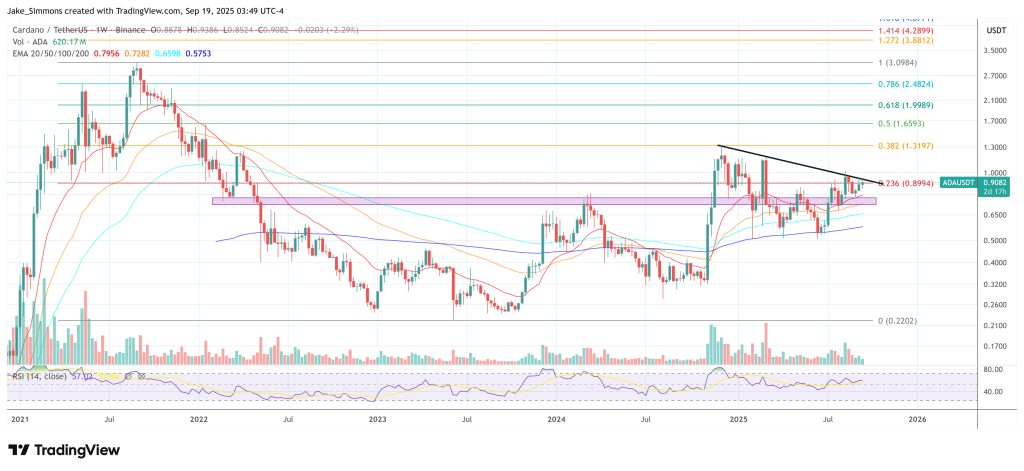
Cardano price
ADA on the verge of breakout, 1-week chart | Source: ADAUSDT on TradingView.com
Featured image created with DALL.E, chart from TradingView.com
Editorial Process for bitcoinist is centered on delivering thoroughly researched, accurate, and unbiased content. We uphold strict sourcing standards, and each page undergoes diligent review by our team of top technology experts and seasoned editors. This process ensures the integrity, relevance, and value of our content for our readers.

Jake Simmons has been a Bitcoin enthusiast since 2016. Ever since he heard about Bitcoin, he has been studying the topic every day and trying to share his knowledge with others. His goal is to contribute to Bitcoin's financial revolution, which will replace the fiat money system. Besides BTC and crypto, Jake studied Business Informatics at a university. After graduation in 2017, he has been working in the blockchain and crypto sector. You can follow Jake on Twitter at @realJakeSimmons.

Criptos en tendencia

Lecturas Relacionadas

Te sorprenderá lo diferentes que son WeChat y Telegram a nivel de arquitectura

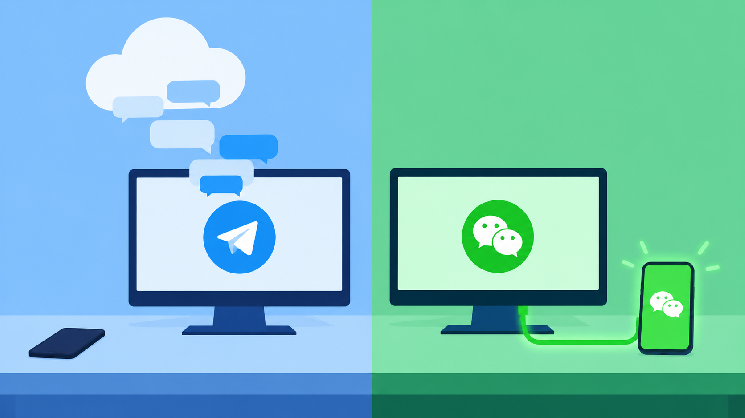
La audiencia mensual de WeChat/Weixin alcanzó los 1.428 mil millones, según el informe financiero del segundo trimestre de 2026 de Tencent. Este análisis contrasta su arquitectura con la de Telegram, destacando sus enfoques opuestos. **Almacenamiento de mensajes:** Telegram sincroniza conversaciones ilimitadas en la nube entre dispositivos. WeChat almacena los chats localmente; transferirlos requiere una migración manual vía código QR, y la versión de escritorio depende del móvil. **Comentarios en canales:** En Telegram, los comentarios en canales están integrados bajo cada publicación. En WeChat, los comentarios en artículos de cuentas oficiales pasan por moderación previa y no hay un sistema unificado de debates. **Desarrollo:** Telegram ofrece una Bot API abierta y gratuita. Las mini-aplicaciones de WeChat operan en una plataforma cerrada, requiriendo verificación, certificación paga y licencia comercial, con un mayor umbral de entrada para desarrolladores. **Límites de archivos:** Telegram permite subir hasta 2 GB (4 GB para Premium). WeChat limita la mayoría de archivos a 200 MB, utilizando herramientas auxiliares para volúmenes mayores. **Pagos:** WeChat Pay está profundamente integrado en la vida diaria china, siendo un método de pago omnipresente. Telegram carece de un sistema de pago fiát integrado a gran escala, centrándose más en bots de terceros y criptomonedas. En resumen, WeChat representa un modelo cerrado e integrado en la economía real, mientras que Telegram se basa en protocolos abiertos, almacenamiento flexible y pocas barreras para desarrolladores. Esta elección arquitectónica define sus audiencias y casos de uso.

cryptonews.ruHace 4 hora(s)

Te sorprenderá lo diferentes que son WeChat y Telegram a nivel de arquitectura

cryptonews.ruHace 4 hora(s)

Desbloqueo de tokens de esta semana: Humanidad Protocol desbloquea tokens equivalentes al 7.9% de la oferta circulante

**Resumen de tokens desbloqueados esta semana** Esta semana, varios proyectos de criptomonedas procederán a liberar (unlock) una cantidad significativa de sus tokens, lo que podría influir en el precio debido al aumento de la oferta circulante. **Humanity Protocol (H)** * **Descripción:** Red blockchain anti-sibila que ofrece mecanismos de verificación de identidad humana y otorga a los usuarios propiedad total sobre sus datos e identidad. * **Desbloqueo:** 270 millones de tokens (aproximadamente el 7.9% de la oferta circulante). * **Valor:** Alrededor de 19.88 millones de dólares. **SoSoValue (SOSO)** * **Descripción:** Plataforma de investigación de inversiones impulsada por IA que combina la eficiencia de las finanzas centralizadas (CeFi) con la transparencia de las finanzas descentralizadas (DeFi). * **Desbloqueo:** 23.45 millones de tokens. * **Valor:** Aproximadamente 7.27 millones de dólares. **Collector (COLT)** * **Descripción:** Plataforma que busca transformar el mercado de coleccionables vinculando la propiedad física con un mercado digital basado en Web3, permitiendo la tokenización, comercio y préstamos respaldados por activos coleccionables. * **Desbloqueo:** 28.86 millones de tokens. * **Valor:** Alrededor de 5.57 millones de dólares. Cada proyecto incluye en el artículo original un gráfico detallado con la curva de liberación de tokens a lo largo del tiempo.

marsbitHace 5 hora(s)

Desbloqueo de tokens de esta semana: Humanidad Protocol desbloquea tokens equivalentes al 7.9% de la oferta circulante

marsbitHace 5 hora(s)

Trading

Spot

Artículos destacados

Cómo comprar ADA

¡Bienvenido a HTX.com! Hemos hecho que comprar Cardano (ADA) sea simple y conveniente. Sigue nuestra guía paso a paso para iniciar tu viaje de criptos.Paso 1: crea tu cuenta HTXUtiliza tu correo electrónico o número de teléfono para registrarte y obtener una cuenta gratuita en HTX. Experimenta un proceso de registro sin complicaciones y desbloquea todas las funciones.Obtener mi cuentaPaso 2: ve a Comprar cripto y elige tu método de pagoTarjeta de crédito/débito: usa tu Visa o Mastercard para comprar Cardano (ADA) al instante.Saldo: utiliza fondos del saldo de tu cuenta HTX para tradear sin problemas.Terceros: hemos agregado métodos de pago populares como Google Pay y Apple Pay para mejorar la comodidad.P2P: tradear directamente con otros usuarios en HTX.Over-the-Counter (OTC): ofrecemos servicios personalizados y tipos de cambio competitivos para los traders.Paso 3: guarda tu Cardano (ADA)Después de comprar tu Cardano (ADA), guárdalo en tu cuenta HTX. Alternativamente, puedes enviarlo a otro lugar mediante transferencia blockchain o utilizarlo para tradear otras criptomonedas.Paso 4: tradear Cardano (ADA)Tradear fácilmente con Cardano (ADA) en HTX's mercado spot. Simplemente accede a tu cuenta, selecciona tu par de trading, ejecuta tus trades y monitorea en tiempo real. Ofrecemos una experiencia fácil de usar tanto para principiantes como para traders experimentados.

2.1k Vistas totalesPublicado en 2024.12.10Actualizado en 2026.06.02

Cómo comprar ADA

Discusiones

Bienvenido a la comunidad de HTX. Aquí puedes mantenerte informado sobre los últimos desarrollos de la plataforma y acceder a análisis profesionales del mercado. A continuación se presentan las opiniones de los usuarios sobre el precio de ADA (ADA).

活动图片