Survey Finds 54% of Firms Plan Stablecoin Adoption by 2026; Best Wallet Token Presale Nears $16M

bitcoinistPublicado a 2025-09-17Actualizado a 2025-09-17

Resumen

Per an EY-Parthenon survey, 54% of business leaders who have yet to touch stablecoins plan to do so by 2026....

Trusted Editorial content, reviewed by leading industry experts and seasoned editors. Ad Disclosure

Per an EY-Parthenon survey, 54% of business leaders who have yet to touch stablecoins plan to do so by 2026.

Why the change of heart? Lower transaction costs and faster cross-border payments are the main reasons organizations are turning to stablecoins.

Since crypto wallets play a key role in enabling stablecoin transactions, choosing the right one matters. One option we like is Best Wallet, thanks to its ease of use and security.

Its native token, $BEST, also deserves a shout-out. It’s close to raising nearly $16M on presale, as it supports the wallet’s developments and grants holders low gas fees.

Only 13% of Firms Use Stablecoins, But 41% Report Big Savings

The report found that, right now, only around 13% of financial institutions and  international corporations use stablecoins. One of the main reasons for them not doing so boils down to regulatory uncertainty.
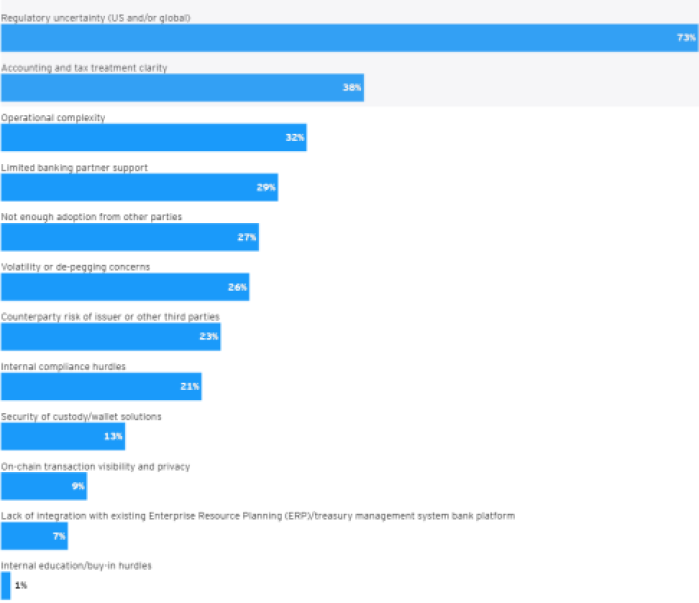
Graph showing reasons behind low stablecoin adoption.
Source: EY-Parthenon

Yet, this percentage is on the rise following the passage of the GENIUS Act on July 18. It gives institutions greater regulatory clarity and, thus, confidence to move forward with adopting these digital assets.

And it’s no wonder stablecoins are attracting attention. Among current users, 41% said they’ve saved over 10% in costs compared to traditional payment methods.

The top use case for stablecoins is cross-border supplier payments, which account for 62% of implementations.

The reason is that they’re 1:1 backed by reserve assets (often the US dollar) for stability. Yet, they have faster settlement times compared to traditional international transfers.

Out of the stablecoins available, US-dollar-pegged ones are the go-to choice. $USDC is the clear frontrunner with 77%, followed by $USDT at 59%.

If these stablecoins are top of your radar, Best Wallet is a great way to manage, buy, and sell them.

Store Top Stablecoins & Cryptos on Best Wallet

Available on Google Play and iOS, the Best Wallet app is a great way to manage, buy, sell, and swap various types of cryptos while out and about.

The mobile app already supports over 1K+ assets across top chains like Ethereum, BNB Chain, and Polygon. This includes top stablecoins like $USDC and $USDT, plus leading cryptos like $BTC, $ETH, and $BNB.

It takes pride in making crypto activities simple. Check out its built-in launchpad, for instance. It gives you access to the best crypto presales. And that’s not to mention its swap engine, which scans 330+ DEXs and 30 bridges to find you the best rates.
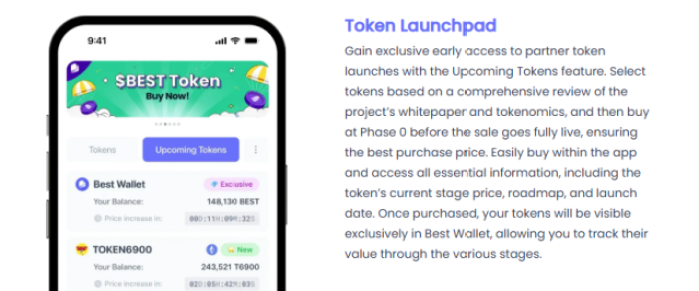
Best Wallet has its own crypto launchpad.
Source: Best Wallet

And all is achieved with security intact. Because Best Wallet’s non-custodial, it ensures that you, and only you, have access to your private keys.

Also helping prevent unauthorized access are extra layers of protection like 2FA, biometrics, and local encryption.

Even if you lose account access, you can rest easy knowing that you can restore your assets through encrypted cloud backups.

The app also has lots to look forward to in the pipeline, including an NFT gallery, intel market analytics, and a rewards hub.

$BEST will make this possible, as a quarter of its total token supply is set aside for product development.
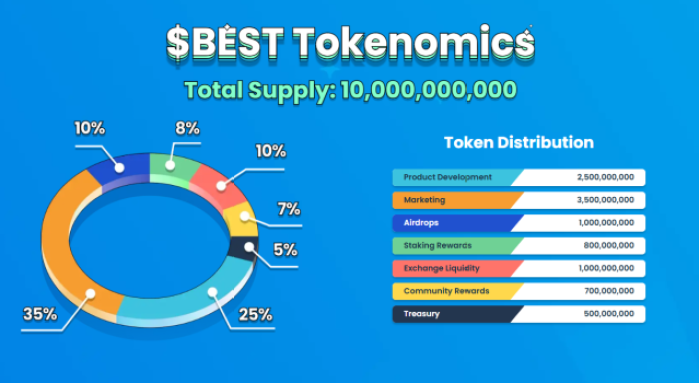
Best Wallet tokenomics.
Source: Best Wallet Token

Holding $BEST also grants governance rights, reduces gas fees, and offers staking rewards at an 83% APY.

So far, $BEST has raised over $15.9M on presale, backed by three major investors ($70.2K, $91.1K, and $59K).

You can buy $BBEST for as little as $0.025655. Following the upcoming app developments, the cost could increase to $0.072 this year, making now a great time to join before it possibly spikes by over 180%.

Want to learn more? Check out our Best Wallet guide.

Authored by Leah Waters, Bitcoinist – https://bitcoinist.com/stablecoin-adoption-rises-best-wallet-nears-16m

Editorial Process for bitcoinist is centered on delivering thoroughly researched, accurate, and unbiased content. We uphold strict sourcing standards, and each page undergoes diligent review by our team of top technology experts and seasoned editors. This process ensures the integrity, relevance, and value of our content for our readers.

Leah is a British journalist with a BA in Journalism, Media, and Communications and nearly a decade of content writing experience. Over the last four years, her focus has primarily been on Web3 technologies, driven by her genuine enthusiasm for decentralization and the latest technological advancements. She has contributed to leading crypto and NFT publications – Cointelegraph, Coinbound, Crypto News, NFT Plazas, Bitcolumnist, Techreport, and NFT Lately – which has elevated her to a senior role in crypto journalism. Whether crafting breaking news or in-depth reviews, she strives to engage her readers with the latest insights and information. Her articles often span the hottest cryptos, exchanges, and evolving regulations. As part of her ploy to attract crypto newbies into Web3, she explains even the most complex topics in an easily understandable and engaging way. Further underscoring her dynamic journalism background, she has written for various sectors, including software testing (TEST Magazine), travel (Travel Off Path), and music (Mixmag). When she's not deep into a crypto rabbit hole, she's probably island-hopping (with the Galapagos and Hainan being her go-to's). Or perhaps sketching chalk pencil drawings while listening to the Pixies, her all-time favorite band.

Lecturas Relacionadas

Huang Renxun: El Prompt está quedando obsoleto, Loop es el nuevo paradigma

En el mundo de la IA, se está produciendo un cambio de paradigma: el "prompt" (instrucción directa) pierde relevancia frente al "loop" (bucle o ciclo). Según expertos como Jensen Huang (fundador de NVIDIA), Peter, Boris Cherny (creador de Claude Code) y Andrew Ng, la nueva tarea clave no es escribir prompts detallados, sino diseñar y gestionar loops. ¿Qué es un loop? Es un sistema automatizado donde la IA recibe un objetivo general, ejecuta tareas, las verifica automáticamente y, si no cumple los criterios, reintenta de forma independiente hasta completarlo o alcanzar un límite. Esto libera al humano de supervisar cada paso, transformándolo de "instructor" a "diseñador de reglas". Un loop no es lo mismo que un agente de IA: el agente ejecuta, mientras que el loop es el mecanismo que orquesta y automatiza su trabajo continuo sin intervención constante. Productos como Claude Code y OpenAI Codex ya implementan esta idea. Claude Code ofrece funciones como `/goal` (ejecución orientada a objetivos) y `/schedule` (tareas programadas), utilizando modelos separados para generar código (modelo principal) y para validarlo (modelo más pequeño como Haiku), asegurando una verificación objetiva. Codex emplea una "línea de ensamblaje automatizada" con múltiples subagentes que trabajan en paralelo. Boris Cherny describe cómo dirige cientos de pequeños agentes en loops automatizados que manejan desde issues de GitHub hasta fallos en CI, interviniendo solo en casos excepcionales. Para implementar loops efectivos, se recomienda: 1) Evaluar si la tarea es repetitiva, verificable automáticamente, con presupuesto de tokens viable y con herramientas adecuadas. 2) Comenzar con un loop mínimo viable (disparador, habilidad/Skill, archivo de estado STATE.md y compuerta/Gate de verificación). 3) Separar siempre la generación de código de su validación, usando agentes o modelos independientes para evitar sesgos. 4) Evitar errores comunes: establecer condiciones de parada claras (límites de tokens, iteraciones), persistir el estado en archivos, asignar solo tareas con criterios objetivos verificables por máquina (como corrección de Lint) y revisar los cambios (diffs) para mantener la comprensión del código. 5) Medir el éxito por el "costo promedio por modificación aceptada"; una tasa de aceptación inferior al 50% indica ineficiencia. Este enfoque representa la evolución natural en la ingeniería de IA: desde el "Prompt Engineering" (2023-2024, enfocado en redactar instrucciones), pasando por el "Context Engineering" (2024-2025, organizar la información de fondo), luego el "Harness Engineering" (2025-2026, crear entornos de ejecución con herramientas), hasta el actual "Loop Engineering". El nivel de control humano asciende desde frases específicas hacia el diseño de sistemas autónomos. Conceptos académicos como el marco ReAct (Reason+Act, 2022) de Shunyu Yao, que integra razonamiento y acción en un ciclo, sentaron las bases teóricas. A pesar del entusiasmo, expertos como Addy Osmani (Google) advierten sobre la etapa temprana de esta tecnología y los costos de tokens. Andrej Karpathy subraya una reflexión crucial: aunque la IA puede externalizar la ejecución, la comprensión profunda del problema sigue siendo responsabilidad humana. El loop marca un paso hacia una automatización más autónoma, pero su adopción requiere cuidado y criterio.

marsbitHace 1 hora(s)

Huang Renxun: El Prompt está quedando obsoleto, Loop es el nuevo paradigma

marsbitHace 1 hora(s)

GPT diseña GPT

OpenAI ha presentado su primer chip, Jalapeño, un cambio estratégico que va más allá de competir con Nvidia. La empresa busca controlar todo el proceso de producción de inteligencia artificial, desde los modelos hasta el hardware, la energía y los centros de datos. La brecha entre modelos líderes se está reduciendo, mientras que la ventaja competitiva se desplaza a capas más profundas: suministro de computación, costes de inferencia y eficiencia de sistemas. Cada token generado implica un costo, y OpenAI, con productos de gran consumo como ChatGPT, necesita reducir esta "tasa de inferencia" para fortalecer su rentabilidad y defensa competitiva a largo plazo. Jalapeño, un chip ASIC optimizado para inferencia de modelos de lenguaje, fue desarrollado en solo nueve meses con Broadcom. Este plazo résubevela la ventaja clave de OpenAI: utiliza su propio conocimiento interno sobre cómo se ejecutan sus modelos masivos en producción para guiar el diseño del hardware. Esencialmente, GPT ayuda a diseñar las máquinas que ejecutarán la próxima generación de GPT, creando un ciclo de retroalimentación potente. El enfoque en la inferencia es crucial porque, a diferencia del entrenamiento (una inversión puntual enorme), la inferencia consume el flujo de caja diario. Al optimizarla, OpenAI reduce costes operativos fundamentales para su escalabilidad comercial, especialmente con futuros agentes de IA que realizarán cadenas largas de razonamiento. Este movimiento refleja una ambición mayor: OpenAI no quiere ser solo un proveedor de modelos, sino construir un ecosistema integrado al estilo de Apple, donde el software, el hardware y la infraestructura se optimizan mutuamente en un ciclo cerrado. A corto plazo depende de Nvidia, pero al trazar su propia hoja de ruta de chips, emerge como un nuevo tipo de actor en la infraestructura de IA. En resumen, OpenAI ya no aspira solo a crear la inteligencia más avanzada, sino a controlar los medios completos de su producción.

marsbitHace 1 hora(s)

GPT diseña GPT

marsbitHace 1 hora(s)

Trading

Spot
Futuros
活动图片