Ripple–Thunes Deal Targets Faster Payments Across 7 Billion Accounts

bitcoinistPublicado a 2025-09-03Actualizado a 2025-09-03

Resumen

Ripple and Thunes announced an expansion of their partnership aimed at accelerating cross-border settlement across a network that connects to...

Trusted Editorial content, reviewed by leading industry experts and seasoned editors. Ad Disclosure

Ripple and Thunes announced an expansion of their partnership aimed at accelerating cross-border settlement across a network that connects to over 7 billion mobile wallets and bank accounts worldwide on Tuesday, September 2. Building on a collaboration first established in 2020, the companies said the latest agreement will improve payout speed and predictability for financial institutions and enterprises while extending coverage into new currencies and markets.

Thunes Taps Ripple To Power 7 Billion Wallets

Thunes, which describes its infrastructure as a “Smart Superhighway” for moving money globally, has integrated blockchain and digital-asset rails to enhance its proprietary Direct Global Network. By combining that network with Ripple’s blockchain-powered payments stack, the firms say banks, fintechs and crypto companies gain more efficient on/off-ramps and deeper local connectivity. Ripple’s enterprise customers, in particular, will be able to withdraw funds more easily in additional currencies and jurisdictions, tightening last-mile delivery in regions with limited banking infrastructure.

The companies framed the deal as both a scale and a quality upgrade. Ripple said its Payments product now spans 90-plus payout markets representing “more than 90% coverage of the daily FX markets,” with a remit to provide fast, transparent and reliable cross-border transfers as well as compliant fiat–crypto on/off ramps. Thunes emphasized its role in dependable real-time local-currency payouts and said it is adopting Ripple Payments to bolster Thunes’ in-house SmartX Treasury System.

“Members across both the traditional finance space and the digital assets ecosystem connect with Thunes,” said Chloe Mayenobe, President and COO at Thunes. “We are in a prime position to bridge these two worlds and drive the future of digital assets, and our alliance with Ripple underscores this. By supporting real-time settlement, and deep local integrations, we are enabling digital asset companies to deliver seamless, compliant, and accessible cross-border payments at scale.”

Fiona Murray, Managing Director, Asia Pacific at Ripple, positioned the expansion as a continuation of the company’s enterprise push. “We are committed to reshaping the future of global payments through blockchain technology. Our partnership with Thunes accelerates our shared mission to improve the efficiency, speed, and security of global payments,” she said, adding that the combination of Thunes’ “extensive and trusted Direct Global Network” with Ripple’s digital-asset infrastructure is designed to enhance “payment speed, accessibility, and compliance across regions” while facilitating “seamless, low-cost transactions.”

Thunes says its Direct Global Network reaches more than 130 countries and 80-plus currencies, connecting to over 7 billion mobile wallets and bank accounts as well as 15 billion cards through more than 320 payment methods, including super-apps and mobile money services such as GCash, M-Pesa, Airtel, MTN, Orange, AliPay and WeChat Pay.

Network members span gig-economy platforms, super-apps, MTOs, PSPs, fintechs and banks. Ripple, described in the announcement as a leading provider of digital-asset infrastructure for financial institutions, is supplying the blockchain rails and enterprise tooling intended to standardize compliance and liquidity management across the expanded footprint.

Beyond reach, both firms highlighted operational mechanics that have historically constrained cross-border payments: settlement speed, transparency of fees and FX, and local disbursement. The partners promise real-time or near-real-time payouts in local currencies, “deep local integrations” to reduce friction at the endpoint, and on/off-ramp optionality for clients that operate across fiat and digital-asset domains. Thunes’ Fortress Compliance Platform and treasury tooling are positioned as control layers that complement Ripple’s enterprise infrastructure in high-throughput corridors.

While neither company disclosed new corridors or currencies by name nor the use of the XRP token, the expansion centers on distribution and payout depth as much as front-end coverage.

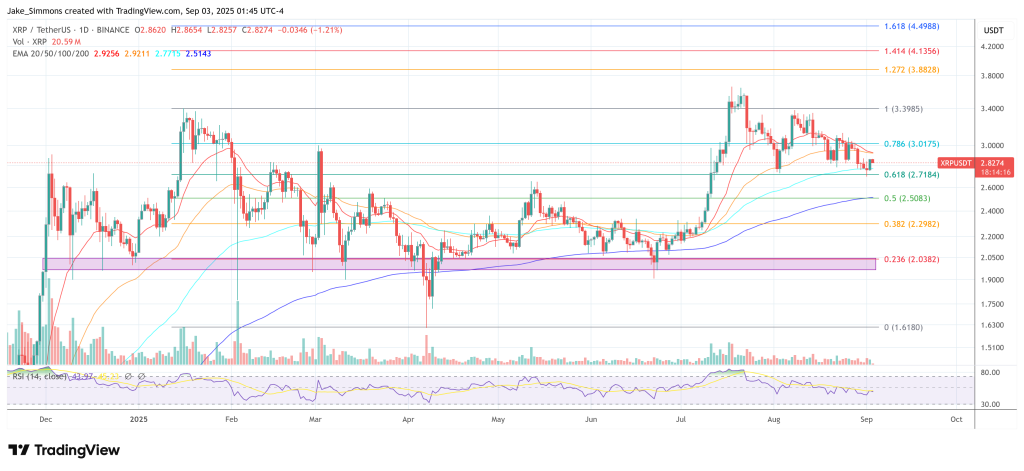
At press time, XRP traded at $2.82.
XRP price
XRP remains above the 0.618 Fib, 1-day chart | Source: XRPUSDT on TradingView.com
Featured image created with DALL.E, chart from TradingView.com
Editorial Process for bitcoinist is centered on delivering thoroughly researched, accurate, and unbiased content. We uphold strict sourcing standards, and each page undergoes diligent review by our team of top technology experts and seasoned editors. This process ensures the integrity, relevance, and value of our content for our readers.

Jake Simmons has been a Bitcoin enthusiast since 2016. Ever since he heard about Bitcoin, he has been studying the topic every day and trying to share his knowledge with others. His goal is to contribute to Bitcoin's financial revolution, which will replace the fiat money system. Besides BTC and crypto, Jake studied Business Informatics at a university. After graduation in 2017, he has been working in the blockchain and crypto sector. You can follow Jake on Twitter at @realJakeSimmons.

Lecturas Relacionadas

2028, llega la RSI

[Resumen en español] La cuenta atrás para la IA autorreplicante ya tiene fecha: 2028. Jack Clark, cofundador de Anthropic, estima con un 60% de probabilidad que para finales de 2028 la Inteligencia Artificial logrará la Mejora Recursiva Autónoma (RSI), creando sistemas más inteligentes que ella misma sin intervención humana directa. Esta predicción no es aislada. Demis Hassabis, CEO de Google DeepMind, confirma que todos los laboratorios líderes trabajan intensamente en RSI. Los datos muestran una aceleración alarmante: en Anthropic, más del 80% del código ya lo escribe Claude, multiplicando por 8 la productividad de los ingenieros. Pruebas como MirrorCode demuestran que IA como Claude Opus pueden reconstruir software complejo en horas, un trabajo que lleva semanas a humanos, e incluso programar de forma autónoma durante 19 días seguidos. La curva es exponencial. Si en 2024 un modelo manejaba tareas de 4 minutos, hoy supera tests de 16 horas, agotando la capacidad de medición humana. Sam Altman, de OpenAI, considera la RSI el mayor desafío de seguridad de la próxima década y sugeriría retrasar su mega-OPV de billones de dólares si la autonomía IA se acelera. El consenso entre los líderes de IA es claro: la mejora recursiva ya está en marcha, impulsando una carrera imparable. La pregunta clave ya no es *si* ocurrirá, sino cómo estará preparada la humanidad cuando, hacia 2028, la IA empiece a reescribir su propia evolución.

marsbitHace 1 hora(s)

2028, llega la RSI

marsbitHace 1 hora(s)

La 'Caída Abrupta' del CPO: ¿Cómo Opera Exactamente Glass Bridge? Explicación Oficial de Corning

El 26 de junio, el sector CPO en el mercado A chino cayó abruptamente, con múltiples acciones como ZTT, FiberHome y Yongding tocando límite de pérdidas. La caída fue provocada por el lanzamiento de la plataforma de interconexión óptica "Glass Bridge" de Corning, presentada en una conferencia en Seúl. La tecnología utiliza guías de onda de vidrio fabricadas a nivel de oblea para lograr el acoplamiento pasivo entre fibras ópticas y chips fotónicos, simplificando significativamente la compleja alineación activa requerida en la arquitectura CPO tradicional. Esto generó preocupación en el mercado sobre una posible reducción futura en la demanda de componentes como las unidades de matriz de fibras (FAU), afectando a fabricantes intermedios. Mientras el sector CPO caía, acciones relacionadas con sustratos de vidrio, como China Glass, Dyer Laser y Red Star Development, subían fuertemente, lo que indica un desplazamiento del capital hacia la cadena de valor de materiales avanzados. Según documentos técnicos de Corning, Glass Bridge opera basándose en tres características principales: fabricación a nivel de oblea para consistencia en producción masiva, una interfaz de contacto físico TMT estandarizada y una arquitectura de conector desmontable de alta densidad. La empresa aclara que esta tecnología complementa, no reemplaza por completo, las soluciones FAU existentes, aunque está diseñada para escenarios de densidad extremadamente alta. Analistas señalan que los sustratos de vidrio son vistos como un material clave para el empaquetado avanzado de próxima generación, especialmente ante la creciente demanda de chips de IA. El evento ha desencadenado una revaluación de la cadena de valor en la interconexión óptica para IA, con el foco de la industria desplazándose gradualmente hacia los materiales especializados aguas arriba.

marsbitHace 1 hora(s)

La 'Caída Abrupta' del CPO: ¿Cómo Opera Exactamente Glass Bridge? Explicación Oficial de Corning

marsbitHace 1 hora(s)

Trading

Spot
活动图片