Bitcoin Derivative Pressure Score Hits 30%: Downside Risk Signal

bitcoinistPublicado a 2025-09-02Actualizado a 2025-09-02

Resumen

Bitcoin is at a crossroads after failing to reclaim higher supply levels, raising concerns among investors about the strength of...

Trusted Editorial content, reviewed by leading industry experts and seasoned editors. Ad Disclosure

Bitcoin is at a crossroads after failing to reclaim higher supply levels, raising concerns among investors about the strength of its current trend. The price has slipped below key demand zones, and bullish momentum is showing signs of exhaustion. For now, traders are watching closely as the market decides whether BTC can recover or if a deeper correction is underway.

The mood across the market has shifted, with many analysts warning that Bitcoin could soon test the $100K level. Such a move would mark one of the most significant corrections of this cycle, sparking fear among short-term participants while possibly presenting opportunities for longer-term investors.

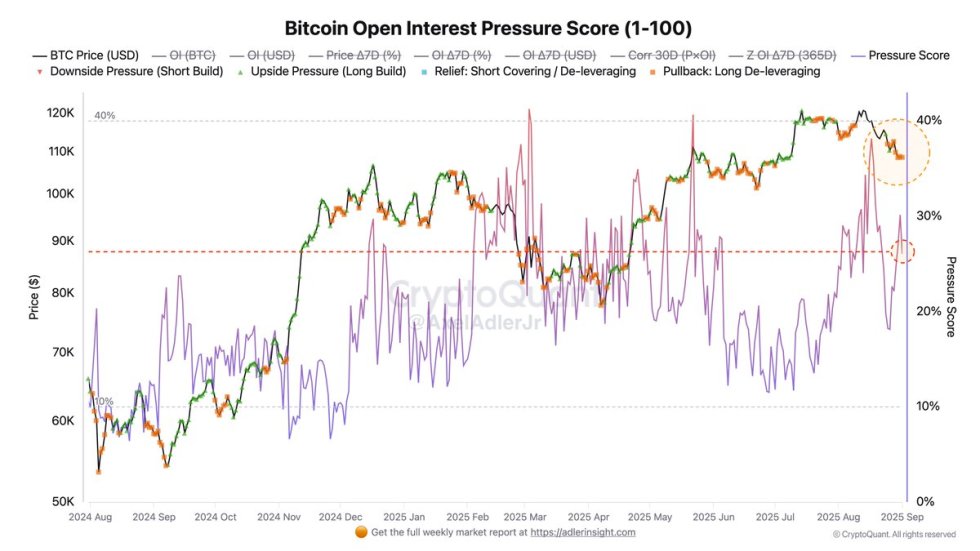
Top analyst Axel Adler has shed light on the situation, pointing to data that highlights persistent derivative pressure. According to him, Bitcoin’s baseline trend suggests pullbacks are being driven by long de-leveraging. With derivative markets heavily influencing price action, this pressure score — currently sitting in an elevated zone — keeps the market vulnerable to downside jolts.

Bitcoin Open Interest Signals Risks Ahead

According to top analyst Axel Adler, Bitcoin’s current weakness is strongly tied to derivative market dynamics. He highlights that the Bitcoin Open Interest Pressure Score sits at 30%, placing it firmly in the upper band. Historically, this level reflects elevated risk conditions, where the market becomes vulnerable to sudden downside jolts. In such environments, leveraged longs face pressure, and any sharp decline in spot prices tends to trigger waves of liquidations that amplify volatility.
Bitcoin Open Interest Pressure Score (1-100) | Source: Axel Adler

Adler points out that the presence of orange cluster markers on the price chart reinforces this risk. These clusters typically favor continued sideways or lower movement as the market undergoes a process of long de-leveraging. Essentially, traders who overextended during Bitcoin’s surge above $120K are now being forced out of positions, which weighs on momentum and creates a ceiling on recovery attempts.

Adding further pressure is the recent capital rotation trend dominating crypto markets. Institutions and whales have been observed selling portions of their BTC holdings to accumulate Ethereum, a strategy supported by growing ETH adoption and whale activity. This shift of liquidity has likely contributed to Bitcoin’s struggle to hold above the $110K level, weakening bullish conviction.

If Bitcoin fails to reclaim lost ground and derivative pressure remains elevated, a test of the $100K zone becomes increasingly probable. Conversely, stabilization and absorption of selling could reset leverage and prepare BTC for its next major move. Either way, market participants should brace for heightened volatility.

Price Action Details: Testing Pivotal Level

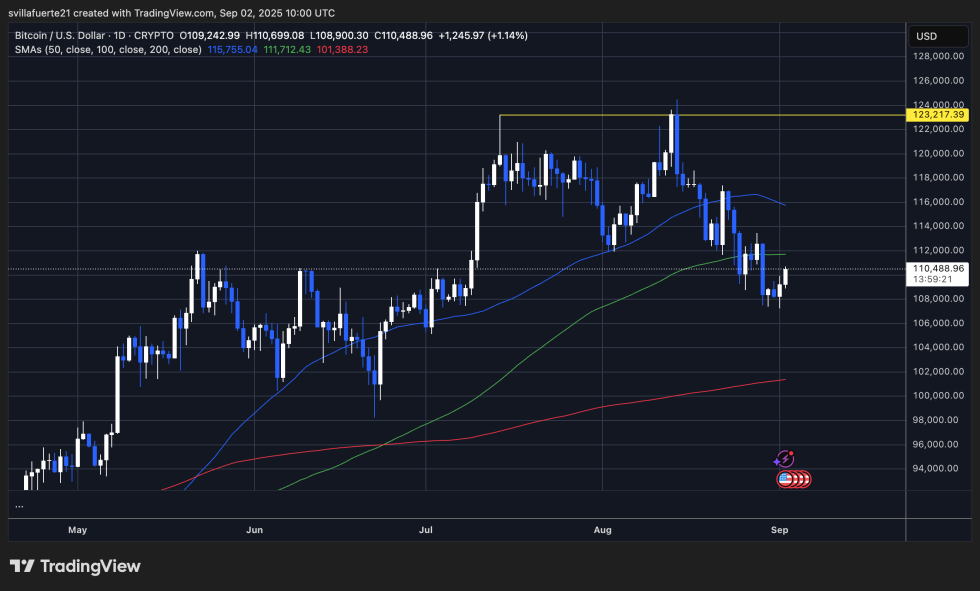
Bitcoin (BTC) is showing signs of stabilization after intense volatility in recent sessions. The chart highlights BTC trading at $110,488, attempting to reclaim ground after dipping below the $110K threshold. This level has now become a pivotal battleground between bulls and bears, with the next moves likely determining short-term direction.
BTC consolidates around pivotal price level | Source: BTCUSDT chart on TradingView

The 50-day moving average sits above current price action, near $115,755, reinforcing the overhead resistance zone. BTC must regain this level to confirm strength and attempt a retest of the $123,217 resistance, which remains the major hurdle for continuation toward new highs. On the downside, the 200-day moving average, currently around $101,388, acts as a critical safety net. A decisive breakdown below that point could accelerate a deeper correction, with the $100K level serving as psychological support.

The structure suggests the market is in a consolidation phase, digesting the steep rally earlier in the cycle. If bulls manage to hold above $110K and build momentum, a move toward $115K and eventually $123K could follow. However, failure here may reopen the door for tests of lower demand zones closer to $105K–$101K.

Featured image from Dall-E, chart from TradingView

Editorial Process for bitcoinist is centered on delivering thoroughly researched, accurate, and unbiased content. We uphold strict sourcing standards, and each page undergoes diligent review by our team of top technology experts and seasoned editors. This process ensures the integrity, relevance, and value of our content for our readers.

Sebastian's journey into the world of crypto began four years ago, driven by a fascination with the potential of blockchain technology to revolutionize financial systems. His initial exploration focused on understanding the intricacies of various crypto projects, particularly those focused on building innovative financial solutions. Through countless hours of research and learning, Sebastian developed a deep understanding of the underlying technologies, market dynamics, and potential applications of cryptocurrencies. As his knowledge grew, Sebastian felt compelled to share his insights with others. He began actively contributing to online discussions on platforms like X and LinkedIn, focusing on fintech and crypto-related content. His goal was to expose valuable trends and insights to a wider audience, fostering a deeper understanding of the rapidly evolving crypto landscape. Sebastian's contributions quickly gained recognition, and he became a trusted voice in the online crypto community. To further enhance his expertise, Sebastian pursued a UC Berkeley Fintech: Frameworks, Applications, and Strategies certification. This rigorous program equipped him with valuable skills and knowledge regarding Financial Technology, bridging the gap between traditional finance (TradFi) and decentralized finance (DeFi). The certification deepened his understanding of the broader financial landscape and its intersection with blockchain technology. Sebastian's passion for finance and writing is evident in his work. He enjoys delving into financial research, analyzing market trends, and exploring the latest developments in the crypto space. In his spare time, Sebastian can often be found immersed in charts, studying 10-K forms, or engaging in thought-provoking discussions about the future of finance. Sebastian's journey as a crypto analyst and investor has been marked by a relentless pursuit of knowledge and a dedication to sharing his insights. His ability to navigate the complex world of crypto, combined with his passion for financial research and communication, makes him a valuable asset to the industry. As the crypto landscape continues to evolve, Sebastian remains at the forefront, providing valuable insights and contributing to the growth of this revolutionary technology.

Lecturas Relacionadas

2028, llega la RSI

[Resumen en español] La cuenta atrás para la IA autorreplicante ya tiene fecha: 2028. Jack Clark, cofundador de Anthropic, estima con un 60% de probabilidad que para finales de 2028 la Inteligencia Artificial logrará la Mejora Recursiva Autónoma (RSI), creando sistemas más inteligentes que ella misma sin intervención humana directa. Esta predicción no es aislada. Demis Hassabis, CEO de Google DeepMind, confirma que todos los laboratorios líderes trabajan intensamente en RSI. Los datos muestran una aceleración alarmante: en Anthropic, más del 80% del código ya lo escribe Claude, multiplicando por 8 la productividad de los ingenieros. Pruebas como MirrorCode demuestran que IA como Claude Opus pueden reconstruir software complejo en horas, un trabajo que lleva semanas a humanos, e incluso programar de forma autónoma durante 19 días seguidos. La curva es exponencial. Si en 2024 un modelo manejaba tareas de 4 minutos, hoy supera tests de 16 horas, agotando la capacidad de medición humana. Sam Altman, de OpenAI, considera la RSI el mayor desafío de seguridad de la próxima década y sugeriría retrasar su mega-OPV de billones de dólares si la autonomía IA se acelera. El consenso entre los líderes de IA es claro: la mejora recursiva ya está en marcha, impulsando una carrera imparable. La pregunta clave ya no es *si* ocurrirá, sino cómo estará preparada la humanidad cuando, hacia 2028, la IA empiece a reescribir su propia evolución.

marsbitHace 4 hora(s)

2028, llega la RSI

marsbitHace 4 hora(s)

La 'Caída Abrupta' del CPO: ¿Cómo Opera Exactamente Glass Bridge? Explicación Oficial de Corning

El 26 de junio, el sector CPO en el mercado A chino cayó abruptamente, con múltiples acciones como ZTT, FiberHome y Yongding tocando límite de pérdidas. La caída fue provocada por el lanzamiento de la plataforma de interconexión óptica "Glass Bridge" de Corning, presentada en una conferencia en Seúl. La tecnología utiliza guías de onda de vidrio fabricadas a nivel de oblea para lograr el acoplamiento pasivo entre fibras ópticas y chips fotónicos, simplificando significativamente la compleja alineación activa requerida en la arquitectura CPO tradicional. Esto generó preocupación en el mercado sobre una posible reducción futura en la demanda de componentes como las unidades de matriz de fibras (FAU), afectando a fabricantes intermedios. Mientras el sector CPO caía, acciones relacionadas con sustratos de vidrio, como China Glass, Dyer Laser y Red Star Development, subían fuertemente, lo que indica un desplazamiento del capital hacia la cadena de valor de materiales avanzados. Según documentos técnicos de Corning, Glass Bridge opera basándose en tres características principales: fabricación a nivel de oblea para consistencia en producción masiva, una interfaz de contacto físico TMT estandarizada y una arquitectura de conector desmontable de alta densidad. La empresa aclara que esta tecnología complementa, no reemplaza por completo, las soluciones FAU existentes, aunque está diseñada para escenarios de densidad extremadamente alta. Analistas señalan que los sustratos de vidrio son vistos como un material clave para el empaquetado avanzado de próxima generación, especialmente ante la creciente demanda de chips de IA. El evento ha desencadenado una revaluación de la cadena de valor en la interconexión óptica para IA, con el foco de la industria desplazándose gradualmente hacia los materiales especializados aguas arriba.

marsbitHace 4 hora(s)

La 'Caída Abrupta' del CPO: ¿Cómo Opera Exactamente Glass Bridge? Explicación Oficial de Corning

marsbitHace 4 hora(s)

Trading

Spot
活动图片