US Federal Regulators To Review State-Level Stablecoin Frameworks Under GENIUS Act

bitcoinistPublicado a 2025-08-20Actualizado a 2025-08-20

Resumen

US federal regulators are set to review state regulations of stablecoins to “even out” rules across jurisdictions under the new...

Trusted Editorial content, reviewed by leading industry experts and seasoned editors. Ad Disclosure

US federal regulators are set to review state regulations of stablecoins to “even out” rules across jurisdictions under the new federal regulatory framework for the sector, the Guiding and Establishing National Innovation for U.S. Stablecoins (GENIUS) Act.

State-Level Stablecoin Rules To Face Federal Review

A federal committee led by the US Treasury Secretary is expected to start evaluating state-level regulatory regimes to determine whether they are similar to the federal regulatory framework under the GENIUS Act.

Following last month’s enactment of the landmark crypto legislation, the Stablecoin Certification Review, comprised of the US Treasury Secretary and the chairmen of the Federal Reserve and the Federal Deposit Insurance Corporation, is in charge of reviewing state-by-state rules and “establish broad-based principles for determining whether a State-level regulatory regime is substantially similar to the Federal regulatory framework under this Act.”
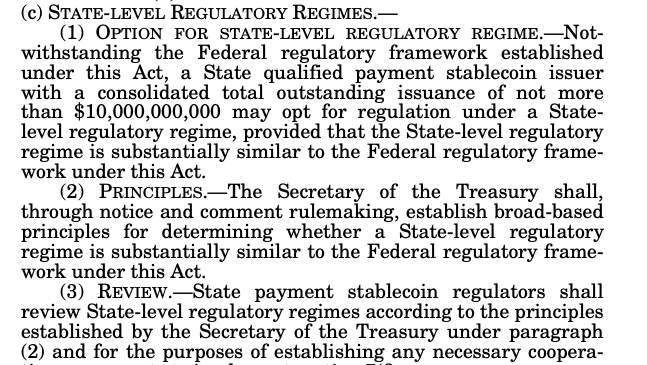
stablecoin

Excerpt from the GENIUS Act. Source: congress.gov

The requirement aims to level out regulatory approaches between states to make compliance by stablecoin issuers more seamless across jurisdictions, as issuers face a different set of rules and policies depending on each jurisdiction, with some states having a stricter approach to the industry while others have a more welcoming strategy.

Gavin Meyers, a financial services regulatory partner at Pierson Ferdinand LLP, told Bloomberg Law that “It creates a potential for less of a mosaic of state-by-state regulation, which kind of plagues other aspects of the financial industry,” asserting that “eliminating that barrier is a highly beneficial aspect of the committee.”

“There will be some wiggle room in states that have been more favorable to crypto generally, like Wyoming,” Meyers affirmed. Notably, Wyoming has passed over 45 pieces of crypto-related legislation since 2016, including a bill in 2023 that authorized a state commission to issue stablecoins pegged to the US dollar.

Moreover, it launched Frontier (FRNT), the US’s first state-issued stablecoin, on seven blockchains, including Ethereum, Solana, and Avalanche, on August 19. Nonetheless, “due to lingering regulatory hurdles, the token is not yet available to the public,” noted crypto journalist Eleanor Terrett on X.

The Importance Of Clear Frameworks

According to the Bloomberg Law report, the federal Committee is ready to “even out the state-by-state approach, curtailing stricter regulatory regimes or building upon permissive state frameworks.”

Rosemary Spaziani, a partner at Gibson Dunn & Crutcher LLP, told the news media outlet that “If 40 states all sign on to what the federal government does, those are going to be pretty simple rubber stamps—they’re going to adopt a model act and incorporate it into their laws,” while “the ones that deviate are probably going to be a bit of a bottleneck.”

Additionally, the companies hoping to enter the stablecoin sector will likely welcome federal oversight to avoid potential compliance issues. Meyers noted that “If you are licensed by whichever state that qualifies under the ‘GENIUS Act,’ that certification is good across the country.”

Recently, leading banking associations sent a joint letter to the US Senate Banking Committee calling for amendments to the GENIUS Act. The associations asked the lawmakers to address multiple “loopholes” in the landmark legislation, arguing that a clear regulatory framework is crucial for the digital assets market.

Among the recommendations, they urged the Committee to strengthen the prohibition on interest payments related to payment stablecoins and to repeal a section of the GENIUS Act that allows uninsured, out-of-state-chartered financial institutions to operate without the host states’ approval, which could complicate regulation.

stablecoin, btc, btcusdt

Bitcoin's performance in the one-week chart. Source: BTCUSDT on TradingView
Featured Image from Unsplash.com, Chart from TradingView.com
Editorial Process for bitcoinist is centered on delivering thoroughly researched, accurate, and unbiased content. We uphold strict sourcing standards, and each page undergoes diligent review by our team of top technology experts and seasoned editors. This process ensures the integrity, relevance, and value of our content for our readers.

Rubmar is a crypto enthusiast who likes learning and improving constantly. She enjoys reporting on the latest news and developments in the crypto industry. Rubmar also enjoys scrapbooking, crafting, simulation games, and watching football.

Lecturas Relacionadas

B20, la nueva compuerta de emisión de tokens en Base: ¿Qué tipo de activos quiere atraer?

**Resumen: B20, la nueva puerta de entrada para emitir tokens en Base, ¿qué activos pretende atraer?** Base, la capa 2 de Coinbase, pospuso el lanzamiento en mainnet de su nuevo estándar B20 tras sufrir dos interrupciones en la producción de bloques. B20 es un componente central de la actualización Beryl y está diseñado para ser la interfaz nativa de Base para la emisión de tokens. A diferencia de un ERC-20 tradicional, B20 no es un contrato inteligente desplegado por cada proyecto. En su lugar, es una funcionalidad integrada en la propia red Base mediante un *precompile* en Rust, lo que promete mayor velocidad y menor costo. Es compatible con las interfaces ERC-20 estándar, facilitando su integración con carteras y protocolos DeFi existentes. La clave de B20 reside en ofrecer a los emisores herramientas avanzadas de control y gestión: * **Permisos granulares:** Roles separados para administración, acuñación, quema y pausa, reduciendo riesgos. * **Control de flujo:** Capacidad de implementar listas blancas y negras para restringir transferencias tanto para remitentes como receptores, crucial para stablecoins y Activos del Mundo Real (RWA). * **Rastreabilidad:** Soporte para campos *memo* (notas) en las transacciones, para vincular operaciones on-chain con registros off-chain. En resumen, B20 no automatiza la normativa, sino que proporciona a los emisores las herramientas para crear tokens con distintos grados de permisividad y control. Está dirigido principalmente a emisores de stablecoins, tokens de RWA y otros activos que requieren funcionalidades de gestión robustas y un coste de emisión estandarizado más bajo, posicionándose como la puerta de entrada nativa de Base para este tipo de activos.

Foresight NewsHace 13 min(s)

B20, la nueva compuerta de emisión de tokens en Base: ¿Qué tipo de activos quiere atraer?

Foresight NewsHace 13 min(s)

MicroStrategy lanza su guion de auto-rescate: el juego y cálculo tras la venta de 12,500 millones de dólares en criptomonedas

MicroStrategy, el mayor tenedor corporativo de Bitcoin, ha anunciado un cambio radical en su estrategia tras acumular más de $13,000 millones en pérdidas no realizadas. Su antiguo modelo de "comprar y acumular sin vender" se ha visto interrumpido por la caída del precio de BTC y la presión sobre su capital. La compañía presentó un nuevo "Marco de Capital de Crédito Digital" basado en cinco pilares clave: 1) Mantener una reserva de efectivo de $2,550 millones para gastos obligatorios, 2) Aumentar el dividendo de sus acciones preferentes (STRC) al 12% para apoyar su precio, 3) Un programa de recompra de hasta $1,000 millones para STRC, 4) Un programa de recompra de hasta $1,000 millones para sus acciones ordinarias (MSTR), y 5) La autorización para vender hasta $1,250 millones en Bitcoin para reforzar la liquidez. Este plan busca reparar su credibilidad y la relación entre el valor de mercado y el valor de sus activos en Bitcoin (mNAV), para eventualmente reabrir sus canales de financiación. Sin embargo, marca un alejamiento de su principio fundacional de nunca vender BTC, lo que podría erosionar la fe de los inversores y convertir a MicroStrategy en una fuente potencial de venta en el mercado. Los analistas señalan que el éxito depende de que las recompras restauren la confianza y de cómo el mercado absorba cualquier venta futura de Bitcoin.

marsbitHace 18 min(s)

MicroStrategy lanza su guion de auto-rescate: el juego y cálculo tras la venta de 12,500 millones de dólares en criptomonedas

marsbitHace 18 min(s)

Trading

Spot
活动图片