US Appeals Court Overturns Yuga Labs’ $9M Trademark Lawsuit Judgment

bitcoinistPublicado a 2025-07-25Actualizado a 2025-07-25

Resumen

A US court of Appeals has sent Yuga Labs, the creator of the Bored Ape Yacht Club (BAYC) non-fungible token...

Trusted Editorial content, reviewed by leading industry experts and seasoned editors. Ad Disclosure

A US court of Appeals has sent Yuga Labs, the creator of the Bored Ape Yacht Club (BAYC) non-fungible token (NFT) collection, back to the district court for its lawsuit against artist Ryder Ripps and business partner Jeremy Cahen.

Yuga Labs Sent Back To District Court

On Wednesday, the Ninth Circuit Court of Appeals partially overturned the judgment in Yuga Labs’ lawsuit against Ripps and Cahen’s NFT collection, ruling that the company had yet to prove its claims of trademark infringement and cybersquatting.

In 2022, Ripps and Cahen launched the Ryder Ripps Bored Ape Yacht Club (RR/BAYC) collection with identical copies of Yuga Lab’s NFT collection and similar marketing tactics. The duo argued that their collection was a satirical and critical response to the original NFTs, which they claimed have racist imagery and neo-Nazi, alt-right references.

Yuga Labs

The Court of Appeals partially overturns Yuga Labs' case judgment. Source: Ninth Distric Court of Appeals

That same year, Yuga Labs filed a trademark infringement lawsuit against Ripps and Cahen, alleging that the duo had deceived buyers by offering NFTs falsely equivalent to the BAYC collection under the pretext of satire. Additionally, the company claimed that Ripps and Cahen had damaged their reputation with their accusations.

Yuga Labs claimed victory in 2023, when the District Court in California ruled that the company was the rightful owner of the BAYC trademarks and determined that Ripps and Cahen utilized these trademarks without consent, likely confusing potential buyers who wanted to purchase an authentic Bored Ape NFT. At the time, Yuga Labs called the ruling “a win for the entire Web3 industry.”

Initially, a judge declared that the plaintiff was entitled to $1.6 million in damages from the duo. However, it was later raised to $9 million after Ripps and Cahen lost their counterclaim.

Notably, Ripps and Cahen countersued Yuga Labs under the Digital Millennium Copyright Act (DMCA), seeking declaratory relief that the company had no copyright protection over the Bored Apes.

The defendant’s counterclaims were dismissed by the district court for a “lack of subject-matter jurisdiction,” granting summary judgment for the company on its two claims and the defendant’s DMCA counterclaim.

A Key Win For NFT Holders

According to the Wednesday ruling, the three-judge panel affirmed in part and reversed in part the district court’s judgment and remanded the case. The panel held that an NFT can be trademarked under the Lanham Act, which protects marks used with “any goods or services.”

Based on this, they concluded that defendants’ NFTs were “goods”, but determined that Yuga Labs had the trademark priority as it was the first to use the Bored Ape Yacht Club marks in commerce.

Nonetheless, they reversed the district court’s grant of summary judgment on the company’s trademark infringement and cybersquatting claims, arguing that Yuga Labs “did not prove as a matter of law that the defendants’ actions were likely to cause consumer confusion.”

Meanwhile, the ruling determined that the duo’s use of Yuga Labs’ marks did not “constitute nominative fair use” and was not “expressive work” protected by the First Amendment.

“As to the trademark claim, (…) the panel could not conclude as a matter of law that a reasonably prudent consumer in the marketplace was likely to be confused as to the origin of the goods bearing Yuga’s marks,” the court document reads.

Yuga Labs co-founder Greg Solano affirmed on X that BAYC NFTs being protectable trademarks is “an important win for every NFT holder,” adding that the company will “now finish the fight in the district court, where the judge already fined the RR BAYC founders $9m+ in damages. We’ll win in the district just like we won before.”
Yuga Labs, ETH, ETHUSDT

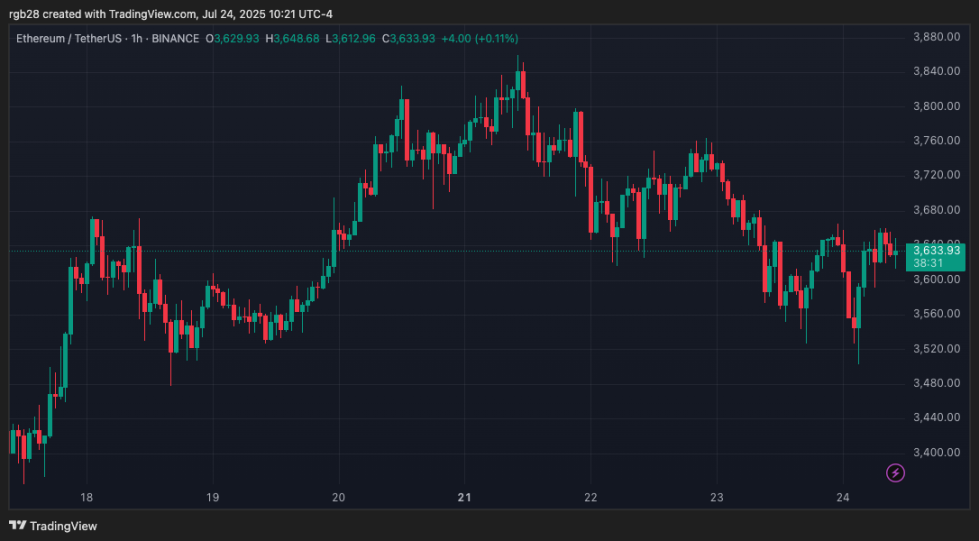
Ethereum (ETH) is trading at $3,633 in the one-week chart. Source: ETHUSDT on TradingView
Featured Image from Unsplash.com, Chart from TradingView.com
Editorial Process for bitcoinist is centered on delivering thoroughly researched, accurate, and unbiased content. We uphold strict sourcing standards, and each page undergoes diligent review by our team of top technology experts and seasoned editors. This process ensures the integrity, relevance, and value of our content for our readers.

Rubmar is a crypto enthusiast who likes learning and improving constantly. She enjoys reporting on the latest news and developments in the crypto industry. Rubmar also enjoys scrapbooking, crafting, simulation games, and watching football.

Lecturas Relacionadas

Doubao y Qianwen retirarán la función de agentes inteligentes el 15 de julio

El 4 de julio, Doubao y Tongyi Qianwen anunciaron la eliminación de sus funciones de "agentes inteligentes". Doubao confirmó que la funcionalidad se desactivará el 15 de julio, redirigiendo a los usuarios hacia la app MaoXiang. Ese mismo día, Tongyi Qianwen notificó que sus agentes de interacción personalizada y aquellos creados por usuarios dejarán de funcionar el 10 de julio, con un cese total de servicios el 15 de julio, tras lo cual el acceso a configuraciones y historiales se perderá. Esta medida afecta escenarios clave de uso personalizado como juegos de rol, asistentes especializados y herramientas verticales. La fecha elegida, 15 de julio, coincide con la entrada en vigor del "Reglamento Provisional para la Gestión de Servicios de Interacción Personalizada de IA", que impone estrictas normas para prevenir adicciones, verificar la edad de usuarios menores y auditar contenidos. Previo a esto, una campaña regulatoria en Shanghai resultó en la eliminación de más de 14,000 agentes ilegales. La decisión es vista como un movimiento proactivo para mitigar riesgos de cumplimiento normativo. Ambas plataformas ofrecen un período de transición para que los usuarios guarden sus datos mediante capturas de pantalla o exportación de texto. Doubao permitirá el acceso hasta el 15 de octubre. Tras la presión regulatoria, la insostenibilidad comercial es otro factor clave. Los agentes de conversación casual consumen muchos recursos computacionales pero generan bajo valor comercial. En la actual fase de validación del valor de la IA, estos ecosistemas de contenido generado por el usuario (UGC) resultan difíciles de monetizar. Qianwen ya muestra un giro estratégico hacia el mercado empresarial (B2B), abriendo sus plataformas de Agente y Habilidad a terceros como Luckin Coffee y China Eastern Airlines. Esto indica un cambio de enfoque desde el UGC de bajo valor hacia escenarios de servicio empresarial de mayor valor.

marsbitHace 1 hora(s)

Doubao y Qianwen retirarán la función de agentes inteligentes el 15 de julio

marsbitHace 1 hora(s)

¿Por qué se fusionaron Codex y ChatGPT? ¿Qué depara el futuro para Codex? Los líderes clave de OpenAI responden a todo

Si preguntas qué producto de IA tuvo el crecimiento más destacado en 2026, "Codex" encabeza la lista. Desde enero, sus usuarios activos semanales crecieron más de 5 veces, alcanzando 5 millones, con una adopción entre trabajadores del conocimiento tres veces mayor que entre desarrolladores. Un catalizador clave fue el lanzamiento de la aplicación de escritorio en febrero, que redujo barreras de entrada. Andrew Ambrosino, responsable de la app de Codex, analiza esta evolución. Señala un cambio fundamental: la implementación ya no es la parte costosa; ahora lo caro es el "gusto" o la capacidad de curar y decidir entre múltiples ideas y prototipos generados fácilmente con IA. Explica por qué la IA aún lucha con el diseño: es más difícil de evaluar que el código, depende del contexto cultural y requiere comprensión de capas abstractas profundas. También destaca que el éxito de un producto de IA depende críticamente del momento de las capacidades del modelo, no solo del diseño de la interfaz. Sobre los roles en su equipo, observa que los límites entre ingenieros, diseñadores y gerentes de producto se están difuminando, pero las habilidades especializadas siguen siendo cruciales. En el desarrollo asistido por IA, la pregunta ya no es cuánto código escribe el humano, sino si la generación fue supervisada o no, y destaca la necesidad de que los modelos mejoren en simplificar código, no solo en crearlo. La fusión de Codex con ChatGPT responde a la observación de que la herramienta, inicialmente para desarrolladores, era ampliamente usada para todo tipo de trabajo intelectual. La visión futura no es un "súper app" que haga todo, sino un "home base" o base central desde la que los usuarios gestionen tareas, automatizen flujos y, crucialmente, donde Codex/ChatGPT interactúe y utilice herramientas profesionales externas (como Excel o Premiere Pro) para realizar trabajos complejos, en lugar de reemplazarlas.

marsbitHace 1 hora(s)

¿Por qué se fusionaron Codex y ChatGPT? ¿Qué depara el futuro para Codex? Los líderes clave de OpenAI responden a todo

marsbitHace 1 hora(s)

Trading

Spot
活动图片