Trump Shares ‘Greatest Bitcoin Explanation Of All Time’—Is It A Hint?

bitcoinistPublicado a 2025-07-21Actualizado a 2025-07-21

Resumen

In a late‑night Truth Social post on July 21, President Donald Trump embedded a video of Coin Center research director Peter Van Valkenburgh’s 2018 Senate...

Trusted Editorial content, reviewed by leading industry experts and seasoned editors. Ad Disclosure

In a late‑night Truth Social post on July 21, President Donald Trump embedded a video of Coin Center research director Peter Van Valkenburgh’s 2018 Senate testimony and declared it the “greatest Bitcoin explanation of all time,” urging supporters to watch the full clip.

The video, recorded during a Banking Committee hearing on the nascent crypto ecosystem, presents Van Valkenburgh’s core argument that Bitcoin is “the world’s first public digital payments infrastructure.” “It lets you send and receive value to and from anyone in the world using nothing more than a computer and an internet connection,” he tells lawmakers, later calling the protocol “a computer‑science breakthrough” that could rival “the birth of the Internet” for its impact on human freedom.

Report On The Strategic Bitcoin Reserve Incoming?

Trump’s public endorsement lands on the eve of a self‑imposed deadline. On January 23 the president signed Executive Order 14178, instructing a high‑level Working Group on Digital Asset Markets to deliver—within 180 days—a sweeping set of legislative and regulatory recommendations on cryptocurrencies. The report is due July 22.

Rumors circulating on X suggest that tomorrow’s document will, for the first time, publish an official inventory of federal Bitcoin holdings, consolidate those coins into the Strategic Bitcoin Reserve created by a March 6 order, and outline “budget‑neutral” mechanisms to expand the reserve without new taxpayer outlays.

Independent tallies suggest the numbers are substantial. Chainalysis estimates that wallets controlled by US agencies contain roughly 200,000 BTC—about $20.4 billion at current prices—making Washington the largest sovereign holder of Bitcoin.

However, it is not quite clear if the US government still owns all of them. In December 2024, weeks before Trump’s inauguration, a federal judge authorized the Justice Department to liquidate 69,370 BTC seized from the Silk Road hacker known as “Individual X,” a haul then worth about $6.5 billion. Prior to the election, coins were transferred to Coinbase Prime under the Biden administration.

Trump’s March order takes the opposite tack, forbidding sales of reserve Bitcoin and directing Treasury and Commerce to devise cost‑neutral acquisition strategies.

The president’s post also caps “Crypto Week.” On Friday Trump signed the GENIUS Act, the first federal statute governing dollar‑backed stablecoins, while the House advanced the CLARITY Act and the Anti‑CBDC Surveillance State Act, measures that would shift much enforcement to the Commodity Futures Trading Commission and bar a Federal Reserve digital currency.

Whether the Working Group’s report will echo Van Valkenburgh’s assertion that “Bitcoin is the world’s first globally accessible public money” remains to be seen. But with the president now personally amplifying that message—and with the policy blueprint due within hours—Washington’s next move on crypto will soon move from speculation to the public record.

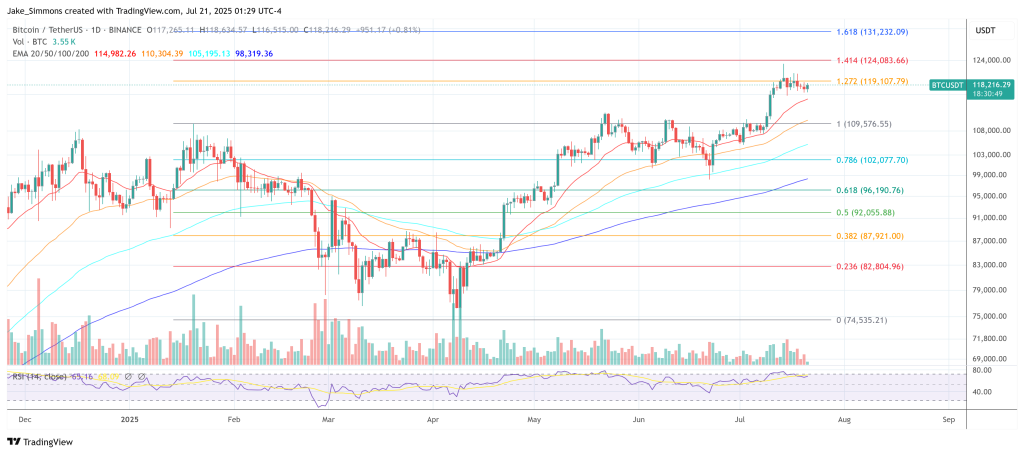
At press time, BTC traded at $118,216.
Bitcoin price
BTC stalls below the 1.272 Fib, 1-day chart | Source: BTCUSDT on TradingView.com
Featured image from YouTube, chart from TradingView.com
Editorial Process for bitcoinist is centered on delivering thoroughly researched, accurate, and unbiased content. We uphold strict sourcing standards, and each page undergoes diligent review by our team of top technology experts and seasoned editors. This process ensures the integrity, relevance, and value of our content for our readers.

Jake Simmons has been a Bitcoin enthusiast since 2016. Ever since he heard about Bitcoin, he has been studying the topic every day and trying to share his knowledge with others. His goal is to contribute to Bitcoin's financial revolution, which will replace the fiat money system. Besides BTC and crypto, Jake studied Business Informatics at a university. After graduation in 2017, he has been working in the blockchain and crypto sector. You can follow Jake on Twitter at @realJakeSimmons.

Lecturas Relacionadas

El último artículo de Fei-Fei Li: Cuando la generación de vídeo, la robótica y NVIDIA se autodenominan modelos del mundo, necesitamos una taxonomía

El artículo de Fei-Fei Li clarifica el término "modelo del mundo", utilizado de manera confusa en IA, proponiendo una taxonomía basada en el ciclo POMDP (Proceso de Decisión de Markov Parcialmente Observable). Identifica tres categorías funcionales: 1) **Renderizador**: genera observaciones (píxeles) visualmente fieles para humanos, como los modelos de video Sora o Genie, pero sin comprensión física precisa. 2) **Simulador**: produce estados del mundo con precisión geométrica, física y dinámica, sirviendo tanto para visualización profesional como para entrenamiento de agentes (robots, vehículos autónomos). 3) **Planificador**: deduce acciones a partir de observaciones y objetivos, cerrando el ciclo percepción-acción, como los modelos de lenguaje-visión-acción (VLA). El artículo argumenta que el simulador es el componente clave y subestimado, pues proporciona la base estructural para la renderización y la planificación. Mientras los renderizadores tienen madurez comercial pero limitaciones físicas, y los planificadores son prometedores pero inmaduros para despliegues reales, los simuladores abarcan aplicaciones cruciales en robótica, diseño y digitalización. La tendencia actual es la fusión de estas categorías, impulsada por la idea de que comparten conocimiento subyacente. Modelos como Marble de World Labs ejemplifican esta convergencia, generando tanto representaciones visuales (splats gaussianos) como mallas para simulación física. La visión final es un **modelo del mundo unificado** capaz de alternar entre renderizar, simular y planificar según la necesidad, avanzando hacia una inteligencia espacial que permita a las máquinas entender e interactuar con el mundo físico.

marsbitHace 5 hora(s)

El último artículo de Fei-Fei Li: Cuando la generación de vídeo, la robótica y NVIDIA se autodenominan modelos del mundo, necesitamos una taxonomía

marsbitHace 5 hora(s)

Trading

Spot
活动图片