Lido Staking Woes Continue as stETH Selloff Accelerates

FXEMPIREPublicado a 2022-06-15Actualizado a 2022-06-15

Resumen

The largest Ethereum liquid staking platform Lido is feeling the pressure as its staked asset has not regained its peg and is started to get liquidated. The Lido stETH token has fallen 5% from its Ethereum price peg. Three Arrows Capital has been liquidating its stETH holdings. The embattled Celsius platform holds more than 400,000 stETH, causing concern.

Staked Ethereum tokens from the Lido network are being liquidated to markets as it has remained below its peg for the past few days.

Lido provides a liquid staking service whereby users can stake Ethereum and receive the equivalent value in a token called stETH. This can then be deposited in other decentralized finance (DeFi) protocols to generate additional yields on top of the staking reward or be used as collateral for loans.

It has several advantages over direct Ethereum staking as there is a flexible limit, and funds can be withdrawn or redeployed. To stake ETH on the Beacon Chain (Ethereum consensus layer) directly, there is a minimum of 32 ETH (worth approximately $38,400), and it remains locked there until after the Merge.

Lido Liquidation

Lido has been wildly popular for those that don’t have the minimum amount of ETH and want more flexibility with their investments. It has 4.2 million ETH staked, about a third of the total Ethereum staked overall (12.8 million ETH).

The problem arises when the stETH token falls below the price of Ethereum, which it is supposed to be pegged to at 1:1. Ethereum is currently trading at $1,217 while stETH is at $1,156, 5% lower, and only worth 0.927 of an ETH.

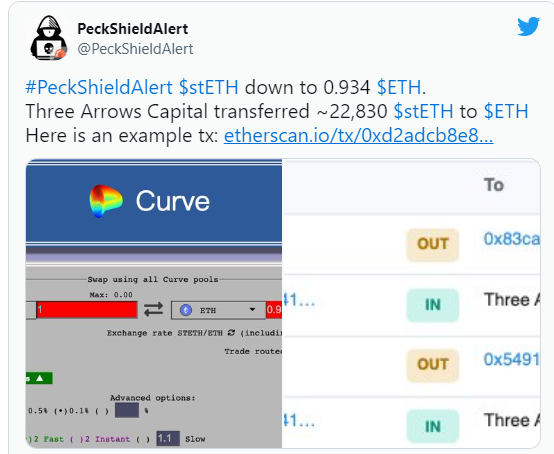
Adding fuel to the fire is the current liquidation of Lido’s staking token. According to a June 14 tweet by blockchain security firm PeckShield, venture capital firm Three Arrows Capital has been offloading stETH. At least 22,830 stETH tokens were converted back into ETH recently, according to the 3AC wallet address.
On June 15, 3AC co-founder Zhu Su attempted to alleviate the concern by tweeting: “We are in the process of communicating with relevant parties and fully committed to working this out.”
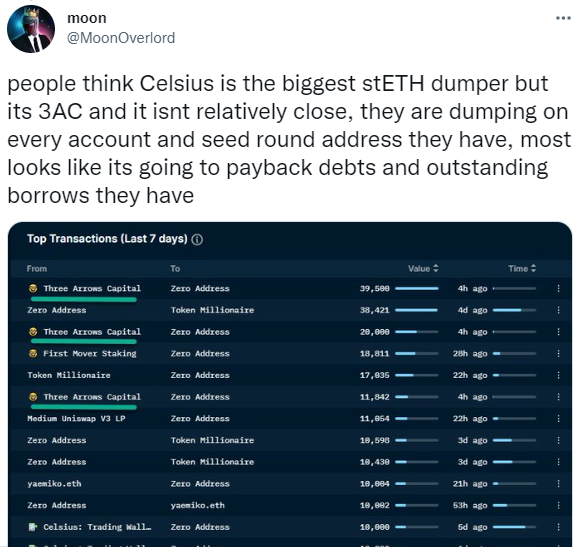
The Curve Finance DeFi platform has a liquidity pool for stETH and ETH that should be in balance. However, the de-pegging and stETH selloff has caused an imbalance in the pool. It is currently 78.4% heavy on stETH with just 21.6% in Ethereum.

Liquidity for staked Ether is shrinking, making it very difficult to conduct token swaps and collateralized loans using the Lido token.

The Celsius Concern

The Celsius fiasco has also been a cause for concern because the crypto lending platform holds a large amount of stETH. Earlier this week, Celsius sent millions of dollars worth of crypto to the FTX exchange in an attempt to shore up liquidity.

Celsius currently holds a whopping 409,260 stETH, equivalent to almost $500 million at the time of writing. If this is liquidated, the de-pegging situation will likely get far worse quickly.

On June 15, Bitcoin Magazine’s Dylan LeClair commented: “While everyone is focused on the Celsius collateralized loan, the biggest worry for the market may just be their massive stETH position. No resolution in sight.”


Lecturas Relacionadas

94.000 millones de yuanes, la mayor financiación de este año para robots humanoides ha aparecido

La empresa de robótica humana Neura, con sede en Múnich, ha completado una ronda de financiación Serie C de 14.000 millones de dólares (unos 94.900 millones de RMB), lo que supone la mayor inversión del año en este sector. Tras la operación, su valoración alcanza los 70.000 millones de dólares. La relevancia de esta ronda radica en la participación de inversores industriales como Schaeffler y Bosch, lo que señala un cambio estratégico: el foco pasa de la demostración tecnológica a la implementación práctica en fábricas. Neura, fundada por el experto en robótica industrial Armin Zeher, ha priorizado desde el inicio la aplicabilidad en entornos de producción real, contando ya con BMW como cliente. Otros inversores como NVIDIA, Amazon y Qualcomm aportan perspectivas complementarias en infraestructura de computación, logística y tecnología. El sector de la robótica humana está experimentando una afluencia masiva de capital, impulsada por dos factores clave: los avances en modelos de IA de gran escala, que mejoran la percepción y la toma de decisiones de los robots, y la creciente presión por la escasez y el encarecimiento de la mano de obra en la manufactura global. Actualmente, las empresas siguen dos caminos principales: los robots humanoides de propósito general (como Figure AI), con un horizonte comercial a más largo plazo, y los enfocados en escenarios industriales verticales y específicos (como Neura), que ofrecen una ruta de comercialización más rápida y definida. El campo de batalla real para estos robots ya no es el laboratorio, sino el suelo de la fábrica. Los escenarios de manufactura industrial, por su entorno estructurado y tareas repetitivas, se consideran los primeros en permitir una adopción a escala. Los entornos de trabajo peligrosos también tienen un gran potencial. Sin embargo, los principales retos para la adopción masiva ya no son puramente técnicos, sino de ingeniería y modelo comercial. Destacan los elevados costes de adaptación a cada línea de producción específica y la necesidad de desarrollar sistemas de mantenimiento y servicio locales robustos para garantizar la operación continua. La entrada de gigantes industriales históricos como inversores y la presencia inicial de robots en fábricas como las de BMW marcan un punto de inflexión: la confianza del sector se consolida y la pregunta central evoluciona de "si es posible" a "cómo hacerlo mejor, más rápido y de forma más estable".

marsbitHace 8 hora(s)

94.000 millones de yuanes, la mayor financiación de este año para robots humanoides ha aparecido

marsbitHace 8 hora(s)

Trading

Spot
Futuros
活动图片