Nearly 90% Of Crypto Firms Fail UK’s AML Standards—What’s Going Wrong?

bitcoinistPublicado a 2024-09-06Actualizado a 2024-09-07

Resumen

The turbulent UK cryptocurrency landscape sees the Financial Conduct Authority report that 87% of crypto registration applications failed in the...

The turbulent UK cryptocurrency landscape sees the Financial Conduct Authority report that 87% of crypto registration applications failed in the last fiscal year.

This is a staggering fact that brings up very serious questions concerning the effectiveness of anti-money laundering controls in the industry. Only four out of 35 applications were approved, underlining how tough the regulatory environment remains.

Struggling To Meet Standards

The FCA has been acting as the regulator for crypto businesses since January 2020, overseeing compliance with the Money Laundering, Terrorist Financing, and Transfer of Funds Regulations.

Overall, the report states that this high number of firms falls short of the required standard. This was because most applications were refused on the grounds of unsatisfactory fraud and AML controls necessary for assurance that illicit funds do not penetrate the financial system.
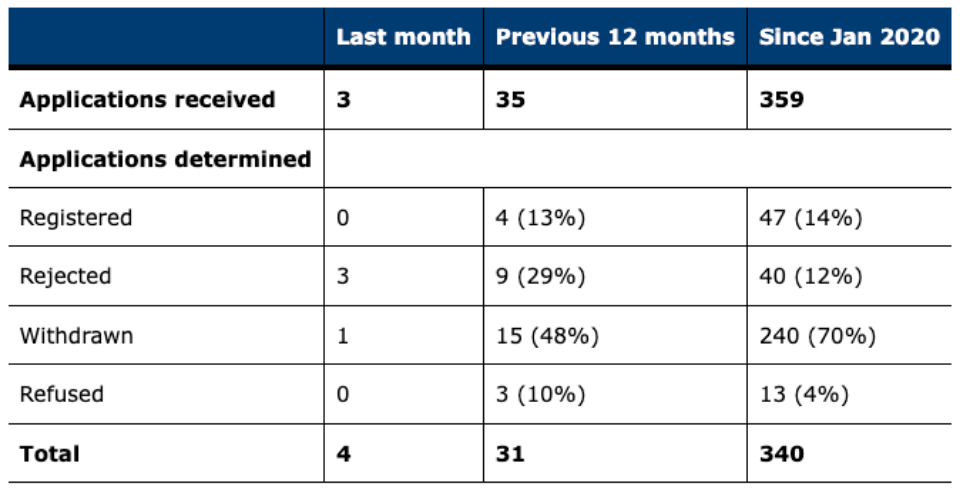
The UK FCA denied the applications of nearly 90% of crypto registrations. Source: FCA

FCA Chair Charles Randell commented:

“Although some firms have shown adequate systems, too many have failed to meet acceptable standards of risk management and controls to date, leading to this wave of rejections and withdrawals.”

But the new European Union regulations, including Markets in Crypto-Assets, or MiCA framework, have made things even more complex. While these rules aim at better regulating crypto assets, they also add further layers of complexity to UK firms already battling local compliance issues.

With rules yet to be implemented, many are wondering if the UK will still be a viable market for crypto operations.

A New Era Of Regulation

The FCA report contributes to the larger initiative aiming at increasing regulatory control of the crypto sector. This also entails the building of a new “Crypto Cell” at the National Crime Agency with more authority to handle crimes connected to cryptocurrencies.

This division will be responsible for investigations and law enforcement support; this therefore reinforces the government’s commitment to stamping out financial crime in this fast-changing sector.

Total crypto market cap currently at $1.9 trillion. Chart: TradingView

However, the FCA has been so strict in its stance that crypto firms are growing frustrated. Many have complained of months of delays and inadequate feedback within the registration process.

Some firms have decided to go overseas in search of easier legal environments for their operations, nonetheless serving UK clients. This issue raises questions about UK competitiveness in the crypto space, at least for companies seeking friendlier regimes for their activities.

The Future Of Crypto In The UK

Under the incoming Labor government, the future of crypto legislation rests in the balance; the UK government has put plans involving cryptocurrencies on the sidelines.

Although the FCA intends to assist companies through the registration procedure, the significant failure rate indicates a long way to go for establishing confidence and system clarity.

Pressure is mounting for authorities and companies to strike a suitable balance between compliance and creativity as only 44 companies effectively registered since the FCA started supervising the sector.

While incoming rules under MiCA could provide a path towards improved governance, the UK’s crypto scene is probably going to stay problematic until then.

Featured image from Pexels, chart from TradingView

Christian Encila

Christian Encila

Christian, a journalist and editor with leadership roles in Philippine and Canadian media, is fueled by his love for writing and cryptocurrency. Off-screen, he's a cook and cinephile who's constantly intrigued by the size of the universe.

Lecturas Relacionadas

2028, llega la RSI

[Resumen en español] La cuenta atrás para la IA autorreplicante ya tiene fecha: 2028. Jack Clark, cofundador de Anthropic, estima con un 60% de probabilidad que para finales de 2028 la Inteligencia Artificial logrará la Mejora Recursiva Autónoma (RSI), creando sistemas más inteligentes que ella misma sin intervención humana directa. Esta predicción no es aislada. Demis Hassabis, CEO de Google DeepMind, confirma que todos los laboratorios líderes trabajan intensamente en RSI. Los datos muestran una aceleración alarmante: en Anthropic, más del 80% del código ya lo escribe Claude, multiplicando por 8 la productividad de los ingenieros. Pruebas como MirrorCode demuestran que IA como Claude Opus pueden reconstruir software complejo en horas, un trabajo que lleva semanas a humanos, e incluso programar de forma autónoma durante 19 días seguidos. La curva es exponencial. Si en 2024 un modelo manejaba tareas de 4 minutos, hoy supera tests de 16 horas, agotando la capacidad de medición humana. Sam Altman, de OpenAI, considera la RSI el mayor desafío de seguridad de la próxima década y sugeriría retrasar su mega-OPV de billones de dólares si la autonomía IA se acelera. El consenso entre los líderes de IA es claro: la mejora recursiva ya está en marcha, impulsando una carrera imparable. La pregunta clave ya no es *si* ocurrirá, sino cómo estará preparada la humanidad cuando, hacia 2028, la IA empiece a reescribir su propia evolución.

marsbitHace 1 hora(s)

2028, llega la RSI

marsbitHace 1 hora(s)

La 'Caída Abrupta' del CPO: ¿Cómo Opera Exactamente Glass Bridge? Explicación Oficial de Corning

El 26 de junio, el sector CPO en el mercado A chino cayó abruptamente, con múltiples acciones como ZTT, FiberHome y Yongding tocando límite de pérdidas. La caída fue provocada por el lanzamiento de la plataforma de interconexión óptica "Glass Bridge" de Corning, presentada en una conferencia en Seúl. La tecnología utiliza guías de onda de vidrio fabricadas a nivel de oblea para lograr el acoplamiento pasivo entre fibras ópticas y chips fotónicos, simplificando significativamente la compleja alineación activa requerida en la arquitectura CPO tradicional. Esto generó preocupación en el mercado sobre una posible reducción futura en la demanda de componentes como las unidades de matriz de fibras (FAU), afectando a fabricantes intermedios. Mientras el sector CPO caía, acciones relacionadas con sustratos de vidrio, como China Glass, Dyer Laser y Red Star Development, subían fuertemente, lo que indica un desplazamiento del capital hacia la cadena de valor de materiales avanzados. Según documentos técnicos de Corning, Glass Bridge opera basándose en tres características principales: fabricación a nivel de oblea para consistencia en producción masiva, una interfaz de contacto físico TMT estandarizada y una arquitectura de conector desmontable de alta densidad. La empresa aclara que esta tecnología complementa, no reemplaza por completo, las soluciones FAU existentes, aunque está diseñada para escenarios de densidad extremadamente alta. Analistas señalan que los sustratos de vidrio son vistos como un material clave para el empaquetado avanzado de próxima generación, especialmente ante la creciente demanda de chips de IA. El evento ha desencadenado una revaluación de la cadena de valor en la interconexión óptica para IA, con el foco de la industria desplazándose gradualmente hacia los materiales especializados aguas arriba.

marsbitHace 1 hora(s)

La 'Caída Abrupta' del CPO: ¿Cómo Opera Exactamente Glass Bridge? Explicación Oficial de Corning

marsbitHace 1 hora(s)

Trading

Spot
活动图片