"Cross the Ages" (CTA) is a mobile collectible card game set in a dystopian world conflict, launched in 2020. CTA creates a metaverse that engages players in role-playing games (RPGs) and strategy games, while allowing them to trade and invest through the in-game economic system. In 2022, CTA migrated from the Polygon blockchain to Immutable X. The mainnet has been launched in 2023.
The Cross The Ages game is based on seven fantasy and science fiction novels that will be published over the next seven years. The first novel La Rune & le Code has been published, and its corresponding digital card series explores a world of high-tech machines as well as wildlife and monsters. The second part will be completed in June and will be available in the fourth quarter.
Basic Information
1. Financing Status
In 2021, CTA secured a $12 million seed round financing, with investors including the gaming-focused crypto investment company Animoca Brands, major game publisher Ubisoft, and Sebastian Borget, co-founder and COO of The Sandbox. Recently, on May 15th, CTA raised an additional $3.5 million in funding.
2. Team Composition
The CTA team currently comprises over 180 individuals, including artists, writers, developers, and business experts. Key members are disclosed, with Sami Chlagou serving as CEO. Sami has been the CEO and founder of five international game development studios (in France, Japan, Brazil, Hungary, and the UK) since 2015. These studios have produced over 50 video games across various platforms such as Nintendo, Sony, Xbox, Steam, and Android. Some of these games have annual downloads exceeding 1 million.
3. Relevant Data
CTA currently has a community of over 148,000 players, with game downloads surpassing 450,000 across major platforms. The Discord community has 26,137 members, with over 1,800 online concurrently. Daily active users of the game exceed 20,000, with monthly active users surpassing 148,000. Twitter followers number 265.3K, and there are over 240,000 followers on Instagram. These metrics illustrate the popularity of CTA and its user base.
Game Mechanics
CTA's first game is a free-to-play trading card game (TCG) where players earn while playing. There are over 400 available cards, illustrated by some renowned artists. The game was initially developed for mobile users. Currently, players can choose between adventure mode and arena mode. The second game, Arise, is currently in development, which is a multiplayer action RPG. The current roadmap is to launch the game demo in September 2024, followed by a series of NFTs and seasonal versions.
CTA's games feature the following four characteristics:
1. Mobile-first Approach
While most Web3 games are accessed through PC, and the mainstream direction of current Web2 games is mobile-oriented. Cross The Ages prioritizes mobile to engage players in the story, gameplay, and characters before transitioning them to PC/MAC blockchain-based applications.
2. IP-based
CTA is an intellectual property project that blends major literary genres such as fantasy, sci-fi, and post-apocalyptic, constructing a world full of conflict and imagination called Artellium, laying the groundwork for the connection between virtual and real.
3. Diverse Ecosystem
The CTA ecosystem spans across gaming, esports, animation, collectibles, and more, providing players with rich experiences. Additionally, CTA offers a blockchain-based NFT marketplace, enabling players to trade their digital collectibles and other valuable NFT assets. The GAMEFI ecosystem of Cross the Ages, along with the NFT marketplace, forms a comprehensive ecosystem containing in-game tokens, NFT assets, and decentralized exchanges.
4. Bridging Virtual and Physical World
CTA aims to break the boundaries between virtual and physical, offering players products related to the cross-century universe. In addition to novel publishing, CTA will also release a 1.5-hour animated film. Additionally, in Arise, players can purchase Cross the Ages land, which is a digital NFT plot where players can enhance their skills. These virtual lands can also be directly converted into physical land, giving players real ownership of land within the cross-century factory. Cross The Ages has acquired land to provide decarbonized energy from surplus production capacity. The clients of these factories include data centers, players in the artificial intelligence sector, Bitcoin miners, etc., all seeking low-cost green energy in a legally stable environment.
Tokenomics
All Cross the Ages games are supported by three currencies and specific mint passes. These include:
- CTA Tokens: CTA tokens are synchronized with project assets, aiding in game progression and exploration. Investors can also use them to purchase mint passes for exclusive drops.
- Pranah: Pranah is the exclusive digital currency within Cross The Ages products, obtained through purchases. It allows access to secondary features like cosmetics and accelerates content acquisition. Pranah is consistent and interoperable across all CTA products.
- Trisel: Trisel is the in-game digital currency within Cross The Ages (CTA) products, earned through player activities. It facilitates crafting functionalities and will soon enable players to sell their Trisel to others. Trisel remains consistent and interoperable across all CTA products.
- Mint Passes: CTA offers six types of Mint Passes, where players can lock CTA tokens to activate benefits.
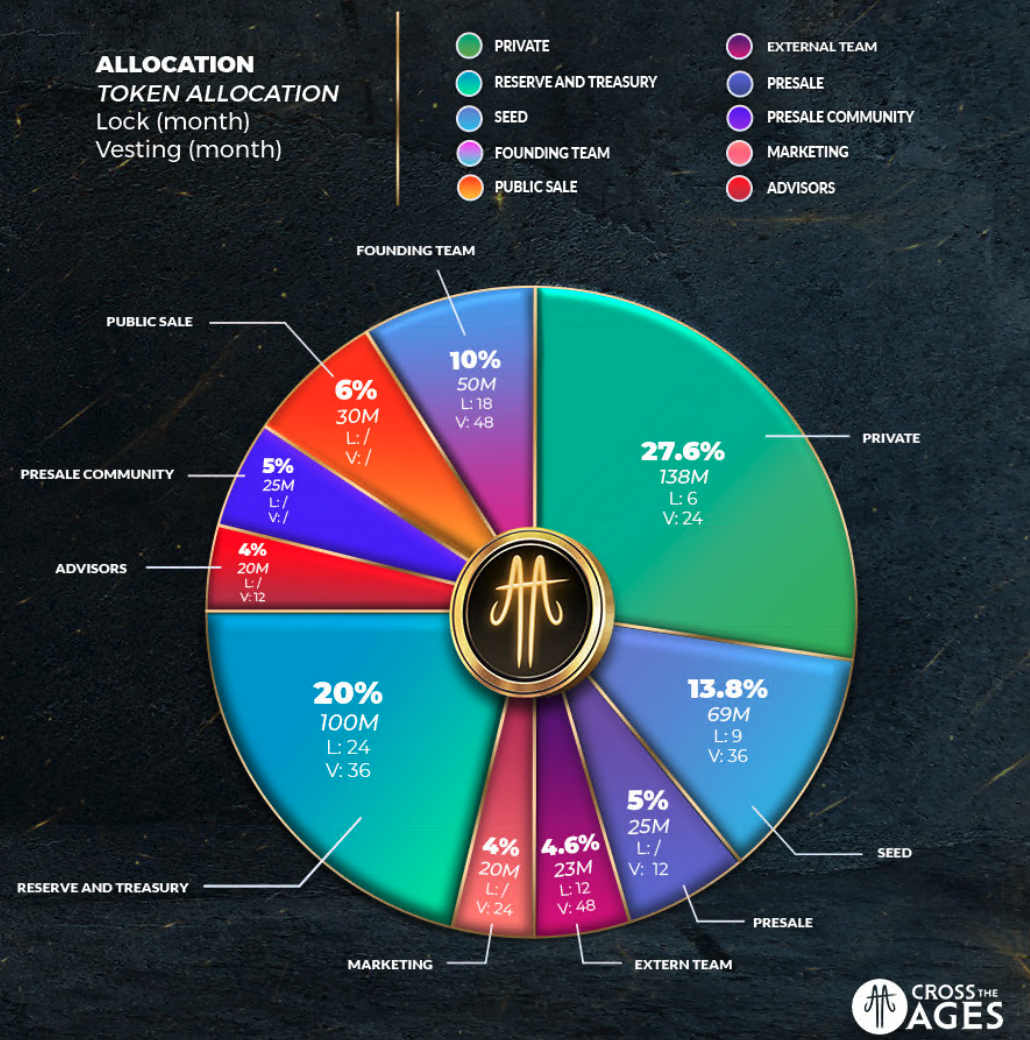
CTA tokens serve as utility tokens within the game, granting primary game advantages and enabling users to transition from the digital space to the physical world. The total supply is 500,000,000 CTA tokens, with no future inflation. The token distribution is as follows:
The CTA token plays a crucial role throughout the entire gaming ecosystem, with diverse use cases:
- Within the game environment, transactions for various commodities require holding CTA tokens.
- NFT minting, merging, lending, and other forms all necessitate holding CTA tokens. NFTs can also be bought and sold on the market in the form of CTA tokens.
- Staking—encouraging players to stake their CTA tokens to earn valuable assets and increase liquidity in the CTA pool. Additionally, stakers of CTA tokens will have exclusive access to Metaverse land sales during the initial issuance period.
- Primary in-game advantages—primary game advantages such as saving game progress, accessing valuable NFTs outside the series, special access to guild matches and tournaments, and accessing exclusive content.
- Governance—as the game progresses, the community engages in game development and metaverse construction through voting and governance participation.
In June, Pranah currency will be completely replaced by CTA tokens, using a single currency to make the players experience more convenient.
Future Development and Challenges
Currently, there are 1572 Web3 games, with an average of 3 million active users daily. The Web3 gaming industry is showing growth compared to 2023, with games being considered as the traffic entry point for Web3. Meanwhile, the competition among Web3 gaming projects is expected to intensify.
Cross the Ages has developed valuable IP for both Web2 and Web3 audiences, with products capable of generating multiple revenue streams, providing momentum for project development. The project has received support from major game publishers like Ubisoft, Animoca Brands, and Square Enix, which have provided solid marketing efforts and opportunities to enter mature communities for Cross the Ages. Cross the Ages has the potential to carve out a place in the Web3 gaming arena. However, CTA still needs to continually update its products to maintain the continuity of its IP and keep users engaged with fresh content.