3 Stablecoins Command Positions in the Crypto Economy’s Top 10, Another Fiat-Pegged Token Is Close to Joining

newsbtcPublicado a 2022-05-07Actualizado a 2022-05-07

Resumen

It is the first time in crypto history that three stablecoin market valuations have existed in the top ten market cap positions.

3 Stablecoins Command Positions in the Crypto Economy’s Top 10, Another Fiat-Pegged Token Is Close to Joining

The last five weeks has been brutal for digital currencies as more than 21% has been shaved off the crypto economy’s fiat value since March 27. While all the crypto assets combined shed roughly 0.8% in the last 24 hours, bitcoin has lost 9.4% since last week and seven day statistics show ethereum has dropped 8.1% against the U.S. dollar. Since the crypto economy’s significant losses, the stablecoin UST has managed to take the top ten market capitalization among 13,439 crypto assets.

3 Stablecoins Hold Top 10 Positions, Terrausd Enters the 10th Spot

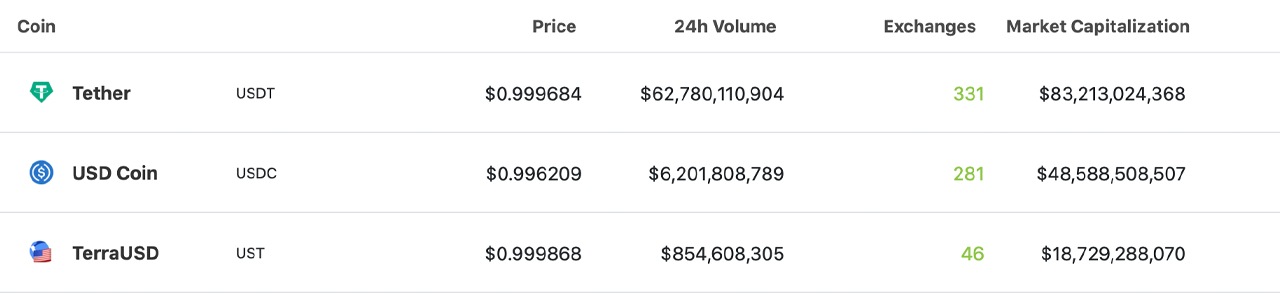
Today, three stablecoins now command a position in the top ten largest cryptocurrency market capitalizations. While tether (USDT) and usd coin (USDC) have been in the top ten for quite some time, Terra’s UST is now holding the top ten spot since the crypto economy’s market conditions turned red. Another fundamental that pushed UST higher is the fact that the algorithmic stablecoin’s market valuation expanded by 12.3% over the last 30 days.
3 Stablecoins Command Positions in the Crypto Economy’s Top 10, Another Fiat-Pegged Token Is Close to Joining

It is the first time in crypto history that three stablecoin market valuations have existed in the top ten market cap positions.

There hasnt been another time when three stablecoins command a top ten position and fiat-pegged tokens have been a prominent force in the crypto ecosystem. Tether (USDT) has a significantly large $83.3 billion market capitalization, which represents 4.78% of the entire crypto economy.

USDC has $48.7 billion market capitalization, which equates to 2.79% of the $1.7 trillion crypto economy. Terrausd (UST) has a valuation of around $18.76 billion and it represents 1.07% of the aggregate value of all 13,439 crypto assets combined.

5 Crypto Assets Represent 66.44% of the Crypto Economy, BUSD and DAI Hold Positions in the Top 20

Between all three of the stablecoins in the top ten, USDT, USDC, and UST represent 8.64% of the crypto economy’s fiat value. That’s pretty large seeing how bitcoin’s (BTC) market valuation is 39.2% and ethereum’s (ETH) capitalization is 18.6% of today’s $1.7 trillion total.

BTC, ETH, USDT, USDC, and UST equate to 66.44% of the entire crypto economy’s capitalization on May 6, 2022. In addition to the prominence of three stablecoins in the top ten crypto market positions, the Binance stablecoin BUSD is currently in the 11th spot with a $17.5 billion market cap.

Besides USDT, USDC, and UST, there’s only two stablecoin projects in the top 20 largest crypto market valuations. The stablecoins include BUSD and Makerdao’s decentralized stablecoin DAI.

Years ago when stablecoins were scoffed at and taken for granted, it’s likely no one thought the fiat-pegged token project’s would be top ten contenders. Furthermore, the entire lot of stablecoins today is worth $189.52 billion. Out of today’s $110.46 billion in global trade volume, stablecoin swaps represent $75.82 billion of Friday’s volume.


Lecturas Relacionadas

¿Por qué está todo el mundo nervioso por la subida de tipos de Japón?

En junio de 2026, el Banco de Japón elevó los tipos de interés al 1%, su primer aumento significativo desde 1995. Aunque esta cifra sigue siendo baja comparada con Estados Unidos o Europa, marca un cambio de rumbo crucial para la economía global. Japón, tras casi tres décadas de tipos cero o negativos, había actuado como el principal centro de financiación barata del mundo. A través del conocido "carry trade del yen", los inversores internacionales tomaban préstamos en yenes de bajo coste para invertir en activos de mayor rendimiento en todo el mundo, impulsando así mercados bursátiles, bonos y bienes inmuebles a nivel global. La decisión del banco central japonés responde a un cambio estructural interno: una inflación sostenida por encima del objetivo del 2%, un crecimiento salarial notable tras décadas de estancamiento, y la presión del yen débil. Sin embargo, la preocupación global no se centra en el nivel del 1%, sino en la tendencia. Si Japón abandona permanentemente su política de dinero ultrabarato, podría desencadenar un proceso de desapalancamiento a escala mundial. Los inversores que dependían de financiación barata en yenes podrían verse forzados a revaluar sus estrategias y reducir riesgo, lo que contraería la liquidez global y afectaría a la valoración de los activos de riesgo. No obstante, la dirección final de los flujos de capital la marcará principalmente la política de la Reserva Federal de EE.UU. Mientras persista un amplio diferencial de tipos entre EE.UU. y Japón, el atractivo del dólar seguirá siendo fuerte. El verdadero punto de inflexión se produciría si la Fed inicia un ciclo de recortes mientras Japón sigue subiendo los tipos. En definitiva, el movimiento del Banco de Japón simboliza el posible fin de una era de financiación ilimitada y barata, lo que obligaría a los mercados globales a redefinir sus lógicas de inversión y riesgo.

marsbitHace 4 hora(s)

¿Por qué está todo el mundo nervioso por la subida de tipos de Japón?

marsbitHace 4 hora(s)

El Congreso Aplaza la Prohibición de la CBDC hasta 2030 mediante una Importante Ley de Reforma de Vivienda

Los legisladores han aprobado un proyecto de ley de reforma de vivienda, la "Ley del Camino a la Vivienda del Siglo XXI", que incluye una prohibición temporal hasta el 31 de diciembre de 2030 para que la Reserva Federal emita un dólar digital (CBDC). La medida, integrada en esta legislación bipartidista más amplia, define el CBDC como un activo digital denominado en dólares y accesible para todos los estadounidenses. Sus defensores argumentan que esta pausa permite más tiempo para evaluar los impactos potenciales, reflejando preocupaciones sobre privacidad, vigilancia financiera y el papel del gobierno en los pagos digitales. La prohibición se aplicaría a cualquier CBDC minorista, ya sea emitida directamente por la Fed o a través de intermediarios, aunque se contemplan excepciones para dólares digitales privados que mantengan un nivel de privacidad comparable al efectivo físico. Aunque el foco del proyecto de ley son las reformas para mejorar la vivienda asequible y la oferta, la cláusula sobre el CBDC ha captado una atención significativa en la comunidad cripto, ya que podría influir en el futuro de los pagos digitales y en el debate sobre el lugar de los activos digitales en el sistema financiero del país. El desarrollo del proceso legislativo determinará si la prohibición entra en vigor durante la próxima década.

TheNewsCryptoHace 5 hora(s)

El Congreso Aplaza la Prohibición de la CBDC hasta 2030 mediante una Importante Ley de Reforma de Vivienda

TheNewsCryptoHace 5 hora(s)

Trading

Spot
Futuros
活动图片