Trump-backed crypto project WLFI to obtain U.S. bank license. What’s the purpose

cryptonews.ruPublished on 2026-08-24Last updated on 2026-08-24

Abstract

The Trump family-supported cryptocurrency project World Liberty Financial (WLFI) has received preliminary approval to establish a national trust bank in the United States, according to Bloomberg. This status, while limiting activities like lending, would allow the company to issue and service its USD1 stablecoin under federal oversight from the Office of the Comptroller of the Currency (OCC). Currently operating under state law, the move to a federal charter aims to mitigate legal risks from varying state regulations. To obtain the final charter, WLFI must still meet requirements for capital, corporate governance, and auditing. The USD1 stablecoin, launched in spring 2025 and backed by U.S. government bonds, saw its market capitalization exceed $5 billion in early 2026 but has since declined to approximately $3.98 billion. The project's revenue is generated from interest on the treasury bonds backing the stablecoin, meaning growth in the token's issuance increases demand for U.S. debt and potential income for the Trump family as co-founders.

The World Libery Financial crypto project ($WLFI), backed by the Trump family, has received approval to establish a national trust bank in the United States, reports Bloomberg. The activities of such banks are limited but allow for the issuance of stablecoins.

Trusts cannot issue loans, but this status will enable $WLFI to issue and service its token $USD1 under the federal supervision of the U.S. Office of the Comptroller of the Currency (OCC). Currently, the company operates under state law. This entails legal risks for operations in other states where regulations may differ significantly.

To become a trust bank, the project still needs to meet capital requirements, as well as corporate governance and audit standards. Then World Libery Financial can obtain final approval.

$USD1 was launched in the spring of 2025. At the beginning of 2026, the capitalization of the Trump stablecoin already exceeded $5 billion, but it has currently fallen to $3.98 billion.

The World Liberty stablecoin is backed by U.S. government bonds, and the issuer's income is generated from the interest on these securities. As the capitalization grows (through the issuance of new tokens), additional demand for government debt emerges simultaneously, increasing the income of the Trump family as co-founders of the company.

end-content

Trending Cryptos

Related Questions

QWhat is the main news regarding Trump's crypto project WLFI reported by Bloomberg?

AThe cryptocurrency project World Liberty Financial ($WLFI), supported by the Trump family, has received approval to establish a national trust bank in the United States.

QWhat key advantage does the trust bank status provide to WLFI's stablecoin operations?

ATrust bank status will allow WLFI to issue and service its stablecoin $USD1 under the federal supervision of the Office of the Comptroller of the Currency (OCC), providing regulatory consistency across states.

QWhat are the final requirements WLFI must meet to obtain its definitive trust bank license?

AWLFI must meet requirements regarding capital, corporate governance, and audit standards to receive final approval for its trust bank license.

QWhat is the current market capitalization of Trump's stablecoin $USD1 as mentioned in the article?

AAs mentioned in the article, the current market capitalization of the $USD1 stablecoin has declined to approximately $3.98 billion.

QHow is the $USD1 stablecoin backed, and how does the issuer generate revenue from it?

AThe $USD1 stablecoin is backed by U.S. government bonds. The issuer's revenue is generated from the interest earned on these bonds. Increased issuance of tokens also creates additional demand for U.S. government debt, potentially increasing income for the Trump family as co-founders.

Related Reads

He Xiaopeng Breaks Unitree's Record

He Xiaopeng Breaks Unitree's Record: Xiaopeng Group's Humanoid Robot Arm Valued at $6.3 Billion In a landmark deal mirroring Unitree's recent listing, Xiaopeng Group has announced the completion of the first private equity financing round for its humanoid robotics business, led by IDG Capital. The funding round raised over $900 million (approximately 6.5 billion RMB), resulting in a post-investment valuation exceeding $6.3 billion (approximately 43 billion RMB). This surpasses the total funds raised by Unitree Technology in its recent IPO. He Xiaopeng, founder of XPeng Motors, is personally leading the robotics venture as its CEO. Established in 2020, the company has quickly become a super unicorn. Its latest robot model, IRON, debuted in late 2025 with a highly realistic, human-proportioned design and the ability to perform complex movements like a "catwalk," sparking significant online attention. The round saw participation from IDG Capital, Gaorong Capital, and strategic investors Tencent and Alibaba. He Xiaopeng stated that Xiaopeng IRON is on the cusp of mass production, with plans for commercial deployment starting from XPeng's own stores and campuses by the end of 2026, followed by official market launch in 2027. He believes each IRON robot's lifetime revenue and profit contribution will significantly exceed that of the current automotive business per vehicle. This development comes amidst a heated race in China's embodied AI sector, following Unitree's recent listing as the "first humanoid robot stock." Major automotive giants, including Tesla, GAC Group, Changan, Li Auto, and BYD, are now entering the field. Leveraging their existing expertise in autonomous driving, supply chains, and mass manufacturing, these companies pose a formidable challenge to standalone robotics startups. The competition signals a shift in the industry, where future success will depend on demonstrable commercialization, mass production capabilities, and clear revenue paths rather than just technological concepts.

marsbit6m ago

He Xiaopeng Breaks Unitree's Record

marsbit6m ago

Coinbase Uses Chainlink to Deeper Integrate Tokenized Stocks into DeFi

Coinbase has selected Chainlink to provide pricing infrastructure for its tokenized stocks, enabling blockchain-based versions of stocks like Apple and NVIDIA to be used freely on decentralized lending and trading markets. This is particularly significant for non-U.S. cryptocurrency users, allowing them to utilize tokenized U.S. equities similarly to how DeFi currently uses stablecoins and tokenized Treasuries. The integration aims to move these tokens beyond mere storage—making them viable as collateral, liquidity, and building blocks within DeFi protocols. For tokenized stocks to hold value or function in DeFi, protocols require reliable price determination. Chainlink’s oracles will supply this critical data, addressing a key gap—especially in lending markets where accurate collateral valuation and liquidation mechanisms depend on trusted price feeds. The stocks, which trade on Coinbase’s Ethereum Layer-2 network Base using the B20 token standard, are structured to mirror real-world equities, with bankruptcy-remote protections. Holders can own fractional shares, trade them on platforms like Aerodrome, and use positions (e.g., in NVIDIA) as loan collateral on Aave. Legally, the initiative operates outside the U.S., with Coinbase securing regulatory approval from Abu Dhabi’s FSRA to run its global tokenization hub. Token holders receive dividends and voting rights, though access remains limited to eligible non-U.S. users, and transfers are subject to sanctions screening and wallet-level freezes. The tokenized equity market has grown rapidly, with its market cap soaring from $329 million in June 2025 to around $1.7 billion by June 2026, and monthly on-chain transfer volume exploding from $53 million to $9.22 billion over the same period. Despite an overall decline in DeFi deposits, risk-weighted deposits for tokenized real-world assets on DeFi lending platforms tripled from $2.3 billion in Q2 2025 to $7.4 billion in Q2 2026. While Coinbase faces competition from players like Nasdaq (partnering with Kraken’s parent) and Robinhood Chain (a current leader in tokenized stock holders), the key challenge is driving active use—transforming tokenized shares from static digital representations into productive components of the blockchain financial ecosystem. As noted by industry observers, the goal is for these assets to “do something on the blockchain,” with Chainlink’s reliable data enabling that crucial DeFi interoperability.

cryptonews.ru8m ago

Coinbase Uses Chainlink to Deeper Integrate Tokenized Stocks into DeFi

cryptonews.ru8m ago

Bitwise's XRP ETF Trading Volume Surpasses $200 Million Over Three Trading Sessions

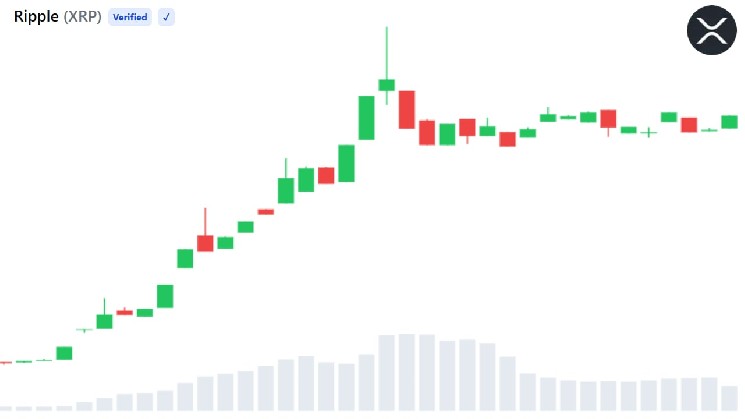
Bitwise XRP ETF Trading Volume Surges, Exceeds $200 Million Over Three Sessions Trading activity in the Bitwise XRP ETF ($XRP) accelerated sharply over the three sessions ending August 24, marking its most active period since launching in November 2025. According to Bitwise President Teddy Fusaro, volume topped $80 million on August 24, after exceeding $60 million on each of the two prior days, bringing the three-day total over $200 million. This secondary market trading surge coincided with a sharp price recovery for XRP in August. The record volumes followed a rally that boosted the fund's Net Asset Value per share by 11.71% to $15.36 by August 20. The broader crypto market uptick was partly attributed to a U.S. Treasury announcement to significantly increase long-term bond buybacks starting September 9. As of August 23, the fund held approximately 328.2 million XRP valued at $484.6 million. The article notes that high ETF trading volume reflects secondary market activity and does not necessarily equate to new capital inflows or additional token purchases. It highlights a separate challenge for XRP: whether demand can absorb the token's increasing circulating supply, which grew 5.5% year-over-year from escrow releases. In H1 2026, U.S. spot XRP exchange-traded products absorbed an estimated 14.8% of this supply increase. Other potential demand sources mentioned include AI agents potentially using the XRP Ledger for settlements and institutional payments, though digital assets currently represent a negligible portion of the vast payment volumes processed by Ripple's acquired companies. The Bitwise XRP ETF, trading on NYSE Arca, provides investors with traditional brokerage account access to XRP, which is custodied by Coinbase Custody Trust Co.

cryptonews.ru11m ago

Bitwise's XRP ETF Trading Volume Surpasses $200 Million Over Three Trading Sessions

cryptonews.ru11m ago

Trading

Spot

Hot Articles

What is $BANK

Bank AI: A Revolutionary Step in the Future of Banking Introduction In an era marked by rapid advancements in technology, Bank AI stands at the intersection of artificial intelligence (AI) and banking services. This innovative project seeks to redefine the financial landscape, enhancing operational efficiency, security measures, and customer experiences through the power of AI. As we embark on this exploration of Bank AI, we will delve into what the project entails, its operational dynamics, its historical context, and significant milestones. What is Bank AI? At its core, Bank AI represents a transformative initiative aimed at integrating artificial intelligence into various banking operations. This project harnesses the capabilities of AI to automate processes, improve risk management protocols, and enhance customer interaction through personalized services. The primary objectives of Bank AI include: Automation of Banking Functions: By leveraging AI technologies, Bank AI aims to automate routine tasks, reducing the burden on human resources and enhancing efficiency. Enhanced Risk Management: The project utilises AI algorithms to predict and identify risks, thereby fortifying security measures against fraud and other threats. Personalization of Banking Services: Bank AI focuses on offering tailored financial products and services by analysing customer data and behaviours. Improving Customer Experience: The implementation of AI-driven solutions, such as chatbots and virtual assistants, aims to provide users with more human-like interactions, revolutionising the way customers engage with banks. With these goals, Bank AI positions itself as a crucial player in rendering banking more efficient, secure, and user-centric. Who is the Creator of Bank AI? Details regarding the creator of Bank AI remain unknown. As such, no specific individual or organisation has been identified in the available information. The anonymity surrounding the project's inception raises questions but does not detract from its ambitious vision and objectives. Who are the Investors of Bank AI? Similar to the project's creator, specific information regarding the investors or supporting organisations of Bank AI has not been disclosed. Without this information, it is challenging to outline the financial backing and institutional support that might be propelling the project forward. Nevertheless, the importance of having a robust investment foundation is pivotal for sustaining development in such an innovative field. How Does Bank AI Work? Bank AI operates on several innovative fronts, focusing on unique factors that differentiate it from traditional banking frameworks. Below are key operational features: Automation: By applying machine learning algorithms, Bank AI automates various manual processes within banks. This results in reduced operational costs and allows human workers to redirect their efforts towards more strategic activities. Advanced Risk Management: The integration of AI into risk management practices equips banks with tools to accurately predict potential threats such as fraud, ensuring that customer information and assets remain secure. Tailored Financial Recommendations: Through continuous learning from customer interactions, the AI systems develop a nuanced understanding of user needs, enabling them to offer tailored advice on financial decisions. Enhanced Customer Interactions: Utilizing chatbots and virtual assistants powered by AI, Bank AI enables a more engaging customer experience, allowing users to have their queries resolved quickly, thus reducing wait times and improving satisfaction levels. Together, these operational features position Bank AI as a pioneer in the banking sector, establishing new benchmarks for service delivery and operational excellence. Timeline of Bank AI Understanding the trajectory of Bank AI requires a look at its historical context. Below is a timeline highlighting important milestones and developments: Early 2010s: The conceptualization of AI integration into banking services began to gain attention as banking institutions recognised the potential benefits. 2018: A marked increase in the implementation of AI technologies occurred when banks started using AI tools like chatbots for basic customer service and risk management systems for improved security handling. 2023: The sophistication of AI continued to advance, with generative AI being introduced for more complex tasks such as document processing and real-time investment analysis. This year marked a significant leap in the capabilities afforded to banks by AI technology. 2024-Current Status: As of this year, Bank AI is on an upward trajectory, with ongoing research and developments poised to further enhance capabilities in banking operations. Continued exploration of AI applications hints at exciting developments yet to come. Key Points About Bank AI Integration of AI in Banking: Bank AI focuses on adopting artificial intelligence to streamline banking processes and improve user experiences. Automation and Risk Management Focus: The project strongly emphasizes these areas, aiming to shift the burden of routine tasks while enhancing security frameworks through predictive analytics. Personalized Banking Solutions: By harnessing customer data, Bank AI enables tailored banking services that cater to individual user needs. Commitment to Development: Bank AI remains committed to ongoing research and development efforts, ensuring its adaptability and ongoing relevance as technology continues to evolve. Conclusion In summary, Bank AI exemplifies a crucial step forward in the banking industry, leveraging artificial intelligence to reshape operational paradigms, enhance security, and promote customer satisfaction. Despite gaps in information surrounding the creator and investors, the clear objectives and functional mechanisms of Bank AI provide a strong foundation for its ongoing evolution. As AI technology continues to advance and merge with the banking sector, Bank AI is well-positioned to significantly impact the future of financial services, enhancing the way we understand and interact with banking.

1.9k Total ViewsPublished 2024.04.05Updated 2024.12.03

What is $BANK

How to Buy BANK

Welcome to HTX.com! We've made purchasing Lorenzo Protocol (BANK) simple and convenient. Follow our step-by-step guide to embark on your crypto journey.Step 1: Create Your HTX AccountUse your email or phone number to sign up for a free account on HTX. Experience a hassle-free registration journey and unlock all features.Get My AccountStep 2: Go to Buy Crypto and Choose Your Payment MethodCredit/Debit Card: Use your Visa or Mastercard to buy Lorenzo Protocol (BANK) instantly.Balance: Use funds from your HTX account balance to trade seamlessly.Third Parties: We've added popular payment methods such as Google Pay and Apple Pay to enhance convenience.P2P: Trade directly with other users on HTX.Over-the-Counter (OTC): We offer tailor-made services and competitive exchange rates for traders.Step 3: Store Your Lorenzo Protocol (BANK)After purchasing your Lorenzo Protocol (BANK), store it in your HTX account. Alternatively, you can send it elsewhere via blockchain transfer or use it to trade other cryptocurrencies.Step 4: Trade Lorenzo Protocol (BANK)Easily trade Lorenzo Protocol (BANK) on HTX's spot market. Simply access your account, select your trading pair, execute your trades, and monitor in real-time. We offer a user-friendly experience for both beginners and seasoned traders.

6.8k Total ViewsPublished 2025.05.09Updated 2026.06.02

How to Buy BANK

Discussions

Welcome to the HTX Community. Here, you can stay informed about the latest platform developments and gain access to professional market insights. Users' opinions on the price of BANK (BANK) are presented below.

活动图片