Viewpoint: A $4 Billion Buyback Can Fix Liquidity, But Not U.S. Fiscal Health

marsbitPublished on 2026-08-20Last updated on 2026-08-20

Abstract

On August 19, the U.S. Treasury announced it would increase its maximum single-operation buyback size for long-term bonds from $2 billion to at least $4 billion, aiming to improve market liquidity. This move initially led to a pullback in long-term yields, such as the 30-year Treasury yield which had recently hit a 2007 high near 5.34%, sparking talk of potential "Treasury support." However, an opposing perspective argues this is merely a temporary fix. While buybacks can enhance trading conditions for older, less-liquid bonds, they do not address the underlying fiscal pressures. The Treasury's actions are a form of debt management, not monetary stimulus like QE; the funds used for buybacks ultimately come from cash balances or new borrowing. They do not reduce the government's overall financing needs. The core issue is growing fiscal supply. With the federal deficit reaching a record $432 billion in July 2026 and cumulative deficits already surpassing the prior fiscal year's total, the market faces a massive wave of new debt issuance. The recent surge in long-term yields may reflect a repricing of this persistent fiscal risk and the associated term premium, rather than just a liquidity shortage. Furthermore, demand-side challenges loom. Foreign holdings of U.S. Treasuries have recently declined, and if official demand weakens, the market will rely more on price-sensitive private investors, potentially requiring higher yields to clear future auctions. In essence, the Trea...

Editor's Note: On August 19, the U.S. Treasury Department announced an expansion of its long-term Treasury buyback program, increasing the maximum single-operation size for 10–20 year and 20–30 year Treasury bonds from $2 billion to at least $4 billion. Previously, the yield on the 30-year Treasury note had briefly risen to around 5.34%, the highest level since 2007. Following the announcement, long-end yields fell rapidly.

This gave the market a straightforward bullish narrative: the Treasury is taking more proactive steps to improve the liquidity of long-term bonds, potentially even creating a kind of "Treasury floor" expectation.

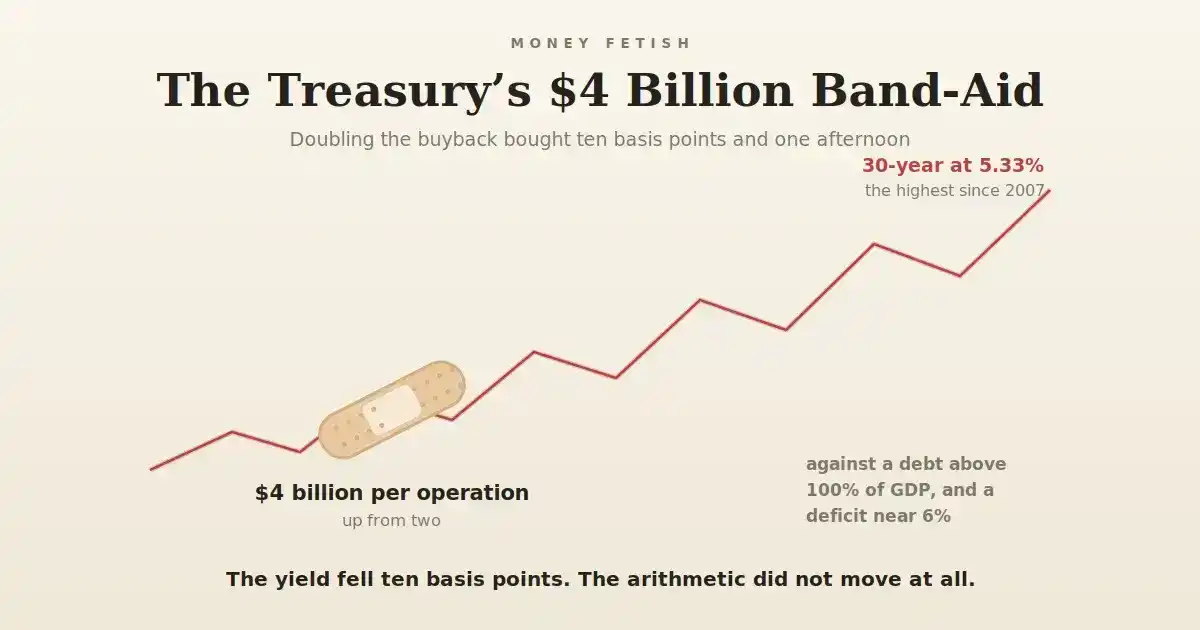
However, Marcus Nunes, in his article "The Treasury's $4 Billion Band-Aid," offers a counterpoint: while buybacks can indeed alleviate liquidity issues, if the pressure on long-term bonds stems from larger fiscal deficits, increased bond supply, and weaker marginal buying interest, then a $4 billion buyback does not address the real underlying conflict.

In other words, the market needs to distinguish between two things: the Treasury can make bonds easier to trade, but it cannot use buybacks to reduce the total amount the U.S. government ultimately needs to finance.

The following is a translated compilation of the original article:

On August 19, U.S. Treasury Secretary Scott Bessent announced an increase in the maximum single-operation size for liquidity support buybacks of 10–20 year and 20–30 year Treasury bonds, from $2 billion to at least $4 billion. The market reaction was swift. The yield on the 30-year Treasury note, which had earlier climbed to about 5.34%, subsequently retreated noticeably, while assets like stocks and gold strengthened in tandem.

But the author, Nunes, believes this reaction risks causing the market to overlook a more fundamental issue: Treasury buybacks address liquidity, not the fiscal deficit.

Buybacks Can Improve Trading, But Don't Reduce Government Financing Needs

Treasury buybacks are not quantitative easing.

When the Federal Reserve conducts QE, it can create base money to purchase Treasuries by expanding its balance sheet; the Treasury lacks this ability. The funds it uses to buy back old debt ultimately still come from its cash balance or from new debt issuance.

Therefore, Treasury buybacks are fundamentally more akin to debt structure management.

They can repurchase illiquid older securities, improving market liquidity, and can to some extent increase demand for bonds of specific maturities. However, they do not change one fact: the U.S. government still needs to issue bonds to finance its fiscal deficit.

The scale difference is particularly stark. The U.S. Treasury previously estimated needing to borrow a net $739 billion in the third quarter of 2026, while this single-operation buyback increase for long-term Treasuries is merely from $2 billion to at least $4 billion.

This is why Nunes refers to it as a "Band-Aid." Four billion dollars is enough to improve trading conditions for some long-term bonds, but it is unlikely to alter the overall supply and demand dynamics of the entire U.S. Treasury market.
What's Really Weighing on Long Bonds is the Growing Fiscal Supply

In Nunes's framework, the recent rise of the 30-year Treasury yield above 5% cannot be interpreted solely as a liquidity issue. More importantly, the amount the U.S. government needs to finance remains substantial.

In July 2026, the U.S. federal budget deficit reached $432 billion, a 48% year-over-year increase, setting a record high for any July. The cumulative deficit for the first 10 months of the fiscal year stands at approximately $1.8 trillion, already surpassing the total for the entire 2025 fiscal year.
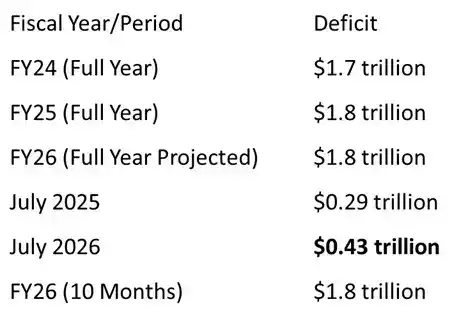
U.S. Federal Deficit – Year-on-Year Comparison

Meanwhile, total U.S. federal debt surpassed $40 trillion on August 19. As the debt stock grows and borrowing costs have risen in recent years, interest expenses are also climbing higher.

This means the core problem facing the U.S. Treasury is not that "old bonds are hard to trade," but rather: who will absorb the massive future supply of new bonds? If investors believe fiscal deficits will remain elevated in the future, they will demand higher yields to absorb the supply of long-term bonds.

From this perspective, the 30-year yield breaking through 5% may not be a temporary market malfunction, but rather a repricing of U.S. fiscal risk and duration risk.

The Buyer Problem Can't Be Solved by $4 Billion Either

Nunes also highlights the shift in foreign demand.

According to the U.S. Treasury's TIC data, foreign holdings of U.S. Treasuries decreased by approximately $72.1 billion month-over-month in June, with Japan, China, and the UK all seeing declines of varying degrees. This is not enough to prove foreign investors are "fleeing U.S. Treasuries en masse," as single-month holdings can be affected by exchange rates, custodian location changes, and asset allocation shifts. Furthermore, TIC data itself cannot fully identify the ultimate owners of securities. However, it at least indicates that previously stable foreign demand can no longer be taken for granted.
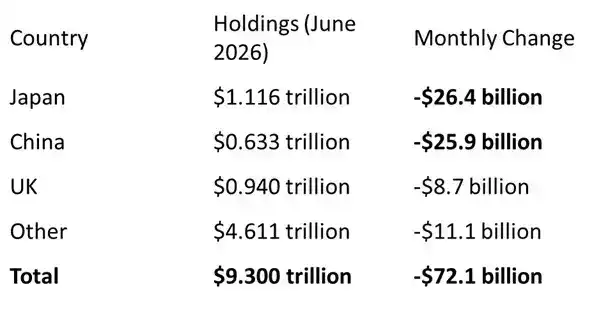
Foreign Holdings of U.S. Treasury Securities (June 2026)

More important is the buyer structure. If the willingness of foreign official institutions to absorb U.S. Treasuries declines, the U.S. will need to rely more on private investors. Private capital typically places greater emphasis on price and yield, meaning the market may require higher long-term interest rates to attract sufficient funds to take on the growing bond supply.

This is also why simply increasing buybacks doesn't solve the problem. The Treasury can buy back a portion of old debt, but it cannot dictate at what price other investors are willing to hold the large volumes of long-term bonds the U.S. will issue in the future.

The Real Divide: Is This a Liquidity Problem or a Fiscal Problem?

Supporters of expanding buybacks could argue that the Treasury is not attempting to solve the fiscal deficit. Buybacks are inherently a market liquidity tool. If they can improve the trading of old securities and reduce market friction, they have already achieved their policy objective. In this sense, criticizing buybacks with "$4 billion can't fix the deficit" might itself confuse the purpose of the policy tool.

But the real question Nunes poses is this: if the primary force driving long-end yields higher has shifted from liquidity to fiscal supply, then continuing to use liquidity tools will naturally have limited effectiveness.

These two explanations correspond to two completely different market judgments. If the recent selloff in long bonds was mainly due to insufficient market depth, deteriorating liquidity in old securities, and short-term positioning shocks, then the Treasury's expanded buyback might be enough to stabilize the market. However, if the rise in long-end yields primarily reflects persistent fiscal deficits, larger long-term bond supply, and higher term premia, then buybacks can only make the adjustment process smoother; they are unlikely to change the ultimate level of yields.

This is the article's core judgment: The Treasury can improve the "trading problem" in the Treasury market, but it cannot buy away America's "fiscal problem" through buybacks.

What truly needs to be watched next is not how much the Treasury increases its next buyback size, but whether long-term Treasury auctions continue to attract sufficient demand, whether the fiscal deficit narrows, and whether higher yields can re-attract foreign and private buyers.

If these variables do not improve, then the yield decline brought about by the $4 billion initiative is more likely to be a short-term buffer, rather than a true reversal of the pressure on U.S. long bonds.


Trending Cryptos

Related Questions

QWhat is the main action taken by the U.S. Treasury according to the article, and what was its immediate market impact?

AThe U.S. Treasury announced an expansion of its long-term bond repurchase program, increasing the maximum single-operation size for 10–20 year and 20–30 year Treasuries from $2 billion to at least $4 billion. The immediate market impact was a rapid decline in long-term bond yields, particularly the 30-year yield which had previously reached a high, and a simultaneous strengthening of assets like stocks and gold.

QAccording to Marcus Nunes's perspective in the article, what fundamental problem does the Treasury's bond repurchase fail to address?

AAccording to Marcus Nunes, the Treasury's bond repurchase program addresses market liquidity issues but fails to address the fundamental problem of the U.S. government's large fiscal deficits and the associated high financing needs. The repurchase does not reduce the total amount the government ultimately needs to borrow.

QWhy does the author refer to the $4 billion repurchase increase as a 'Band-Aid' solution?

AThe author refers to it as a 'Band-Aid' because while the $4 billion increase can improve trading conditions for some long-term bonds, its scale is negligible compared to the broader financing needs (e.g., an estimated $739 billion in net borrowing needed for a single quarter). Therefore, it cannot meaningfully alter the overall supply and demand dynamics of the U.S. Treasury market driven by large fiscal deficits.

QWhat are the two main factors, beyond liquidity, that the article suggests are putting upward pressure on long-term bond yields?

ABeyond liquidity issues, the two main factors are: 1) The increasingly large supply of new bonds required to finance persistent and growing U.S. federal budget deficits. 2) Potential weakening in demand from traditional major buyers, such as foreign official institutions, which may require higher yields to attract sufficient private investor capital to absorb the supply.

QWhat does the article conclude about the true test for the U.S. long-term bond market, beyond the Treasury's repurchase actions?

AThe article concludes that the true test for the U.S. long-term bond market is not the size of Treasury repurchases, but whether upcoming long-term bond auctions continue to attract sufficient demand, whether the fiscal deficit narrows, and whether higher yields can successfully re-attract foreign and private investor buying. Without improvement in these underlying variables, the yield decline from the repurchase program is likely just a short-term buffer, not a fundamental reversal of pressure.

Related Reads

The article "Strategy" examines in detail 6 securities built on bitcoin

In the article "Strategy," six securities based on Bitcoin are examined. Strategy Inc. (Nasdaq: MSTR) announced investor materials detailing its common stock and five preferred securities. Executive Chairman Michael Saylor emphasized this with the comment, "Six securities. One Strategy." While each targets different investor goals, all depend on Strategy's financial health and capital management decisions. The capital structure positions common shares of MSTR at the bottom, absorbing profit or loss after debt and priority claims. These shares represent a residual stake in the company's net reserves, including its software and capital markets businesses, but provide no direct claim on specific bitcoins. The five preferred securities offer varied cash flows and priority levels: - STRC: Variable cumulative dividends, currently 12% annually on a $100 stated value, with twice-monthly cash payments. - STRF: Higher priority, paying fixed 10% annual cumulative dividends with quarterly cash payments. - $STRK: Lower priority, combining 8% cumulative dividends with a conversion right into MSTR shares. - STRD: Offers 10% annual dividends but has the weakest claim; its quarterly cash dividends are non-cumulative. - STRE: Denominated in euros, offers 10% cumulative dividends on €100, with quarterly cash payments and a priority ranking between other issues. Strategy's broader "Digital Debt Capital" concept involves maintaining a dollar reserve for dividend and interest payments, and permitting limited Bitcoin sales to fund this reserve. However, this does not make the preferred securities direct, collateralized claims on the company's Bitcoin holdings. Investors face risks beyond Bitcoin's price volatility, including issuer credit risk, interest rate changes, dividend decisions, liquidity, and capital structure priority. These securities add potential dividend income to Bitcoin exposure, making returns contingent on the company's financial stability, Bitcoin's performance, and management's capital allocation decisions.

cryptonews.ru18m ago

The article "Strategy" examines in detail 6 securities built on bitcoin

cryptonews.ru18m ago

Bitcoin Miners Invest Billions in AI as Capital Expenditure Outpaces Revenue by 15 to 1

Public Bitcoin miners are investing billions to diversify into artificial intelligence (AI) and high-performance computing (HPC), but their revenues from these new ventures are not keeping pace with the massive capital expenditures. According to BlocksBridge Consulting, a group of 15 mining and AI data center companies spent $30.7 billion on capital assets in recent periods of 2026, a 42.6% increase from 2025. For nine comparable Bitcoin miners specifically, the gap is stark: they spent $5.11 billion on capital assets in the first half of 2026 while generating only $341.2 million in disclosed AI/HPC revenue, a capital-to-revenue ratio of approximately 15 to 1. Despite this initial disparity, AI and HPC revenues are growing rapidly, jumping 52% quarter-over-quarter in Q2 2026 for these nine miners. The transition from Bitcoin mining to AI infrastructure requires significant upfront investment in substations, buildings, cooling systems, networking gear, and in some cases, GPUs, even for miners with advantages like power contracts. The recent recovery in Bitcoin's price, which surged over 13% to surpass $72,000, may provide some relief to companies still holding major mining operations. In a related strategic shift, CoinShares has rebranded its industry-tracking ETF to focus on "companies powering the digital economy," including Bitcoin miners, AI data center operators, and semiconductor makers.

cryptonews.ru19m ago

Bitcoin Miners Invest Billions in AI as Capital Expenditure Outpaces Revenue by 15 to 1

cryptonews.ru19m ago

Trading

Spot

Hot Articles

How to Buy 4

Welcome to HTX.com! We've made purchasing 4 (4) simple and convenient. Follow our step-by-step guide to embark on your crypto journey.Step 1: Create Your HTX AccountUse your email or phone number to sign up for a free account on HTX. Experience a hassle-free registration journey and unlock all features.Get My AccountStep 2: Go to Buy Crypto and Choose Your Payment MethodCredit/Debit Card: Use your Visa or Mastercard to buy 4 (4) instantly.Balance: Use funds from your HTX account balance to trade seamlessly.Third Parties: We've added popular payment methods such as Google Pay and Apple Pay to enhance convenience.P2P: Trade directly with other users on HTX.Over-the-Counter (OTC): We offer tailor-made services and competitive exchange rates for traders.Step 3: Store Your 4 (4)After purchasing your 4 (4), store it in your HTX account. Alternatively, you can send it elsewhere via blockchain transfer or use it to trade other cryptocurrencies.Step 4: Trade 4 (4)Easily trade 4 (4) on HTX's spot market. Simply access your account, select your trading pair, execute your trades, and monitor in real-time. We offer a user-friendly experience for both beginners and seasoned traders.

5.3k Total ViewsPublished 2025.10.20Updated 2026.06.02

How to Buy 4

Discussions

Welcome to the HTX Community. Here, you can stay informed about the latest platform developments and gain access to professional market insights. Users' opinions on the price of 4 (4) are presented below.

活动图片