Storj Labs Files for Bankruptcy Protection: Can Token Holders Exchange for Company Equity?

Foresight NewsPublished on 2026-07-27Last updated on 2026-07-27

Abstract

Storj Labs, parent company of decentralized cloud storage platform Storj, filed for Chapter 11 bankruptcy protection on July 26 in the U.S. District Court for the Northern District of West Virginia. The company stated its network will operate normally and token functions will be unaffected. Notably, Storj plans to propose a mechanism in its reorganization plan allowing STORJ token holders a path to equity in the restructured company—an unprecedented offer in the crypto industry. However, its feasibility depends on whether any residual value remains after creditor repayments, as token holders are low in the legal priority hierarchy. Founded in 2014, Storj is an early decentralized infrastructure project. It reported a 7x increase in Annual Recurring Revenue (ARR) to approximately $30 million in 2024. In October 2025, it was acquired by Inveniam Capital Partners. Less than a year later, the merged entity entered bankruptcy proceedings. Storj attributed the filing to historical debts from past operations and acquisitions, stating they were too large to be absorbed by business growth. The company also plans to refocus on its core decentralized storage business, likely divesting Valdi, a GPU computing company acquired in 2024. The proposed token-to-equity conversion faces significant legal hurdles. Under U.S. bankruptcy law, creditors are paid before equity holders, and utility token holders are not automatically recognized as equity members. The details—such as eligibility, all...


Written by: ChandlerZ, Foresight News


Storj Labs, the parent company of the decentralized cloud storage platform Storj, filed for Chapter 11 bankruptcy protection in the U.S. Bankruptcy Court for the Northern District of West Virginia on July 26.
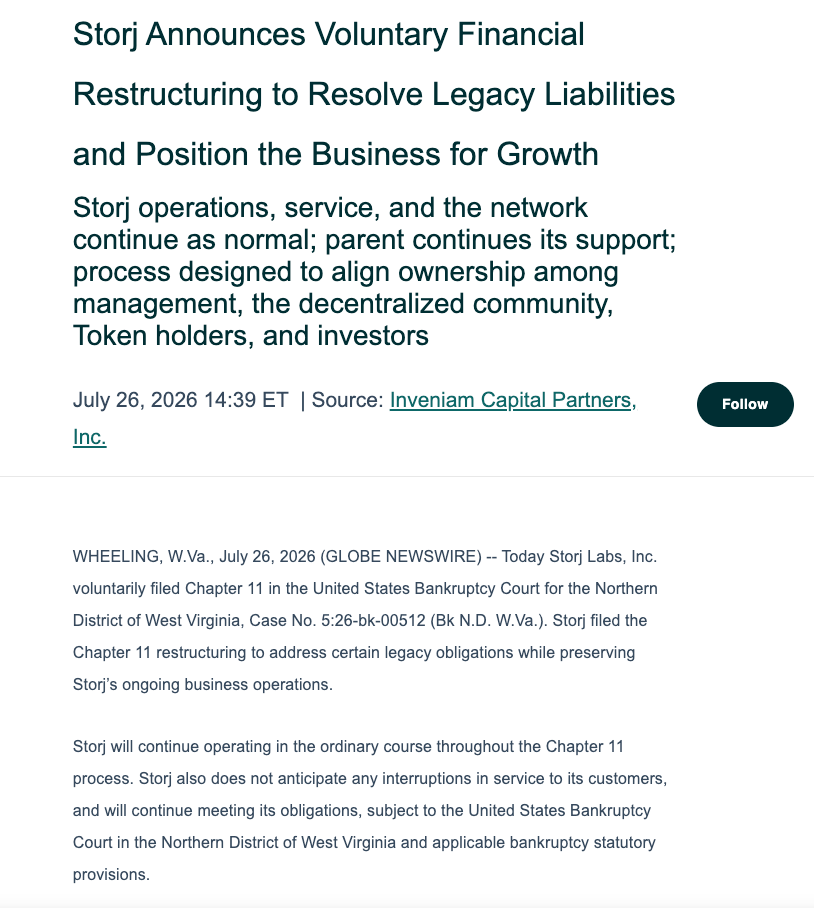


Storj stated that the network will continue to operate normally, token functionality will remain unaffected, and it plans to include in its reorganization plan a path for STORJ token holders to obtain equity in the restructured company. This proposed token-to-equity swap is unprecedented in the crypto industry, and its implementation hinges on whether there is residual value after creditors are repaid.


Bankruptcy Within a Year of Acquisition


Storj was founded in 2014 and is one of the earliest decentralized infrastructure projects in the crypto industry. Its core business is building a distributed cloud storage network via blockchain incentive mechanisms, encouraging global node operators to contribute idle hard drive space as an alternative to centralized storage services like Amazon S3. Users pay for storage and bandwidth with the STORJ token, and node operators are rewarded in STORJ.


In its early stages, the project received seed funding from Google Ventures, Qualcomm Ventures, and Techstars. It raised approximately $30 million through a token sale in 2017. In 2024, Storj achieved a 7x growth in Annual Recurring Revenue (ARR), reaching about $30 million, with a team size of 81 people. That same year, Storj also acquired GPU computing company Valdi, expanding its business from pure storage to compute power leasing.


In October 2025, Inveniam Capital Partners, focused on data assetization, acquired Storj through a reverse triangular merger. CEO Colby Winegar remained in his position, and Executive Chairman Ben Golub joined the Inveniam board. On the day the acquisition was announced, the STORJ token fell by 18%. Less than a year later, the merged entity entered bankruptcy proceedings.


In a public letter, Storj attributed the bankruptcy to historical debts, stating that the liabilities primarily stemmed from previous operations and acquisitions, predating the current business strategy, and were too large to be naturally absorbed through business growth. The company claimed its current operations are streamlined, but the burdens of the past can only be resolved through a court-supervised reorganization. The company also stated it would divest non-core businesses brought in by previous acquisitions during the restructuring to refocus on its core decentralized storage business.


The GPU computing company Valdi, acquired in July 2024, is the most likely asset to be divested. Valdi brought Storj a compute network of over 16,000 GPUs globally, originally the core of Storj's expansion into AI computing. However, from a bankruptcy restructuring perspective, this acquisition itself may be one of the sources of increased debt. Divesting Valdi means Storj will return to the pure storage track, abandoning its previous positioning as a full-stack distributed cloud platform.


Token-to-Equity Swap: Promise or Empty Promise?


The most notable proposal in the official public letter is providing a path for token holders to company equity. Storj management indicated plans to propose a mechanism in the reorganization plan allowing token holders to participate in the equity distribution of the restructured company, realigning company ownership among management, the decentralized community, token holders, and investors.


Kaloyan Raev, Director of Software Engineering at Storj, was quite measured in his wording in the public letter, stating the company would give users a seat and sincere intent, not a guaranteed outcome. The company has not yet disclosed eligibility criteria (whether a token snapshot or lock-up is required), the proportion of equity available for distribution, or the specific participation mechanisms. All terms need to be formulated during the reorganization process and approved by the court.


The core obstacle to this proposal lies in the priority rules of bankruptcy law. In Chapter 11 reorganization, creditor repayment takes precedence over equity holders. Token holders are legally closest to the position of equity holders, at the very end of the repayment sequence. Only after creditors are fully or proportionally repaid can residual value potentially flow to token holders.


There is no bankruptcy precedent in the crypto industry for a token-to-equity swap. In the WTT lawsuit involving crypto miner Giga Watt's bankruptcy after raising about $22 million via an ICO, the court ruled that utility token holders did not qualify as members of the company. This means token holders cannot automatically gain equity status; separate rights must be created through the reorganization plan. The FTX bankruptcy case set precedents in crypto asset valuation but dealt with creditor claims, which is entirely different from the token-to-equity path proposed by Storj.


Another noteworthy variable is the concentration of token holdings. The total STORJ supply is 425 million tokens, with approximately 30% (about 130 million) still held by Storj Labs. If the company's own token holdings also participate in the equity conversion, there is a potential conflict of interest between management and external token holders.


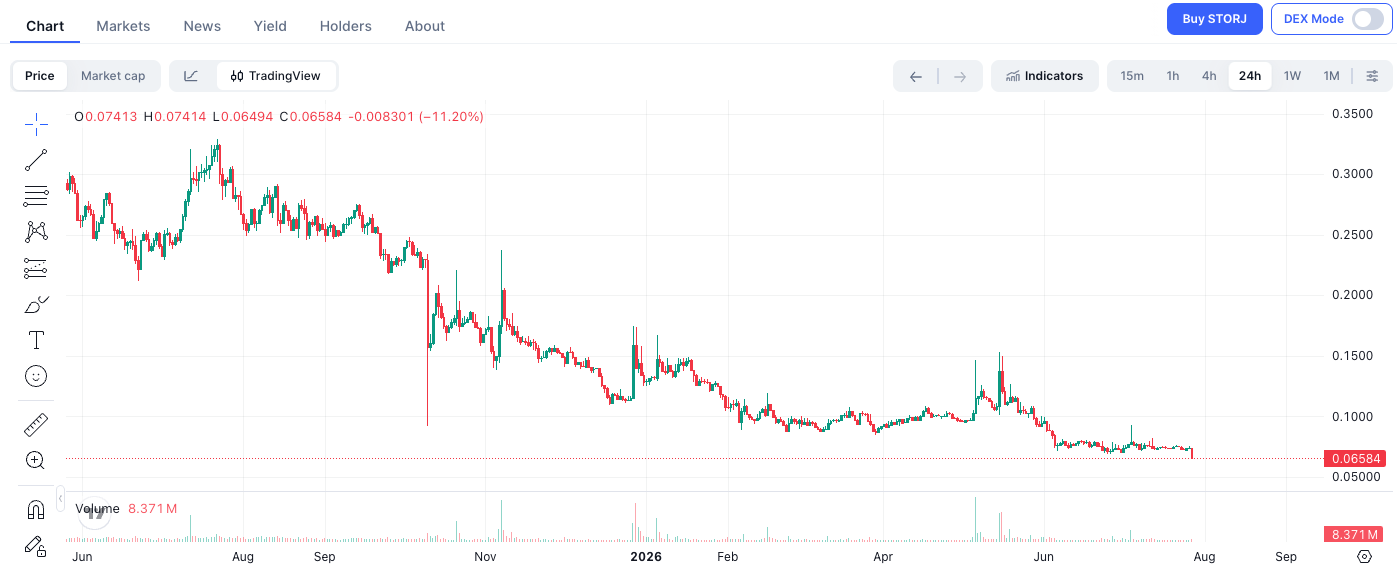
The STORJ token is currently priced around $0.06584, with a total market capitalization of approximately $27.97 million. The price fell 11.2% in the 24 hours following the news announcement.


A Marginal Player in the Decentralized Storage Race


Storj's scale in the decentralized storage sector is far smaller than its top competitors. Filecoin's current market capitalization is approximately $607 million, nearly 20 times that of STORJ, with a network capacity exceeding 1.8 EiB. In early 2026, Filecoin officially launched its Onchain Cloud roadmap, supporting automated data repair, perpetual renewals, and liquid staking of storage power via the Filecoin Virtual Machine (FVM), positioning itself as a decentralized alternative to AWS. Arweave follows another path, capturing the market for NFT metadata and blockchain historical state storage with its one-time payment for permanent storage model.


In comparison, Storj's advantage lies in retrieval speed. Storj uses Erasure Coding to split files into over 80 fragments distributed across global nodes, requiring only 29 fragments to reconstruct a file, achieving millisecond-level retrieval latency, performance close to that of centralized cloud providers. This gives Storj some competitiveness in hot data storage (video streaming, application data), but its market share is far behind Filecoin's.


During bankruptcy restructuring, whether node operators and enterprise clients will migrate to Filecoin or Arweave due to uncertainty is a real risk for the Storj network. For STORJ token holders, the key variables to monitor include: the specific terms of the token-to-equity swap in the reorganization plan and court approval progress, how the company's 30% token holdings will be handled, and whether the post-Valdi-divestiture business can support valuation.

Trending Cryptos

Related Questions

QWhat is the main reason Storj Labs cited for filing for Chapter 11 bankruptcy protection?

AStorj Labs cited historical legacy debts from previous operations and acquisitions, which were incurred prior to the current business strategy. The company stated that the scale of this debt was too large to be digested through natural business growth.

QWhat unprecedented proposal has Storj made for its STORJ token holders during the restructuring process?

AStorj has proposed creating a path for STORJ token holders to potentially acquire equity in the restructured company. This is presented as an effort to realign company ownership among management, the decentralized community, token holders, and investors. However, this is an unprecedented proposal in the crypto industry and its implementation is not guaranteed.

QAccording to the article, what is the major legal hurdle for Storj's proposal to convert tokens to equity?

AThe major legal hurdle is the priority rules in bankruptcy law. In Chapter 11 restructuring, creditors are paid before equity holders. Token holders are positioned similarly to equity holders at the end of the payment priority sequence. They would only receive any value after creditors are fully or partially satisfied.

QWhat key non-core asset acquired in 2024 is Storj likely to divest during its restructuring?

AStorj is likely to divest Valdi, a GPU computing company acquired in July 2024. This acquisition was part of Storj's expansion into AI computing, but divesting it means the company will refocus on its core decentralized storage business.

QHow does Storj's market position in decentralized storage compare to its main competitor, Filecoin?

AStorj is a much smaller player compared to Filecoin. Filecoin's market capitalization is approximately $607 million, which is nearly 20 times larger than STORJ's market cap of around $28 million. Filecoin's network capacity exceeds 1.8 EiB, and it is positioning itself as a decentralized alternative to AWS.

Related Reads

US Stock Market Trends (Aug 27): PCE Exceeds Expectations, Pressures Broader Market; Nvidia Rises 4% After-Hours, Nasdaq Futures Up 1%

U.S. Market Trends (Aug 27): PCE Data Weighs on Indices, Nvidia Rises 4% After-Hours, Nasdaq Futures Up 1% U.S. stocks closed slightly lower on Wednesday amid narrow trading. The S&P 500, Nasdaq, and Dow Jones all edged down, ending the Dow's two-day winning streak. The key pressure came from July's PCE inflation data, which showed a 3.7% year-over-year increase, exceeding expectations. While the core PCE met forecasts at 3.3%, the hot headline number boosted Treasury yields and the dollar, dampening hopes for imminent Fed rate cuts. Gold fell below $4,600/oz. Oil prices continued to weaken despite mixed geopolitical signals. The market's real focus was after the close. Nvidia reported Q2 revenue of $96.2 billion, beating estimates, guided for current-quarter revenue to surpass $100 billion for the first time, and projected 70% revenue growth for the next fiscal year. Its shares rose approximately 4% after-hours, lifting Nasdaq futures by about 1%. Amazon's announcement to deploy an additional 2 million GPUs further validated the data center demand narrative for Nvidia. In other sectors, chip stocks like Western Digital and Arm gained. Among the "Magnificent Seven," moves were mixed. Salesforce surged on strong guidance and an expanded partnership with Anthropic. Meta settled a youth addiction case with 29 U.S. states for up to $18 billion, a figure seen as favorable compared to earlier fears. Bitcoin retreated from recent highs, while industrial metals like copper extended their rally. The core market tension remains between inflation concerns pressuring the broader market and strong AI earnings providing sector-specific momentum, setting the tone for early September trading.

marsbit51m ago

US Stock Market Trends (Aug 27): PCE Exceeds Expectations, Pressures Broader Market; Nvidia Rises 4% After-Hours, Nasdaq Futures Up 1%

marsbit51m ago

A Record $70 Billion Inflow in 5 Days! Investors Are No Longer Choosy, Buying Gold and Bitcoin Together

Investors are moving beyond "either/or" choices and are simultaneously pouring money into both gold and bitcoin ETFs. Over the past five trading sessions, ETFs tracking these assets attracted a record $7 billion in combined inflows, pushing some of the largest gold and bitcoin funds to the top of the U.S. weekly ETF inflow rankings. This surge was triggered by U.S. Treasury Secretary's announcement to at least double long-term bond buybacks, which initially pressured Treasury yields and the dollar, boosting prices for both assets. Gold has risen about 13% this month, while bitcoin reclaimed the $80,000 level. The synchronized rally signals the return of the "monetary debasement trade." Amid growing concerns over fiscal sustainability and easing financial conditions, investors are seeking scarce assets perceived as outside direct government control. Gold benefits from its traditional safe-haven role, while bitcoin's fixed supply of 21 million coins positions it as a potential hedge. The SPDR Gold ETF (GLD) attracted nearly $3.4 billion, and the iShares Bitcoin Trust (IBIT) saw $1.5 billion in inflows, both ranking in the weekly top ten. Analysts note the momentum behind the flows is as significant as the volume, indicating investors are aggressively adjusting previously underweight positions. While the narrative of hedging against fiscal stress and currency debasement is gaining traction, some analysts question its sustainability, suggesting equities might be a more reliable hedge in the long run.

华尔街日报56m ago

A Record $70 Billion Inflow in 5 Days! Investors Are No Longer Choosy, Buying Gold and Bitcoin Together

华尔街日报56m ago

Yangtze Memory: Is It the Second ChangXin?

The largest IPO in the history of the STAR Market is approaching. Yangtze Memory Technologies (YMTC) has filed for a listing on the Shanghai Stock Exchange's STAR Market, aiming to raise 33 billion yuan. This surpasses the previous record set by competitor ChangXin Memory Technologies (CXMT), which raised 29.5 billion yuan and saw its market capitalization surge on its debut. Despite both being leading Chinese memory chipmakers founded in 2016 and operating under the IDM model, the two companies are fundamentally different. CXMT focuses on DRAM, the memory used for temporary data processing, while YMTC specializes in NAND Flash, used for long-term data storage. Industry reports indicate the global DRAM market is significantly larger and more concentrated among three major players, where CXMT ranks as the fourth-largest supplier. The NAND Flash market is more fragmented, with YMTC ranking third globally by shipment volume in Q2 2026, though fifth by revenue due to a stronger focus on consumer-grade products. Experts are divided on whether YMTC can replicate CXMT's explosive market debut. Some analysts believe it is highly unlikely, citing a cooler market environment and YMTC's perceived lower strategic scarcity within the AI supply chain compared to DRAM/HBM-focused companies. They warn that aggressive IPO pricing could lead to downward pressure post-listing. Industry forecasts suggest the DRAM market may remain tight, while the NAND Flash market could face price corrections due to new capacity and weaker demand. Other experts argue that while short-term market sentiment differs, the long-term investment value of both companies is comparable, hinging on future performance and potential breakthroughs in areas like HBM. They believe YMTC's IPO is unlikely to face significant cooling given still-elevated market interest in the semiconductor sector.

marsbit1h ago

Yangtze Memory: Is It the Second ChangXin?

marsbit1h ago

Trading

Spot

Hot Articles

How to Buy STORJ

Welcome to HTX.com! We've made purchasing STORJ (STORJ) simple and convenient. Follow our step-by-step guide to embark on your crypto journey.Step 1: Create Your HTX AccountUse your email or phone number to sign up for a free account on HTX. Experience a hassle-free registration journey and unlock all features.Get My AccountStep 2: Go to Buy Crypto and Choose Your Payment MethodCredit/Debit Card: Use your Visa or Mastercard to buy STORJ (STORJ) instantly.Balance: Use funds from your HTX account balance to trade seamlessly.Third Parties: We've added popular payment methods such as Google Pay and Apple Pay to enhance convenience.P2P: Trade directly with other users on HTX.Over-the-Counter (OTC): We offer tailor-made services and competitive exchange rates for traders.Step 3: Store Your STORJ (STORJ)After purchasing your STORJ (STORJ), store it in your HTX account. Alternatively, you can send it elsewhere via blockchain transfer or use it to trade other cryptocurrencies.Step 4: Trade STORJ (STORJ)Easily trade STORJ (STORJ) on HTX's spot market. Simply access your account, select your trading pair, execute your trades, and monitor in real-time. We offer a user-friendly experience for both beginners and seasoned traders.

2.9k Total ViewsPublished 2024.03.29Updated 2026.06.02

How to Buy STORJ

Discussions

Welcome to the HTX Community. Here, you can stay informed about the latest platform developments and gain access to professional market insights. Users' opinions on the price of STORJ (STORJ) are presented below.

活动图片