Derive [DRV] gains 40% on Upbit news – THIS zone marks next major hurdle

ambcryptoPublished on 2026-07-14Last updated on 2026-07-14

Abstract

Derive (DRV) surged approximately 40% following news of its upcoming listing on the South Korean exchange Upbit, with trading in KRW, BTC, and USDT pairs set to begin on July 14th. The announcement triggered aggressive buying, raising the price from $0.1147 to a peak of $0.19, though it later settled near $0.1471. Market capitalization reached roughly $109.64 million, and 24-hour trading volume spiked by over 1744% to $9.38 million. Technical indicators like the RSI hitting 84.43 prompted early profit-taking, suggesting overheated momentum. The key challenge for DRV is to prove sustained demand beyond the initial listing hype. Maintaining support above $0.131 will be crucial to confirm continued buyer interest, while metrics like holder growth, stable volumes, and exchange flows will determine if the rally can evolve into a stronger, long-term market foundation or follow a typical post-listing reversal pattern.

Derive [DRV] will enter one of Asia’s largest crypto markets after Upbit announced KRW, Bitcoin [BTC], and Tether [USDT] trading pairs. Trading will begin on 14th of July, expanding access following Derive’s migration from Lyra Finance.

The listing opens the protocol to South Korea’s active retail market and could attract broader global participation. Greater accessibility could deepen liquidity and strengthen price discovery across multiple trading pairs.
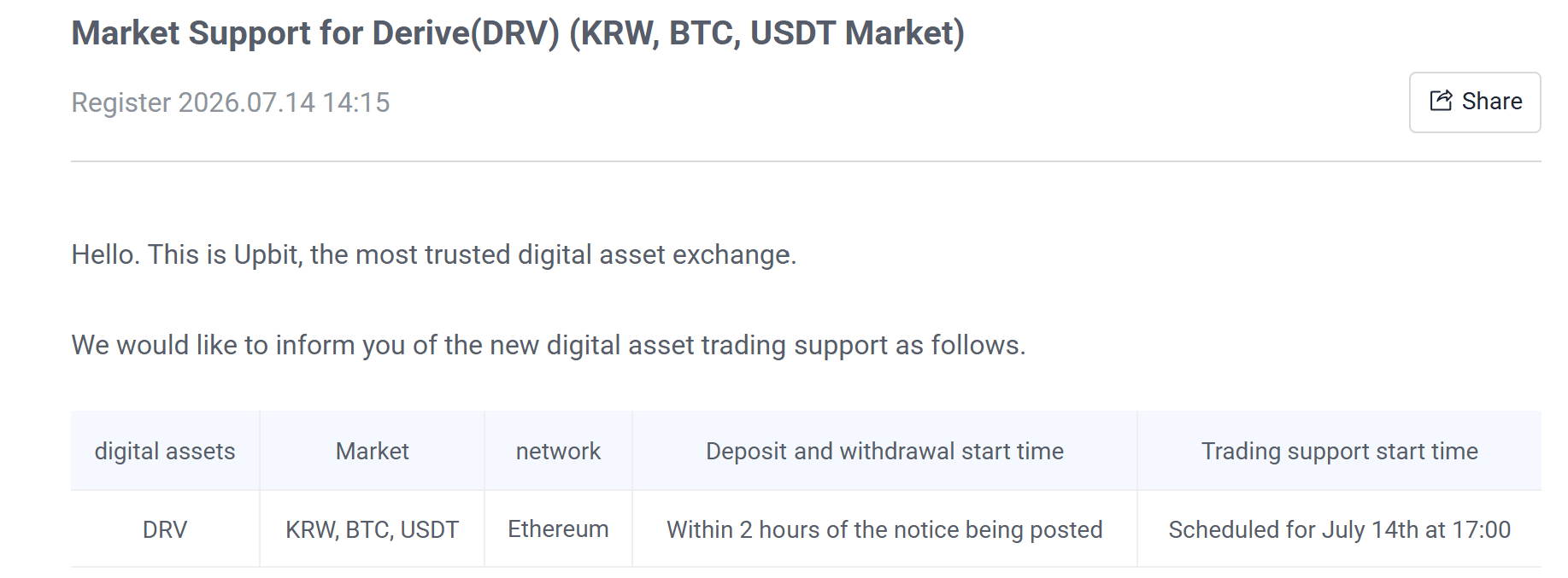
Source: UPbit

Derive has continued expanding its on-chain options and perpetual futures ecosystem following its 2024 rebranding.

However, it is unlikely that simply receiving additional Exchange support will help to create long-term demand.

Traders must deliver stronger volumes, deeper order books, and consistent participation. Those metrics will reveal whether broader accessibility strengthens Derive’s market position beyond its initial listing.

Why did DRV rally?

The announcement quickly changed DRV’s market dynamics. Rather than waiting for trading to begin, buyers aggressively repriced the token in anticipation of stronger liquidity and broader market participation.

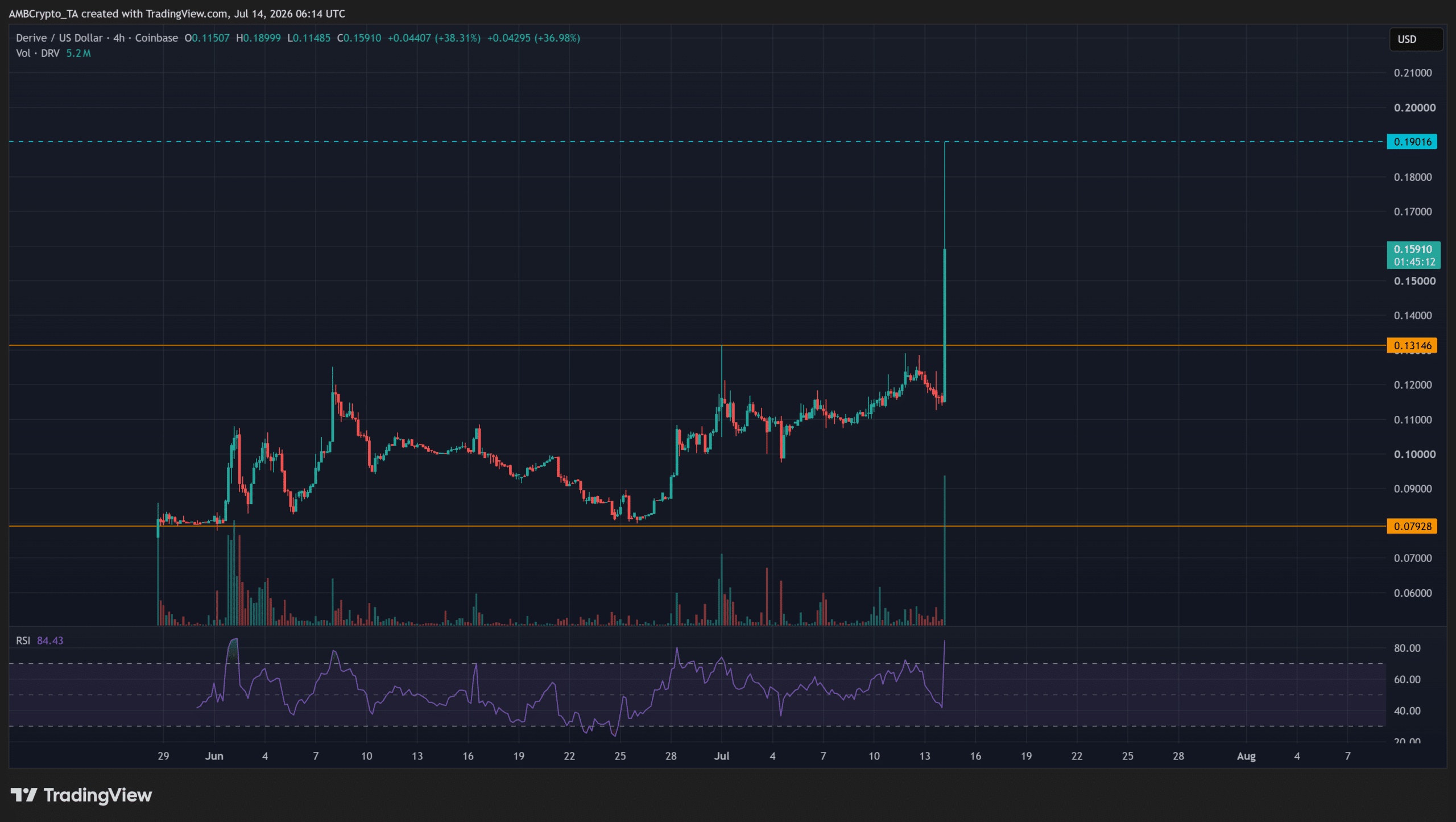
The price rose by approximately 40%, or from $0.1147 to $0.19, before falling to $0.1486. Meanwhile, market capitalization rose to approximately $109.64 million.

Notably, 24-hour trading volume grew by 1744.3% to $9.38 million. These developments suggested that the rally attracted fresh capital instead of isolated buying.
Source: DRV/USD on TradingView

However, the Relative Strength Index (RSI) reached 84.43.

As a result, it prompted early profit-taking as momentum became overheated.

That reaction implied that traders were locking in gains rather than abandoning the breakout completely. At the press time, the token was trading near $0.1471.

Still, holding above $0.131 would confirm buyers continue absorbing supply, whereas losing that level would suggest speculative demand is fading.

Can DRV build on the listing rally?

Early investor enthusiasm for the token has been evident in recent price action. The next challenge is proving that demand extends beyond the listing catalyst.

In many cases, speculative buying by short-term traders drives early price movement. However, sustained price appreciation requires continued investment over time after the immediate hype from the listing wears off.

Rising holder growth would indicate investors are accumulating rather than flipping tokens. Meanwhile, stable trading volumes and improving market depth would suggest liquidity is becoming more resilient.

More importantly, exchange net flows will also reveal whether buyers continue absorbing supply or early participants dominate selling.

Together, those indicators will determine whether DRV develops a stronger market foundation or follows the familiar pattern of post-listing reversals.


Final Summary

  • Derive [DRV] is set to gain broader liquidity and market access as Upbit prepares to open KRW, BTC, and USDT trading.
  • Derive now turns its focus from securing a major exchange listing to proving the rally reflects lasting demand.


Related Questions

QWhy did DRV's price rally by approximately 40%?

AThe price rallied by approximately 40% following the announcement of DRV's upcoming listing on Upbit. Buyers aggressively repriced the token in anticipation of stronger liquidity and broader market participation from the new trading pairs.

QWhat are the new trading pairs for Derive (DRV) on Upbit and when does trading begin?

AUpbit announced KRW, Bitcoin (BTC), and Tether (USDT) trading pairs for Derive (DRV). Trading is set to begin on the 14th of July.

QWhat key price level does the article suggest buyers must hold above to confirm continued demand?

AThe article suggests that holding above $0.131 would confirm buyers continue absorbing supply, whereas losing that level would suggest speculative demand is fading.

QWhat does the article say is needed to create long-term demand for DRV beyond the initial listing hype?

AThe article states that simply receiving additional exchange support is unlikely to create long-term demand. It requires stronger trading volumes, deeper order books, consistent participation, rising holder growth, and resilient liquidity to build a stronger market foundation.

QWhat did the high RSI reading of 84.43 prompt among traders, according to the article?

AThe high RSI reading of 84.43 prompted early profit-taking as momentum became overheated, indicating traders were locking in gains.

Related Reads

The Verdict in Choi Tae-won's Divorce Case: Revealing the Inheritance Undercurrent Behind SK Hynix's Trillion-Won Empire

SK Group Chairman Chey Tae-won's high-profile divorce case, involving a record 1.38 trillion won settlement, has drawn attention to the succession plans for Korea's second-largest conglomerate, especially its crown jewel, SK hynix. Unlike traditional chaebol scripts centered on the eldest son, Chey's three children from his marriage to former President Roh Tae-woo's daughter, Roh Soh-yeong, are carving distinct, non-traditional paths. Eldest daughter Chey Yun-jung (b. 1989) is seen as the most evident successor. With a scientific and consulting background, she holds executive roles at SK bioscience and SK Inc.'s growth support department, focusing on future strategy and biopharma. Her marriage is to an AI infrastructure entrepreneur, not a traditional business alliance. Second daughter Chey Min-jung (b. 1991) took a unique route, voluntarily serving as a South Korean naval officer, including an anti-piracy deployment. She later worked on policy and strategy for SK hynix in Washington D.C. before co-founding an AI-driven healthcare startup. She married a former U.S. Marine Corps officer, connecting her to U.S. defense and policy circles—networks crucial for a global semiconductor giant. The only son, Chey In-geun (b. 1995), who studied physics like his father, worked briefly at SK E&S before joining McKinsey. Despite fitting the traditional "heir" profile as the eldest son, he remains silent and holds no public position or shares in SK, suggesting the old succession playbook is obsolete. As SK hynix's valuation soars, becoming a geopolitical asset in the AI era, the heirs' legitimacy is no longer automatic. They must prove themselves in fields like AI biotech, global policy, and strategic consulting. Their marriages also reflect new elite networks in tech and defense, not old political alliances. Their inheritance is the complex challenge of navigating a globalized, tech-driven world, not just a corporate throne.

marsbit2 days ago 09:06

The Verdict in Choi Tae-won's Divorce Case: Revealing the Inheritance Undercurrent Behind SK Hynix's Trillion-Won Empire

marsbit2 days ago 09:06

From OpenSea to OpenRouter: Is Alex Atallah Repeating His 'Exit at the Peak' Playbook?

From OpenSea to OpenRouter: Is Alex Atallah Repeating His "Exit at the Peak" Playbook? According to the Wall Street Journal, payments giant Stripe is in talks to acquire the AI model aggregation platform OpenRouter in a potential deal valuing the company near $100 billion. This would mark founder Alex Atallah's second creation of a company reaching a $100 billion valuation, following his co-founding of NFT marketplace OpenSea. OpenRouter, founded just over three years ago, has grown rapidly by acting as a unified gateway for developers to access over 400 AI models. It currently has about 10 million users and processes over 200 trillion tokens monthly. While the platform's annualized revenue is around $50 million, its valuation has skyrocketed from $1.3 billion in March 2026. The potential acquisition by Stripe, a company OpenRouter's founder once likened it to, represents a major expansion into AI infrastructure for the payments leader. This move echoes Atallah's previous timing with OpenSea, where he departed before the NFT market's significant downturn. For OpenRouter, selling now may be strategic. Despite its scale, its business model—charging a 5-5.5% fee on AI inference calls—faces pressure from competition, open-source models, and potential price wars among model providers, limiting its profitability narrative for an IPO. A key asset for potential acquirers like Stripe is OpenRouter's vast repository of real-world AI usage data, which offers unique insights into model performance and developer preferences that are difficult to replicate. Whether this potential deal signifies a new valuation benchmark for AI infrastructure or another market peak signal remains to be seen.

链捕手2 days ago 08:42

From OpenSea to OpenRouter: Is Alex Atallah Repeating His 'Exit at the Peak' Playbook?

链捕手2 days ago 08:42

Trading

Spot
活动图片




