Founder of Baixing.com: I Only Half Believe in the Notion that Large Language Models Devour Everything

链捕手Published on 2026-07-07Last updated on 2026-07-07

Abstract

The founder of Baixing Wang states that while large language models (LLMs) are an extremely important foundational technology—akin to electricity or the internet—he only "half believes" the notion that they will "consume everything." He argues that LLMs provide a base layer of intelligence, but real-world value and transformation come from integrating this intelligence into specific applications and devices designed for particular scenarios—like how electricity powers various appliances from washing machines to TVs. He agrees LLMs will likely consume or replace a significant portion of existing rule-based, workflow-driven software (e.g., many SaaS systems, CRMs), as these are precisely what LLMs excel at handling. However, numerous other elements—such as customer data, execution capabilities (e.g., booking a flight), trust, and physical-world interactions—will not be consumed. Wang emphasizes that after LLMs absorb certain software layers, they will open up a much larger space for innovation: new types of "streaming" software with less rigid interfaces, where fixed rules are managed by AI. This next wave of applications built on top of the stable LLM foundation is where the true mainstream opportunity lies. He cautions against the short-sightedness of declaring any technology as all-consuming, drawing parallels to past premature predictions about internet giants monopolizing the web. The key is to find opportunities within the areas LLMs do transform.

Author: Wang Jianshuo, Founder of Baixing.com

Many people blurt out phrases like 'large models are everything.' I'm not so convinced.

Every time I hear phrases like 'devour everything,' I think it's mostly because our understanding of the future hasn't reached that level, leading us to make such broad statements. Otherwise, how could one thing devour everything? Take the internet for example—it has been touted as devouring everything for so many years, has it truly devoured everything now? So which is it, the internet devouring everything or large models devouring everything? Both are devouring, leaving nothing left?

So, I'd rather put it differently: it is a very important foundational layer. Without this foundation, the entire world cannot develop, just as the internet cannot exist without the underlying backbone network, or using electricity is impossible without power plants. This I acknowledge.

But once the foundation is in place, the real excitement happens on top of it.

Take electricity. Once electricity was generated, what were the first applications people saw? The light bulb. Thomas Edison lit the first one, and then it just kept shining, shining, shining. If the world ended there, with just one light bulb, I could totally say: the power plant is the core of the entire world, the power plant devours everything.

But that's not how it happened. Later came motors to drive machines; then you realize that once you have a fundamental thing like electricity, countless electrical appliances will grow on top of it to use it. Washing machines are for washing clothes, televisions are for watching TV, vacuum cleaners are for vacuuming—they are all applications of electricity. Without electricity, none of these things would exist. But if you say 'electricity devours everything,' I don't believe it.

Large language models are the same. They provide foundational intelligence. But this intelligence must be placed into a specific, scenario-oriented 'machine' or 'appliance' to truly function and change the world.
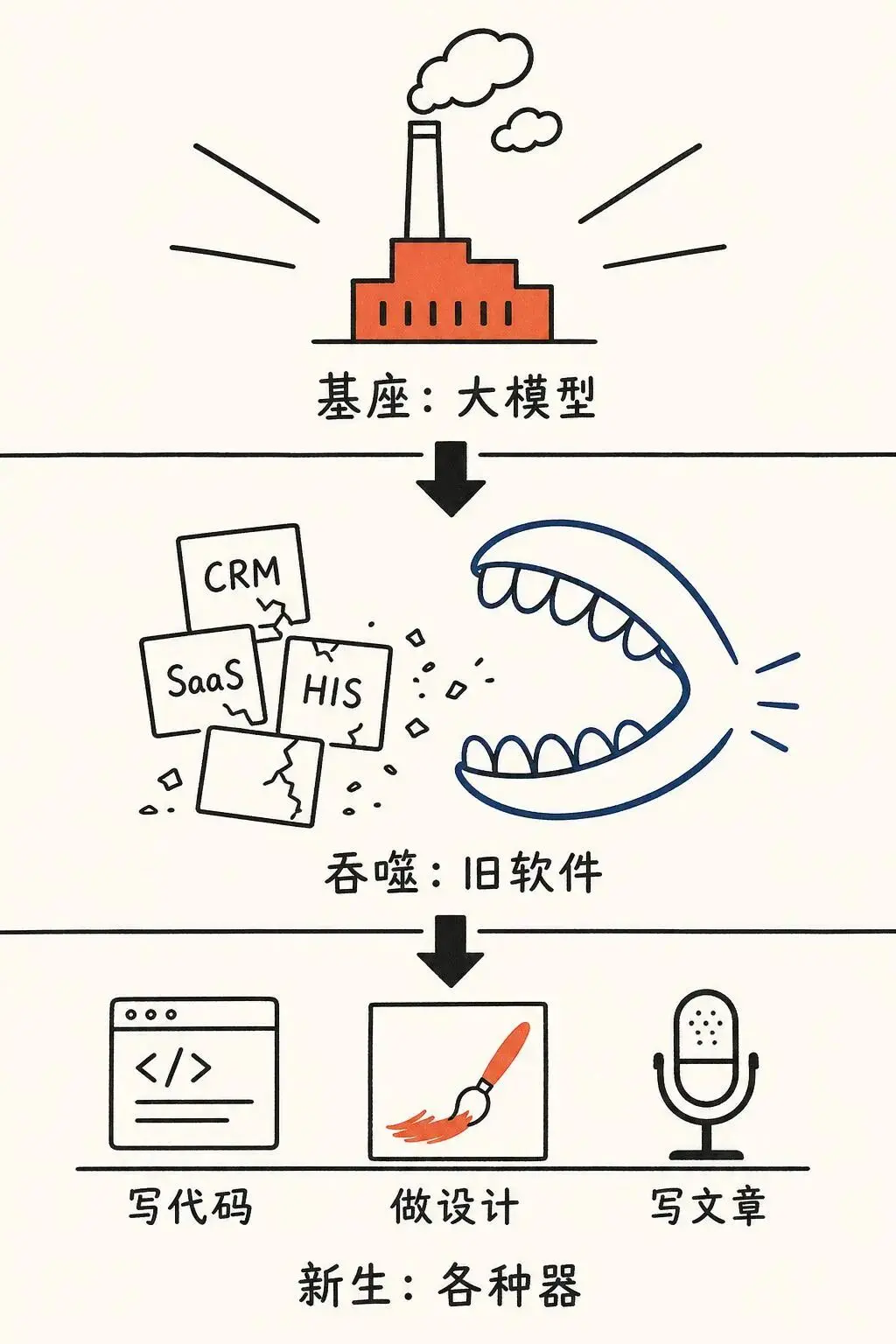
Claude Code is for writing code, Claude Design is for design, VoiceDrop is for writing articles. The same large model, placed into different 'appliances,' solves completely different problems.

Just having electricity, just having water, without a washing machine, clothes still can't be washed. Imagine, the power plant produces a massive amount of electricity, the electricity is incredibly powerful, and then what? Without a washing machine, can this pile of electricity wash clothes by itself?

Intelligence is great, but most things in the world require the combination of multiple elements to work, just as a washing machine needs to combine elements like electricity, water, and even a drum. Large models might replace a lot in the field of software, but there aren't many application scenarios in the world that require only one element.

Let's take a current example. We have large models now, but just having a large model isn't enough. There needs to be a layer on top of it called Harness—this layer has only recently emerged—which interacts with code to finally form something truly usable. A large model by itself cannot write code. Of course, the core of something like Claude Code, honestly, I could write it in fifty-odd lines, add a few more for longer versions, and it could run to write programs. But you must see: with only the large model and without this outer layer, it's still not user-friendly—meaning, the intelligence of the large model, if not combined with the code execution capabilities provided by an operating system, relying on the large model for calculations is uneconomical and sometimes even impossible.

The core value of this interface layer is to help us put that intelligence, akin to electricity and water, into a specific application scenario, turning it into a machine that solves a concrete problem.

Having said that, of course, I don't completely disbelieve the logic behind 'devour everything.'

What it mainly refers to is existing software. Up until now, we have piled up a very large layer of software—things pieced together with many rules, forms, buttons, workflows. A lot of filters, fixed templates, backend operations, many SaaS detection functions. And the various things we used to know as 'M' systems, whether CRM, HIS (hospital information system), all sorts of things called 'systems,' 'software,' or whatever, a whole lot.

This layer, I believe large language models will indeed devour quite a bit of.

Why? Because these software were originally formed by solidifying and repeatedly executing clear, computer-executable instructions—that's what we call software. And this is precisely what large language models are most adept at tackling.

But.

Beyond software, within this layer, there are many other things. Customer information. Execution capabilities—like when you book an airline ticket, the actual capability to move a plane, to transport people from here to there. And trust. Many things in the physical world. These, I don't think will be devoured.

After devouring that layer, it actually opens up an even larger space—on top of it lies the new type of software.

The new software will definitely have a fluid interface; it likely won't solidify as many rules as before. After handing all those rules to AI, think about it, before we could achieve something like Salesforce's CRM, which was already the pinnacle of human effort, requiring immense struggle. If this part becomes relatively easier to solve, then what everyone will work on next is unlocking even more imagination, more possibilities on top of that—and that part is precisely what we haven't seen yet.

This is the mistake we often make. When a new technology arrives, because we can't see the bigger path that follows, we can only focus on the immediate part. We see the leaf but not the forest.

Forget such trend judgments. I still remember in 2004, a group of friends were complaining together, saying that the entire internet could never produce companies larger than Sina, Sohu, and NetEase, that the internet was almost over, that they would monopolize everything. And look how many years have passed since then? The world turned upside down. We would be shocked by our own shortsightedness back then.

So my view is this: Are large models important? Yes, they are a foundational layer, the main focus of recent times. But once they become stable, continuously provided resources, they will require various 'machines' and 'appliances' on top to solve specific problems. That thick layer—where it's used, how it's used—will be the mainstream of the second wave of this trend.

The phrase 'devour everything' is far too imprecise. What thing, what social form, what technology in the world has ever truly devoured everything?

Finding the opportunities within the areas it does devour—that is what truly matters.

Trending Cryptos

Related Questions

QWhy does the founder of Baixing.com believe that 'large models will devour everything' is an imprecise statement?

AHe believes it's imprecise because no single technology has ever truly devoured everything. Large models are a foundational infrastructure, like electricity or the internet, but to be useful, they need to be integrated into specific applications ('machines' or 'devices') that solve real-world problems. They are an essential base, not the entirety of the solution.

QWhat is the author's main analogy for explaining the role of large language models?

AThe author compares large language models to electricity. Just as electricity is a foundational utility that powers various specific appliances (like light bulbs, washing machines, and TVs), large models provide a base of 'intelligence' that must be channeled into specific application tools to solve concrete problems in different fields.

QAccording to the article, what layer of the current software stack is most susceptible to being 'devoured' by large language models, and why?

AThe layer of current software built on fixed rules, forms, workflows, and templates (like many SaaS applications, CRMs, or HIS systems) is most susceptible. This is because such software essentially consists of clear, computer-executable instructions—precisely what large language models are good at processing and generating, making them efficient at handling these structured tasks.

QWhat new layer or space does the author predict will emerge after large models 'devour' parts of the existing software layer?

AThe author predicts the emergence of a larger space for new types of software. Once AI handles the rule-based logic, software can become more 'stream-like' and fluid, without needing to hardcode so many rules. This opens up more imagination and possibilities for applications that are currently unseen, moving beyond the limitations of traditional, rigidly structured software.

QWhat historical example does the author use to caution against short-sightedness when evaluating new technological trends?

AThe author recalls the year 2004, when people complained that the internet was nearing its end, with companies like Sina, Sohu, and NetEase monopolizing everything and no larger companies could emerge. Looking back just a few years later, this view was proven completely wrong and short-sighted, as the internet landscape transformed dramatically.

Related Reads

Beyond Private Keys: From Wallets and L2 to Supply Chains, How to Guard the Security Perimeter of Web3?

Beyond Private Keys: Securing Web3's Expanding Attack Surface from Wallets to L2s and Supply Chains The crypto space faced a wave of security incidents in June, with over $75 million lost across 40 major attacks. These breaches highlighted risks beyond private key theft, exposing vulnerabilities across the entire user interaction chain. Wallet security was compromised not through stolen seed phrases, but via a critical flaw in the Cardano wallet SecondFi's signing implementation. This bug allowed attackers to potentially derive private keys from publicly visible signature data, emphasizing that wallet security depends on correct cryptographic implementation, ideally in open-source, auditable code. Layer-2 networks also revealed complex trust chain risks. Attacks on legacy Aztec deployments exploited inconsistencies in proof systems, showing that a valid zero-knowledge proof is only as secure as its underlying rules. Another attack on Taiko's SGX-based prover stemmed from a leaked signing key and inadequate verification checks. Furthermore, a technical glitch halted Base's block production, underscoring that L2 security encompasses network availability and reliable user exit paths as much as asset safety. Finally, the Polymarket incident demonstrated that even audited smart contracts are not immune. A compromised third-party supplier led to a malicious script being injected into the platform's frontend, resulting in user fund losses. This "supply chain attack" shows that the security of the entire interaction path—from the webpage to the wallet signature—is critical. The conclusion is clear: Web3 security now involves safeguarding the entire journey from transaction intent to on-chain settlement. Users must adopt layered security habits: isolating long-term holdings, using dedicated wallets for daily interactions, scrutinizing transaction details before signing, and managing authorizations cautiously. Defense must evolve from protecting a single point (the private key) to securing a complete chain of interactions.

marsbit8m ago

Beyond Private Keys: From Wallets and L2 to Supply Chains, How to Guard the Security Perimeter of Web3?

marsbit8m ago

Robinhood Chain Goes Viral in One Week: Memes Drive Traffic, Stablecoins Support TVL

Robinhood Chain, an Arbitrum-based Layer 2 network launched on July 1st, experienced explosive growth in its first week. While meme coin hype drove user activity, stablecoin deposits fueled its surge in Total Value Locked (TVL). The chain's rapid adoption was driven by multiple factors. CEO Vlad Tenev reversed his initial stance, endorsing the chain for meme coins despite its original focus on Real-World Assets (RWA). The integration of the popular Solana-based launchpad Pump.fun significantly lowered the barrier for meme trading. Furthermore, the prediction market application World announced a migration from Solana to Robinhood Chain. Meme coin mania, led by tokens like CASHCAT, generated massive trading volume, with daily active addresses skyrocketing from near zero to hundreds of thousands. However, the primary driver of the chain's TVL, which soared past $234 million, was a major institutional deposit. Ethena injected approximately $50 million in stablecoins into the Morpho lending protocol, which underpins Robinhood's Earn product, accounting for the bulk of locked value. This highlights two concurrent narratives: retail-driven meme speculation boosting transactions, and institutional stablecoin deposits building foundational liquidity. In contrast, the chain's flagship RWA offerings, like tokenized stocks, remain a minor part of the ecosystem at around $12.8 million. The first week demonstrates a path where speculative trading and yield-seeking capital provide initial momentum, while the core RWA vision is still in early development.

Foresight News42m ago

Robinhood Chain Goes Viral in One Week: Memes Drive Traffic, Stablecoins Support TVL

Foresight News42m ago

The Illusion of a Prodigy

The Illusion of the "Genius Youth" The article discusses the recent interview incident involving Li Bojie, a former "Huawei Genius Youth," and AI company DeepSeek. It highlights the core conflict not as a simple case of suspected cheating during a coding test, but as a profound mismatch in expectations. Li, with an impressive background including entrepreneurship, a role at Huawei, and a position as a chief scientist, was deeply affected by a standard remote interview where the interviewer questioned his actions. The key point is his stated view of DeepSeek as the "pinnacle of the Chinese tech world." For him, the interview was a quest for identity validation—proof he belonged at the center of the new AI era. For DeepSeek, it was a routine skills assessment. The article argues that Li, while publicly rejecting the "genius" label, subconsciously expected to be treated as a peer for discussion, a courtesy extended by other companies like MiniMax and Xiaomi. DeepSeek, however, adhered strictly to its standardized process, prioritizing consistent, merit-based evaluation over individual prestige. This clash symbolizes a larger shift in the tech industry. The core thesis is that the AI era is dismantling the old system where past titles, companies, and accumulated experience guaranteed status. Now, with rapid knowledge obsolescence, "excellence is calculated in real-time." Li's anxiety—waiting weeks for the DeepSeek interview despite other offers—stems from the fear that rejection means being left behind by technological progress. The article concludes that this incident is a harbinger; soon, everyone will face a constant, implicit "interview" with the AI age itself, asking: "You were excellent yesterday. What about today?"

marsbit57m ago

The Illusion of a Prodigy

marsbit57m ago

Vanguard Group Enters the Arena, Opening a New Crypto Portal for 50 Million Traditional Investors

Vanguard Group, the world's second-largest asset manager with $12 trillion in assets under management and over 50 million investors, has signaled a significant strategic shift by posting a job opening for a "Head of Digital Assets, Personal Wealth." The role entails developing a comprehensive digital asset strategy, establishing long-term plans, and overseeing the full integration of digital assets into Vanguard's wealth management platform, covering areas like custody, settlement, asset tokenization, and stablecoins. This move marks a notable reversal from the firm's previous stance. In 2024, Vanguard refused to list spot Bitcoin ETFs and removed Bitcoin futures products. By late 2025, it allowed some third-party crypto ETF trading but reiterated it would not create its own crypto funds. The new hire represents a third step: building an internal team to integrate digital assets into its core infrastructure, moving beyond merely listing products. The initiative focuses on foundational financial infrastructure—how tokenized assets and digital settlement systems can connect to Vanguard's existing platform, which primarily serves long-term, conservative investors. While Vanguard maintains it will not launch proprietary crypto ETFs, it is proactively preparing its systems for a future involving tokenized assets and stablecoins, which Citigroup projects could reach a $5.5 trillion market by 2030. Vanguard's scale means its chosen standards for custody, settlement, and compliance could set de facto rules for the broader wealth management industry. The firm is acting despite regulatory uncertainty and cautious market sentiment (e.g., Citi recently lowered crypto price targets). Analysts suggest even a minimal 0.01% allocation from Vanguard's asset base would bring ~$12 billion into digital assets, forcing the development of robust risk and operational frameworks. Ultimately, Vanguard's focus is on building the plumbing for digital assets to potentially serve its vast client base, an effort whose impact may extend far beyond any single market cycle.

Foresight News1h ago

Vanguard Group Enters the Arena, Opening a New Crypto Portal for 50 Million Traditional Investors

Foresight News1h ago

Trading

Spot

Hot Articles

How to Buy PEOPLE

Welcome to HTX.com! We've made purchasing ConstitutionDAO (PEOPLE) simple and convenient. Follow our step-by-step guide to embark on your crypto journey.Step 1: Create Your HTX AccountUse your email or phone number to sign up for a free account on HTX. Experience a hassle-free registration journey and unlock all features.Get My AccountStep 2: Go to Buy Crypto and Choose Your Payment MethodCredit/Debit Card: Use your Visa or Mastercard to buy ConstitutionDAO (PEOPLE) instantly.Balance: Use funds from your HTX account balance to trade seamlessly.Third Parties: We've added popular payment methods such as Google Pay and Apple Pay to enhance convenience.P2P: Trade directly with other users on HTX.Over-the-Counter (OTC): We offer tailor-made services and competitive exchange rates for traders.Step 3: Store Your ConstitutionDAO (PEOPLE)After purchasing your ConstitutionDAO (PEOPLE), store it in your HTX account. Alternatively, you can send it elsewhere via blockchain transfer or use it to trade other cryptocurrencies.Step 4: Trade ConstitutionDAO (PEOPLE)Easily trade ConstitutionDAO (PEOPLE) on HTX's spot market. Simply access your account, select your trading pair, execute your trades, and monitor in real-time. We offer a user-friendly experience for both beginners and seasoned traders.

7.4k Total ViewsPublished 2024.03.29Updated 2026.06.02

How to Buy PEOPLE

Discussions

Welcome to the HTX Community. Here, you can stay informed about the latest platform developments and gain access to professional market insights. Users' opinions on the price of PEOPLE (PEOPLE) are presented below.

活动图片